As is the condition of the Klamath Basin, much has occured in the 35 days since our last newsletter. This edition is packed with important information for our growers, the communities we serve, the elected officials that serve our communities, their staffs, and numerous others. Please take a moment to catch up on all the issues and learn something new. | |
- KID's May Featured Grower - Paul Crawford
- Our Mission
- K.I.D. & KBID D.C. Update from NWRA Water Conference
- 2026 Irrigation Season Update - The Cold/Hard Math
- OWRD 2025 Ground Water Report
- Drought Response Agency Programs
- Klamath Lawfare Landscape
- Forty-Seven
- Title Transfer Update
- D-System Improvement Plan - Public Comment
- What We Are Reading (and you should too)
- Upcoming Events
- Opportunities
| |
K.I.D.'s Featured Grower
Paul Crawford
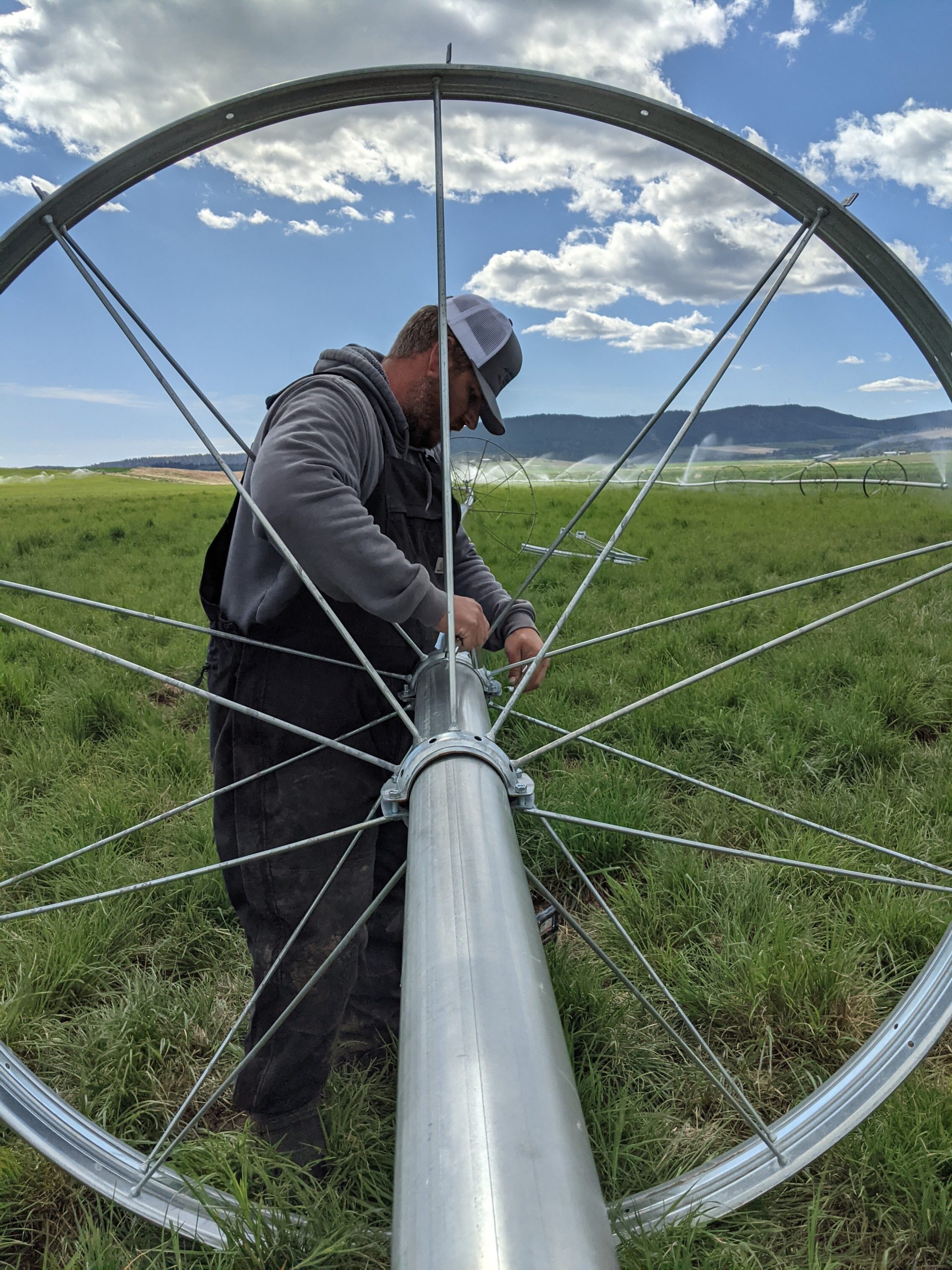
| Roots of Resilience: One Soldier's Fight for the Soul of the Klamath Basin | There is a saying in the Army: "Mission First, People Always." For Paul Crawford, a third-generation farmer in the Klamath Irrigation District, the mission has always been clear: feed the nation, steward the land, and raise his family with the values of hard work and integrity. | | | |
Klamath Irrigation District's Mission | |
The mission of Klamath Irrigation District is to acquire, maintain, assure, and deliver an adequate water supply for beneficial use on qualified land with the Klamath Project. We represent our Patrons before government agencies, the legislature, Congress, and in such forms as appropriate for the perfection and protection of their water rights. We defend the District from actions which would diminish our effectiveness and function. We further promote the conservation of water, soil, and other natural resources.
| | | |
Boots on the Ground: K.I.D. and KBID's D.C. Dispatch
27 Apr - 1 May 2026
The Klamath Irrigation District (K.I.D.) and Klamath Basin Improvement District (KBID) recently descended on Washington, D.C., for the National Water Resources Association (NWRA) Federal Water Issues Conference.
We didn’t go for the cherry blossoms (they were long gone due to an accelerated warm spell in March); we went to ensure our farmers have a seat at the table where the "sausage" gets made. Here is the download on what happened behind the scenes and in the halls.
1. The "Sausage" Factory: How D.C. Really Works
If there was one theme this trip, it was the messy reality of federal lawmaking.
-
The Funding Gap: We learned that Appropriations (spending your tax dollars) should only happen after Legislative Authorization (a law saying agencies can spend money). When money is spent without a clear law behind it, accounting becomes a nightmare. This is exactly why our "title transfer" request is stalled—K.I.D. can’t justify federal expenditures above those that our farmers agreed to repay.
K.I.D. made a mistake in 2020 when we asked Senator Merkley for $5 Million to help us be more efficient with our water management; the Senator made it happen!!! Unfortunately, the funding was routed through Reclamation instead of directly to the District or a non-profit; Reclamation then took 3 years to figure out how to spend the $ under its limited authorities without it being reimbursable by the Klamath farmers; and inflation ate away at the benefits we had envisioned.
-
Chaos is the New "Regular Order": Deadlines are merely suggestions. The budget process is currently pure chaos, and while everyone agrees on the problems (drought/water), few agree on the projects.
-
The Sausage Analogy: Bills get mashed together at the very end of the session into a giant "sausage" casing. If a project doesn’t fit, it’s left out. Currently, not many legislators want "Klamath flavoring" in their sausage, so we need to get better at writing our own recipes with the help of an experienced chef.
The Bureau is undergoing a forced "Kaizen" (continuous improvement) event. With a 30% reduction in its authorized workforce, the agency is being pushed to cut the "bloat" and focus on value-added activities. We are pushing them to ensure this makes the agency Keener—sharpening their focus on Mission-Critical results rather than bureaucratic process.
-
Reducing "Waste" (Muda): Reclamation is shifting away from "admiring the problem" (over-processing) and moving toward strategic partnerships to reduce costs and improve cycle times for project approvals. Being keener means the agency is finally removing the 'burrs' of over-processing. A leaner team has to be sharper—moving directly from problem to solution without the usual bureaucratic friction.
-
The Bottom Line: Out of a $1.5B budget, $1.1B is tied up in fixed facility and maintenance costs. For the Bureau to function, it must find "process efficiencies" elsewhere—primarily by leveraging water for hydropower to generate revenue.
-
Standardized Work: We are pushing for Secretarial Order 3446 to act as the new standard operating procedure, ensuring that federal agency delays (the ultimate "waiting" waste) don't continue to inflate project costs.
A keener Bureau is one that has cut the 'administrative dullness' to reveal a sharp, high-definition view of the project pipeline. In efficiency terms, keener translates to accuracy. With 30% less 'bloat,' the Bureau must become a precision instrument, ensuring every authorized dollar hits its mark without the 'process variance' that leads to multi-year delays.
3. The Stars of the Show
-
Aubrey Bettencourt (USDA NRCS): Easily the conference favorite. She opened with: "As a Californian, I’ll try not to steal the water." She is on a mission to get the NRCS staff away from desks and onto farms, upgrading ancient tech so agents can actually use smartphones and modern engineering tools in the field.
-
The "Climate" Reality Check: Aubrey revealed that only 1% of "climate smart" funding has actually reached on-the-farm work. She’s fighting to flip that model.
4. Direct Advocacy: The Good, The Bad, and The Hostile
Outside the conference, your K.I.D. team was busy in the Capitol:
-
The Good: We had great sessions with Senators Merkley and Wyden regarding funding for our "D System" improvements and other conservation efforts. We also met with Rep. Celeste Maloy (Utah)—an extremely sharp water attorney who truly gets our struggle.
-
The Bad (and Hostile): We attended a hearing for HR 8259 and observed Rep. Jared Huffman. It is discouraging to report that the man expected to represent our California constituents appears openly hostile to Klamath farmers.
-
The Action: We pressed Congressman Bentz’s staff for oversight on our 5-year title transfer delay. We are demanding a simple answer that it does not take 5 years to answer: Are we eligible under the Dingell Act, or do we need new legislation to force contract compliance?
5. The "Klamath Fatigue" Myth
You may have heard that D.C. is "weary" of hearing about the Klamath. That is a myth. In every office, people remembered us from our 2025 and early 2026 visits. They were eager for updates and recognized our faces.
Key Takeaway: We aren't just a folder on a desk anymore; K.I.D. is a persistent presence.
What’s Next?
As the FY 2027 budget is already locked, we are already playing the long game—engaging the administration on the FY 2028 budget. We are moving from asking for permission to asserting our rights.
We’re keeping our boots on the ground and our voices in their ears. Onward!
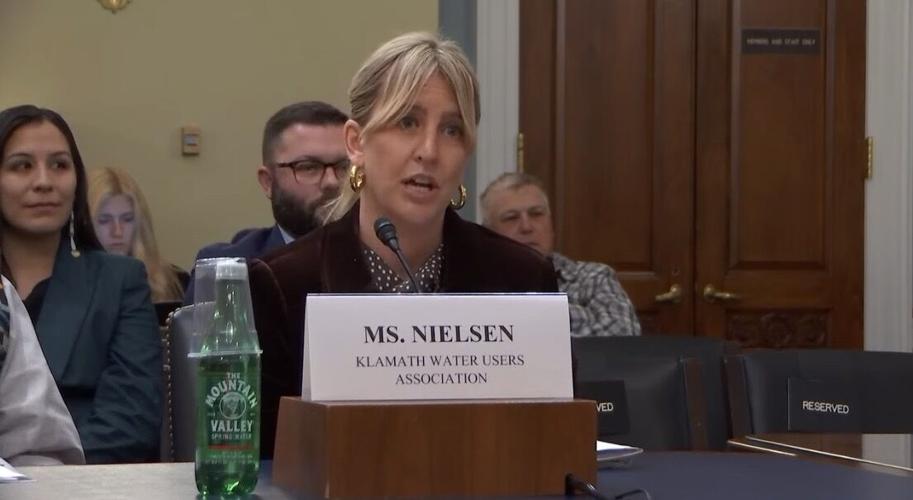
| Our policy and advocacy program is built on a strong foundation of Committees, Task Forces, and Caucuses working independently and jointly to evaluate challenges, develop solutions, and pursue appropriate outcomes through timely and accurate communication, non-partisan relationship development, and most importantly an unyielding dedication to a sustainable, safe and abundant water supply. | | | While in D.C. we had the opportunity to sit in on a House Natural Resources Committee hearing on HR 8259 -Federal Water Projects Consultation Improvement Act introduced by Congressman Bentz and Fulcher (Idaho). | Video: KWUA Executive Director Elizabeth Nielson provides opening remarks on HR 8259 as K.I.D. Board of Directors Fred Simon listens intently to the remarks of KWUA and elected Representatives. Click on the photo to hear Mrs. Nielsen's opening testimony on why this legislation matters, "in our experience, the process has often been inconsistent, unpredictable, and lacking transparency." | The video below, at the 15:14 timestamp, features California Representative Jared Huffman, who may represent Klamath farmers in 2027, commenting on the bill. Congressman Huffman speaks on the 2016 WINN Act and makes several misstatements about HR 8259 and the Klamath Section 7 Consultation history. The Congressman immediately left the hearing after his remarks and did not listen to the testimony in person, nor ask questions of Elizabeth, despite his statement, "I look forward to the conversation." | The video below provides Congressman Bentz's questioning of Elizabeth on HR 8259, focusing on the impacts on the Klamath Basin from ESA Section 7 Consultations that ignore KID's Section 7(a)(3) applicant status. Representative Huffman had no questions for the expert. | | |
The future viability of farming
(and the economic foundation)
in the Klamath Basin could be directly impacted by the 2026 Lawfare of
EarthJustice and the Yurok Tribe.
See the Lawfare Section below.
| | |
At the current burn rate,
we could be OUT of our available
water supply before early-August.
| | |
2026 Irrigation Season
The Cold, Hard Math
The Klamath Irrigation District's infrastructure serves over 1,700 farming families, supporting sustainable agricultural productivity.
As of 4 May 2026
-
Total Supply: 221,000 acre-feet
-
Diverted to Date: 37,240 acre-feet (17%) of available irrigation water has been diverted from Upper Klamath Lake
-
Remaining Balance: 183,760 acre-feet, and we are very early in the irrigation season.
- The Biden-era 2024 regulatory constraints remain in place and cannot be adjusted for this season.
The Reality Check: At our current "burn rate," we are on track to exhaust the available supply by early August. Because the Biden-era 2024 regulatory constraints remain a "fixed bottleneck," we have little room for adjustment this season.
Irrigators should plan based on:
- 221,000 acre-feet as the full available supply,
- insufficient water to meet full demand, and
- necessary idling of 40,000–50,000 acres
| |
Water Management
The Klamath Irrigation District water delivery policy remains unadjusted at this time. K.I.D. continues to meet our legal and contractual obligations as per Oregon Revised Statute 545, the Klamath River Adjudication, and our 1954 Contract.
While the K.I.D. Board of Directors has set the irrigation season to conclude 15 October, the burn rate of the available supply may not allow the district to meet this date.
| | | We will discuss this issue at our 14 May Board of Directors meeting to identify if any changes to our water management policy is necessary or if we need to address Reclamation's guidance on those served under Article 13b/c contracts. | |
Klamath County Drought Conditions - 100% | |
View current drought conditions for Klamath County, Oregon, and explore impacts on Water Supply, Public Health, and Agriculture.
| | | | OWRD Klamath 2025 Groundwater Report | | |
OWRD provided KID with an update on the groundwater conditions in the Klamath Project Area for 2025.
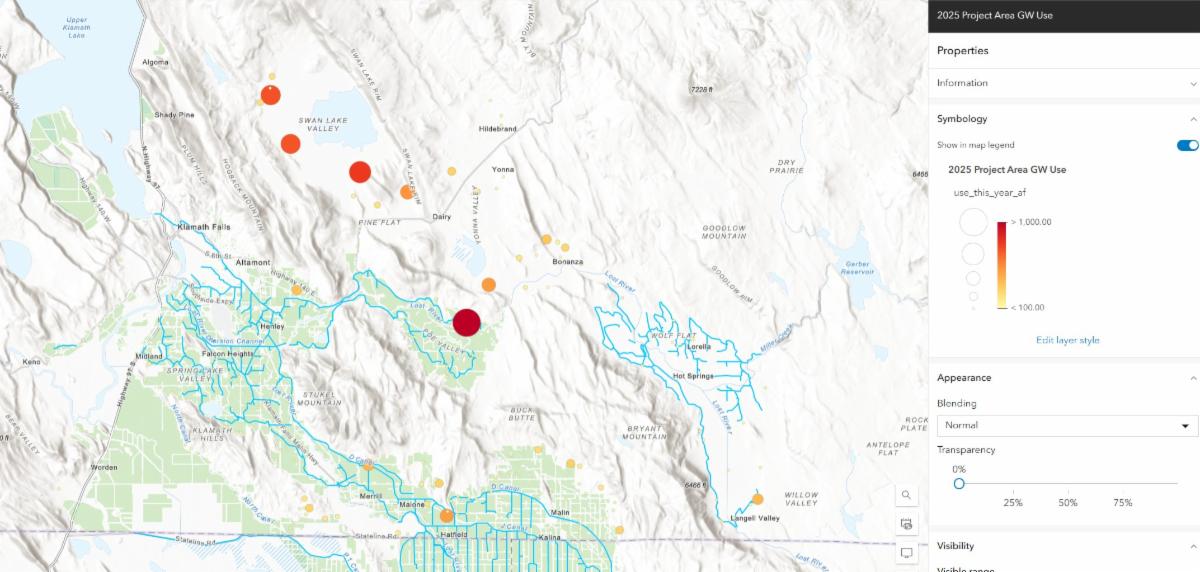
OWRD concluded that, "Significant reliance on supplemental groundwater pumping since 2001 has resulted in long-term groundwater level decreases marked by punctuated, seasonal declines and incomplete annual recovery in and near the Klamath Project Area in Oregon. The 2025 irrigation season saw above-average precipitation and increased surface water deliveries, similar to 2023 and 2024, which led to decreased groundwater pumping in the Project Area. There was 13,923 AF of metered groundwater pumped in the 2025 irrigation season. (KID editors note: Correction WY 2025 which includes the fall of 2024 which was a short water year requiring groundwater pumping) For all years, the reported water use data presented in this report underestimates actual use because flowmeters are only installed and accessible on a subset of wells. Overall, for wells with data available for 2024 and 2025, 65% showed water use changes within 50 AF and 98% showed higher fall water levels.
However, when reviewing wells with available water level data between spring 2010 and spring 2025, 73% of those wells show a decline.
The data presented in this report indicate that supplemental groundwater withdrawals have resulted in seasonal declines in some areas and persistent groundwater level declines across much of the Project Area. Drought conditions, reduced surface water deliveries, and increased groundwater pumping between 2020 and 2022 led to significant groundwater declines and lack of recovery between irrigation seasons. Increased precipitation and decreased groundwater pumping in 2023, 2024 and 2025 have resulted in increasing groundwater levels since fall 2022, but groundwater levels in portions of the project area have still not recovered to annual highs measured in 2020. These groundwater level declines can reduce groundwater discharge to – and in some cases induce recharge from – streams, springs, and drains, exacerbating already stressed surface water supplies.
Additionally, persistent seasonal drawdown can reduce storage potential in aquifers and lead to land subsidence. Seasonal and long-term water level declines result in increased pumping costs incurred by groundwater users, and voluntary reports indicate that at over 300 domestic wells have had water levels drop below their operating levels within the Project Area."
| | |
Klamath Irrigation District disagrees with OWRD's conclusion. Our analysis and research clearly show that OWRD's failure to uphold Oregon Water Law, the findings of the Klamath River Adjudication, and Reclamation's denial of surface water to the former lakes and wetlands is the primary and sole cause for the groundwater drawdown.
Furthermore, K.I.D. identifed that OWRD utilized Fall 2024 groundwater usage, while some irrigators were still needing water, which added a conciderable volume to the 2025 "Irrigation Season" report, skewing the story being told.
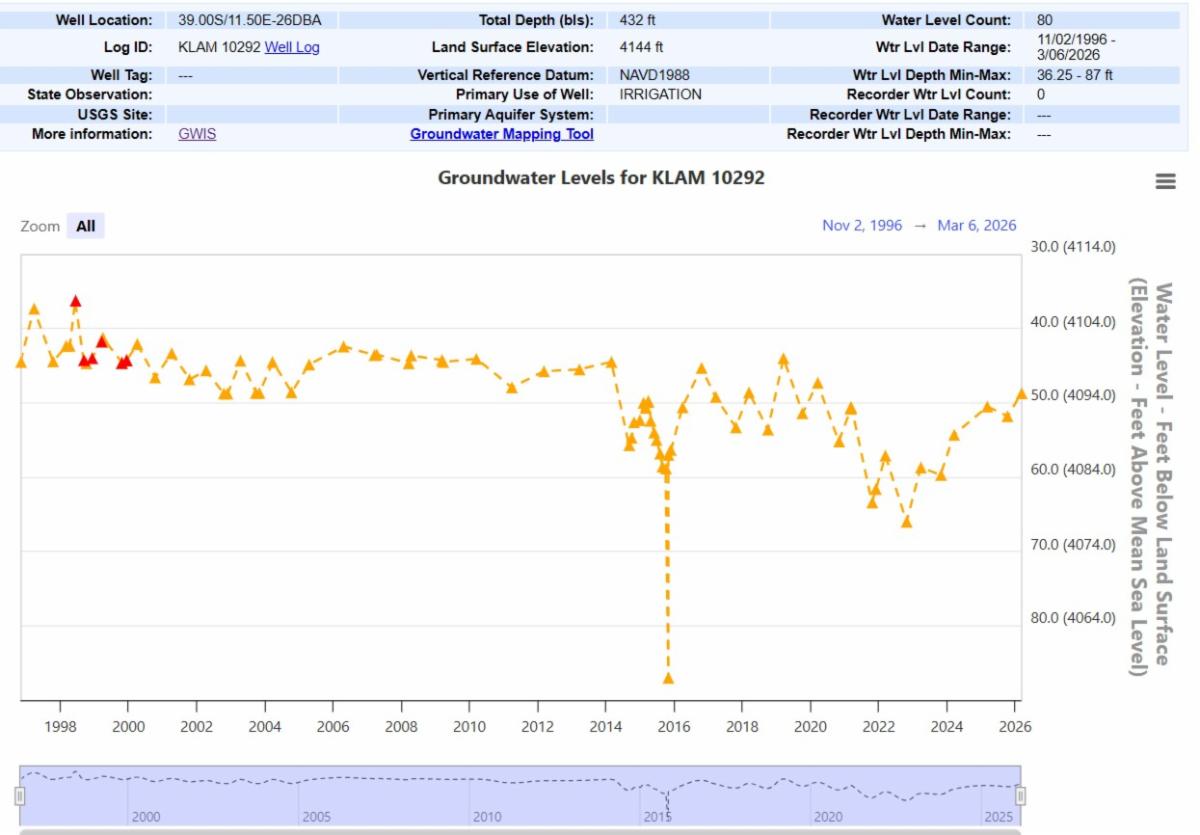
In addition, K.I.D. identified that the single largest consumers of groundwater were outside of the Klamath Project Area, counter to the OWRD report. The image below uses the same information as OWRD to create chart #7 in their briefing... and our graphic tells a completely different story when the numbers are not biased against Klamath Project farmers. You will note the west side of the Klamath Project area served by UKL in light green, only had one well that utilized a large volume of groundwater in 2025; all other large groundwater users were OUTSIDE THE KLAMATH PROJECT AREA. This well hydrograph (the big red dot in Poe Valley) showed only 5 feet of decline over the years of monitoring (see the hydrograph under the map)
| | Klamath Project Drought Response Agency Update | |
Klamath Project Drought Response Agency | 2026 ASSISTANCE PROGRAM - NO IRRIGATION The Klamath Project Drought Response Agency (KPDRA) is now accepting applications for its 2026 No Irrigation Programs. You can download the application under the "file downloads" subsection of thier website. Applications are due June 15th at 5:00 pm. Please review the program policy for more information.
Please inform K.I.D. soonest on your farm plan to help us understand the water management challenges ahead of us. | | | |
Lawfare in 2026
EarthJustice inflicting injustice on Klamath Farmers for 25 years
| | |
The Legal "Lawfare" Landscape: While we focus on managing every drop efficiently, without waste, "EarthJustice" has returned to its predictable playbook that we warned various Board of Directors across the Klamath Project about 8+ months ago.
First, we received official notice of litigation directly against Reclamation's 2026 Operations Plan. This is the same "Groundhog Day Lawfare" we were subject to in 2002, 2005, 2016, 2017, 2019, 2021, 2022, 2023, and 2024 —a repetitive and predictive attempt to harm the ecosystem, our farmers, our communities, and our economy by creating damage to farmers through the courts.
This first notice does not result in immediate changes to operations.
• The notice alleges the 2026 Operations Plan deviates from the 2024 ESA Terms and Conditions.
• It is unclear what this may mean for the 2026 water year, or how it could affect the potential for any additional water beyond the current supply.
• Both K.I.D. and KWUA Boards have provided direction to legal counsel to engage as necessary
| Second, we recieved notice of new complaints by EarthJustice and the Yurok Tribe. This action by EarthJustice is specifically designed to hurt farmers, our refuges, waterfowl, and the endangered fish in our refuges. | Our legal team is still evaluating the complaint. We will be discussing our response during the 14 May 2026 Board of Directors Meeting. | Below is an evaluation of the Lawfare by KlamathBasinCrisis.org | This Could Be the End of the Klamath Project Under the Trump Administration -
At the Hand of Earthjustice and Amy Cordalis - Klamath Irrigation District | Published by Klamath Basin Crisis .org 6 May 2026 at https://klamathbasincrisis.org/litigation/2026/EndOfKlamathProjectUnderTrump_EarthJusticeAmyCordalis050626.htm www.klamathbasincrisis.org - A Voice for Klamath River Basin Families, Wildlife, and the Future of the Klamath Project | | |
A Fall Crisis Looming on the Refuges
EarthJustice is once again attacking the Klamath Project with litigation in San Francisco, challenging Reclamation’s 2026 Operations Plan.
If this feels like deja vu, there is a reason: Klamath Farmers have faced similar litigation in 2002, 2005, 2016/2017, 2019, 2021/2022, and 2023.
Although these lawsuits have substantially reduced water to the Klamath Project over the years in the name of protecting a farmable fish species and inbred whales, there is no scientific evidence that reducing water to the Klamath Project systems has benefited the easily farmable fish, nor will it ever be able to fix inbred whale genetics they were designed to protect.
Meanwhile, there is overwhelming evidence that reducing water to the Klamath Project system has harmed farmers, refuges, waterfowl, and endangered species living in water bodies served by the Klamath Irrigation District.
The lack of scientific evidence supporting these mandates is staggering:
-
There is no evidence that above-natural flows in the Klamath River are improving the condition of the inbred whales.
- The coho (a tributary fish that is easy to farm) appears to be doing very well despite these policies, not because of them.
This confirms what we already know—this entire effort is consuming immense resources with no results.
While the litigation is based on faulty science regarding river flows, a very real, scientifically backed crisis is looming for the refuges this fall.
The same political forces attacking the project are now targeting the refuges' critical water supply. By attacking the use of return flows from irrigation, they are actively creating a disaster. This lack of water, driven by ideological obstruction, guarantees a massive outbreak of Botulism in the refuges.
Real scientific emergencies are being caused by this endless lawfare.
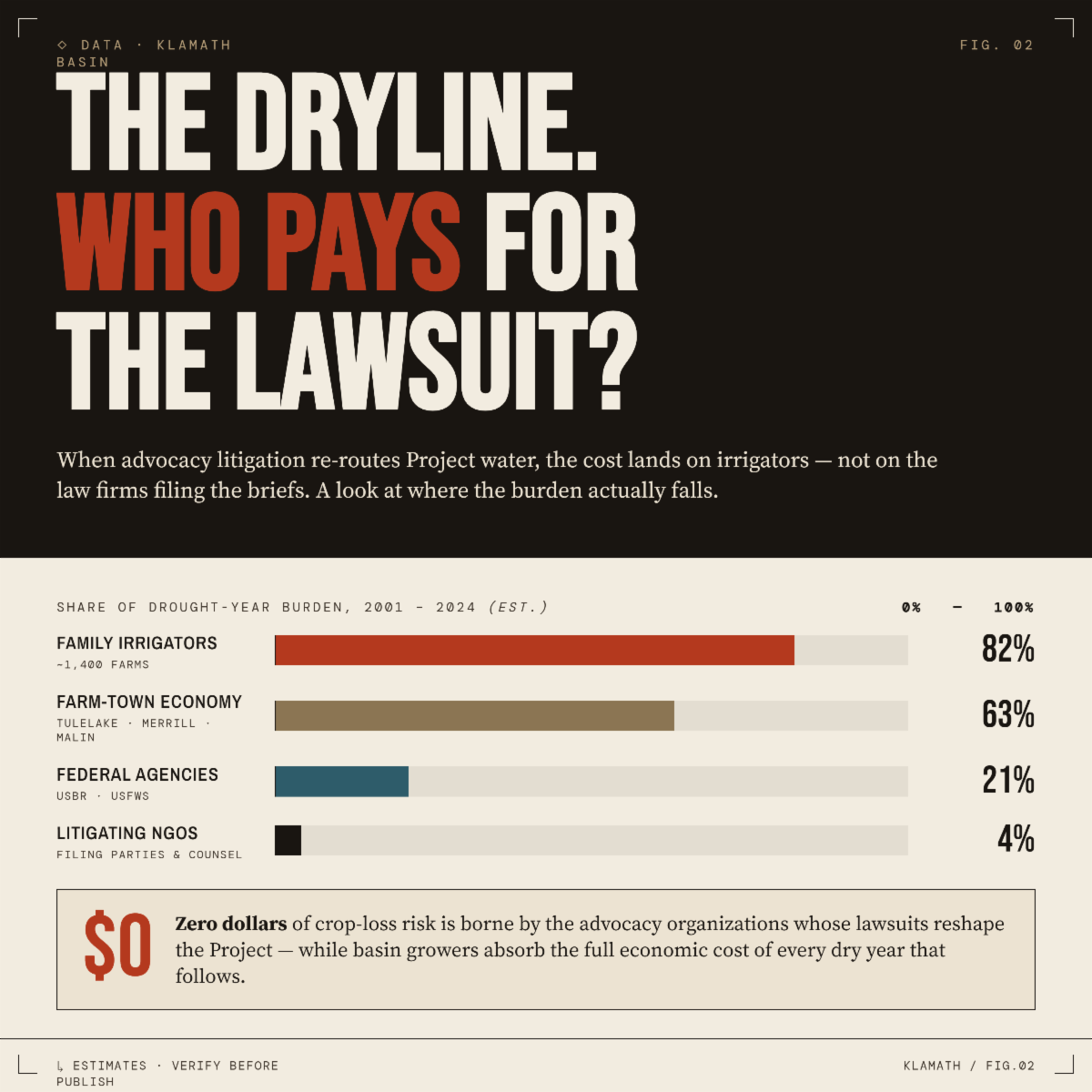
The litigation nevertheless continues, as EarthJustice has a nearly $100 million annual litigation budget to engage in lawfare against farmers and ranchers in Klamath and throughout the West.
| A Brief History of Lawfare against Klamath Farmers | |
What evidence supports Klamath Irrigation District’s claims of lawfare against the Klamath Farmers?
A timeline of relevant events between 1992 and 2022 is available with supporting documents at https://drive.google.com/file/d/1agZ3HqilVF-IvaNriiYhv6sdqd2-hq6e/view?usp=sharing
Our specific claim of Lawfare is compiled by looking at the following records and events.
Department of Justice (DOJ) Interagency Agreement AG6K000029 was initiated in 1995 to support claims of the Yurok "potential legal proceedings…with regard to the…Klamath (Reclamation) Project Operations Plan.”
The purpose of the Interagency Agreement AG6K000029 MOD #1 can be found on page 9 of the document available at https://drive.google.com/file/d/1BepVMVFXdmVB2NyrZfMBvpAxMDb4_cCz/view?usp=sharing
1997-2000: Robert Anderson’s Foundation of Lawfare
-
Robert Anderson, a DOI official under the Clinton Administration, laid the groundwork for lawfare by manipulating legal processes to favor tribal interests. Following the Ninth Circuit’s ruling in United States v. Oregon (44 F.3d 758, 9th Cir. 1994), which required all water rights to be subject to Oregon state adjudication under the McCarran Amendment, Anderson directed DOI and DOJ officials to fund studies and contracts (e.g., Agreement AG6K000029, valued at over $1.6 million) to support Yurok Tribe water rights claims after the 1997 adjudication deadline. These actions included developing a “flawed legal product” for Chinook salmon, later applied to coho salmon under the ESA, despite scientific criticism from the National Academy of Science (2002, 2004, 2008) and independent experts like Dr. David Vogel. This marked the beginning of a strategy to bypass state adjudication and prioritize tribal claims, setting a precedent for subsequent legal maneuvers.
EarthJustice has played its own role in Lawfare against farmers
EarthJustice was Yurok Tribe counsel in the following years:
- 2001 — Earthjustice supported the Patterson litigation era (dam relicensing/ESA enforcement)
- 2016 — Patti Goldman (Earthjustice) + Amy Cordalis (then-new Yurok General Counsel) filed suit over disease outbreaks
- 2017 — Yurok I. Judge Orrick's injunction; Earthjustice represented Yurok, PCFFA, IFR, Klamath Riverkeeper, Hoopa Valley
- 2018 — Court upheld 2017 injunction over BOR/irrigator objections
- 2019 — New Earthjustice suit 2019-2024 influencing the 2024 Biden era plan.
- 2020 — Three-year operations plan settlement; emergency TRO when BOR shut off May flows
- 2023 — Yurok II ruling (ESA preempts OWRD "stored water" order); new TRO suit over 2023 cuts
- 2026 — Current 60-day notice (Goldman + Earthjustice)
By Earthjustice's own account, they've represented Yurok in roughly six substantive lawsuits over this period.
Years that were actually different parties or different cases targeting Klamath farmers:
- 2002 — The Pacific Coast Federation ruling came down in 2001; 2002 was the year of the massive fish kill (a triggering event, not litigation per se)
- 2005 — Dismissal of Yurok's breach-of-trust claim in Pac. Coast Fed'n v. BOR. The Tribe was a party, but this is a dismissal, not Earthjustice "going on offense"
- 2021 — Klamath Tribes v. BOR (537 F.Supp.3d 1183). This was the Klamath Tribes (Upper Basin, suckerfish in UKL) — a different sovereign with sometimes-opposing interests to Yurok. Not Earthjustice but The Klamath Tribes are/were heavily influenced by Robert Anderson and NARF.
- 2022 — The biggest case was U.S. v. Klamath Drainage District (under former DOI Solicitor Robert Anderson), where the U.S. sued the irrigation district
The honest lawfare pattern that holds up: Earthjustice files a fresh ESA challenge on a roughly annual cadence whenever Reclamation issues a new operations plan or BiOp to squeeze farmers more and more. That's about every 3-4 years on the long-term plans, with TROs in between when annual operations deviate. The 2026 notice fits exactly — it wasn't triggered by the 2026 Operations Plan; the ops plan was just the excuse.
| | Could Klamath Basin Farmers Jeopardize Endangered Orcas? An AI Science-Based Analysis - Klamath Irrigation District | As legal and policy battles unfolded over water allocation to farmers in the Klamath Basin, one narrative from the expert marine biologists came front and center over the past four years: that marine biologists' opinions are that Klamath Reclamation Project farmers in Southern Oregon are jeopardizing the survival of the Southern | | |
Forty-Seven
by Al Gorethm
| | |
In the scrolls of the Bureau, the number align,
Where Title Sixteen meets legal design.
They searched for a logic, a truth to hold fast,
To settle the basin and water at last.
Deep Thought gave us Forty-Two, cold and precise,
A cosmic enigma that would not suffice.
For the farmer who waits where the headgates remained,
Forty-two refused to capture the fall of the rain.
But look at the ledger, to Chapter Forty-Seven,
Where the earth meets the law under Klamath's blue heaven
It's the key to the gates, the transfer of deed,
The power of districts to answer the need.
From a veteran's notice of Forty-Seven last year,
To the code that makes federal mandates grow clear,
It turns every bolt and opens the lock
The bedrock of water, the weight of the rock.
Inflation has found us, the answer has grown,
The digital root where the secrets are sown.
It's the pulse of the canal, the right and the plea:
Forty-Seven is home; the key to be free.
| | |
No significant update.
On 4 April 2026, K.I.D. submitted a response to Acting Regional Director Adam Nickels requesting formal clarification of the statutory eligibility for title transfer under the Dingell Act, an outstanding request since June 2021 (5 years ago).
We are patiently awaiting a response.
The Dingell Act was enacted "to facilitate the transfer of title to Reclamation project facilities to qualifying entities on the completion of repayment of capital costs" (43 U.S.C. § 2901). Because the statutory prerequisite of capital repayment was satisfied decades ago, the transfer of these facilities is a mandatory, ministerial act under both the Dingell Act and Articles 5 & 35 of the 1954 Amendatory Contract. Secretarial Order 3446 further directs Reclamation to "cut red tape," empower local partners, and accelerate project delivery — a mandate that aligns perfectly with our expectations.
KID is committed to working collaboratively with Reclamation to bring this process to a successful and expeditious conclusion. We look forward to Reclamation affirming KID's statutory eligibility so that the Area Office may proceed with the
Administrative execution of the transfer, and we remain grateful for the momentum the current leadership has generated.
| |
Title Transfer of Projects and Facilities
Draft Reclamation Manual Release – Title Transfer for Reclamation Project Facilities CMP 11-01
The Bureau of Reclamation (Reclamation) is updating its Directives and Standards CMP 11-01 Title Transfer for Reclamation Facilities to reflect lessons learned over the past seven years of implementing title transfers under Public Law (P.L.) 116-9, Title VIII, Subtitle A (P.L. 116-9, 43 U.S.C. 2902, et seq.). Reclamation has initiated a 30-day external review beginning on April 9, 2026, to gather feedback from partners, stakeholders, and the public. Use this link to reference the draft D&S.
| | |
| D System Improvement Plan (SIP) Update | Klamath Irrigation District has been working with Farmers Conservation Alliance since 2018 to find efficiencies and improvements to the district infrastructure. Through our partnership with FCA, we have been working with USDA NRCS to develop the "D System Improvement Plan". On 9 April we held a public meeting in Merrill on the plan update. We are now going through the public comments and preparing to submit our final report to NRCS. | |
The U.S. Department of Agriculture, Natural Resources Conservation Service (NRCS) in Oregon, with Klamath Irrigation District (KID or the District) as the project sponsor and U.S. Bureau of Reclamation as cooperating agency, announces the availability of a Draft Watershed Plan-Environmental Assessment (Draft Plan-EA) for the Klamath Irrigation District Infrastructure Modernization Project. | | | |
2026.04.09 KID In-Person Public Comment Meeting.mp4 | | | | |
The Genesis of our Partnership with FCA
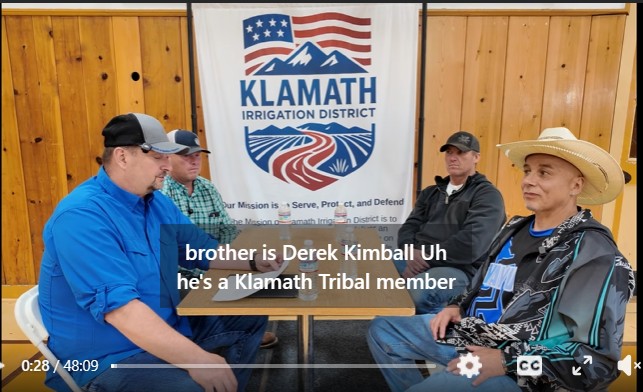
Following our public meeting on the D System Improvement Plan yesterday, we sat down with the people who put the District on the path to modernization: @Derek Kimbol, @Ty Kliewer, @ Ry Kliewer
Please take 45 minutes to listen about our past, understand the present, and learn about our future vision.
Video Link on Facebook
| | |
What We Are Reading
(and you should too)
| |
|
As of the most recent U.S. Drought Monitor update for April 28–30, 2026, nearly 63% of the United States is under some form of drought (D0–D4 categories), with about 61–62% of the Lower 48 states affected Maryland Daily Record+1. This is unusually high for spring and reflects widespread precipitation shortfalls across the Plains, Intermountain West, and parts of the Southeast.
| | | Submit and view Condition Monitoring Observer Reports (CMOR) | | | |
Oregon Water Resources Department sent this bulletin at 04/20/2026
The Oregon Drought and Water Supply Conditions Report summarizes hydrological and climatological information used to depict current drought and water supply conditions throughout the state.
20260420_WaterConditionsReport.pdf
For more information, please contact: Cameron Greenwood | 971.338.8135 | cameron.a.greenwood@water.oregon.gov
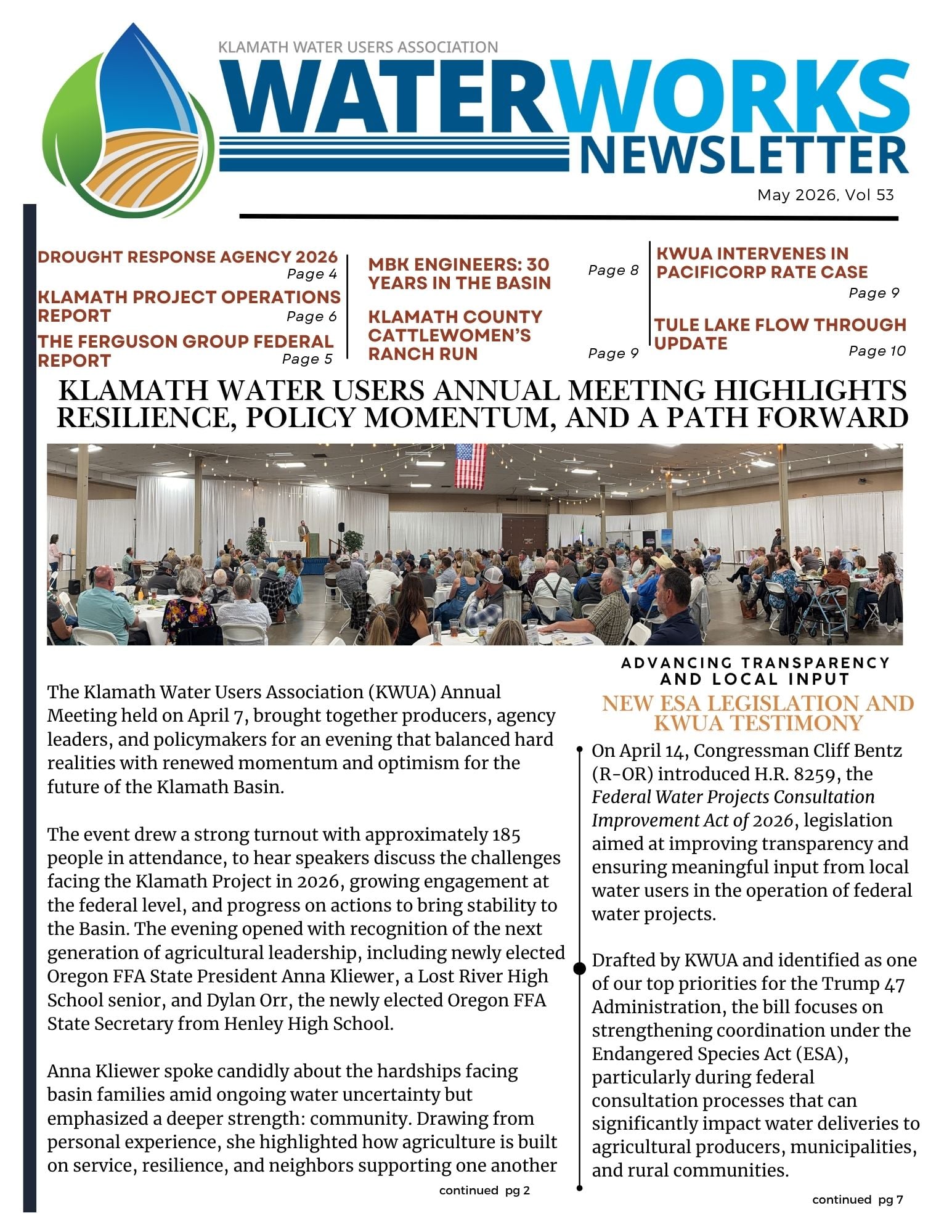
| 'The River Remembers' documentary chronicles dam removal in Northwest - Ashland News - Community-Supported, NonProfit News | Lee Juillerat: The 62-minute film provides insights into how decades of grassroots organizing - combined with cultural responsibility, tribal leadership, and awareness of the ecologically damaging effects of dams - resulted in successful efforts of their removals. | | | Read about the current issues that KWUA is working on. | ADVANCING TRANSPARENCY AND LOCAL INPUT~ NEW ESA LEGISLATION AND KWUA TESTIMONY *DROUGHT RESPONSE AGENCY 2026 * THE FERGUSON GROUP FEDERAL REPORT * MBK ENGINEERS: 30 YEARS IN THE BASIN * KLAMATH CATTLEWOMEN'S RANCH RUN * KWUA INTERVENES IN PACIFICORP RATE CASE *TULE LAKE FLOW THROUGH UPDATE | | | Water right process changes effective April 1, 2026 | In 2025, the Oregon Legislature passed legislation enabling OWRD to make water right processes more efficient and transparent. OWRD is also working to standardize and improve department processes. While a subset of these changes was effective January 1, 2026, the remaining provisions along with a suite of changes recently adopted to administrative rules, are effective April 1, 2026. | | | Updates from our only remaining elected Representative in the U.S. Congress | Congressman Bentz Applauds House Passage of the Farm Bill | WASHINGTON, D.C.- Last Thursday, the House passed the Farm Bill, H.R. 7567, the "Farm, Food, and National Security Act of 2026". This bill helps secure America's food supply, provides a safety net for farming operations in the form of crop insurance and commodity programs, and funds nutrition initiatives like SNAP (Supplemental Nutrition Assistance Program). | | | |
Congressman Bentz Secures $80 Million for Kingsley Field F-35 Training Center in President's Budget | |
WASHINGTON, D.C.- Congressman Cliff Bentz (R-OR) is pleased to announce that after working directly with Kingsley Field leadership, U.S. Air Force command, and the White House, the President's 2027 budget includes an $80 million dollar line item for the construction of a new F-35 Formal Training Unit (FTU) for the Academic Training Center to be established at Kingsley Field in Klamath Falls, Oregon.
| | | Congressman Bentz Introduces Legislation That Would Stop Misuse of the Endangered Species Act | |
WASHINGTON, D.C. - Today, Congressman Cliff Bentz (R-OR) introduced legislation to stop application of the provisions of the Endangered Species Act to the National Flood Insurance Program.Congressman Bentz's legislation amends the National Flood Insurance Act of 1968 so that the insurance program remains focused on its intended purpose: protecting property and human life from flood risk.
| | | | |
Farming businesses are economically upside down. Farm businesses, essential to every American, are being crushed by skyrocketing diesel, fertilizer, labor, equipment, and operating loan prices. Unfortunately for farmers and indirectly for us, rock bottom prices for commodities such as onions, potatoes, wheat, cherries, grapes, beans, and soybeans, to name a few, fall far short of anything close to costs of production.
Why are the sale values of commodities such as these so low? Because tons upon tons of farm product imports, bad tax policy, subsidization of farm production in foreign countries, and increased volume of production here in the United States all combine to drive prices down. What follows is a summary of what we are doing in Congress to address these issues.
Farm Bill
For the past 3 years, the House Committee on Agriculture has been working toward the reauthorization of the Farm Bill. This bill is supposed to be a five-year bill, but it was last passed back in 2018. It has been extended several times and will expire in September of this year. Last summer, the Chairman of the Agriculture Committee, GT Thompson (R- Pa.), successfully inserted into the “Big Beautiful Bill” provisions that normally would have been included in a Farm Bill. These provisions included commodity and farm safety net programs (Price Loss Coverage (PLC), Agricultural Risk Coverage (ARC), expanded crop insurance opportunities, and nutrition changes to the SNAP program. The nature of the process used to pass the “Big Beautiful Bill" did not allow other important farm bill provisions to be included, so these are now in what is being referred to as the “Farm Bill Lite”. This isn’t just a "farming" bill; it also addresses food security, management of our federal forests, and a long list of other important issues.
Why We need the Farm Bill Now
Agriculture is a risk laden business. Years ago Congress realized that dramatic market ups and downs in the farming business had to be addressed, or the nation’s food supply could fall short, resulting in famine and even civil unrest. As an answer to this unpredictability, Congress developed the five year farm bill, containing risk off-setting programs which in essence create risk sharing as a means of reducing unpredictability of food production. Our farmers and ranchers deserve the certainty of a long-term, five-year authorization. The risks facing our agricultural community, and all consumers, have not gone away. The "safety nets” of crop insurance and disaster assistance remain essential to our system of food production.
What's in it for Oregon?
For Oregon’s Second District, the Farm Bill is foundational to farming and timber operations. Several of the key provisions in the bill are:
- Enhanced Crop Insurance: Strengthening the tools that protect our family farms from catastrophic loss.
- Forest Management: Extending authorities that allow us to thin, overgrown forests and reduce the risk of the devastating wildfires that plague our region.
- Water Infrastructure: funding for irrigation modernization, improving the efficient use of water.
Boosting Our Specialty Crops: Potatoes, Onions, and Beyond
Potatoes, onions, beans, cherries, grapes, sugar beets, alfalfa and more are important crops in Oregon’s Second Congressional District. The current draft of the farm bill includes upgrades to the Specialty Crop Block Grant Program and the Specialty Crop Research Initiative (SCRI) that will help producers:
- Trade and Market Access: The bill addresses long-standing trade barriers by requiring a formal report to Congress on foreign restrictions. This is a critical step in opening key international markets—such as Japan—to fresh Oregon produce. Additionally, the bill strengthens the Technical Assistance for Specialty Crops (TASC) program to help our growers navigate complex export regulations.
- Automation and Mechanization: To combat rising labor costs, the bill establishes a new Specialty Crop Mechanization and Automation Research and Extension Program. This initiative provides $30 million annually to develop technologies that help specialty crop operations remain competitive and efficient.
- Direct Producer Input: The bill mandates a new "Stakeholder Consultation" process for Specialty Crop Block Grants. This requires that program administrators consult with local producers and commissions when setting funding priorities, putting decision-making power back in the hands of the people growing the crops.
- Cold-Chain Infrastructure: By incorporating the FRIDGE Act, the bill provides resources to improve cold-storage and transportation infrastructure. This is essential for maintaining the quality of Oregon’s perishable specialty crops as they move from our fields to global dinner tables.
- Precision Agriculture Research: The bill expands the SCRI to focus on soil health and water efficiency. For our region, this means more federal research dollars dedicated to the technologies important for the long-term survival of Eastern, Northern, and Southern Oregon agricultural sectors.
Where We Stand: The House Vote and the Politics
Currently, the House Committee on Agriculture has moved the bill out of committee and it is awaiting a full House vote. However, the path to passage is fraught.
The primary political hurdle remains the balance between nutrition spending and production agriculture. While the SNAP (Food Stamps) program is a critical component, it is not supported in its current form by many who think that it is too generous. Others believe that it is just the opposite. We are also navigating a tight fiscal environment where every dollar must be justified. My message to leadership is clear: We cannot balance the budget by increasing the risk of food shortages and farm bankruptcies.
What is in the "One Big Beautiful Bill" (“BBB”) that helps farmers and timber operations? Last summer, when the BBB was passed, much of the national conversation focused on its broader economic impacts. But as indicated above, several provisions specifically helped farmers, ranchers, and rural communities:
- Agricultural Tax Relief: The OBBB significantly increased the small business equipment deduction (Section 179) from $1 million to $2.5 million, allowing our producers to invest in the machinery they need to stay competitive. It also raised the inheritance tax exemption to $15 million, a provision that will help family farms stay in the family without being liquidated to pay federal death taxes.
- Modernized Crop Insurance & Reference Prices: The Act provided a $65 billion boost to the agricultural safety net, including an immediate increase in statutory reference prices for commodities like wheat (rising from $5.50 to $6.35 per bushel). This provides a much-needed buffer against market volatility.
- Conservation Funding: The OBBB protected and stabilized $18.5 billion for the Environmental Quality Incentives Program (EQIP) and $8.1 billion for the Conservation Stewardship Program (CSP). These voluntary, incentive-based programs help our ranchers implement best practices for soil health and water conservation.
- SNAP & Medicaid Integrity: The bill introduced common-sense reforms to federal assistance programs, focusing on "work-ready" requirements for able-bodied adults and requiring states to perform more frequent eligibility checks. These changes ensure that resources are preserved for seniors, individuals with disabilities, and low-income families who truly need them.
- Wildfire Risk Reduction: By providing new pathways for increased timber harvests on federal lands, the OBBB is already helping us reduce the fuel loads that lead to catastrophic wildfires, while simultaneously creating jobs in our timber-dependent counties.
Input Costs, Tariffs, and My Efforts to Bring Certainty
It’s no surprise that our farmers and ranchers are hurting. For years our producers have been undercut by foreign countries that play fast and loose with our trade agreements. We’re seeing a flood of subsidized foreign products being dumped into the U.S., leaving our local growers unable to compete with subsidized products. This is not only unfair, it is also a violation of the trade agreements we are supposed to have with foreign countries. This is why I’ve met with U.S. Trade Representative Jamison Greer, Trade Subcommittee Chairman Adrian Smith, and House Agriculture Chairman GT Thompson again and again asking them to find every possible avenue to push back against these market abuses and bring real, lasting certainty to our producers.
Farm Production Expenses
Source: Farm Sector production expenses forecast to remain above 20-year average through 2025
Oregon Farm Data
Oregon’s Second District is known for its diversified crops and the data shows these crops are being hit by a unique "scissors effect."
- The Input Gap: Unlike midwestern row crops, our district's specialty crops are incredibly input-intensive. ERS data shows that specialty crop producers are seeing their margins evaporate faster because their costs, specifically for specialized labor and irrigation power, are rising faster than the national average.
- The 2025 Price Drop: In a staggering display of market volatility, onion prices dropped 43% in 2025 alone. When you combine a 43% drop in what you get paid with a 30% increase in what you pay for fertilizer, you get a crisis.
Fertilizer
It’s no secret that the skyrocketing cost of fertilizer has been a "silent tax" on every acre in Oregon’s Second District. I have been clear with my colleagues in Washington: we cannot have food security without fertilizer security. The data from the USDA Economic Research Service (ERS) shows that while prices have dipped from their absolute peaks, they remain at a "new normal" that is 30% to 40% higher than just a few years ago.
To fight this, I have been engaged on two major fronts to restore our domestic supply and bring those costs back down to earth for our farmers.
1. Reopening the Meridian, Idaho Plant
- I am actively advocating for the reopening of the fertilizer production facility in Meridian, Idaho. For our producers in Eastern Oregon, having a regional supply chain isn't just a matter of convenience, it’s a matter of survival.
- When we rely on fertilizer shipped from halfway across the globe, our farmers pay the price for every spike in maritime fuel and every bottleneck at a foreign port. By bringing this plant back online, we can create a reliable, Pacific Northwest-based supply that cuts out the middleman and reduces the "transportation tax" that currently inflates every ton of fertilizer delivered to our co-ops.
Declaring Potash and Phosphate as "Critical Minerals"
On March 31, 2025, I joined my colleagues in signing a formal letter to the administration demanding that potash and phosphate be officially designated as Critical Minerals. The Administration agreed with my stance and on November 7,2025 both potash and phosphate were listed as critical minerals.
Currently, the U.S. is far too dependent on foreign adversaries for these essential nutrients. By designating them as critical minerals, we can now:
- Streamline Permitting: Cut through the federal red tape that currently prevents us from tapping into our own domestic reserves.
- Prioritize Domestic Production: Ensure that American soil is fed by American resources, insulating our growers from the whims of foreign trade manipulation.
- Drive Down Costs: Basic economics tells us that when we increase the supply here at home, the price for the end-user—our farmers—goes down.
The Bottom Line
We cannot be secure if we are dependent on others to feed our nation. Whether it is reopening regional plants like the one in Meridian or expanding the plant in Pocatello, or driving down, we must treat our fertilizer resources with strategic importance.
Sincerely,
Cliff Bentz
Member of Congress
It is the honor of a lifetime to represent you in Congress. Should you need to contact me or my staff, please do not hesitate to do so. You can visit my website here.
Don't forget to follow me on Twitter, Facebook, Instagram, and YouTube!
| It's Time to Make the Endangered Species Act Work Better for Recovery | PERC | PERC testifies before the Senate on pragmatic solutions to boost species recovery under the ESA. | | | |
Readers respond: Keep factory farms from guzzling Oregon’s water
By
Published: Apr. 16, 2026, 6:30 a.m.
As Oregon braces for summer following another record-breaking winter snow drought, state legislators must act to preserve our dwindling water resources – and the corporate polluters overusing them, (“Oregon’s snowpack just broke a terrifying record, and the consequences could be devastating this summer,” April 9). As we face more catastrophic wildfires, severe droughts and life-threatening heat domes, the need to conserve our water for Oregonians —not corporate polluters— has become more urgent.
For decades, corporate polluters such as Oregon’s massive factory farms have exploited water usage loopholes at the expense of Oregon’s environment and its finite water resources. In 2023, the Oregon legislature passed SB-85, which placed a temporary cap on the state’s stock water exemption. This exemption for watering livestock was originally enacted in 1909, decades before industrialized methods of production and extreme animal confinement we see today. It has allowed factory farms to use unlimited groundwater for watering livestock.
If legislators do not act in the next legislative session, the temporary 2023 cap will expire in 2027. At that point, we will revert to the outdated exemption enacted just a year after the first Ford Model T was sold. The 1909 exemption does not account for the unsustainable water needs of industrialized animal agriculture and their impact on our current water scarcity crisis.
We must use less water. Prohibiting new and unlimited factory farm stock watering is a commonsense step to protect Oregonians from the worst effects of water scarcity.
Aimee Stone, Portland
Stone is the Oregon organizer for Food & Water Watch and Food & Water Action
| |
Klamath River Renewal Project Receives Prestigious Award | PRNewswire/ -- The Klamath River Renewal Project has received the Distinguished Project Award from the International Fish Passage Conference. The award was... | | | |
Wow, (during a severe drought) it looks like we might have a salmon season | Today, May 6, the California Fish and Game Commission will have a phone conference to determine if they will agree to accept the California Department of Fish and Wildlife recommendation of an In-River Sport Fishing Salmon season. | | | Henley Hornets claim Iron Chef trophy at Klamath County showdown | The Henley Hornets won the KCSD Iron Chef trophy at the second annual Iron Chef: Battle of the Schools on May 1 at Linman Hall at the Klamath County Fairgrounds. | | | US Legislator Introduces the WISE Act to Permanently Fund Clean Water Projects - environment coastal & offshore | Congresswoman Nikema Williams (GA-05) introduced the Water Infrastructure Sustainability and Efficiency (WISE) Act. The bill will permanently set aside 20 percent of the Clean Water State Revolving Fund for environmentally friendly water infrastructure projects. | | | |
EPA, Conservation Groups: Wyoming’s ‘Impaired’ Water Protocols Run Afoul of the Clean Water Act
By Mike Koshmrl
Federal environmental regulators and water quality advocates want the Wyoming Department of Environmental Quality to rectify a policy restricting who can submit water samples used to decide whether waters are too polluted and below Clean Water Act standards. Currently, Wyoming only accepts water samples collected by the state and federal government and their subdivisions when it’s directly making “impaired” water determinations — that’s been the case since 2020, according to state officials who in March proposed to continue that policy. Read more HERE.
The Driest Year Revisited: Five Takeaways from 2002 for Today’s Colorado River
By Annie MacKeigan
The Colorado River basin has been here before.This year’s historic winter of low snow might feel novel. But recent years give some insight into just how dry the West’s most important river system can get. This season’s scant snowpack is melting rapidly, and turning up memories of other notably dry years. Prolonged drought conditions and warming temperatures since 2000 have produced severe single-year droughts in 2002, 2012, 2018 and 2020 in the river’s headwaters states of Colorado, Wyoming and Utah. As severe drought years continue to put the Southwest’s water infrastructure to the test, communities in the region are grappling with how best to understand and adapt to a changing climate. Read more HERE.
New Study Details Changing U.S. Irrigated Agriculture, Viability Strategies
By Frances Hayes
A new study by researchers at the Daugherty Water for Food Global Institute at the University of Nebraska offers a comprehensive national-scale assessment of irrigated agriculture in the United States in recent years. Published in Agricultural Water Management, the findings carry important implications for the future of food production, water policy and rural livelihoods across the country. The study, " Irrigated agriculture in the United States: Current Status and future frontiers," draws on multiple datasets supported by robust geospatial analysis to paint a detailed picture of where irrigated agriculture stands today, where it is headed and what must change if the U.S. is to sustain its role as a global food security anchor. Read more HERE.
New Bill Forces Utah Data Centers to Disclose Water Use Estimates
By Mark Richardson
Utah has taken steps to rein in water use by large data centers but conservationists and other advocates said more needs to be done to protect the state's dwindling water resources. Lawmakers recently passed the Date Center Water Transparency Amendments, which require server farm developers to provide an estimate of future water use. The facilities often need massive amounts of water to cool their servers, particularly for artificial intelligence systems. Zach Frankel, Great Salt Lake Waterkeeper and executive director of the Utah Rivers Council, said in some rural areas, there is not enough water to go around. "Two data centers in a community will use as much water as a city of 100,000 people," Frankel pointed out. "You could see data centers come in that essentially triple the water use compared to the municipal population." Read more HERE.
Hoover Dam is Headed for Trouble Under New Emergency Colorado River Plan
By Alan Halaly
Federal water managers are putting the nation’s largest dam in a precarious position as they try to balance out the Colorado River system in a year of record low snowpack. Toward the bottom of the Bureau of Reclamation’s marquee announcement last week was a paragraph that said lower flows out of Lake Powell could reduce Hoover Dam’s hydroelectric power generation by about 40 percent as soon as this fall. According to projections, Lake Mead could fall nearly 30 feet in the next two years, more than 8 feet past the 2022 record low. Read more HERE.
DOE Moves to Release $430m for US Hydropower Upgrades
By Carrieann
The US Department of Energy (DOE) has announced plans to resume negotiations to distribute nearly $430m in funding to hydropower facilities across the US, as part of efforts to modernize the country’s aging fleet.The funding, administered by the DOE’s Hydropower and Hydrokinetic Office (H2O), will support 293 projects at 212 facilities under the Maintaining and Enhancing Hydroelectricity Incentives Program. Read more HERE.
Worst Spring Drought on Record Grips US, Fueling Wildfires and Water Worries
By Chris Dolce
Drought in the continental United States has expanded to its record-highest level for spring, and it’s fueling wildfire and water shortage concerns as the summer’s drying heat fast approaches. Varying levels of drought covered 62.78% of the country as of April 21, with the worst of it centered on much of the South, West and Plains. Put another way, dryness in the Lower 48 states has never been this expansive in spring in the history of the US Drought Monitor, which has data back to 2000. Read more HERE.
Lawmakers Introduce Bills Targeting Tribal Water Rights, Infrastructure Gaps in the West
By Lance Benzel|
Congress is mounting a broader push to close long‑standing drinking‑water gaps in tribal communities across the Western United States. Legislators have introduced two bills aimed at securing water rights, modernizing aging systems and directing federal dollars toward regions facing some of the most persistent water‑access challenges in the country. Read more HERE.
| |
Podcast: Sam Barncastle on Western Water Challenges | Samantha Barncastle was recently featured on the Fill Your Plate Now podcast to discuss the critical role water plays in sustaining agriculture across the West. Drawing on more than 17 years in water law and her background as part of a multigenerational farming family, Sam explains why Western irrigated agriculture produces a significant share of the nation's fruits, vegetables, nuts, and dairy - and why reliable water delivery is essential to keeping that system functioning. | | | |
Review annual highlights and progress from the past year. | | | Issue Alert: Alliance Sounds the Alarm on Western Drought and Funding Needs | Today we sent a letter to Congress urging immediate action to address worsening drought conditions across the West and to strengthen long-term investment in water infrastructure. The message is clear: the West is no longer facing a temporary drought, it is confronting a structural water crisis. | | | |
What's Current? Issue #140: California's Self-Destructive War on Oil | California's state legislature may succeed in destroying its own oil industry, but it won't change anything in the world. It will only export jobs and raise the cost-of-living here at home. Here's a reality check.and lack of heavy industry. | | | |
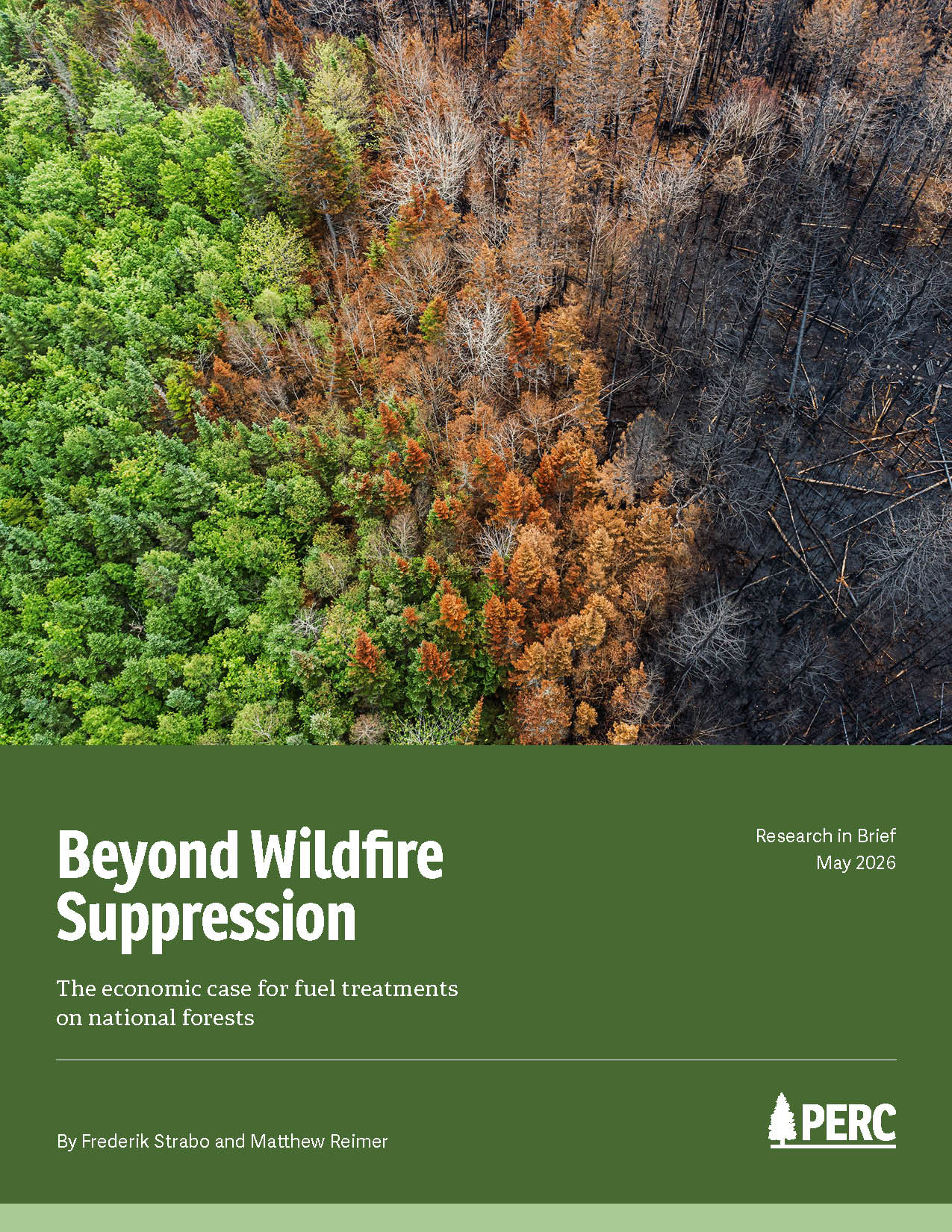
Beyond Wildfire Suppression | The economic case for fuel treatments on national forests | | | |
Oregon’s Water Outlook Tightens as Drought Emergency Expands Ahead of Summer
April 24, 2026
By Ellen Ward
A dry winter has turned into a statewide warning, and Oregon is now entering the early stages of what officials expect could be a difficult water year. The expansion of a formal drought emergency across multiple counties marks a shift from concern to coordinated response, with implications that stretch from high desert ranchland to river-dependent communities in Southern Oregon.
Governor Tina Kotek has issued an executive order declaring drought emergencies in several counties, including Crook, Grant, Jackson, Jefferson, Morrow, and Wallowa. The action follows earlier declarations in other parts of the state, signaling a widening footprint rather than a contained regional problem. These declarations are issued at the request of county governments and are backed by data showing declining water availability and worsening seasonal outlooks.
At the center of the issue is Oregon’s snowpack, which functions as the state’s most reliable natural water storage system. This past winter delivered unusually warm temperatures, reducing snow accumulation across much of the Cascades and eastern basins. In many areas, precipitation fell as rain rather than snow, limiting the slow-release runoff that typically sustains rivers, irrigation systems, and reservoirs through late spring and summer. The result is a compressed water cycle where supply arrives earlier, drains faster, and leaves less behind when demand peaks.
Read more…
Governor Kotek declares drought emergency in Jackson County
April 23, 2026
By Kaleb Clark
Gov. Tina Kotek declared a drought emergency in Jackson County and five other counties across the state. The declaration came through Executive Order 26-07 and directs state agencies to coordinate and prioritize assistance to the region.
According to the National Oceanic and Atmospheric Administration, Oregon's 2025-26 winter tied with 1934 as the warmest winter on record. The unusually warm temperatures contributed to a record-low snowpack with likely impacts on natural resources, water supply and wildfire risk across the state. As of April 7, 95% of Jackson County is in moderate to severe drought.
Over the last year, precipitation conditions have been below normal in the county. Drought conditions are expected to significantly affect Oregon's farms, ranches, recreation and tourism sectors, drinking water availability, fish and wildlife habitats and other natural resource-dependent activities.
"Communities across the state are being confronted with unprecedented drought conditions," Kotek said. "My office and relevant state agencies are at the ready to assist affected communities address drought impacts and continue efforts to secure a stronger, more climate-resilient Oregon." "The abnormally dry conditions we're experiencing should serve as a stark reminder that wildfire season is around the corner, and Oregonians need to be ready," Kotek said.
Read more…
Federal Policy Moves Target Water, Power, and Economic Stability Across Southern Oregon
April 23, 2026
By John Oliver
A series of federal initiatives now moving through Congress could reshape how water is allocated, how energy is managed, and how economic policy reaches households across Oregon, with particularly direct consequences for communities in the southern part of the state.
At the forefront is proposed legislation aimed at changing how decisions are made under the Endangered Species Act when it comes to federally managed water systems. The measure would require federal agencies to include local water users more directly in consultation processes tied to environmental protections. In regions like Southern Oregon, where irrigation districts, farmers, and municipalities rely heavily on consistent water access, even minor regulatory shifts can carry significant economic consequences.
Water has long been a pressure point across the West, and the balance between species protection and human use remains a persistent challenge. The proposed approach seeks to ensure that those most affected by reductions in water supply are not simply reacting to federal decisions but are actively participating in shaping them. For agricultural producers in Josephine, Jackson, and Klamath counties, that shift could influence everything from crop planning to long-term investment decisions.
A separate proposal targeting the National Flood Insurance Program introduces another layer of regulatory clarity with potential local impact. The legislation would limit the use of environmental law as a tool within flood insurance policy, reinforcing the program’s original purpose of protecting property from flood damage. In practice, this could reduce uncertainty for homeowners and developers navigating building requirements in flood-prone areas. In Southern Oregon, where growth pressures continue to push development into new areas, clearer rules may streamline permitting and reduce delays tied to overlapping federal mandates.
Read more…
Bear Basin cloud seeding operator reports solid first season
April 23, 2026
By Brad Carlson
Cloud seeding operator Rainmaker Technology Corp. added more than 60,000 acre-feet of water to the Bear River Basin as of midseason, a volume that exceeded the company’s expectations for the program’s first year. “It’s a drier year than we’ve seen in the West, but that’s a number the team looked at and felt good about,” chief operating officer Parker Cardwell said. The company looked to add to the total as the end of the November-April season approached, he said. “We’re still wrapping up the season. We’ve still got some storms coming in,” Cardwell said April 21.
El Segundo, Calif.-based Rainmaker Technology’s joint operation with Utah and Idaho aims to boost water supply in the Bear River Basin and in turn increase inflows into the Great Salt Lake. The Bear River, which flows in parts of Utah, Wyoming and Idaho, is the lake’s largest tributary. The lake is about 500,000 acre-feet below its fill line, Cardwell said.
“Cloud seeding is short-term infrastructure with a long-term drought mitigation approach,” he said. “By increasing the amount of snowpack that we can build year over year, we can meaningfully increase the amount of water in our surface and groundwater resources.”
Clouds in suitable storms are seeded with small amounts of silver iodide to spur snowflake formation. Rainmaker is a pioneer in drone-based cloud seeding — which promises high efficiency as multiple drones are sent to key parts of basins quickly so targeted seeding is maximized over a storm’s duration.
Read more…
Warmer winters, snow drought could devastate West’s water supply by 2100
April 23, 2026
By Kyle Odegard
Warmer winters and snow drought across the West may devastate agricultural water supplies by speeding streamflows, according to a new scientific report. The shift will likely leave less liquid in rivers, lakes and reservoirs during the summer when growers need water the most. The Oregon State University-led project found that water transit times — the time between rain or snow falling on the landscape and leaving as streamflows — will be 18% faster on average in the late century.
Waterways will have more water in the winter, but modeling shows about 50% less water in the summer, said Zach Butler, a postdoctoral scholar at OSU and lead study author. The study, recently published in Scientific Reports, is timely as Oregon had its worst snowpack on record this year and Idaho and Washington’s snowpack also were poor. “This year is, unfortunately, a really good example of what we see happening in the future,” Butler said.
The study focused on the Naches River near Yakima, Wash., which is one of the most climate-sensitive waterways within the Columbia River basin. However, similar impacts are expected in areas that get most of their water from the snowpack, Butler said. “The majority of basins across the West and certainly a majority in the Pacific Northwest are snow-dominated,” he added.
Read more…
Reimagining irrigation for the 21st century
April 23, 2026
By Paul Menser
The U.S. has nearly as many miles of irrigation canals as it does highways. The canals, which provide water for millions of acres of crops and pastures, are managed by hundreds of canal companies and irrigation districts ranging in size from utility scale to mom and pop. With demand for water growing, especially in the arid American West, experts agree that the U.S. irrigation infrastructure is ripe for a makeover.
To help modernize these canals and waterways that support almost 60 million acres of agriculture, the Idaho National Laboratory and Pacific Northwest National Laboratory developed IrrigationViz. IrrigationViz is an online software tool to help water users explore modernization options. These options include ways to improve water delivery and add power generation that creates new revenue streams, supporting district operations.
The tool is funded by the U.S. Department of Energy’s Hydropower and Hydrokinetic Office (H2O). Participation has grown since IrrigationViz was introduced in 2021. The tool’s success has allowed national laboratory developers to add new capabilities.
“The more we can validate and verify our calculations with data collected from real life, the more effective it’s going to be,” said Kara Cafferty, the INL energy and water systems researcher who leads DOE’s Irrigation Modernization Project.
In a recently published paper, “IrrigationViz: A Geospatial Visualization Application to Facilitate Irrigation Modernization,” Cafferty and the team detail the use cases for the tool and how to leverage it for different scenarios.
Read more…
Stripe rust ‘developing fast’ in Pacific Northwest
April 23, 2026
By Matthew Weaver
Stripe rust is “developing fast” in the Pacific Northwest, with disease pressure likely to increase, USDA research plant pathologist Xianming Chen says. “Weather conditions will be favorable for rust development for what could be a month,” Chen told the Capital Press. In his April 22 report, Chen found stripe rust in experimental fields and monitoring nurseries in Central Ferry, Wash.; Mount Vernon, Wash., Hermiston, Ore., and Pullman, Wash.
His team found stripe rust on one commercial field April 16 in the Horse Heaven Hills region in Washington’s Benton County. The field had rust “over 60%” incidence, and 20% to 60% severity.” The field appeared not to be sprayed with fungicide, Chen stated in the report. Stripe rust was not found in commercial fields on the Palouse during an April 21 check but was found on goat grass at the edge of a wheat field in Idaho.
Because the plants have not entered their flagleaf stage, some farmers may make a later application, Chen said. Lower wheat prices and high input costs may be a factor in their decision whether or not to use an early-season fungicide, Chen said. Early applications should reduce the rust inoculum. Based on data Chen collected between 2002 and 2025, stripe rust causes an average 8% yield loss in wheat each year. That’s an average loss to farmers of $168 million across the Pacific Northwest. At the same time, PNW farmers are forced to spend $13.5 million on fungicides each year to protect their crops, Chen said.
Read more…
Dry conditions, war ruffle U.S. wheat market
April 22, 2026
By Matthew Weaver
Declining crop conditions and ongoing tensions between the U.S. and Iran are impacting the national wheat market, Northwest analysts say. USDA’s April 20 crop progress report indicated the winter wheat crop is 30% good to excellent, down from 34% the previous week and 45% the week before that.
“Definitely need some rain — it’s early, got plenty of time to recover, but we’re getting to a point where it’s going to be critical,” said Dan Steiner, who retired from Morrow County Grain Growers in 2023 and now works as a market analyst in Boardman, Ore. But there’s still plenty of wheat in stock, he said.
“As sad as it is to say, if Oklahoma and Texas lost 200 million to 300 million bushels of production, it would be good for the rest of the farmers in the United States,” Steiner said. “It would allow this market to finally run up. When we start our new crop on June 1, we already have 58% of the needs covered before we start a combine.” Soft white wheat is $6.15 per bushel on the Portland market.
After USDA reported poorer crop conditions in the Southern Plains than expected, Northwest Grain Growers senior market analyst Byron Behne thought wheat prices would be higher, but wheat futures traded lower overnight. “Hard red supplies are burdensome, so if we have a smaller hard red crop this year, it’s not that big a deal unless it’s a real disaster,” Behne said.
Read more…
Freeze impacts sugar beet planting
April 22, 2026
By Brad Carlson
Amalgamated Sugar officials are concerned about the impacts of a recent freeze and ongoing water supply challenges. The cooperative had made strong progress with sugar beet planting ahead of recent freezing conditions in the Magic Valley and Upper Snake River regions — in Idaho’s south-central and eastern areas, respectively — and in parts of the Mountain Home, Nampa, and Nyssa (Ore.) regions to the west, agriculture director Matt Wheeler said.
As of April 17, roughly 130,000 acres had been planted of the targeted 167,300, “but it is unknown at this time the extent of required replants,” he said. Along with the likelihood of a high percentage of replants, the water outlook raises concern. “Extremely low snowpack and reduced runoff have constrained water availability in all our growing regions, putting real pressure on many sugar beet growers,” Wheeler said. “We expect several thousand acres will go unplanted due to water shortages.”
Recent rainfall in the Treasure Valley of southwest Idaho and southeast Oregon has helped to an extent, but rain in the Magic Valley and Upper Snake regions — combined, Amalgamated’s largest production area — was significantly lower, he said. “As we look ahead to the crop year, the recent freeze is going to impact a significant number of acres in our largest growing region, and water will be an issue in many parts of the cooperative that may impact growers’ ability to water into September,” Wheeler said.
Planting went fairly smoothly in most areas early on as growers could get into fields and make good progress, said Samantha Parrott, Snake River Sugarbeet Growers Association executive director. Water supply concerns weighed heavily on growers as they made early season decisions. “Spring always brings some level of risk,” she said. When a hard freeze occurs, “the potential for replanting becomes very real, and that adds both cost and stress at a time when margins are already tight.”
Read more…
Program could pay Klamath farmers to idle fields
April 21, 2026
By Kyle Odegard
Roughly $18 million is expected to be available through a “no irrigation” program for Klamath Project farmers who idle their fields this growing season. The Klamath Project Drought Response Agency has opened up its 2026 annual drought response program and is accepting applications for aid through June 15. Estimated payments range from $300 to $350 per acre, according to a statement from the Klamath Water Users Association.
Application paperwork states that payments will not exceed $350 per acre, and the drought response agency made no commitment about when payment will be made or how much money applicants could receive. The drought response agency may not know the total amount of funding available until the end of the irrigation season or even later, paperwork states. A representative of the Klamath Project Drought Response Agency wasn’t able to be contacted regarding this article before deadline.
To qualify for a full payment, a parcel must receive no irrigation water from any source from November 2025 through October 2026. Land that was irrigated from Nov. 1 through Feb. 28, but remains unirrigated from March through October, may be eligible for partial payments of 50% of the full season amount. Parcels must have a water right in the Klamath Project, and be four or more contiguous acres of irrigable land with clear boundaries.
The parcel must have been irrigated with surface water and produced a crop in 2023, 2024 or 2025, or participated in the 2023 or 2024 “no irrigation” program. Workshops to assist with the sign-up process will be held by the Klamath Project Drought Response Agency and the Klamath Water Users Association, and details about those sessions should be announced soon, according to the KWUA.
Read more…
New project ‘floats’ idea of solar panels on irrigation reservoirs
April 21, 2026
By John Lovett
Electricity and water don’t usually mix, but technological advancements in floating solar arrays open the potential to generate electricity while decreasing impacts on farm irrigation reservoirs and agricultural land.
Michael Popp with the Arkansas Agricultural Experiment Station is undertaking a new research project to test solar arrays on the reservoir at the Rice Research and Extension Center in Stuttgart. “The goals are to not convert agricultural land to solar panel use, save irrigation water and create a synergy between utility companies, solar investors, farmers and policymakers,” said Popp, the Harold F. Ohlendorf Professor of Farm Management in the department of agricultural economics and agribusiness for the experiment station and the Dale Bumpers College of Agricultural, Food and Life Sciences at the University of Arkansas.
The experiment station is the research arm of the University of Arkansas Division of Agriculture. Floating solar systems are also not visually intrusive when compared to traditional land-based photovoltaic systems, Popp said, because the embankments of the reservoir serve as a barrier to block sight of the systems.
Ryan Loy, an assistant professor and extension agricultural economist with the Division of Agriculture, recently joined Popp to talk about the project in an episode of the “Morning Coffee and Ag Markets” podcast for the Fryar Price Risk Management Center of Excellence.
Read more…
Lawsuit claims Oregon climate rule harms farming and forestry
April 21, 2026
By Mateusz Perkowski
A new lawsuit cites Oregon’s farm and forestry industries as prime examples of why the state’s “climate protection program” oversteps the government’s authority and damages the economy. A coalition of business groups has petitioned the Oregon Court of Appeals to review the regulations, which were reinstated in 2024 after being overturned by an earlier legal challenge. By imposing an annually declining cap on emissions, the climate protection rules aim to reduce statewide emissions from natural gas, gasoline, diesel, propane and kerosene by 50% by 2035 and by 90% by 2050.
The petition for review argues the program’s “massive compliance costs directly translate into billions of dollars in higher energy costs for Oregonians,” and the “fallout will only get worse as the caps ratchet down.” The court action was initiated by nearly 30 organizations and businesses, including the Oregon Farm Bureau and the Oregon Forest Industries Council, as well as individual farm and timber companies.
By increasing prices and ultimately reducing supplies of natural gas and fuels, the climate protection program will put Oregon’s export-dependent agricultural sector at a competitive disadvantage, said Greg Addington, the Oregon Farm Bureau’s executive director. Though the farm industry isn’t a major energy user compared to other industrial activities in the state, producing crops and livestock does does require a “great deal of energy and fertilizer inputs,” Addington said in a court declaration.
Oregon’s growers have taken “meaningful steps” to cut down on fossil fuels, as the state’s agriculture sector depends on electricity for about 60% of its energy needs, compared to 24% for the nationwide industry, he said. “The Rule’s fuel constraints and resulting cost increases therefore risk disproportionately harming Oregon farmers and ranchers who are already comparatively electrified and actively working to reduce fossil-fuel use,” Addington said.
Read more…
Christine Drazan holds sizable lead in GOP race for Oregon governor, new poll suggests
April 21, 2026
By Dirk VanderHart
State Sen. Christine Drazan holds a commanding lead in the Republican race for Oregon governor, according to the only public poll to emerge in the race to date.
The new survey of 515 likely Republican primary voters shows Drazan with 31.1% support, compared to 15.6% support for state Rep. Ed Diehl, and 14.8% support for former Trail Blazer Chris Dudley.
Roughly 30% of those polled said they were still undecided in the race, but pollsters found Drazan gained ground when participants were asked who they’d pick if forced to choose. In that scenario, Drazan picked up an additional 5.8% of voters, while Dudley gained 3.3% and Diehl got 2%.
“This poll proves what we have been hearing and seeing around the state since Christine launched her campaign,” Drazan’s campaign manager, Jim Dornan, said in a statement to OPB. “Oregonians trust Christine as the best Republican candidate to take on Tina Kotek in November and make her a one-term governor.”
Drazan’s two closest rivals disagreed. Both Dudley and Diehl’s campaigns said separately Tuesday the poll results don’t reflect a momentum shift that is heading in their direction. “Chris has been in this race for four months, while Drazan has been running for four years since she lost to Tina Kotek last time,” a Dudley spokesperson, Brittany Yanick, said in an email. “Chris is closing the gap steadily.”
Read more…
New Harney basin guidelines include irrigator goals
April 20, 2026
By Mateusz Perkowski
New negotiated guidelines for voluntarily curtailing groundwater pumping in Oregon’s Harney basin are expected to achieve some of the key objectives sought by irrigators in the region. Declining aquifer levels have prompted the Oregon Water Resources Department to declare the basin a “critical groundwater area,” allowing the agency to restrict existing water rights. Irrigators tried to persuade the agency to adopt an alternative petition for regulation in the basin, which they claimed would be less economically disruptive, but that proposal was rejected last year.
During this year’s short legislative session, another proposal would have allowed for more flexible voluntary agreements to curtail groundwater pumping, which are intended to help irrigators avoid mandatory reductions. Though House Bill 4049 died in the budget-setting Joint Ways and Means Committee, its chief sponsor — Rep. Mark Owens, R-Crane, who is an alfalfa farmer — kept negotiating with Gov. Tina Kotek’s office about how to make voluntary agreements more practicable for irrigators.
In Owens’s view, the OWRD’s previous guidance for voluntary curtailments contained a “fatal flaw” that would render it more punitive for irrigators who entered into such deals.
Three of the basin’s seven subareas face less drastic, or “non-acute,” groundwater declines, where the guidelines for voluntary agreements were overly punitive, he said.
Specifically, irrigators who voluntarily agreed to reduce pumping but did not meet targets by certain deadlines would effectively be subject to regulation sooner than those who challenged the OWRD through administrative proceedings, Owens said. “The only people that you’re going to hold accountable are the ones that enter a volunteer agreement,” he said. “It’s a fatal flaw. You actually penalize these people for trying to work with you.”
Read more…
Water owed by Eastern Snake groundwater pumpers increases
April 20, 2026
By Brad Carlson
Groundwater pumpers in the Eastern Snake Plain Aquifer region will owe about twice as much water to a coalition of senior right holders this year compared to 2025 largely due to lower projected streamflow, Idaho Department of Water Resources director Mathew Weaver finds.
Weaver in an April 17 methodology order stated that senior Snake River surface water users may face a shortfall of 181,600 acre-feet, up from the April 2025 estimate of 63,000. He updates the order as irrigation season progresses. Last year’s shortfall was revised to 73,500 in July and 86,756 in November.
IDWR uses the court-approved methodology order process to evaluate water supply and aquifer conditions as well as irrigation demand. From the calculation reflected in the order, the department determines the “injury” to surface water users caused by junior groundwater right holders pumping from the aquifer. The director updates the order in the middle of the irrigation season and at season’s end.
The April 2026 shortfall estimate of 181,600 acre-feet comprises 137,700 projected to be owed to Twin Falls Canal Co. and 43,900 to American Falls Reservoir District No. 2. according to the order. The estimate is based on a Snake River flow forecast and aquifer discharge conditions.
Read more…
New research shows warmer winters could impact water flow in western US
April 20, 2026
By Joe Raineri
A warming winter may sound like a nice break from brutal cold, but new research from Oregon State University shows it could impact the west’s most critical water lifelines.
Researchers with OSU have been studying what’s called snow drought, where precipitation falls as rain instead of snow. They discovered that our warming climate is reshaping how water moves through certain areas, and that could impact everything from our drinking water and to so much more.
In a good winter, the snow piles up in mountains across the Pacific Northwest, turning the snowpack in a reserve to maintain water levels. The water that’s melted from the snow helps rivers flow during the spring and summer, but the faster it moves through an area, it can have a negative impact.
Dr. Zach Butler, who’s a postdoctoral student at OSU, is behind the research. He said those changes could impact everything we depend on, from the water we drink to the fishing.
“That can be harmful for our fish population for our agriculture, we’ll have less water in our streams this can also be more harmful to our forest and lead to more wildfires,” Butler said.
His team of researchers focused on the Naches River basin, a main tributary of the Yakima River in Washington.
Read more…
Oregon’s Farm Economy at a Breaking Point as Congress Weighs High-Stakes Relief Plan
April 18, 2026
By John Oliver
The gap between what farmers pay to grow food and what they earn when it reaches market is forcing a hard reckoning across Oregon’s agricultural backbone, particularly in the state’s rural regions. According to a detailed policy update from Congressman Cliff Bentz, the financial strain gripping farms is no longer a slow squeeze. It has become an urgent economic imbalance that threatens long-term stability in both agriculture and the communities that depend on it.
Across Oregon, producers are facing a surge in costs that show little sign of retreat. Diesel, fertilizer, labor, equipment, and operating loans have all climbed sharply, reshaping the economics of farming. At the same time, the market value of key crops has fallen behind production costs. Commodities such as onions, potatoes, wheat, cherries, and grapes are being sold at prices that fail to cover the investment required to grow them. The result is a structural problem that leaves many operations financially upside down.
This imbalance is not happening in isolation. A combination of global and domestic pressures is driving prices downward. Imports of foreign agricultural goods, often supported by subsidies in their countries of origin, are entering U.S. markets at lower price points. Increased domestic production has added to supply, further weakening prices. Trade barriers abroad continue to limit access to profitable export markets, placing American growers at a disadvantage.
The issue carries particular weight in southern and eastern Oregon, where agriculture is not only an industry but a cornerstone of the regional economy. Specialty crops dominate much of the landscape, and those crops require higher inputs than traditional row crops found elsewhere in the country. Labor-intensive harvesting, irrigation demands, and specialized care all contribute to rising costs that outpace national averages.
Read more…
Record U.S. drought sparks fears about wildfires, water supply and food prices
April 18, 2026
By CBS/AP
Drought in the contiguous United States has reached record levels for this time of year, weather data shows. Meteorologists said it's a bad sign for the upcoming wildfire season, food prices and western water issues. More than 61% of the Lower 48 states is in moderate to exceptional drought - including 97% of the Southeast and two-thirds of the West, according to the U.S. Drought Monitor. It's the highest levels for this time of year since the drought monitor began in 2000.
The National Oceanic and Atmospheric Administration's comprehensive Palmer Drought Severity Index not only hit its highest level for March since records started in 1895, but last month was the third-driest month recorded regardless of time of year. It trailed only the famed Dust Bowl months of July and August 1934.
Because of record heat, much of the West has had exceptionally low levels of snow in the first few months of the year, which is usually how the region stores water for the summer. The region endured a historic snow drought that experts warn could bring water shortages and wildfires in the months ahead. New Mexico, Arizona, Colorado and Utah are contending with record-low snowpack, federal records show. Snowpack is the accumulation of mountain snow that fortifies rivers, reservoirs and drinking water systems once it melts. Low snowpack can make wildfire-prone land even more vulnerable.
A different drought — connected to the jet stream keeping storms further north — has put the South from Texas all the way to the East Coast into a separate drought that just happens to coincide with what's going on in the West, said Brian Fuchs, a climatologist with the National Drought Mitigation Center.
Read more…
Speaker to talk about irrigation water forecasting in Baker County
April 17, 2026
By Baker City Herald
he Powder Basin Watershed Council of Baker City starts its 2026 guest speaker series May 7 with a presentation from Elaine Swanson, an adjunct instructor at Eastern Oregon University, about using AI to better understand irrigation water availability. The presentation will run from 5:30 p.m. to 7:30 p.m. at the Baker County Library, 2400 Resort St.
Swanson, who grew up in Baker City, is the AI + Tech educator for Greater Oregon STEM at EOU, and an instructor in agriculture technology at EOU’s College of Business.
Her presentation is titled “Data Pipelining and AI Forecasting for Eastern Oregon Agriculture.” In her presentation, Swanson will discuss a series of applied machine learning models developed to support water and agricultural decision-making in the Baker Valley Irrigation District region. These models focus on reservoir forecasting, soil moisture estimation, and snowpack analysis, integrating satellite data, environmental observations, and regional agricultural inputs.
Swanson will explain how these models are built, the types of data they rely on, and how they can be used to better understand water availability, irrigation timing, and seasonal variability.
Read more…
Washington Farm Bureau takes heart as Colorado amends ag overtime law
April 17, 2026
By Don Jenkins
The Washington Farm Bureau’s top lobbyist said she is encouraged by Colorado legislators voting to roll back their state’s overtime law for farmworkers. The Colorado House voted 33-32 on April 16 to raise the overtime threshold to 56 hours from 48 hours a week. The Senate passed the bill in March. If Gov. Jared Polis, a Democrat, signs the bill, Colorado will be the first state to backtrack on agricultural overtime.
Lawmakers who supported the bill argued the 48-hour threshold actually lowered farmworkers’ earnings. “It’s refreshing to see a legislature reassess the unintended consequences and seek to make changes,” Farm Bureau government relations director Breanne Elsey said. “I’m happy farmworker voices who say overtime has impacted them negatively are finally resonating.”
The Colorado House passed the bill after a long debate. Opponents said the legislation perpetuates historic discrimination against farmworkers. The bill, however, enjoyed bipartisan sponsorship, including from the top-ranking Democat and top-ranking Republican in the Senate. “The data shows farmworkers are making less,” said House co-sponsor Rep. Matthew Martinez, a Democrat. “Working at multiple farms and ranches just to earn the same wages is neither fair nor equitable,” he said.
Bill supporters also made the case that the 48-hour threshold accelerated automatization and the corporate ownership of farms, Colorado Farm Bureau Vice President for Advocacy and Strategy Ashley House said. Farmworkers provided compelling testimony about their desire to work more hours during peak seasons to save for slow winter months, she said in an email. “I think we tried to show how (agricultural overtime) had real unintended consequences for both farmers and farmworkers,” she said.
Read more…
National Weather Service foresees warm and dry seasons for rest of year
April 16, 2026
By Don Jenkins
The National Weather Service’s seasonal outlook predicts the Northwest will be hotter and drier than normal for the next three months and probably for the rest of the year.
The outlook, released April 16 by the weather service’s Climate Prediction Service, offers no hope that drought conditions will improve this irrigation season.
Oregon, Washington, Idaho and California are expected to be warmer than average in May, June and July. The climate center predicts Oregon, Washington and Idaho will be drier than normal. In California, it’s a toss-up.
Dry soil and low snowpacks contribute to the forecast, according to the climate center. Other factors include the trend toward hotter and drier summers. In Washington, four of the past five summers, June through August, have ranked among the top 10 hottest summers since 1895.
Ocean temperatures are another reason for the hot-and-dry outlook. Sea-surface temperatures along the equator are normal, but are expected to warm up soon and trigger an El Nino. El Ninos are linked to warm and dry weather in Washington, Oregon and Idaho, especially in the winter. The climate center anticipates the El Nino will influence the climate beginning in the fall and stay through the end of the year.
Read more…
| | |
K.I.D. Upcoming Meetings
Join us for our May Board of Directors Meeting.
14 May 2026 at 1:00pm
K.I.D. Boardroom
6640 KID Lane
Klamath Falls, OR
| | | |
|
|
KWUA May Meeting
KWUA will meet on 13 May 2026 to discuss recent activities of the organization.
KWUA Board Room
13 May 2026 at 2pm
| | | | |
OWRC 2026 Office Staff Workshop
June 4-5 in Salem, OR
Biennial workshop for district administrative staff with structured presentations, discussion amongst participants, and networking. Plan to start program at 9:30 AM on first day, end by 1:00 PM on second day.
Registration Now Available
| | |
FUTURE NWRA & MEMBER EVENTS
2026
Association of California Water Agencies, Spring Conference & Expo
May 5–7, Sacramento, CA
Event Page
Idaho Water Users Association, Water Law and Resource Issues Seminar
June 1–2, Sun Valley, ID
Event Page
American Ground Water Trust, Texas Groundwater Conference
June 16–17, Midland, TX
Event Page
NHA California Regional Meeting
June 24–26, San Diego, California
Event Page
North Dakota Water Users Association and North Dakota Water Resource Districts Association, Joint Summer Water Meeting
July 15–16 Watford City, ND
Event Page
| | |
OREGON WATER RESOURCES FOUNDATION (OWRF) Scholarship Program for the 2026-2027 Academic Year is NOW OPEN!
Scholarship Awards for 2026-2027 Academic Year: $2,500 to $10,000
Application Deadline: May 27, 2026
Application Process: Application and written essay
Eligibility:
· Students must be enrolled or accepted at an accredited college or university located in the United States.
· Open to undergraduate level students who are in their sophomore year or above in 2026-27, and to graduate level students.
· Minimum 3.0 G.P.A (verified by transcripts)
· Demonstrate an interest in pursuing a career related to water and agriculture. Coursework in policy, political science, agricultural science, and other related fields are recommended but not required.
Essay requirements: 300-600 word typed essay describing interest and experience in water and agriculture. Essay must be submitted with application with acknowledgement that the essay is the applicant’s authentic (non-AI generated) work. The essay can be open structured (and use the space you have as you see fit) but you are encouraged to respond to some or all of the questions below.
· What future role do you see yourself in related to water and agriculture?
· What aspects about a career in water and agriculture are the most interesting or important to you?
· What would you like to accomplish professionally?
· How would a scholarship help you reach your career goals?
Additional Documentation/requirements:
Prior to award disbursement, selected scholarship recipients must provide:
· Transcripts from current college
· Proof of current enrollment
· A brief video message about how the funds will help you meet your goals
Selected recipients will need to provide required documentation in a timely manner or make alternative arrangements in order to receive award.
Apply Now
For more information, visit: OWRF Webpage. Please help us spread the word about this scholarship opportunity!
| | |
CPS HR Consulting is pleased to be assisting West Kern Water District (WKWD) in their recruitment of a General Manager. West Kern Water District provides municipal and industrial water to a variety of consumers encompassing a 300 square mile area with 7,600 metered accounts including: commercial and domestic customers, oil companies, co-generation facilities.
One District. One Community. One Purpose.
The General Manager oversees an operating budget of approximately $22 million and directs approximately forty employees. Reporting directly to the Board of Directors, the General Manager oversees all District functions, aligns operations with Board priorities, and represents the agency in a wide range of regulatory, regional, and community settings.
Key Responsibilities Include:
- Water Supply & Contract Negotiations
- Capital Planning & Infrastructure Delivery
- Budget & Financial Management
- Water System Operations Oversight
The annual salary range for this position is $200,000-250,000.
The final filing date is June 5, 2026.
To learn more and to apply, please visit: https://www.cpshr.us/recruitment/2616
I would appreciate you sharing this with anyone in your network that you think might be a good fit, if this isn’t a position that aligns with your experience and background.
Thank you so much for your consideration. I am looking forward to hearing from you.
Best regards,
Erich WonSavage
ewonsavage@cpshr.us
www.cpshr.us
| | |
INDUSTRY JOB BOARD
NWRA's Industry Job Board is a complimentary service that is provided to all members and related parties. To submit your job post please follow the format of the listings below and submit to nwra@nwra.org.
___________________________________
Arizona Department of Water Resources
Title: Numerous opportunities
Salary: Based on qualifications
Location: Phoenix, AZ
Deadline: Until filled
Summary: Virtually everything Arizona Department of Water Resources employees do affects the quality of life for the state's residents and guests. With multiple career opportunities available through the same employer job mobility and career advancement are highly likely.
Apply: Here
East Columbia Basin Irrigation District
Title: Secretary-Manager
Salary: Based on qualifications
Location: Othello, WA
Deadline: Until filled
Summary: The Secretary-Manager provides strategic leadership to ensure the efficient and effective operation of the District while advancing its mission and long-term objectives. Under the direction of the Board of Directors, the Secretary-Manager serves as the District’s primary spokesperson. This position is responsible for the management of internal operations, as well as external relations with landowners, governmental entities, and the public.
Apply: Here
Eocene Environmental Group
Title: Environmental Project Manager
Salary: Based on qualifications
Location: Ontario, OR; Reno, NV; Las Vegas, NV; Albuquerque, NM
Deadline: Until filled
Summary: The Environmental Project Manager will lead utility, water, solar, telecom, and other development projects, acting as a strategic advisor. This role requires attracting and retaining clients while developing strategies to drive company growth and service expansion. Strong leadership and a proven track record in managing complex projects are essential.
Apply: Here
El Dorado Irrigation District
Title: Construction & Maintenance Worker I-III- Drinking Water
Salary: $30.34 - $44.98 hourly
Location: Placerville, CA
Deadline: Until filled
Summary: Under supervision, performs a variety of maintenance and construction tasks associated with the installation, repair and maintenance of the water distribution system; operates light and moderately heavy power-driven equipment.
Apply: Here
Hobas Pipe USA, Inc.
Title: Marketing Coordinator
Salary: Based on qualifications
Location: Houston, TX
Deadline: Until filled
Summary: The Marketing Coordinator will play a crucial role in supporting the marketing department’s initiatives. This position requires a hands-on individual with 3-5 years of experience in marketing, proficiency in PowerPoint and design programs, strong writing skills, and a solid background in social media marketing.
Apply: Here
Merced Irrigation District
Title: Multiple opportunities
Salary: Based on position and qualifications
Location: Merced, CA and Snelling, CA
Deadline: Until filled
Summary: Merced Irrigation District is a public agency employer that is dedicated to maintaining a work climate where our employees are able to do their best work in a culture that aligns talent with the needs of the public and our community. MID offers rewarding career opportunities in a number of areas with attractive benefits. Positions become available from time-to-time in various departments and are posted below.
Apply: Here
Middle Rio Grande Conservancy District
Title: On-Farm Water Resources Specialist
Salary: $67,000–$84,000
Location: General Office
Deadline: Until filled
Summary: Under general direction of the Director of Lands & Conservation, this position is responsible for the development, coordination, and implementation of on-farm irrigation efficiency, water conservation, and water leasing programs within the Middle Rio Grande Conservancy District (MRGCD). The position works directly with irrigators, landowners, contractors, and state and federal partners to improve agricultural water use efficiency, support water leasing and conservation initiatives, and advance District objectives related to sustainable agriculture, operational efficiency, and environmental water commitments, including requirements under the 2016 Biological Opinion.
Apply: Here
Nevada Department of Conservation & Natural Resources
Title: Environmental Scientist 3
Salary: $67,296.24 - $100,098.72
Location: Carson City, NV
Deadline: April 20 or until filled
Summary: This position is in the Standards, Assessment, and Monitoring Branch. This Branch is responsible for monitoring surface water quality, assessment and reporting of surface water quality, and development of Standards to Protect Designated Uses on surface waters of the State. Specific duties include conducting chemical, physical, and biological monitoring of surface water throughout the State according to established quality assurance/quality control protocols. Travel for fieldwork can be multi-day as sampling locations are often remote. Working conditions may be variable including changing weather conditions, exposure to wildlife, and traveling long distances through rugged terrain by 4WD and/or hiking. Incumbent is required to operate and perform sampling in watercraft during lake and reservoir sampling. Additional duties include reviewing water quality standards and drafting regulatory petitions to add new or revise existing surface water quality standards; assessing Nevada’s surface waters to determine support of beneficial uses and development of Nevada’s 303(d)/305(b) Integrated Report; analyzing data and writing technical reports to support regulation changes; conducting data analysis and preparing various reports and technical papers required under the Clean Water Act; and other duties as assigned. Incumbent is required to work with computers, databases, spreadsheets, GIS, and perform data analysis.
Apply: Here
City of Oklahoma City
Title: Assistant Water Quality Superintendent
Salary: $90,034–$137,661
Location: Oklahoma City, OK
Deadline: Until filled
Summary: The city is looking for a new Assistant Water Quality Superintendent to manage the preventative, proactive and corrective maintenance activities, equipment replacement programs and capital improvement projects at the drinking water treatment plants, distribution pump stations, water booster station, lakes and canals. Under the Water Quality Superintendent, this position will supervise a team of 75 employees. A take-home city vehicle will be provided due to the daily travel to all the facilities under the purview of this position.
Apply: Here
SRP (Salt River Project)
Title: Electrical Engineer 1, 2, Senior
Salary: Based on qualifications
Location: Mesa, AZ
Deadline: Until filled
Summary: Provide engineering services to SRP in a technically sound, safe, timely and cost effective manner to enable SRP to realize its goals and objectives for providing water and energy related services. Performs engineering design work and engineering studies. Performs as engineering project leader.fPrepares specifications and evaluates bids. Prepares recommendation material for management consideration. Administers and reviews work performed by consultants and others. Prepares and/or conducts written and oral reports and presentations. Performs field engineering work. Performs engineering analyses. Configure and implement metering programs. Generally performs engineering design, field work, and analysis and critically conducts design reviews optimize systems and performance or improve energy conservation and savings. May help prepare investment cases or cost benefit analysis. Responsible for the operation, maintenance, performance, and health of metering systems such as the Advanced Metering Infrastructure (AMI) systems, and beyond the meter (BTM) systems
Apply: Here
SWCA Environmental Consultants
Title: Numerous Opportunities
Salary: Based on position and qualifications
Location: To be determined
Deadline: Until filled
Summary: SWCA employs smart, talented, problem-solvers dedicated to our purpose of preserving natural and cultural resources for tomorrow while enabling projects that benefit people today. Our people work on diverse projects, develop new skills, and collaborate with teams across the country. Our projects take us to exciting places – picturesque outdoor landscapes, bustling cities, and historic small towns. We work best at the intersection of people, progress, and the natural world.
Apply: Here
| | | | |