Rail & Labor News from RWU
| |
Weekly Digest Number 40 - October 1, 2024 | |
Welcome to the RWU Rail & Labor News! This news bulletin is produced and emailed out each Tuesday morning. We hope you find each week's news and information useful. If so, please share with co-workers, friends, and colleagues. If you like, you can sign them up to get all the news from RWU HERE. Or forward them the link. Got a hot tip? Please forward the article and a link to raillabornews@gmail.com. Note: If you read over this news bulletin each week, you will be sure to never miss the important news of what is going on in the railroad world from a worker's perspective! | |
THIS WEEK'S RAIL AND LABOR NEWS | |
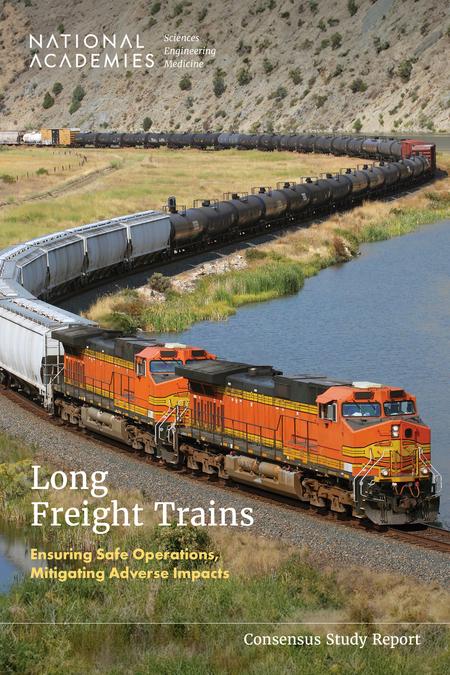
Editor's Note: We ran an article of two about this study already. For those of you who might have missed it previously, make sure to read it over. This Study is great ammunition in the rail workers fight against extremely long and heavy trains. Pass it on! | |
|
The National Academies of Sciences, Engineering and Medicine is conducting a study of freight trains longer than 7,500 feet using an ad hoc study committee of experts. The period of performance is from September 2022 to June 2024. The committee will examine factors associated with the operation of these trains, including train dynamics and handling, braking, distributive power, communications and training. The scope of task will also include impacts on labor and crew requirements, highway rail grade crossings, passenger rail operations and air quality. The study was requested by Congress and is sponsored by the Federal Railroad Administration.
| |
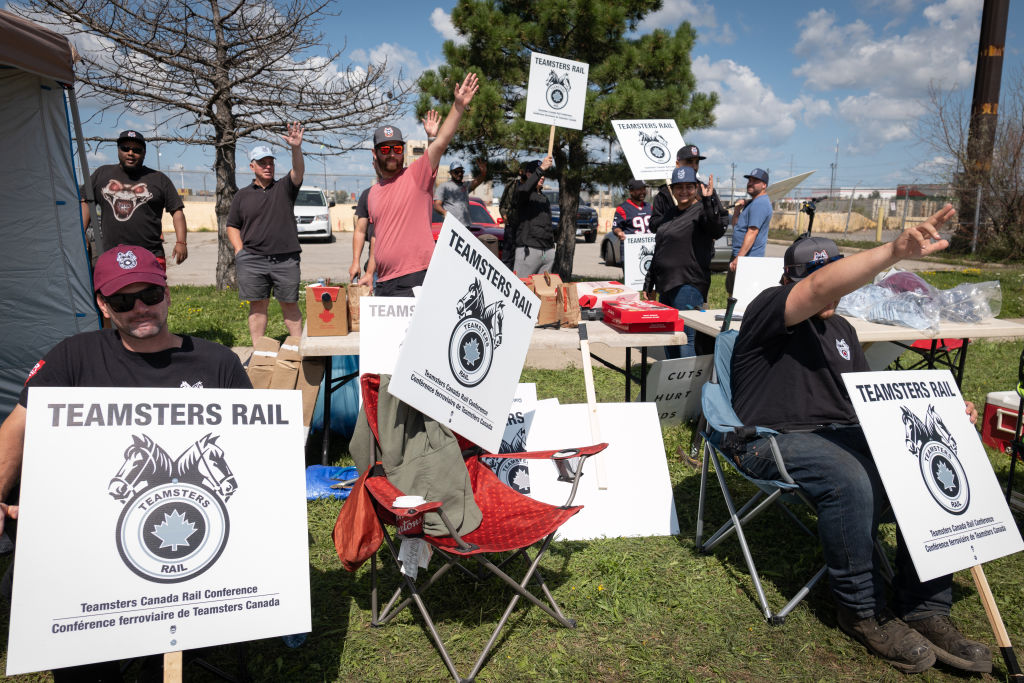
Editor's Note: In another blatant attack on workers’ rights, Canada’s Liberal government has sided with rail giants to force binding arbitration on Teamsters rail workers, effectively quashing their strike for improved safety and working conditions. This move echoes a disturbing trend where government intervention favors corporate interests over labor, undermining the very workers who keep the rails running. As rail workers continue to fight against the scourge of precision scheduled railroading, this betrayal reminds us that solidarity and collective action remain our most potent tools in the face of corporate greed. | |
|
After months of tense negotiations, Canadian rail companies enlisted the government to block a strike, shutting down railworkers’ fight for safer conditions and better hours. The federal intervention sets a troubling precedent for future union talks. In August 22, Canadian rail workers represented by the Teamsters Canada Rail Conference (TCRC) spent a brief moment on the picket lines before the Canadian Liberal government intervened to end the work stoppages and force binding arbitration. After months of intransigence at the bargaining table, the two corporations that make up Canada’s rail duopoly — the Canadian National Railway Company (CN) and Canadian Pacific Kansas City Ltd (CPKC) — locked out their workers, counting on government intervention to resolve the dispute in their favor.
| |
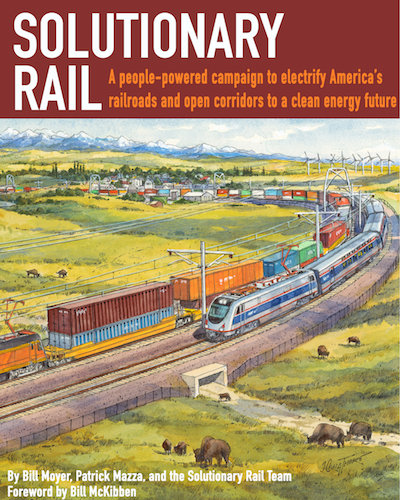
Editor's Note: Bill Moyer’s testimony before the Surface Transportation Board highlights the urgent need for a complete overhaul of the U.S. rail system. He calls for rail electrification, stronger regulations, and the revocation of exemptions that allow corporate interests to dominate public infrastructure. Moyer underscores how the shift from trucks to rail can save billions in social costs but emphasizes that this transformation must prioritize labor, safety, and overburdened communities. His vision pushes back against the status quo and calls for rail to serve the public good, not private profit. | |
|
Railroad corporations have been cutting out less profitable services to maximize the bottom line, shifting much freight to trucking. So over the past 10 years freight rail volume has decreased even as profits have soared. This has increased air pollution and road runoff, accident injuries and death, and road damage, which is disproportionately caused by trucks. The Surface Transportation Board (STB), the federal agency responsible for regulating freight rail, convened a hearing Sept. 16-17 to explore how freight service can be rebuilt. Backbone Campaign Executive Director Bill Moyer shared our Solutionary Rail campaign’s recommendations with the Board, and documented how returning freight from trucks to rail could save the public $46 billion in costs. Watch this 9-minute video of Bill’s testimony.
|
|
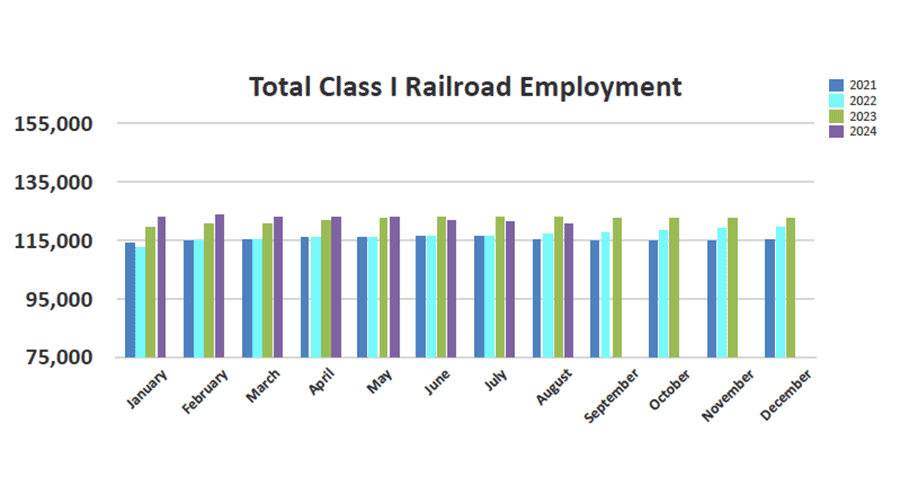
Editor's Note: The continued decline in Class I railroad employment, down nearly 2% in August 2024, is another consequence of Precision Scheduled Railroading (PSR). As railroads chase lower operating ratios, vital jobs in maintenance and transportation are cut, compromising safety and service. While executive positions remain stable, PSR’s cost-cutting obsession puts both workers and the public at risk. Rail labor must resist these reductions and push for a future that prioritizes the safety and sustainability of the workforce over short-term profits. | |
|
As of mid-August, Class Is employed 120,611 people, down 0.39% since July and down 1.78% compared with employment levels a year ago, according to Surface Transportation Board data. Five of the six employment categories registered decreases last month since July. They were: professional and administrative, down 1.11% to 9,768 workers; maintenance of equipment and stores, down 0.54% to 17,082; maintenance of way and structures, down 0.43% to 28,985; transportation (train and engine), down 0.31% to 51,845; and transportation (other than train and engine), down 0.28% to 5,029.
The only category that registered an increase in August was executives, officials and staff assistants, which rose 0.33% to 7,902 workers. Year over year, five of the six categories logged decreases: maintenance of equipment and stores, down 6.44%; professional and administrative, down 5.41%; executives, officials and staff assistants, down 4.01%; transportation (train and engine), down 0.49%; and maintenance of way and structures, 0.03%.
| |
Editor's Note: In a push for equitable treatment of rail workers, Transportation Secretary Pete Buttigieg and acting Labor Secretary Julie Su have urged three Class I railroads—CPKC, CN, and CSX—to ensure paid sick leave for all employees. While many workers have gained this benefit since 2022, 10% remain without it. The call emphasizes the necessity of paid sick leave for both worker safety and the public good. Rail labor deserves nothing less than guaranteed protections, and the current imbalance is unacceptable. | |
 |  | U.S. Transportation Secretary Pete Buttigieg and U.S. Department of Labor Acting Secretary Julie Su yesterday called on the CEOs of Canadian Pacific Kansas City, CN and CSX to guarantee paid sick leave to all of their employees. In letters sent to the CEOs, Buttigieg and Su called attention to the progress that rail labor and the rail industry have made in expanding access to paid sick leave, with three Class Is now guaranteeing it for all their employees. Since the end of 2022, the number of Class I employees who have access to paid sick days increased from 5% to 90%, they noted. "While three Class I freights currently provide all their employees paid sick leave, there are employees on your railroad who do not have this basic benefit. These workers are no more immune to illness than those who already have coverage," the letter states. Buttigieg and Su encouraged CPKC, CN and CSX to reach agreements with each of their unions to make paid sick leave without penalty available to all employees. "This does not have to wait for national negotiations; your railroad should come to terms immediately with your labor unions," they wrote.
| |
Editor's Note: Norfolk Southern’s $600 million class-action settlement following the East Palestine, Ohio, derailment reflects the long-term impact of the railroad’s negligence. Despite no admission of wrongdoing, the settlement aims to compensate displaced residents and business owners affected by hazardous chemical exposure. This disaster, caused by preventable failures like an overheated wheel bearing, is a reminder that profit-driven safety compromises come at the expense of communities. Rail labor and the public deserve stronger protections and a commitment to safety over stock buybacks. | |
| | 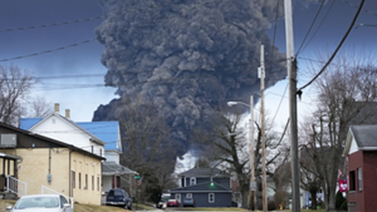 | YOUNGSTOWN — Despite a flurry of affidavits filed in the 25th hour calling into question testing results related to derailment-related contamination, Judge Benita Y. Pearson finalized the $600 million settlement between class-action plaintiffs and Norfolk Southern in the U.S. Northern District of Ohio Court on Wednesday. Pearson, calling the settlement “fair, reasonable and adequate,” gave final approval of the historic deal — the largest settlement paid out by a railroad in U.S. history — and cleared the way for personal-injury awards to be distributed in 30 days and property damage awards to be sent out by the end of thae year. The ruling also cleared the way for the plaintiffs’ attorneys to receive 27% of the settlement for legal fees and an additional 3% for out-of-pocket fees, equaling $180 million. With $10 million to be put aside in a “holdback” fund, the Plan of Distribution approved by Pearson leaves $410 million to be awarded to residents ($265 million in direct payments for property damage, $25 million for losses to area businesses and $120 million for personal injury damages)
| |
Editor's Note: Unifor, representing 3,600 Canadian National workers, has filed a Notice of Dispute with the Canadian government, just days after the start of contract negotiations. This move highlights the union’s resistance to concessions proposed by the railroad, which threaten wages, pensions, and work protections. With CN signaling layoffs and maintaining a hardline stance, this request for conciliation signals the deep divisions between labor and management. Rail labor must remain united in fighting for fair treatment and resisting corporate-driven demands that undermine workers’ rights. | |
 | | MONTREAL — Unifor, the union representing about 3,600 Canadian National Railway mechanical, clerical, and intermodal employees in Canada, has filed a Notice of Dispute with the Canadian government regarding its negotiations with the railroad, CN has announced. The move on Friday, Sept. 27, came just three days after Unifor — Canada’s largest private-sector union, with more than 315,000 members — began negotiations with CN over a contract that expires on Dec. 31. The notice, sent to Canada’s labor minister, generally leads to appointment of a conciliation officer to assist the parties in reaching an agreement. In announcing the start of negotiations, Unifor said it would focus on improving wages, pensions, benefits, and work protection. The union said in a Friday press release that it had filed the notice because the railroad “came to the table with demands for concessions that would undermine our members’ rights and working conditions,” according to Unifor National President Lana Payne, and because the railroad issued notice of intent to lay off at least 65 members of the union within 24 hours of the start of negotiations.
| |
Editor's Note: Hopefully this bill will be emulated in states across the country and rail electrification will be more easily facilitated as a result. | |
| |  | On September 27, 2024 Governor Gavin Newsom signed AB 2503, which exempts electric rail projects within existing rights-of-way for passenger service from review under the California Environmental Quality Act (CEQA). Based on the experience of years of delay via CEQA lawsuit Caltrain experienced and the aborted attempts by other agencies to electrify due to perceived CEQA risk, CER knew that de-risking common sense low impact rail electrification projects was a precondition to achieving its goal. CER extends its deep appreciation to Assemblymember Alex Lee, sponsors Streets for All and California Transit Association and the many mobility advocates that spoke up to support AB 2503. Reforming how rail electrification is treated under environmental review is only the first step. With this victory CER looks forward to addressing state capacity to regulate and deliver a rail electrification program as well as the crucial funding and financing needed to truly decarbonize our rail network with gold-standard overhead line electrification.
| |
Editor's Note: The Teamster Rail Conference has come out in support of the Harris/Waltz ticket. Below is the BLET's justification for that stance. Rail workers should compare for themselves the previous two administrations and see what they think. | |
|
With the 2024 general election just over a month away, the BLET is taking a close look at the two previous presidential administrations. The winning administration will have a major impact on our industry and our members. To help BLET members make an informed decision at the ballot box, the National Division has prepared the following fact-based analysis to compare and contrast how each administration (2016-2020 vs. 2020-present) has handled various issues of importance to the BLET, rail labor, rail safety, and the industry as a whole.
| |
Editor's Note: Below are descriptions of two upcoming webinars that may be of interest to railroad workers and our allies. | |
|
Do you care about the climate crisis and see trains as part of the solution? In 2023, the Sierra Club outlined a detailed series of recommendations to improve both passenger and freight rail and expand rail electrification. This resource shows how investing in rail can help create good jobs, provide equitable mobility, reduce traffic congestion, and cut climate emissions. In this talk, Sierra Club staff Katherine García and Yassi Kavezade, who were part of the team that published the report, will provide an overview of their advocacy and the importance of investing in rail in the U.S.
| |
With America’s first two true high-speed rail projects underway in California and Nevada - and with Congress appropriating tens of billions of dollars in new railroad funding in recent years—this is an exciting moment for high-speed rail. But to sustain and build on the momentum, “we need to address the intercity rail market with a holistic vision for rail across the country.” That’s one conclusion of a recent report by the Transit Costs Project at New York University’s Marron Institute of Urban Management. In this talk, we’ll hear from Professor Eric Goldwyn, lead author of the "How to Improve Domestic High-Speed Rail Project Delivery” report. | |
Editor's Note: Often overlooked, the efficiency of regenerative braking is impressive. Without wires or batteries to capture the electricity produced, most all North American trains and basically ALL freight trains employ dynamic braking where all of this potentially useful energy that is produced when slowing, descending, and stopping the train is simply dissipated as heat into the atmosphere. | |
|
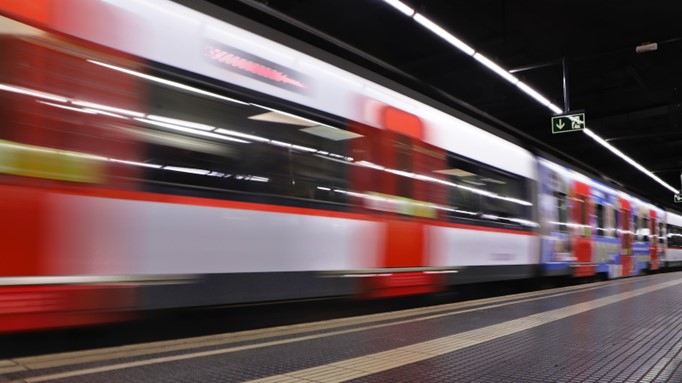
Most of the passengers emerging from the station in Bellvitge, a working-class neighborhood outside Barcelona, have no idea just how innovative the city’s subway system is. Using technology not unlike the regenerative braking found in hybrids and electric vehicles, the trains they rode generated some of the power flowing to the EV chargers in the nearby parking lot, the lights illuminating the station, and the escalators taking them to the platforms. Every time a train rumbles to a stop, the energy generated by all that friction is converted to electricity, which is fed through inverters and distributed throughout the subway system. One-third of that powers the trains; the rest provides juice to station amenities and a growing network of EV chargers.
| |
Editor's Note: The residents of East Palestine, Ohio continue to fight back against Norfolk Southern after the cataclysmic derailment and fire in February, 2023. Below are a few videos the group Unity Council for East Palestine is distributing. | |
Videos from Unity Council for East Palestine | |
NEWS FROM AROUND THE LABOR MOVEMENT | |
Each week, RWU includes a few articles about advances and developments in the larger labor movement that are of interest to railroad workers. Got an artcile to submit for possible inclusion next week? Email it along to raillabornews@gmail.com. Thank you! | |
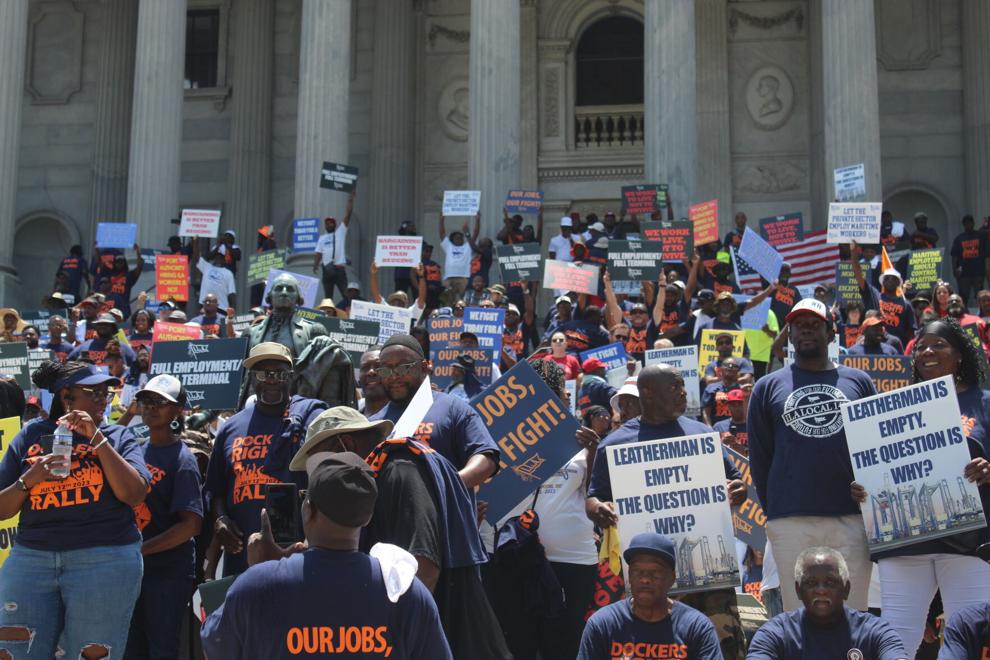
Editor's Note: RWU and our allies such as the Southern Workers Assembly offer our full solidarity and support to the east coast longshore workers (ILA) who are poised to shut down Atlantic and Gulf Coast ports on October 1st. And we call on the U.S. government to not break this strike the way the rail strike was broken in 2022. | |
|
The Southern Workers Assembly expresses our full solidarity with the 65,000 members of the International Longshoreman’s Association fighting for a good contract who are poised to strike up and down the East Coast and the Gulf, from Maine to Brownsville, TX. We urge other workers and community members to join picket lines if no agreement is reached when the contract expires at midnight, October 1. Longshore workers play a vital role in the functioning of the global capitalist economy, and thus have a tremendous amount of power to leverage. Five of the top ten busiest ports in the U.S. by volume are located on the East and Gulf Coasts, and four of those five are in the South. More than three-fifths of container shipments of goods come through East and Gulf Coast ports. A strike is estimated to cost shippers around $5 billion per day, and a one day stoppage at any port can take nearly a week to clear out. The last time there was a coast-wide strike was in 1977.
| |
Editor's Note: For those who have yet to have a look at it, the Project 2025 plan would gut more than a century of legislation and history of workers' progress. | |
|
Steven Greenhouse
Wed 25 Sep 2024 07.00 EDT
Even as Donald Trump seeks to disavow Project 2025, he and the rightwing effort’s authors have voiced similarly hostile plans for the US’s 2 million-plus federal employees – to replace many of them with political appointees. These plans are stirring alarm among federal employees, with many warning that “politicizing” the civil service will hurt not just them, but also millions of Americans across the US by undermining how well the US government provides services and enforces regulations that protect the public. Speaking about federal employees last month, the former president said: “They’re destroying this country. They’re crooked people, they’re dishonest people. They’re going to be held accountable.”
| |
Editor's Note: The Labor Movement is the most powerful force that often can thwart a rising fascist threat. The power of working class solidarity is something that can protect a democracy under fire. | |
WEEKLY DERAILMENT DEPARTMENT | |
Each Tuesday in this news bulletin, RWU does our best to present a picture of what has been happening over the course of the previous week in terms of derailments in North America, and investigation determinations of previous accidents. NOTE: This list is by no means comprehensive. Smaller and less consequential mishaps are generally not reported here. If the wreck results in injury or fatality, or is especially damaging/extreme, a full article will appear as a feature in the dozen or so rail articles above. Know of a train wreck? Please feel free to forward a link to raillabornews@gmail.com for possible inclusion next week. Thanks! |
| | | |