Rail Workers Weekly News Digest
Number #34- August 25th, 2020
|
|
Below is a series of articles compiled over the previous week.
They are of interest to railroad workers and activists.
|
|
ARTICLE #1 - DERAILMENT NEWS
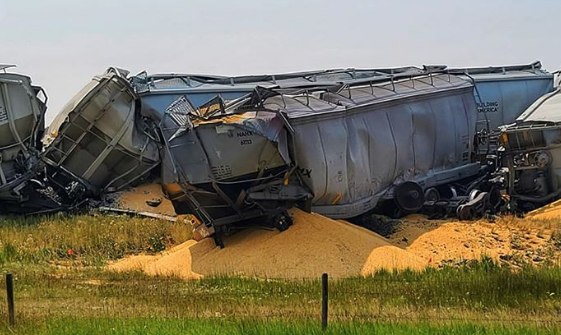
Union Pacific Derails Two Monster PSR Trains Within Hours of One Another, Shutting Down the Railroad
|
|
(Editor's Note: The first derailment was around 6;00 AM in Wyoming, followed by the second derailment in Nebraska around 6;00 PM, both on Saturday, August 22nd. The first involved 57 loaded grain cars of a train of 222 cars, a new "double" grain train more than 2 miles long, a hallmark of so-called Precision Scheduled Railroading (PSR). The second wreck involved 38 cars of a mixed freight train of 152 cars, nearly 2 miles long at 9804 feet.) |
|
ARTICLE #2 - RAIL EMPLOYMENT NEWS
Class I Workforce Continued to Shrink in July
|
|
Class Is employed 117,230 people as of mid-July, up 0.95 percent from June's count but down 16.7 percent from July 2019's level, according to Surface Transportation Board data.
Five out of six employment categories logged month-to-month decreases. They were: maintenance of way and stores, down 2.18 percent to 19,550 employees; maintenance of way and structures, down 1.44 percent to 29,931; professional and administrative, down 1.25 percent to 10,381; transportation (other than train and engine), down 1.17 percent to 5,075; and executives, officials and staff assistants, down 0.92 percent to 7,521.
Only one category — transportation (train and engine) — posted an increase in employment. Class Is employed 44,772 employees in that category, a 5.26 percent increase from mid-June.
Year over year, all employment categories logged decreases. The largest decline was in transportation (train and engine), which tumbled 24.49 percent. In the other categories, maintenance of equipment and stores, down 21.60 percent; professional and administrative, down 9.18 percent; transportation (other than train and engine), down 8.82 percent; maintenance of way and structures, down 5.65 percent; and executives, officials and staff assistants, down 3.03 percent.
|
|
ARTICLE #3 - LNG BY RAIL NEWS
Environmental Groups Sue Trump Admin to Stop LNG Trains
|
|
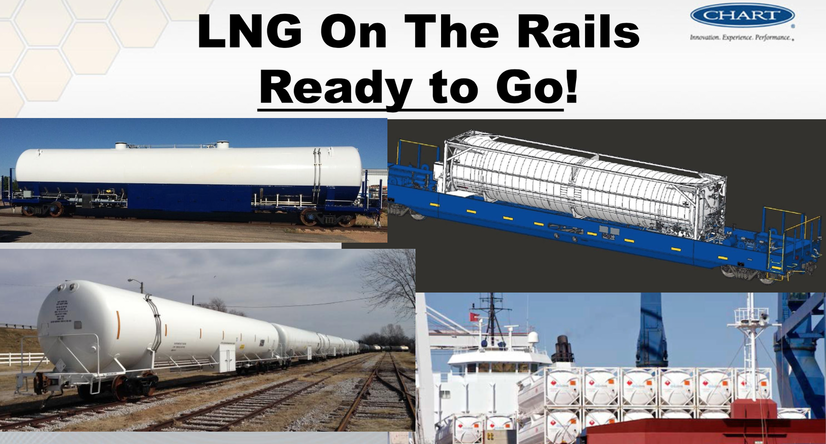
Nonprofit environmental law firm Earthjustice has filed a lawsuit on behalf of a coalition of environmental groups against the U.S. Pipeline and Hazardous Materials Safety Administration (PHMSA), challenging a recently finalized Trump administration rule to allow the transportation of liquefied natural gas (LNG) by rail.
“It would only take 22 tank cars to hold the equivalent energy of the Hiroshima bomb,” Jordan Luebkemann, an Earthjustice attorney, said in a statement. “It’s unbelievably reckless to discard the critical, long-standing safety measures we have in place to protect the public from this dangerous cargo.”
As DeSmog has reported, the Trump administration has fast-tracked rolling out the rule to allow LNG-by-rail without requiring any new safety regulations beyond a slightly thicker tank shell for the rail cars.
The potential consequences of an accident involving a train carrying LNG could be far greater than the already catastrophic and deadly accidents that have resulted from the rail industry moving large amounts of volatile crude oil and ethanol in recent years.
Regulators have set no limitations on the length of a train carrying tanks of LNG, which means that trains moving 100 or more tank cars of LNG are possible. Longer trains are more profitable for rail companies, and trains stretching 100 cars long already carry crude oil.
No Lessons Learned from Oil Trains
After the 2013 oil train accident in Lac-Mégantic, Quebec, wiped out the scenic downtown and tragically claimed 47 lives, a chorus of questions arose but essentially boiled down to: What happened and how could new safety rules prevent another accident like this? While the incident occurred in Canada, U.S. and Canadian rail networks, and the rules that govern them, are closely tied. At a 2014 forum discussing these issues, Deborah Hersman, the head of the U.S. National Transportation Safety Board (NTSB), addressed a group of regulators and industry representatives, asking a simple question about the risks of moving oil by rail.
|
|
ARTICLE #4 - RAIL SAFETY NEWS
AAR, ASLRRA Seek Exemption from Certain Hours-of-Service Regs
|
|
(Editor's Note: Corporate America is using the pandemic as a cover to rollback decades of gains made by working people and their unions).
Filed on behalf of member railroads, the associations are requesting exemptions from the following provisions:
• driving a property-carrying commercial motor vehicle without first taking 10 consecutive hours off duty;
• driving after the 14th hour after coming on duty;
• driving more than 11 hours during the 14-hour period after coming on duty;
• driving if more than eight hours have passed since the end of the last off-duty or sleeper-berth period of at least 30 minutes; and
• driving after accumulating 60 hours of on-duty time in seven consecutive days (60-hour rule) or 70 hours of of on-duty time in eight consecutive days (70-hour) rule.
The exemption would enable railroad employees subject to the hours-of-service rules to respond to unplanned events that occur outside of, or extend beyond, the employees' normal work hours, the FMCSA reported in the Federal Register.
The FMCSA is requesting public comments on the application by Sept. 21.
|
|
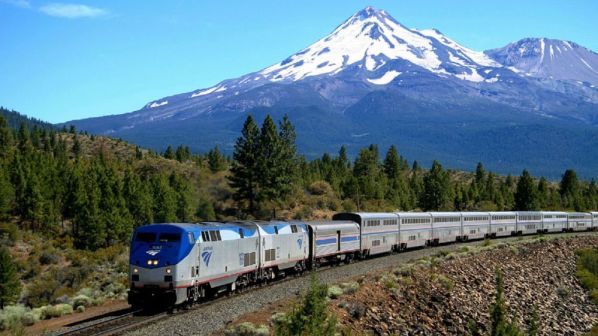
ARTICLE #5 - AMTRAK NEWS
Act Now to Protect Amtrak's Workers & Daily Service
|
|
When Rail Passengers heard Amtrak planned to respond to the collapse in ridership and revenue by slashing train frequencies and laying off 20% of its workforce, we took action. With your help, we were able to secure $10 billion for Amtrak and $24 billion for transit in the FY2021 House transportation bill. This bill not only includes funding, but it includes policy protections for workers and daily service.
However, the Senate has yet to advance any significant legislation targeted at the crisis facing our transportation systems. That inaction is forcing us to confront a grim reality: absent meaningful action by the Senate, we could experience the sudden collapse of America’s intercity rail network and major transit systems.
We are asking you to write and tweet your members of Congress using the form to the right. Tell your story of how these cuts would affect you while including the Association's ask and conditions.
This is an issue that affects not only passengers from all regions of the country, but the very people who run the trains we so passionately want to protect and maintain.
Make Your Voice Heard!
|
|
ARTICLE #6 - COMMUTER RAIL NEWS
Labor, Passenger Group Asks STB to Issue Injunction in Metra-UP Dispute
|
|
Filed Aug. 18, the coalition's statement notes that the STB determined earlier this month it would not rule on Metra's injunction request, at least until a U.S. District Court rules in a legal case between the two railroads. Metra granted UP's request to hold the injunction proceeding in abeyance.
The coalition also notes that the court may not grant an injunction promptly — something the STB acknowledged in its abeyance order — and as a result there's an immediate need for a preliminary injunction to prevent UP from ceasing service on the lines known as UP North, UP Northwest and UP West.
The coalition represents the interests of the employees affected by the potential termination of service on the UP lines, as well as organizations that represent the interests of passengers. Coalition members are the Transportation Communications Union (TCU), Brotherhood of Railway Carmen Division-TCU, International Association of Machinists District Lodge 19, the Rail Passengers Association and Transportation For America.
|
|
ARTICLE #7 - FREIGHT RAIL TRAFFIC NEWS
U.S. Freight-Rail Intermodal Volume Inches Up for Second Straight Week
|
|
For a second consecutive week, U.S. railroads reported an increase in intermodal volume — a small bright spot in the nation's still-declining freight-rail traffic compared with year-ago figures, according to Association of American Railroads (AAR) data.
The railroads posted 278,210 containers and trailers for the week ending Aug. 15, a 1.9 percent increase compared with the same week in 2019, AAR reported in a press release.
Carloads for the week totaled 222,353 units, down 15.9 percent. Combined, carload and intermodal volume fell 6.9 percent to 500,563 units.
Only one of the 10 carload commodity groups posted an increase: Grain was up 2,791 carloads to 22,582.
|
|
ARTICLE #8 - RAIL LABOR CONTRACT NEWS
Rail Bosses Tighten the Screws on Workers, Representatives
|
|
As freight rail traffic levels rebound strongly from the economic slowdown caused by the coronavirus (COVID-19) pandemic, railroad management has unleashed an unprecedented barrage of measures to manipulate recalls from furloughs, make already draconian attendance policies even more punitive, and interfere with union representatives who fight to protect their members from this abuse.
The BLET’s National Division and the SMART Transportation Division both have received multiple reports from their General Committees of Adjustment on various Class I railroads indicating two specific types of recall-related conduct that could jeopardize tens of thousands of dollars in unemployment benefits. These benefits are paid pursuant to the Railroad Unemployment Insurance Act (RUIA), which is administered by the U.S. Railroad Retirement Board.
At least one carrier is disputing unemployment claims for all days later than the date of a recall notice, regardless of when the furloughed worker actually received the notice and irrespective of collective bargaining agreement provisions that provide the employee with a certain number of days within which to report.
The GCAs have also reported that one or more carriers have recalled furloughed employees who, after reporting for work, are then furloughed for a second time.
|
|
|
|
|
|
|