|
American College of Vedic Astrology
The ACVA Newsletter 2026-02 (February 2026)
|
| | Note from the President of ACVA
By Professor Charlotte Benson (Jyoti Devi)
President, ACVA
February 2026
Dear Friends of ACVA –
As we step forward into a new season of growth and service, I’m delighted to share several meaningful updates from the College.
DharmaVedas Accreditation Finalized — Turkey Rollout
I’m pleased to announce that ACVA has finalized the accreditation of DharmaVedas for the delivery of an ACVA-aligned Jyotisha education track in Turkey, led by our alumna and ACVA faculty member Gizem Heukelom and her team. This accredited initiative is designed to expand access to authentic Jyotisha learning in the Turkish language while remaining fully aligned with ACVA’s educational standards, assessment integrity, and ethical foundations. The program will roll out with a clear pathway toward ACVA’s Jyotisha Prabhakara (Level 2) certification for eligible students who choose to pursue ACVA examinations. We look forward to welcoming new students from Turkey into the extended ACVA learning community.
ACVA Membership — A Wonderful Time to Join
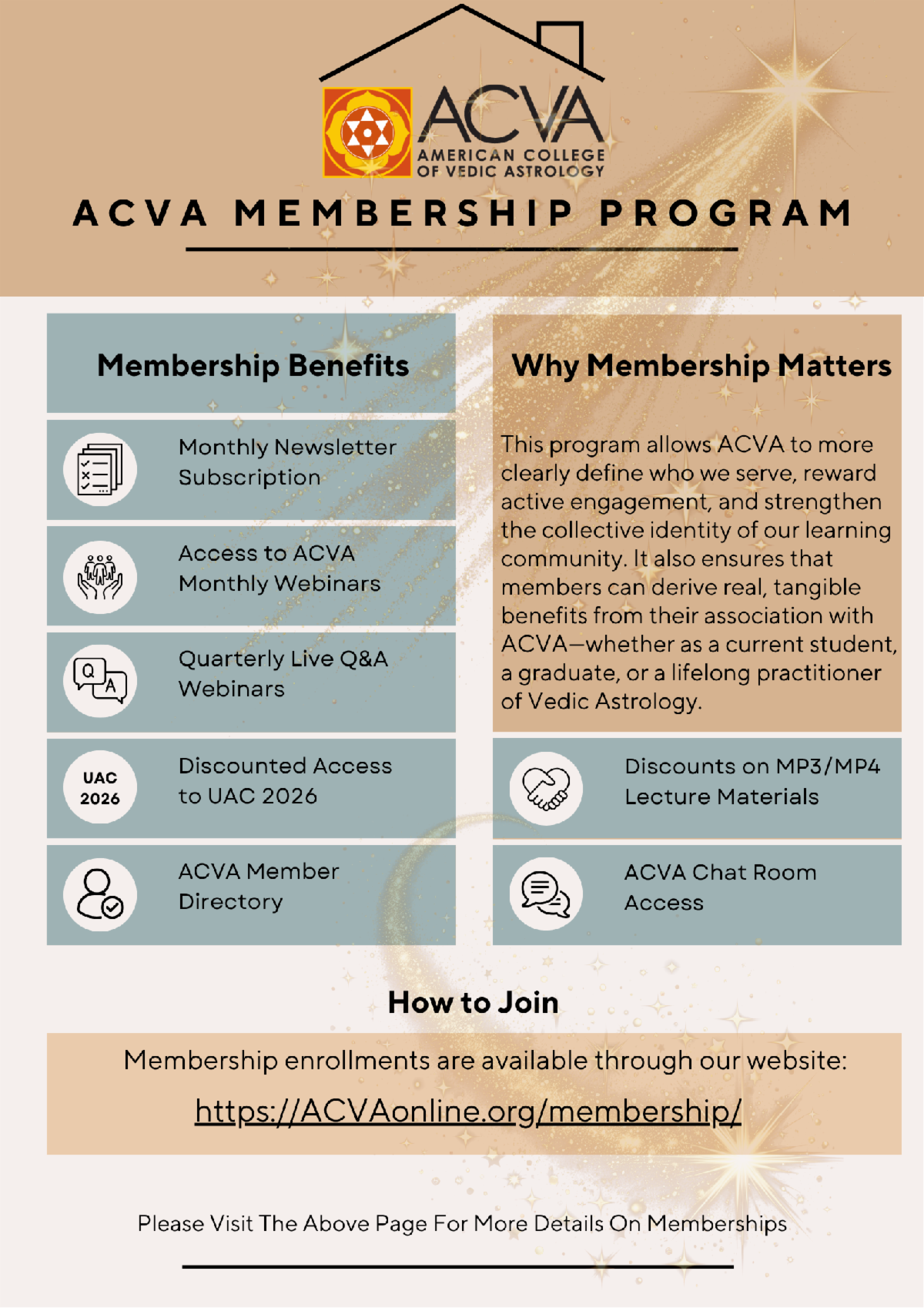
ACVA membership is growing, and we invite you to become part of our mission to make Vedic astrology accessible to learners worldwide. We currently offer three membership categories: Public, Professional, and Recent Graduates — and I’m happy to emphasize that membership is free for currently enrolled ACVA students.
For a limited time, we are also extending a special benefit: members who join during this promotional period will receive lifetime free access to ACVA’s monthly webinars. Our webinars represent a substantial educational value—approximately $216 per year—and are an important part of our continuing education offerings. We warmly encourage you to take advantage of this opportunity and participate regularly. Please visit: https://acvaonline.org/membership
Appreciating Our Provost — Professor Juliana Swanson
I would also like to congratulate and sincerely appreciate our Provost and Dean of Academics, Professor Juliana Swanson, who recently celebrated her birthday. Juliana’s dedication to the College—her steady leadership, academic discernment, and tireless service—continues to uplift ACVA. We are grateful for her commitment and the spirit she brings to our work.
A Note on the Eclipses — Recent Solar Eclipse and the Coming Lunar Eclipse
We have just passed through an eclipse season, including an annular solar eclipse on February 17, 2026, sometimes called a “ring of fire” eclipse. And we now look ahead to a total lunar eclipse on March 2–3, 2026, visible across much of North America and other regions. Eclipses are powerful reminders of rhythm, alignment, and reflection—times when many of us naturally pause, re-center, and renew our intentions. May this season support clarity, steadiness, and wise discernment in our personal lives and in our shared service through ACVA.
With every best wish for peace, learning, and spiritual illumination,
| |
Professor Charlotte Benson (Jyoti Devi)
President, American College of Vedic Astrology
| | |
Chaitra Navaratri (March 19-27, 2026) and Rama Navami (March 26-27, 2026)
By Professor Juliana Swanson
ACVA Provost and Dean of Academics
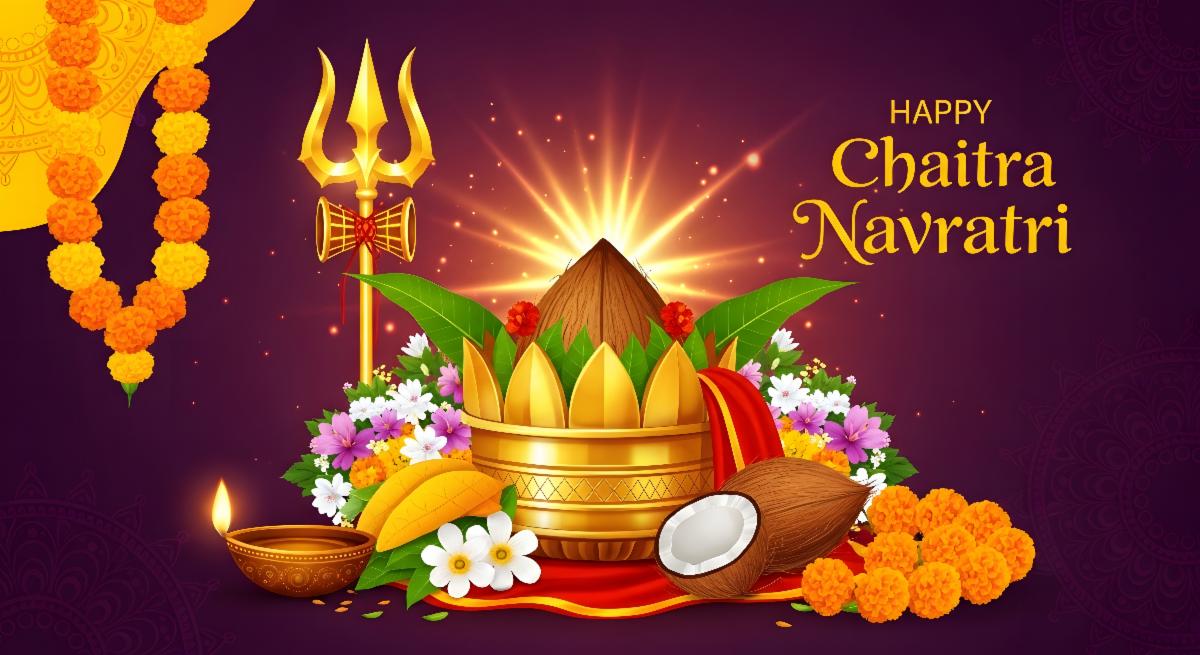
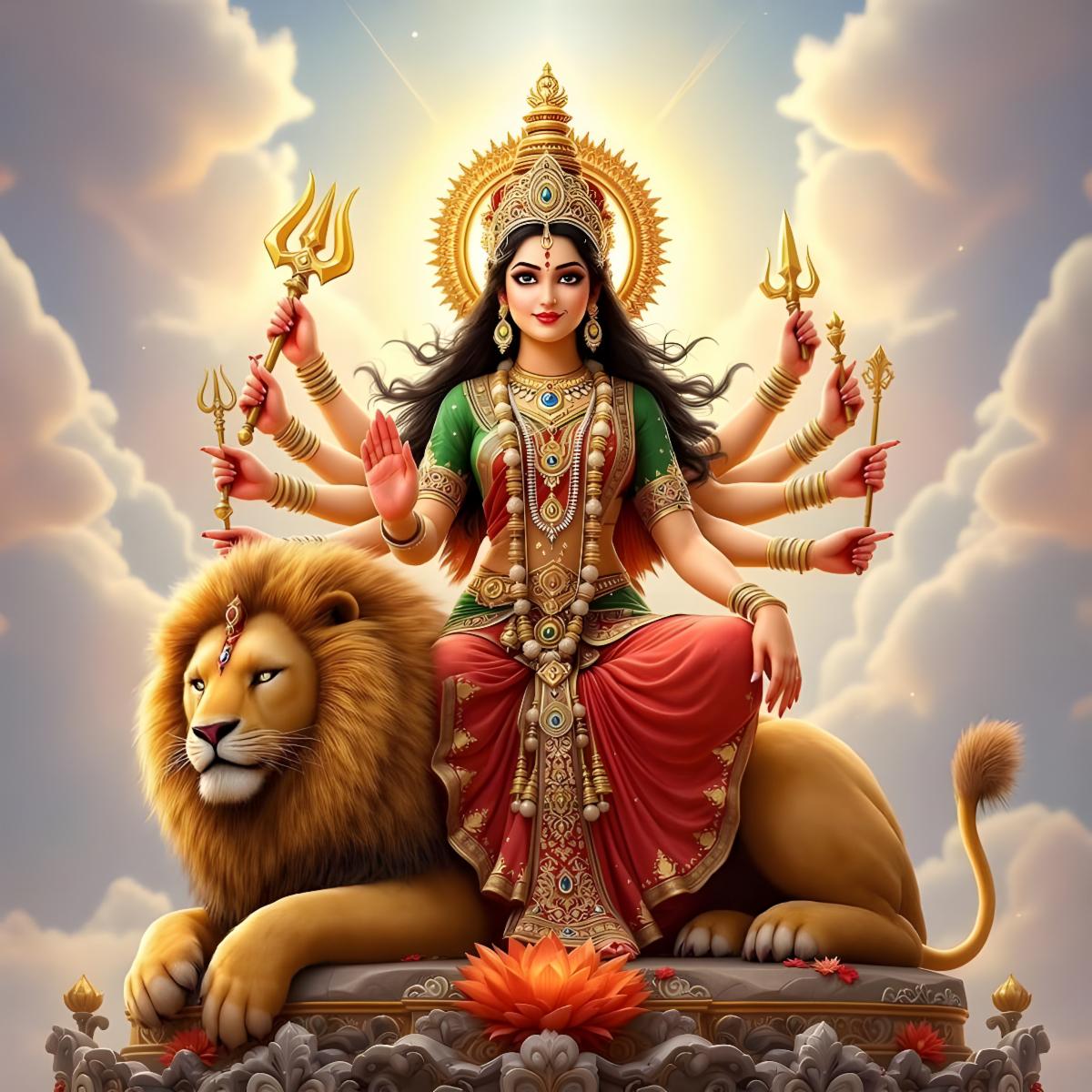
The springtime celebration of Chaitra (or Vasant) Navaratri, the Nine Nights of Mother Divine, will be celebrated from Thursday, March 19 through Friday, March 27, 2026. This joyous Vedic festival is celebrated for nine nights in commemoration of the allegorical battle of good versus evil which is symbolized by Mata Durga’s defeat of the demon Mahishasura. This epic battle is memorialized in the Vedic text called Devi Mahatmya. During the nine days and nights, excerpts from this thirteen-chapter book are often read aloud, acted out, or discussed in homes, temples, and ashrams.
| | |
Navaratri has profound esoteric meaning and significance for devotees who fast, pray, meditate, chant, bathe in holy rivers, offer seva and charity, and participate in other kinds of specific ancient rituals during this time. During the nine nights, Devi Durga is worshiped in various forms. She is said to walk among us to bring blessings and healing during this time, to transmute some of the evil of the world, and to assist her devotees in overcoming their own personal demons.
There are many ways to celebrate Navaratri. One simple way is to propitiate three aspects of the goddess for three days and nights each (with fasting, prayer, meditation, mantra, offerings, and pujas):
- The first three are devoted to Durga Devi, the personification of power and purification.
| | - The second three are devoted to Lakshmi Devi, the essence of compassion and beauty.
| | - The last three are devoted to Saraswati Devi, the embodiment of wisdom and grace.
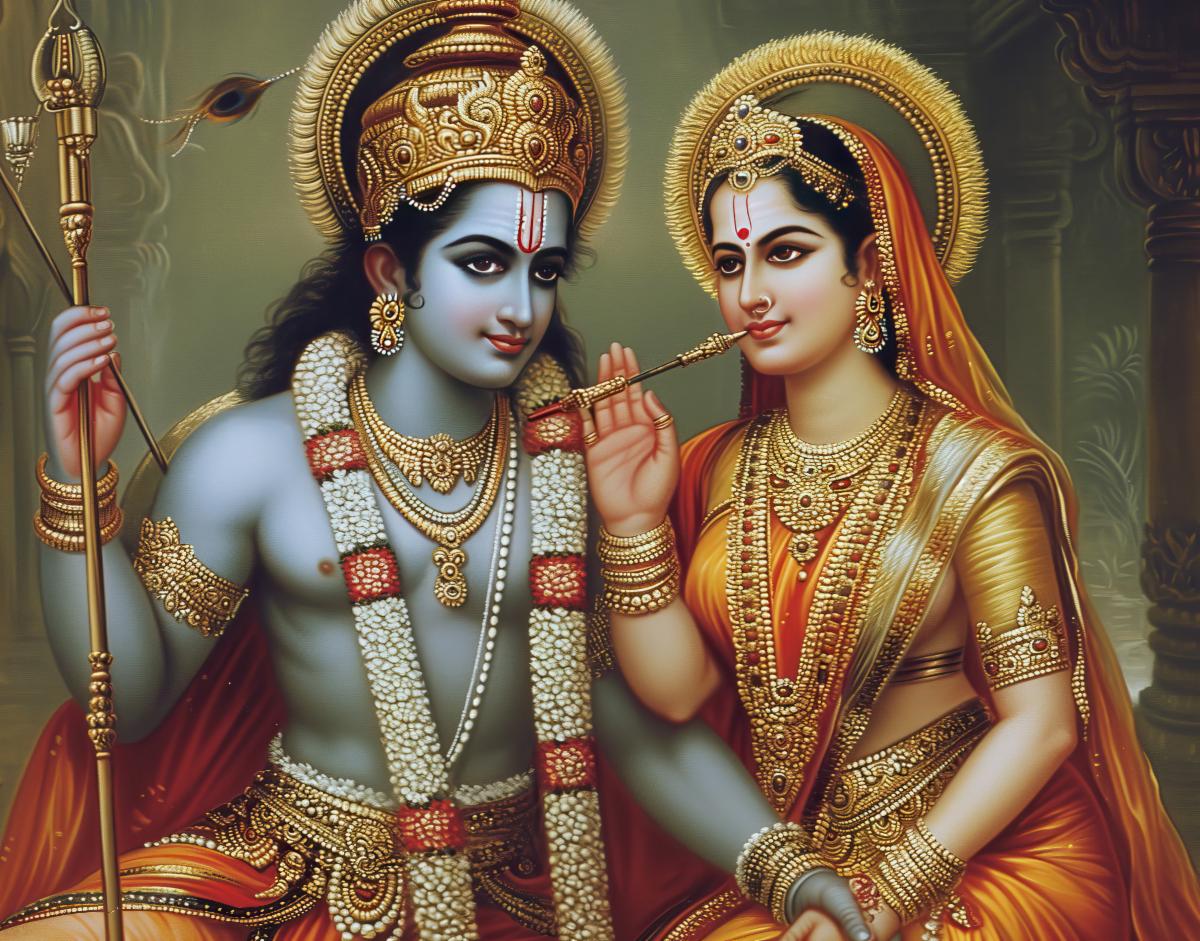
| | Chaitra Navaratri will culminate in the divine celebration of Lord Rama’s birthday, known as Rama (or Ram) Navami, which will take place on March 26-27 this year. Dates vary slightly throughout the world, so please check your local calendar (panchanga) for the exact timing for this holy day. | | |
The Observatory
By Dr. Lynn Bootes, MD
ACVA Dean of Students and Registrar
registrar@acvaonline.org
February 2026 edition
Sun in Aquarius/Pisces 2026 edition
Dear Readers,
We are in between the annular Solar Eclipse of February 17 and the Lunar Eclipse on March 3, and getting ready for the Equinox on March 20, bringing the change of seasons of spring and fall around the globe. These annual cycles of the seasons and the 19-year cycle of the Equinoxes continually supply us with wonder, and keep our planet active, just as we have our bodily cycles of ingoing and outgoing breath.
This month the more mobile planets, Mercury, Venus and Mars, continue to move close to the path of the Sun, but with some changes. Mercury has begun retrograde motion on February 26, and will continue in reverse apparent motion until March 20, between the degrees of 28 and 14 Aquarius. On March 15-18, Mercury, Mars and Rahu will pass within a degree of each other between 14-15 degrees Aquarius, a powerful combination which may incite sharp tempers and righteous or rigid opinions and doctrines.
This is a good time for all people of good will to exercise spiritual and personal practices of calm and compassion. Venus enters its exaltation sign of Pisces on March 1, elevating those values of compassion, and may take these to a more universal level as it conjoins Neptune on March 7 and Saturn on March 8. Venus is gaining speed and will enter Aries on March 31.
Jupiter finishes its season of retrograde motion on March 11 at 20deg52 of Gemini. It casts a Vedic 1:5 aspect upon all the planets in Aquarius this month, giving the possibility of compassionate communication as opposed to mere opinion. Saturn and Neptune remain very close, having just passed conjunction last month.
| | |
Navatārā cakra – Part 2
By Pratik Mehta
Vedic Astrologer
Now that we’ve seen how the Navatārā Cakra builds on top of the Vimśottarī Dasa and how we can apply it to natal chart interpretation, let’s talk about the cherries on top of the Navatārā cake. We briefly touched upon them in the last article by way of listing their names.
Over the next couple of months, we’ll examine their meanings and significations as well as the interpretative bells and whistles they add to the Navatārā Cakra. As we’ll see, the nine Tārās can be used to add additional hues to the interpretation of a chart’s static potential and its Daśās as well as be leveraged for Muhūrta, transits and compatibility purposes.
Let’s begin with getting to know the Navatārās a little better, numbered here in sequence:
(1) Janma (जन्म) Tārās
Meaning: Janma means birth. By extension, it also indicates initiations, new beginnings and the like.
Significance: Janma Tārā is the Nakṣatra wherein the Moon is posited at the time of one’s birth and is more commonly referred to as the Janma Nakṣatra. In Jyotiṣa, the Moon’s Nakṣatra is the centrifugal force that governs the soul’s current incarnation as well as the events and experiences it’s meant to undergo in each lifetime. The Moon being representative of the Manas i.e. the innate Self, fully imbues the hues and colors of the Janma Tārā. And as seen previously, it also determines the Vimśottarī Daśā sequence. It’s no surprise then that it becomes the starting point of the Navatārā cakra.
You would recall from last month’s article, that each of the Tārās are a triad. For all Navatārās other than the Janma Tārās, a given triad is identified by a single name as we shall see starting with the second Navatārā. The Janma Tārās are the exception to the rule where in the each of the Tārās within the triad has a different name (Janma, Karma and Ādhāna respectively) but nonetheless are collectively referred to as the Janma Tārās. (Refer Jan’26 newsletter for further details).
| | Coming Attractions at ACVA | | |
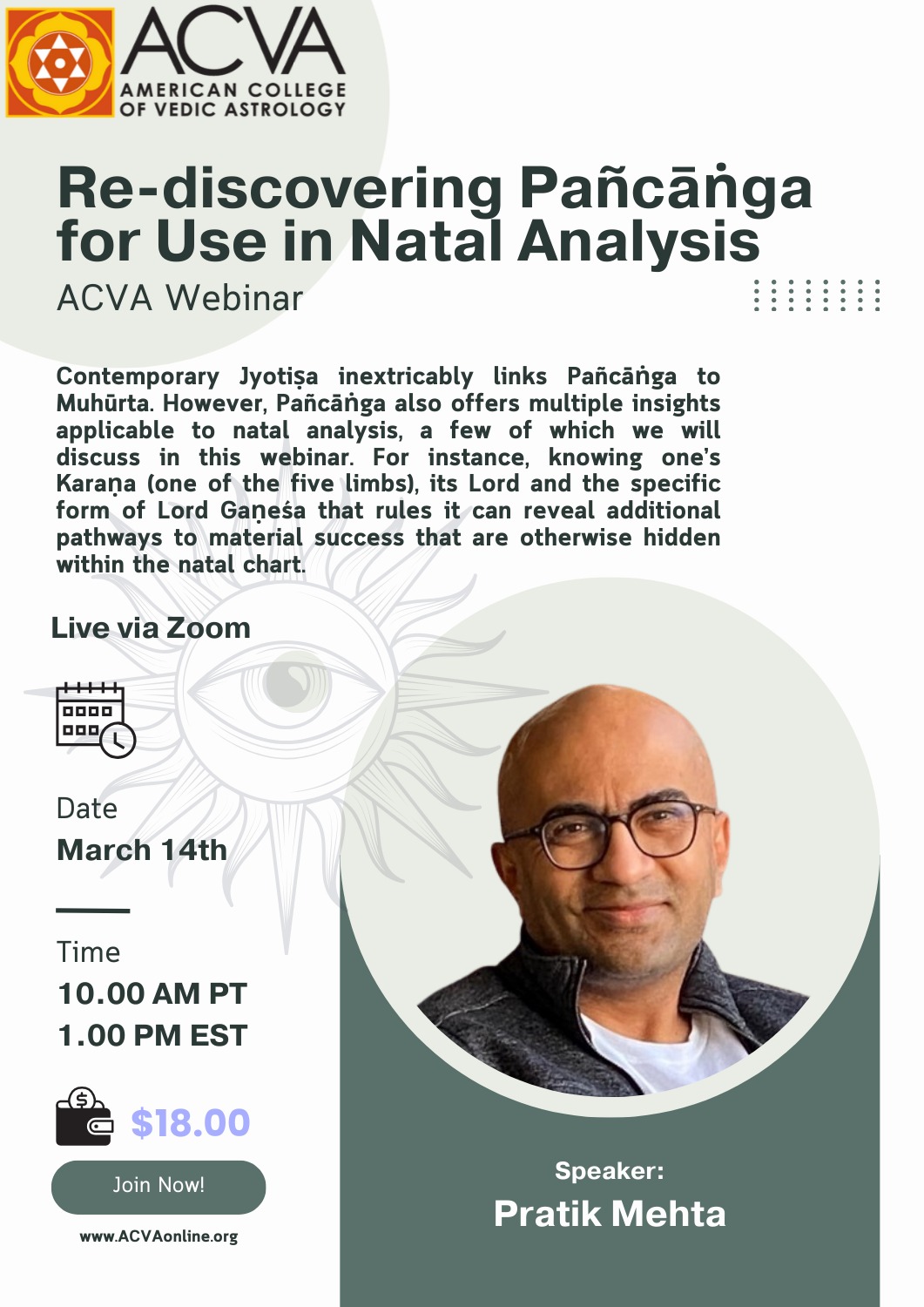
1. ACVA webinar – 14th March 2026 – Pratik Mehta
SATURDAY 10am Pacific, 11am Mountain, Noon Central, 1pm Eastern
Topic: Re-discovering Pañcāṅga for Use in Natal Analysis
Contemporary Jyotiṣa inextricably links Pañcāṅga to Muhūrta. However, Pañcāṅga also offers multiple insights applicable to natal analysis, a few of which we will discuss in this webinar. For instance, knowing one’s Karaṇa (one of the five limbs), its Lord and the specific form of Lord Gaṇeśa that rules it can reveal additional pathways to material success that are otherwise hidden within the natal chart.
| | |
Speaker: Pratik Mehta
Pratik is an IT professional by day but a Jyotiṣi at heart. Drawn to Jyotiṣa since his teenage years, he has always relied on it for divine guidance and grace. He never considered studying Jyotiṣa until he became immersed in learning it by sheer happenstance at age 41, when he had his Lagneśa (Jupiter) and Saturn transiting his ascendant, which he believes brought about this destined transformation. Since then, he has been ardently pursuing the magical science with the sole intent of using it to better his life, the lives of his loved ones and anyone else that the Universe sends his way. To him, Jyotiṣa is a sadhana that brings him mental peace and emotional bliss. He can be reached at jyotishforgood2020@gmail.com.
Webinar Registration link:
https://us06web.zoom.us/webinar/register/WN_EMO_r5RnTMyvSu-VxgiFqg
| | |
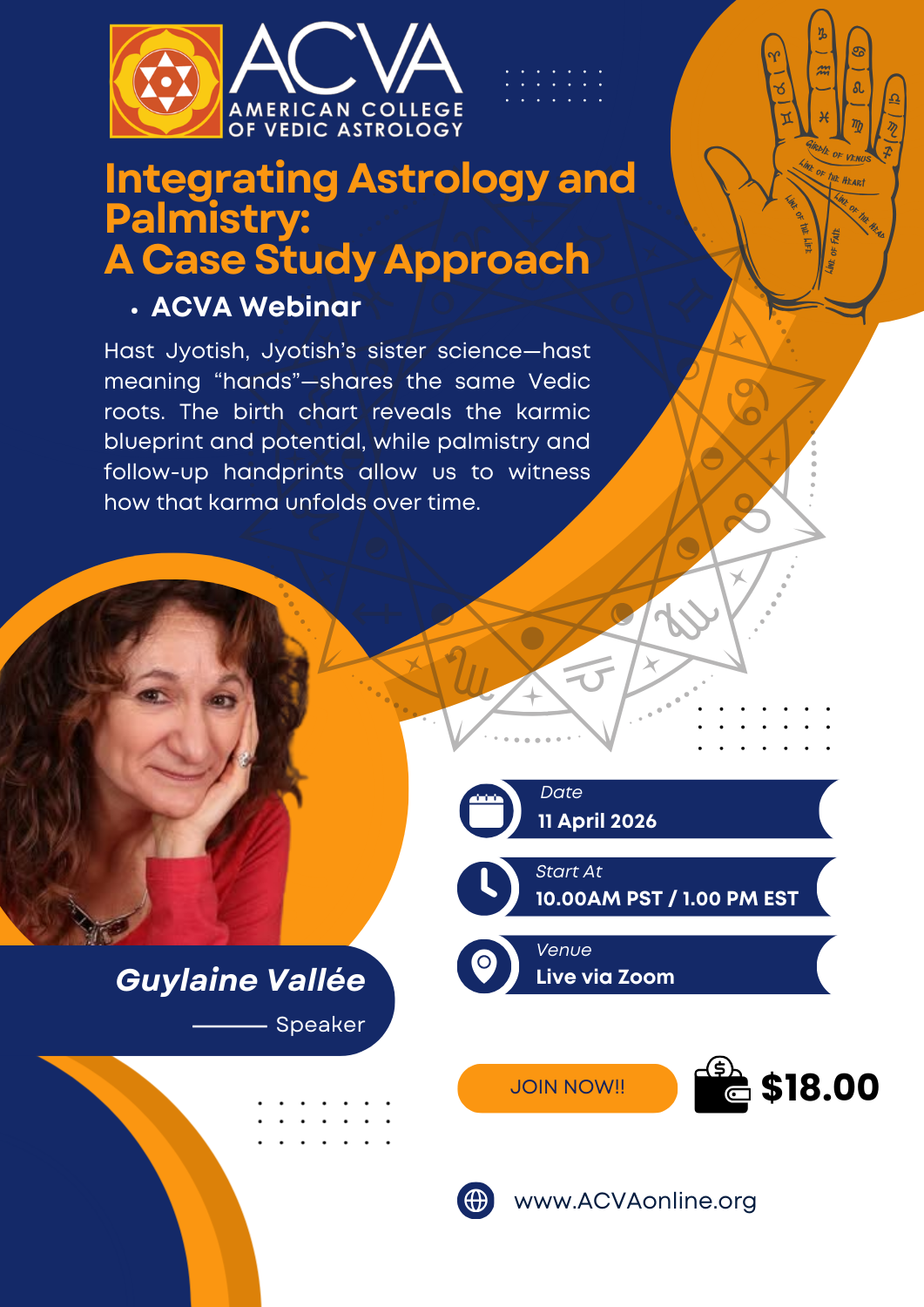
2. ACVA Webinar – 11th April 2026 – Guylaine Vallée
SATURDAY 10am Pacific, 11am Mountain, Noon Central, 1pm Eastern
Topic: Integrating Astrology and Palmistry: A Case Study Approach
I am delighted to speak to an audience of astrologers. Hast Jyotish, Jyotish’s sister science—hast meaning “hands”—shares the same Vedic roots. The birth chart reveals the karmic blueprint and potential, while palmistry and follow-up handprints allow us to witness how that karma unfolds over time.
I will share the story of Patrick to illustrate how astrology and palmistry work together, presenting his Vedic chart alongside time-lapsed handprints that demonstrate the changes taking place over the years. I will highlight the importance of comparing the dominant and non-dominant hands and explore the three key components of the hand: the mounts (the planetary zones), the major and minor lines. The webinar is followed by a Q&A
| | |
It is due to the generosity of our patrons that ACVA can continue to offer its current special tuition rates. Thank you.
ACVA is a 501-C3 not-for-profit educational institution that provides a very valuable service to learners of Vedic astrology.
It is due to the generosity of our volunteers and patrons that ACVA can continue to thrive. If you choose to press the "donate" button, your donation will be tax-deductible.
To donate, Visit our Website!!
https://acvaonline.org/donate/
In gratitude,
The Leadership Team
| | American College of Vedic Astrology | | |
ACVA Leadership Team
-
Prof. Charlotte Benson (Jyoti Devi) - President, ACVA’s External Relations Leader
-
Dr. Sisira K. Amarasinghe, Ph.D. – ACVA Vice President, Executive Director of Corporate Strategy and Technology
-
Prof. Juliana Swanson - ACVA Provost and Dean of Academics
-
Dr. Lynn Bootes, M.D.- Registrar, and Dean of Students
-
Julene Louis – Curriculum Leader
-
Arjun Kodikannath – ACVA Corporate Communications Officer
-
Alan Annand – ACVA Editor-in-Chief of Publications
ACVA Staff
-
Dr. Arjuna de Silva, MBBS (ACVA LMS & IT Operations Manager)
-
Sudath Mudalige (IT Administrator)
- Susheel Erramilli (Social Media and Digital Marketing Coordinator)
To contact any one of us
| | American College of Vedic Astrology Inc, 2675 W. S.R. 89A #190, Sedona, AZ 86336 | | | | |