July 21, 2026

Top stories

■ Jim Acosta, Ann Curry, and over 500 journalists renew call to confront Trump at WHCA Dinner (TheWrap) / The tightened security plan for White House Correspondents’ Dinner 2.0 after alleged gunman slipped in (New York Post) / Officer who stopped alleged gunman at White House Correspondents’ Dinner to receive award (POLITICO) 


■ ‘A judge has unsealed the NYT's request for the court to quash the subpoenas against its journalists. NYT says the subpoenas are "an instrument to chill criticism of the administration" and they "conflict both with the law and fundamental First Amendment principles."… Key hearing in this case coming on Thursday’ (Brian Stelter) 


■ ‘The Pentagon hasn’t held a press briefing in two and a half months. Pete Hegseth hasn't explained the military strategy behind the renewed air strikes. His department hasn't revealed the circumstances that led to the recent deaths of US service members.’ (Brian Stelter)


■ Trump’s war on journalists (The New Yorker) / Federal judge hands fact-checking journalists, researchers a First Amendment win in Trump administration immigration case (Poynter) / Trump snaps at female ABC reporter for question he cannot answer (Daily Beast)


■ Melania Trump files for sanctions against journalist Michael Wolff (Courthouse News Service)


■ ‘CBS’ Eleventh-Hour Call: The Bari Weiss-led network privately indicated it would snub Donald Trump’s primetime address last week…only to reverse course at the last minute and air the speech.’ (Status)


■ ESPN is cutting jobs again. Here's what the network's chairman told staff. (Business Insider) / Karl Ravech, Tom Pelissero among ESPN layoffs in latest round of cuts: Sources (The Athletic) / Pixar and National Geographic hit in latest round of Disney layoffs (Los Angeles Times) 


■ SiriusXM licenses 42 Audacy news and sports radio stations, marking the return of terrestrial radio to SiriusXM; the deal starts Sept. 1 with 23 sports stations (Radio Insight)


■ Washington State University plans to sell broadcast license for KWSU-TV (Current)


■ Union files another complaint against Reuters (Talking Biz News) 


■ After leaving NBC News, Chris Berend is joining Hearst Magazines as content chief (Variety) / 'New changes on our National team for Annie Gowen, Hannah Knowles, N. Kirkpatrick, Brady Dennis, Gina Harkins.' (Washington Post) / Adrian Ashford joins Houston Chronicle as new religion reporter covering faith in Texas (Houston Chronicle) / ABC13 reporter Mo Haider leaves Houston station after 2 years (Chron) / Reuters names Shanghai bureau chief, China chief tech correspondent (Talking Biz News) / WHRO President and CEO Bert Schmidt announces plans to retire following transformational leadership (WHRO) 


■ Zoom, with new story, bets on indie journalist to tell it (Variety) 


■ Poynter’s PolitiFact launches service providing reliable, engaging health information to consumers and news organizations (Poynter) 


■ EL PAÍS to take part in the largest Spanish-language journalism event in US (EL PAÍS)


■ OpenAI renews $5M bet on local news (Axios) / Trove of LION Audit data reveals what a 'sustaining' news business looks like in 2026 (LION Publishers)

CAREER

Advice from editors on finding opportunities in audience engagement journalism


By Jennifer Nehrer, NPCJI Intern


In an era when audiences increasingly get their news from social media and newsletters, being well-versed in audience engagement is growing more crucial. 


For the Intitute’s fourth Career Office Hour of 2026, audience editors from three outlets — MS NOW, The Baltimore Banner, and The Guardian US — spoke about what it takes to break into the world of audience engagement, including the most important skills to have as a candidate, how to move from traditional reporting to audience engagement (and vice versa), and tips to improve your hiring chances this week. 


Here are some key takeaways from the discussion.


What skills and tools are essential to knowing before joining an audience engagement team?


Max Benwell, deputy head of audience for The Guardian US, said those interested in joining an audience engagement team should be familiar with the platforms used by both news organizations and non-journalist accounts like Reddit, CapCut, and Premiere Pro, even if you don’t use them regularly yourself. He also encouraged listeners to join new platforms early and explore their uses to put themselves ahead of the curve. 


T.J. Ortenzi, on the other hand, emphasized the need for a skill that isn’t necessarily connected to digital platforms: problem-solving. Ortenzi, the deputy managing editor of audience and digital for The Baltimore Banner, recounted a time when a photographer on his staff wasn’t able to obtain a last-minute credential for an event but worked out a solution to still get good photos. Ortenzi said the experience reminded him of what he looks for in candidates when it comes to learning and troubleshooting on the go. 


“If you’re tenacious and you are able to solve a problem like that, then you’ll probably be able to figure out how to get an RSS feed to automatically tweet out a link using some program that you’ve never used before,” he said. 


Is it possible to switch from a traditional reporting role to audience engagement or vice versa?


All three editors on the panel said that yes, it is absolutely possible to go from one to the other, but there are some factors to keep in mind.


Molly Stier, coordinating editor of audience engagement for MS NOW (formerly MSNBC), said that before you make the switch, you should find opportunities to collaborate with different sections of your newsroom. Forming these relationships can help you both build skills and have allies in the newsroom if and when either of you are looking to move teams.

For example, someone on an audience team might recognize when a reporter tries their hand at social video, while a reporter might give an audience team member tips on news coverage.


“There are opportunities to learn from each other in that way,” Stier said.


Benwell added that you should always look for opportunities to do more in the newsroom.

“The more that you can offer up your skills to other people and get more stuff in your portfolio — often it comes down to building those individual relationships,” he said. “It can pay off hugely when you eventually want to pivot.” 


Benwell said that when you do make the switch, be transparent in your cover letter and resume about why you might be moving into different types of journalism roles and what you can bring. Let the employer know how you can translate your skills to their newsroom. He said he looks for this kind of self-awareness in potential candidates.


What can someone applying for jobs do this week to increase their chances of getting hired somewhere or help their job search?


To close the webinar, panelists shared one task job seekers can do this week to help boost their portfolio, for a job search or otherwise. 


Ortenzi emphasized the helpfulness of your network. He said the best piece of advice he ever received was that he should tell absolutely everyone he knows when he is looking for a job and what he is looking to do in his next role. He suggested preparing a short bio about yourself, your expertise, and your goals, then sending it around. 


Similarly, Stier advised viewers to build their networks by joining a journalism organization and finding fellow members to grab coffee or lunch with. She said that another great way to build your portfolio is to volunteer with local groups and offer help with social media and digital marketing.


Lastly, Benwell told viewers to begin that passion project they may have been putting off. Even if it isn’t connected to their job, it may prove to be a good place to showcase their skills.


“Start the pet project which you feel really passionate about, and that you won’t kick yourself in a year’s time for not starting,” he said. “Have fun with it, and even if you have no subscribers or no followers, it doesn’t matter. Just find an outlet for your passions and your audience skills that brings you joy. And that should be alone enough, but it might also lead to other things.”

CRAFT
 
 
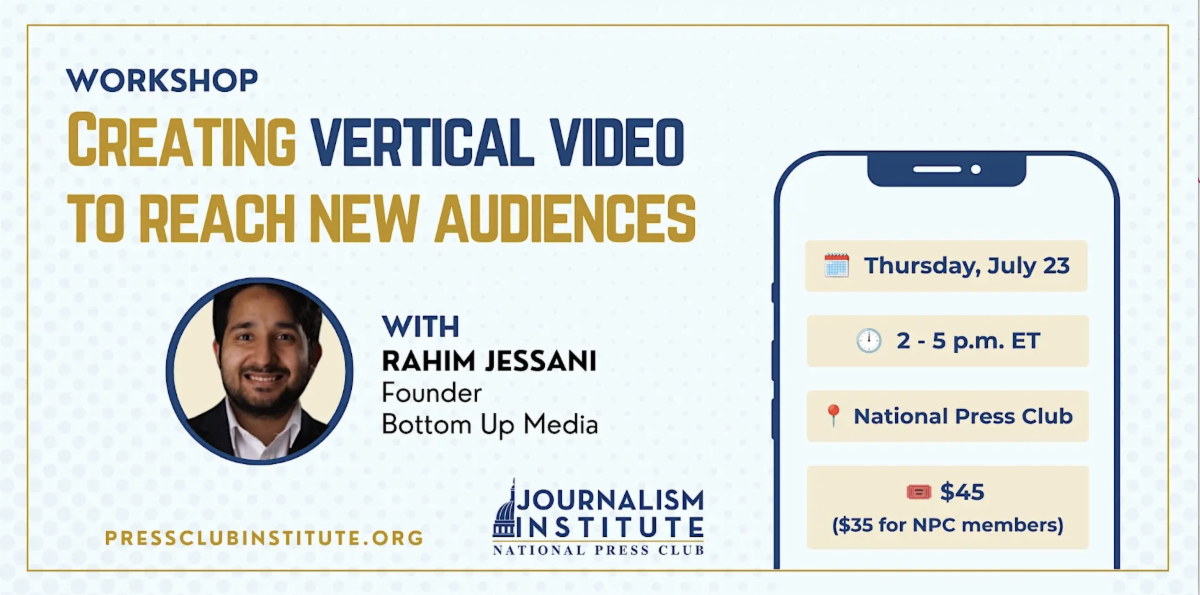
Workshop: Creating vertical video to reach new audiences with creator-journalist Rahim Jessani. July 23, 2 p.m. ET. Get tickets.

Workshop: Creating vertical video to reach new audiences


Learn how to make short-form vertical videos that grab attention and grow your audience on social media.


In this hands-on workshop with creator-journalist Rahim Jessani (The Creator Translator), you'll learn how to script videos, master the basics of shooting content on your phone, and pick up exclusive tips and tricks for making concise, digestible videos for social media.


🗓️ Thursday, July 23 | ⏰ 2 - 5 p.m. ET | 📍National Press Club | 🎟️ On sale now


By the end of the session, you'll be ready to create your own short-form videos that engage and grow new audiences.

Space is limited to 40 seats, so be sure to register soon while tickets last. Email Institute@press.org with any questions.


COMMUNITY

Resources

This newsletter is written and edited by the National Press Club Journalism Institute staff. Send us your questions and suggestions for topics to cover.


Get this from a friend? Subscribe and view the archives.

Bluesky  Facebook  Linkedin  X  Youtube

DONATE TO THE INSTITUTE


The National Press Club Journalism Institute promotes First Amendment values by equipping journalists in Washington, D.C., and nationwide with the skills, knowledge, standards, resources and networks to empower and inform the public. As the non-profit affiliate of the National Press Club, the Institute powers journalism in the public interest. The Institute's tax ID number is 52-1750908.