Volume 4, Issue 10 - October, 2026 | | |
Dear Friends,
October in Chicago brings shorter days, cooler temperatures, and the realization that our remaining days on the water are numbered.
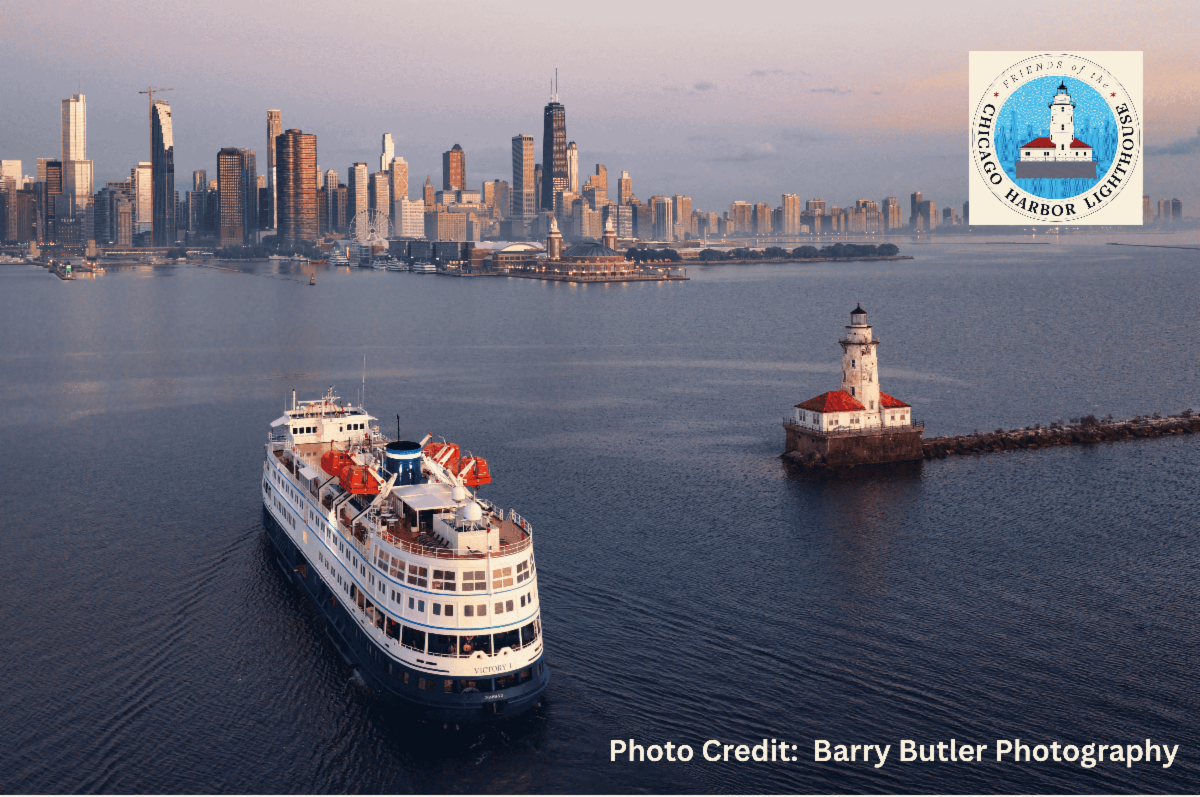
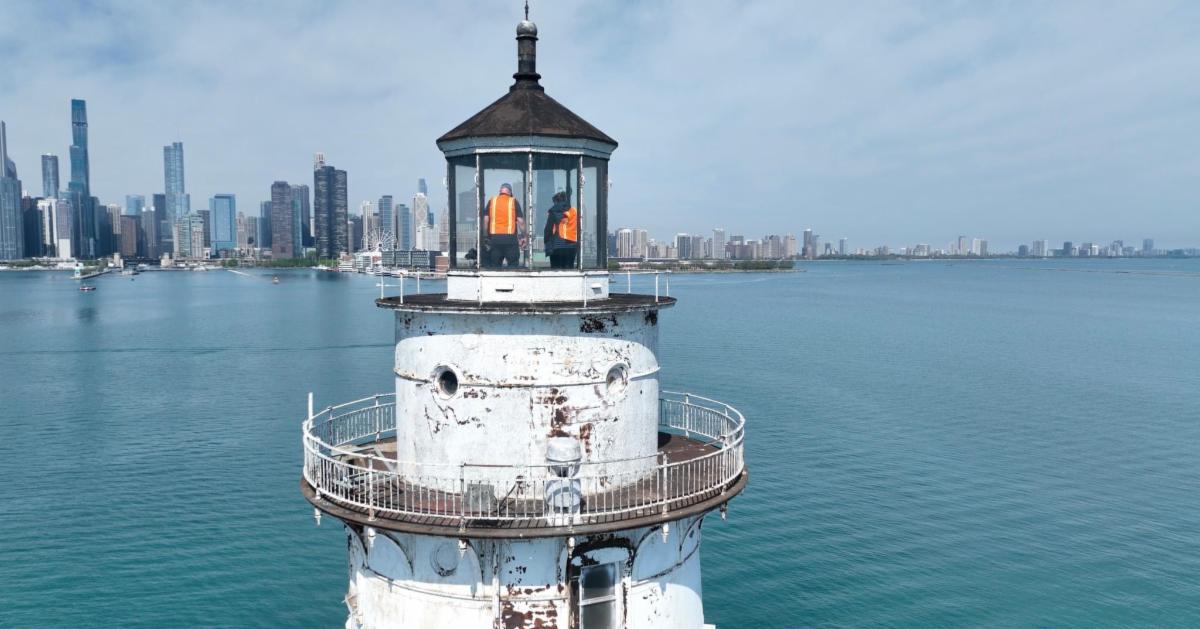
For those of us who love boating, every chance to get out on the lake feels a little more precious. I find myself taking another look at the lighthouse as we pass, thinking about all it has witnessed—and everything we hope its future will hold.
Boating season may be winding down, but there is plenty of energy behind our lighthouse dream.
| | |
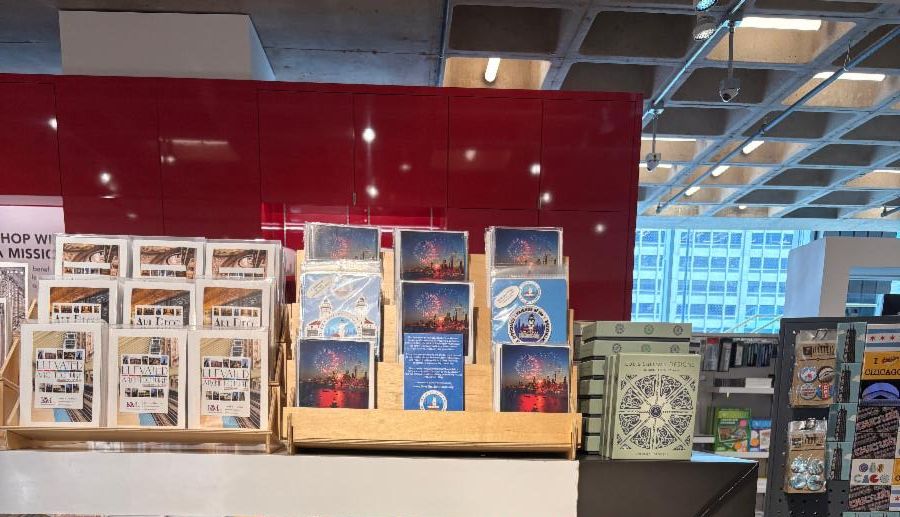
This month, we have something especially exciting to celebrate: the Chicago Architecture Center has become our first retail partner! Seeing FOCHL merchandise on its gift shop shelves is a proud moment.
It means more people can discover our lighthouse, learn about our mission, and take a little piece of that story home. A heartfelt thank-you to the CAC for believing in our work and helping us reach new friends.
Please stop in, visit the shop, and support those who support us.
In this issue, Steve takes us into the lighthouse’s past with “Five Men at a Turning Point.” We also look toward its future through Classroom on the Lakefront™ and our search for a Volunteer Director of Technology who can help bring those possibilities to life.
You’ll find an invitation to support the Coast Guard Foundation, whose connection to our lighthouse reminds us of the people behind the light.
And yes, our Light the Way committee is already planning for August 5, 2027—save that date!
What keeps me dreaming is the people who continue to show up. Our volunteers give their time and talents. Our donors and sponsors give us the means to move forward. Our partners open doors, and our friends share the story with someone new. Every one of those contributions matters.
Thank you for being part of this journey and for believing that the Chicago Harbor Lighthouse deserves a future as meaningful as its past.
As the seasons change, we keep working toward the day we can welcome people out to the lighthouse to learn, explore, and make memories of their own.
There is still so much to dream about—and so much we can accomplish together.
Give today at give.SaveTheLighthouse.org and help us Light the Way!
Thank you!
Be Safe and Be Well!
Regards,
Kurt Lentsch
Chief Dreamer and President
| | |
Five Men at a Turning Point
Chicago Harbor Lighthouse and the 1939 Coast Guard Transition
By Steve Clements
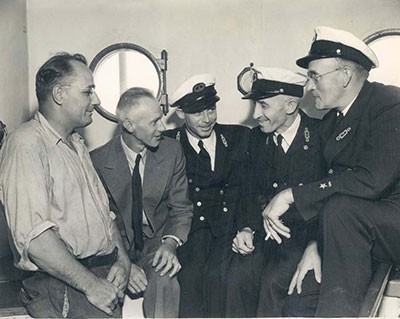
| | In the summer of 1939, five men living and working at the Chicago Harbor Lighthouse stopped long enough to pose for a photograph. | | |
At the far left, dressed in work clothes, is Thomas J. Brennan, a skilled laborer. Beside him are Clarence Mason, third assistant keeper; John “Jack” J. Short, second assistant keeper; James N. Brotherson, first assistant keeper; and Robert McKillop, the station’s head keeper.
They look relaxed. Nothing in the photograph suggests that they were living through one of the most significant changes in the history of American lighthouse keeping.
A later Lighthouse Digest caption dates the photograph to July 29, 1939 and describes it as the men’s final day as employees of the U.S. Lighthouse Service, with the Coast Guard taking over the following day. Federal records establish that the actual transfer occurred several weeks earlier, on July 1, 1939, when the Bureau of Lighthouses was abolished and its functions transferred to the U.S. Coast Guard.
That correction does not lessen the photograph's importance. If anything, it makes it more revealing.
These are five men photographed during the first month of a new era, when the organization responsible for their lighthouse had changed but much of their daily work had not.
A Service Almost as Old as the Nation
Federal responsibility for America’s lighthouses dated almost to the beginning of the United States itself.
In 1789, Congress placed federal lighthouses under the oversight of the Secretary of the Treasury. As the nation and its maritime commerce grew, so did its system of lights, beacons and other aids to navigation.
By the middle of the nineteenth century, criticism of lighthouse administration led Congress to establish the U.S. Lighthouse Board in 1852. It brought greater scientific and engineering expertise to lighthouse construction and operations, while improved technology, particularly the Fresnel lens, spread throughout the system.
Chicago Harbor Lighthouse was a product of that era. Completed in 1893, its third-order Fresnel lens was first exhibited on November 9 of that year.
Another major change came in 1910, when the Lighthouse Board was replaced by the Bureau of Lighthouses, commonly known as the U.S. Lighthouse Service.
It was a civilian service. Its keepers, engineers, laborers, vessel crews and other employees maintained a nationwide system of lighthouses, fog signals, buoys, lightships, tenders and depots.
Then, in 1939, another reorganization changed everything.
Why the Coast Guard?
The merger was part of President Franklin D. Roosevelt’s broader effort to reorganize the federal government. Congress had already passed the Reorganization Act of 1939, approved April 3, which authorized the President to prepare and submit reorganization plans to Congress. Roosevelt transmitted Reorganization Plan No. II on May 9 under that authority.
The Lighthouse Service and Coast Guard performed related maritime functions. Both operated vessels and shore facilities, maintained equipment in difficult marine environments, and supported navigation and safety on the water.
Under Plan No. II, the Bureau of Lighthouses was transferred from the Department of Commerce and consolidated with the Coast Guard, then part of the Treasury Department, effective July 1, 1939.
| | |
A few lines in Reorganization Plan No. II transferred and consolidated the
Bureau of Lighthouses with the Coast Guard.
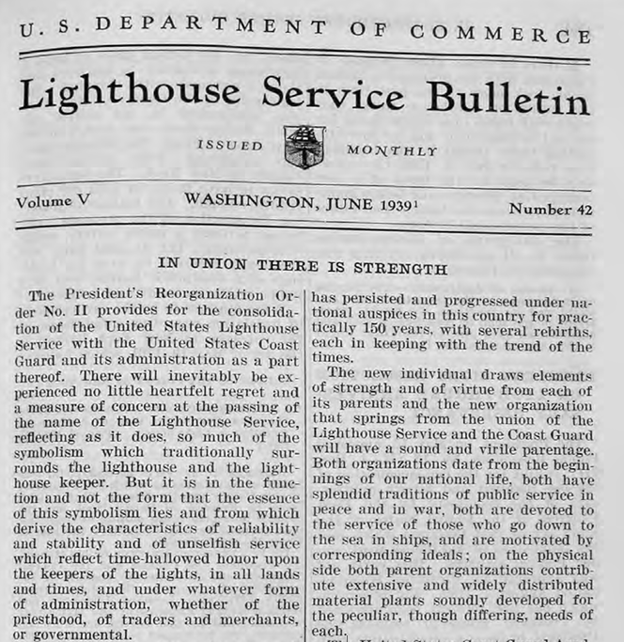
| | The Coast Guard describes the consolidation as having been undertaken in the interest of efficiency and economy. With the transfer came thousands of employees, tens of thousands of aids to navigation, lighthouse tenders, depots and district offices. | | With only weeks remaining before the Coast Guard takeover, the final Lighthouse Service Bulletin spoke directly to the men and women affected by the change. Its June 1939 lead article, “In Union There Is Strength,” acknowledged their regret at losing the Lighthouse Service name while urging them to see the consolidation as a joining of two proud maritime traditions. | | |
On an organizational chart, the change happened overnight.
For the people who kept the lights burning, it was much more gradual.
What Happened to the Keepers?
The civilian keepers did not simply remove Lighthouse Service insignia on June 30 and report the next morning as enlisted Coast Guardsmen.
Many former Lighthouse Service employees continued working as civilian employees of the Coast Guard, often performing essentially the same duties as before.
Congress also created a path for some former Lighthouse Service employees to enter commissioned, warrant or enlisted Coast Guard status. Over time, many vacancies left by retiring or departing civilian lighthouse employees were filled by uniformed Coast Guard personnel.
The organization changed first; the workforce changed gradually. At Chicago Harbor Lighthouse, that transition can be seen through the five men in the photograph.
The photograph has also become part of FOCHL’s continuing effort to reconstruct the human history of Chicago Harbor Lighthouse.
Following these five men through photographs, personnel records and other archives has answered some questions and raised others.
The image is not simply an illustration of a government reorganization. It is a starting point for recovering the stories of the people who experienced it.
So what became of them?
Epilogue: What Became of the Five Men?
Reconstructing individual lighthouse careers is not always simple. Published keeper rosters are valuable, but some accounts conflict and not every entry has yet been traced to its underlying personnel record. Some details therefore remain subject to further research.
Still, the larger picture is clear.
Robert A. McKillop
Robert McKillop, standing at the right of the photograph, was already a veteran lighthouse keeper.
Compiled records place him in charge of Chicago Harbor Lighthouse by at least 1935, continuing into the early 1940s. They also indicate earlier Chicago service as a second assistant beginning around 1919, along with assignments at other Great Lakes stations.
Whatever the precise boundaries of those assignments, one fact is important to the story of 1939.
The Coast Guard did not take over Chicago Harbor Lighthouse and immediately replace its experienced principal keeper; McKillop stayed.
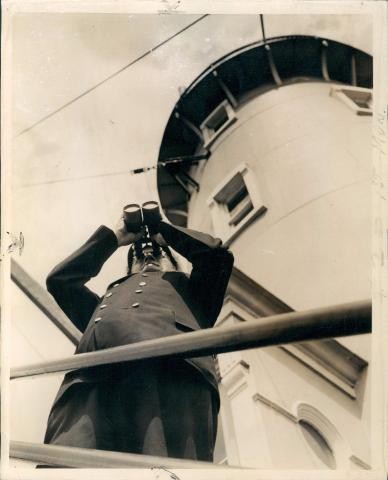
| | |
Head Keeper Robert McKillop shown on duty in August, 1939.
Source: U.S. Lighthouse Society Digital Archives.
| | |
James N. Brotherson
Beside McKillop is James N. Brotherson.
Compiled Chicago rosters place Brotherson at the lighthouse as first assistant beginning in 1936 and later as principal keeper beginning in 1943, with service continuing for many years afterward.
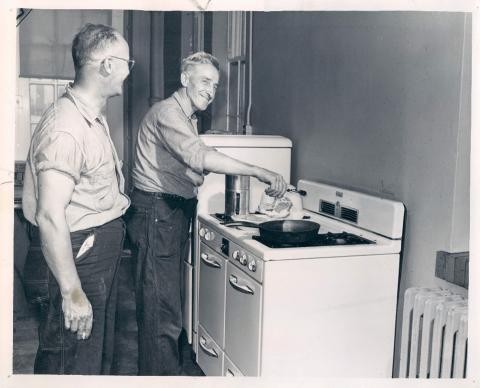
FOCHL newsletter readers may recognize Brotherson from another remarkable photograph, taken in 1947, showing him preparing dinner in the Chicago Harbor Lighthouse kitchen.
Eight years after the Lighthouse Service disappeared, Brotherson was still living and working at the same station.
| | James Brotherson (right) is preparing a meal in the lighthouse kitchen in August, 1947. Likely off-duty based on his casual appearance. Source: U.S. Lighthouse Society Digital Archives. | | |
John “Jack” J. Short
Jack Short provides another example of continuity.
Compiled records place him at Chicago as third assistant beginning in 1935, then as second assistant beginning in 1939, with service continuing through at least 1948. Another published source differs on his later rank, so that detail deserves further investigation.
But the central fact remains: Short stayed at Chicago for years after the Coast Guard takeover.
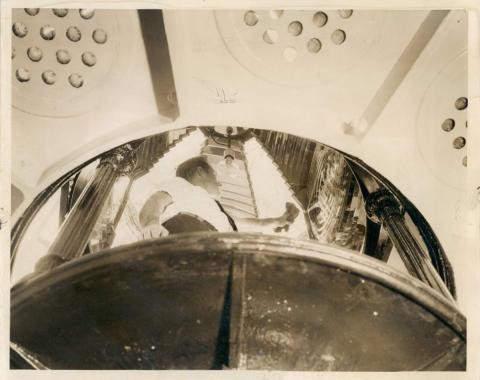
| | |
John Short cleaning the Fresnel lens at Chicago Harbor Lighthouse in August, 1939.
Source: U.S. Lighthouse Society Digital Archives.
| |
Clarence R. Mason
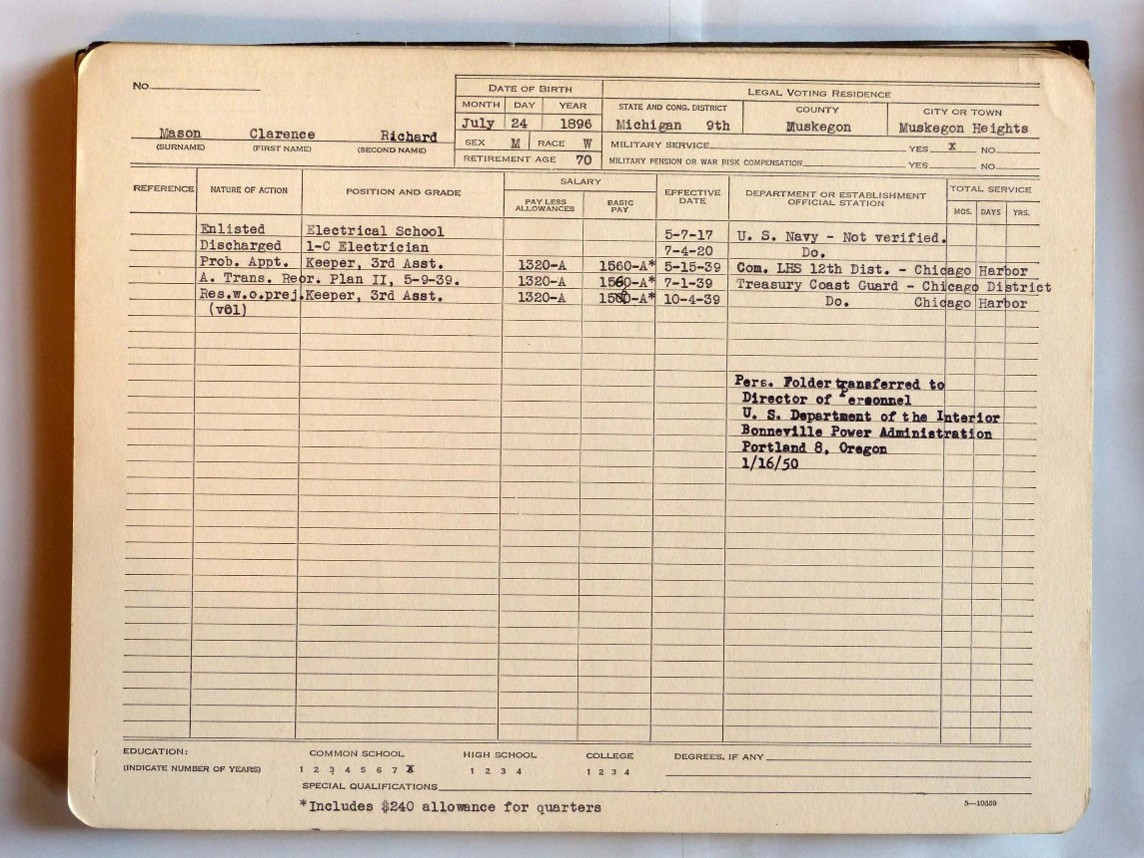
A U.S. Lighthouse Service personnel card records Mason’s appointment as third assistant keeper at Chicago on May 15, 1939. On July 1, he was automatically transferred to the Coast Guard, remaining at Chicago in the same position.
Mason resigned without prejudice on October 4, 1939. A later notation shows his personnel file being transferred in 1950 to the Department of the Interior’s Bonneville Power Administration, suggesting later federal employment.
| One line on Clarence Mason’s personnel card records the transition: “A. Trans. Reorg. Plan II,” effective July 1, 1939. His employing office changed from the Commissioner of Lighthouses, 12th District, to the Treasury Coast Guard, Chicago District. Source: U.S. Lighthouse Society Digital Archives. | |
Thomas. J. Brennan
T. J. Brennan’s personnel record provides the clearest career trail of the five men. It identifies Thomas Joseph Brennan as a skilled laborer at Chicago beginning March 14, 1939. On June 29 he was appointed second assistant keeper at South Fox Island.
Brennan went on to serve at White Shoal, Lansing Shoal and Manistique, advancing through the keeper ranks until becoming principal keeper at Manistique in 1962.
The skilled laborer at the far left of the Chicago photograph ultimately spent more than two decades tending Great Lakes lights and rose to command a station himself.
| |
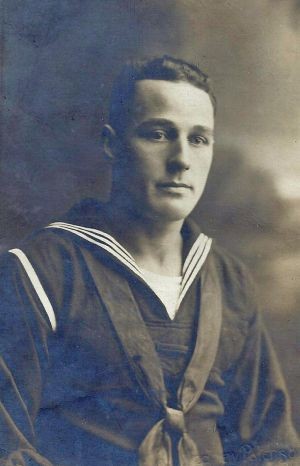
Thomas J. Brennan during his earlier U.S. Navy service, circa 1917–1919.
Source: U.S. Lighthouse Society Digital Archives.
| |
One Date, a Much Longer Transition
The federal record gives us a precise date: July 1, 1939. That was the day the Bureau of Lighthouses ceased to exist and responsibility for America’s lighthouse system passed to the Coast Guard.
But Chicago Harbor Lighthouse did not suddenly acquire an entirely new crew.
McKillop stayed.
Brotherson stayed.
Short stayed.
Mason was automatically transferred to the Coast Guard in the same position at Chicago and remained until his resignation that October.
Brennan had already been appointed second assistant keeper at South Fox Island just two days before the merger. His personnel record followed him into the Coast Guard and through a long Great Lakes career that eventually took him to the position of principal keeper.
Their different paths show what the July 1 transition really meant. The Lighthouse Service disappeared as an organization, but its people did not. Some remained at their stations. Some transferred elsewhere. Some advanced through the keeper ranks. Gradually, as civilian lighthouse employees retired, resigned or moved on, the old keeper system gave way to uniformed Coast Guard crews.
The institution changed in a day. Its people, knowledge and traditions changed much more slowly.
The name of the service had changed. The light still had to shine.
------------------------------------
Want to learn more?
· Reorganization Plan No. II of 1939
The actual legal instrument that transferred and consolidated the Bureau of Lighthouses with the Coast Guard, effective July 1, 1939.
Read Reorganization Plan No. II
· Final Lighthouse Service Bulletin, June 1939
The last issue published before the merger. Its lead article, “In Union There Is Strength,” addressed the impending consolidation from inside the Lighthouse Service itself.
Read the June 1939 Lighthouse Service Bulletin
· President Franklin D. Roosevelt’s May 9, 1939 Message to Congress
Useful for understanding the broader reorganization effort and the authority under which Roosevelt submitted Plan No. II.
Read Roosevelt’s message
· “Consolidation of the Lighthouse Service with the Coast Guard,” U.S. Naval Institute Proceedings, January 1940
A near-contemporary account of the merger, including how Lighthouse Service personnel were incorporated into the Coast Guard.
Read the article
| A Little Lighthouse Love at the Chicago Architecture Center! | |
Our lighthouse story has found a new home—on the shelves of the Chicago Architecture Center gift shop! We’re excited to share that the CAC is now selling Friends of the Chicago Harbor Lighthouse merchandise, giving Chicagoans and visitors another way to take home a little lighthouse love.
Seeing our merchandise displayed alongside items celebrating Chicago’s remarkable architecture is something special. Our lighthouse is part of that story, too—a familiar presence on the lakefront with a rich history and a future we are working together to make possible.
Every new connection helps us introduce more people to our mission to Preserve, Restore, and Celebrate the Chicago Harbor Lighthouse.
A heartfelt thank-you to the Chicago Architecture Center for supporting our mission and making room for us in your shop. Partnerships like this help turn a big dream into real progress, one person—and one purchase—at a time.
Be sure to visit the CAC, explore the stories behind the city we love, and stop by the gift shop to see our display.
Pick up something for yourself or share a little piece of the lighthouse with a friend!
We’d love to bring that same lighthouse spirit to more stores. If you own or manage a store or gift shop—or know someone who does—and would like to participate in our FOCHL Wholesale Merchandise Program, please contact Jan Marie Ferris at janmarieferris@savethelighthouse.org.
Thank you for helping us carry the lighthouse’s story beyond the breakwater!
| Help Us Build a Classroom Full of Possibilities | |
What might a lighthouse inspire in a seven-year-old? A fascination with how light works? A love of Lake Michigan? A dream of becoming a captain, an engineer, or a keeper of history?
Those possibilities are at the heart of Classroom on the Lakefront™, our developing education initiative. We envision the Chicago Harbor Lighthouse as a place where history, science, engineering, and the natural world come together—and where curiosity leads the way.
While we work toward welcoming visitors to the lighthouse, we’re exploring ways to bring its stories ashore through online resources, hands-on activities, and community partnerships. Our dream is to help people of all ages discover something new and leave eager to learn more.
We need curious minds to help us build it! If you’re an educator, storyteller, artist, technology enthusiast, or someone who enjoys making learning fun, we’d love to hear from you. Reply to this newsletter and tell us how you’d like to get involved.
Together, we can help this historic light inspire a whole new generation.
| Put Your Technology Skills to Work for the Lighthouse! | |
Big dreams need people who can help bring them to life.
Friends of the Chicago Harbor Lighthouse is seeking a Volunteer Director of Technology to help us build the digital foundation for our mission to Preserve, Restore, and Celebrate.
This hands-on leadership role will select, implement, and maintain website tools, digital experiences, and organizational systems, including Microsoft 365 and Salesforce. Responsibilities also include planning future visitor technology and coordinating secure access, documentation, training, and technical support for our volunteer team.
From keeping our organization connected to helping bring Classroom on the Lakefront™ to life, your skills could shape how people discover and experience the lighthouse—online today and in person in the future.
We’re looking for someone who is practical, organized, collaborative, and comfortable helping others use technology. A love of lighthouses, historic preservation, education, or giving back is a must! Chicagoland candidates are strongly preferred.
This is an unpaid volunteer opportunity with a chance to make a lasting difference. Interested—or know someone who would be a great fit?
Email info@savethelighthouse.org with the subject “Volunteer Director of Technology.”
Help us connect a historic lighthouse to a future full of possibilities!
| They Show Up for Us. Let’s Show Up for Them. | |
The Chicago Harbor Lighthouse’s story is also a Coast Guard story.
Generations of Coast Guard keepers cared for the light and helped guide mariners safely home. As we work to preserve that legacy, we also have an opportunity to support the people who carry that commitment to service forward today.
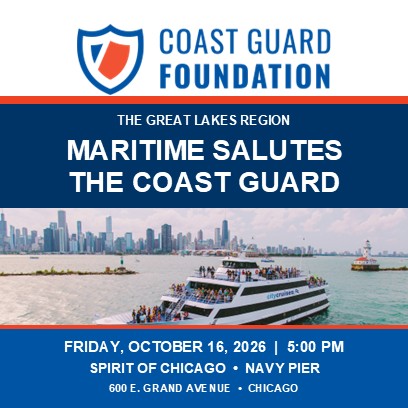
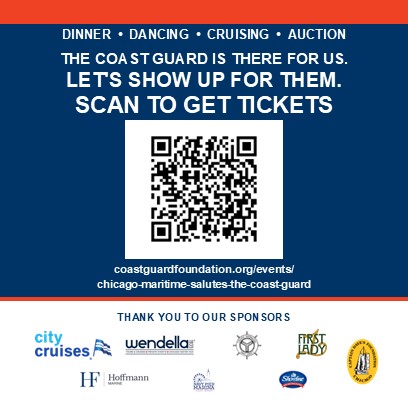
Join us in supporting the Coast Guard Foundation at Maritime Salutes the Coast Guard on Friday, October 16, 2026, at 5:00 PM, aboard the Spirit of Chicago at Navy Pier. Enjoy dinner, dancing, cruising, and an auction—all for a meaningful cause.
Attend if you can. Donate if you are able. Every gesture of support is a way to say thank you to the Coast Guard members and families who give so much.
Let’s bring a little lighthouse love aboard and show up for those who show up for us!
Get tickets or support the Coast Guard Foundation TODAY!
| Save the Date—Let’s Light the Way Again! | |
The dreaming—and planning—has already begun!
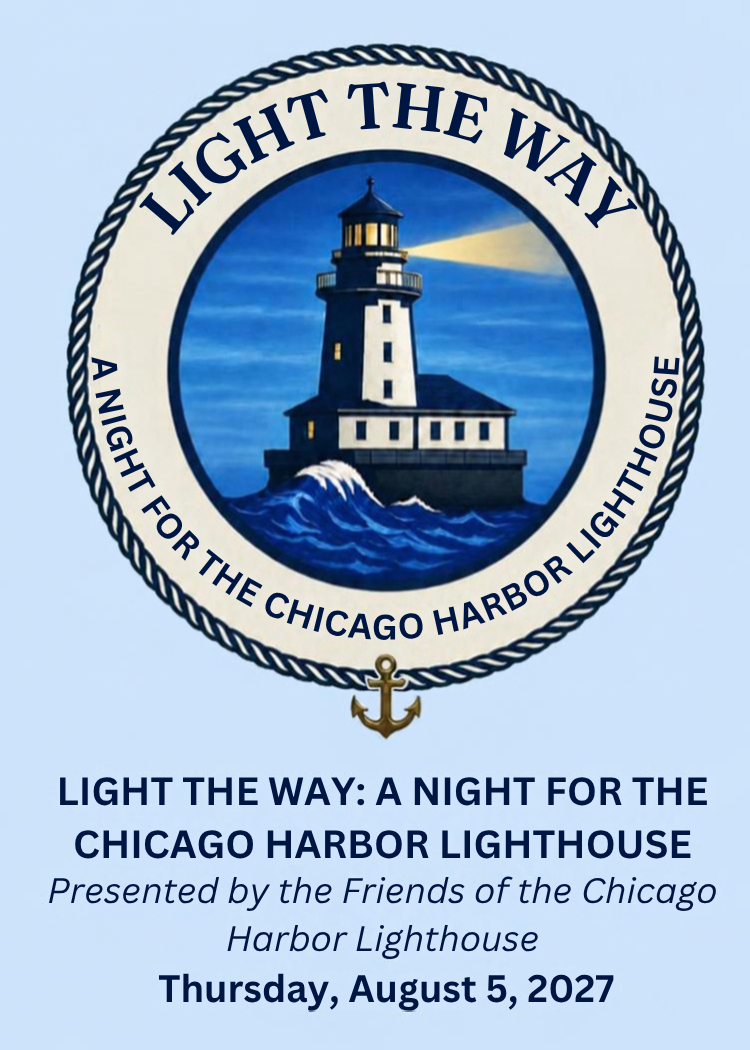
Our Light the Way 2027 Planning Committee is getting to work on our third annual fundraiser, a special evening celebrating National Lighthouse Day and the Chicago Harbor Lighthouse.
Mark your calendar for Thursday, August 5, 2027!
We’re returning to The Northman and Chicago’s First Lady for another night of friendship, celebration, and lighthouse love.
To our sponsors and donors: thank you for helping make this dream possible.
Your generosity keeps us moving forward, and we can’t wait to welcome you back on August 5, 2027!
Tickets go on sale June 1, 2027. More details—and a few surprises—are on the horizon.
For now, save the date!
| | If you are part of an organization that has an interest in financially supporting our efforts to Preserve, Restore, and Celebrate the Chicago Harbor Lighthouse, please reach out to Nick Naber (nicknaber@savethelighthouse.org), our treasurer and a member of our fundraising working group. | | Copyright © 2026 Friends of the Chicago Harbor Lighthouse - All Rights Reserved. | | | | |