|
Dear Executive,
Most organizations don’t realize this mistake is happening within their leave programs—until the cost shows up. Read the story below to see how it unfolds—and whether your organization is prepared.
The Story
The CEO was frustrated.
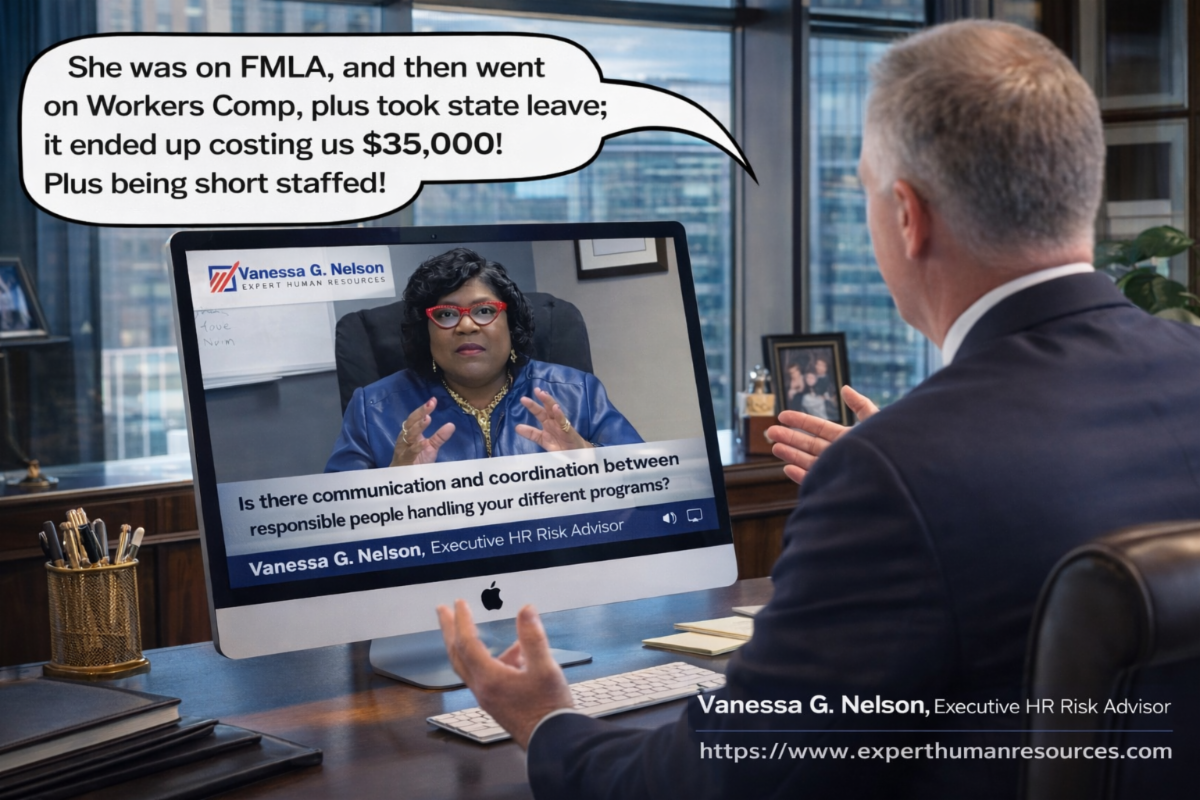
“She was on FMLA, then went on Workers’ Comp, then took state leave.
It ended up costing us $35,000 — and we were short-staffed the entire time.
How does this happen?”
I asked him one question:
“Who was coordinating between the people managing each of those programs?”
The silence told me everything I needed to know.
The Hidden Risk Inside Every Leave of Absence
Most organizations manage their leave programs in silos.
- HR handles FMLA.
- The insurance carrier handles Workers’ Compensation.
- State leave gets managed by whoever is available.
- ADA accommodation obligations—if considered—are often addressed at the end.
On the surface, each piece may be handled correctly.
But here’s the problem:
These programs do not operate in silos.
They overlap.
They interact.
They create legal obligations that no single person sees when they are only managing one part of the process.
Compliance without coordination is where organizations lose control.
What This Looks Like in Practice
An employee sustains a workplace injury.
Workers’ Compensation begins immediately.
But at the same time:
- Is FMLA being triggered and tracked concurrently?
- Is someone ensuring the FMLA clock is running during Workers’ Comp?
- Or are these programs being allowed to run separately—quietly extending total leave time?
When FMLA exhausts:
- Is there a proactive ADA accommodation review?
- Or is a standard “FMLA exhausted” letter sent with no further evaluation?
When state leave laws—like Michigan’s ESTA—are layered in:
- Who is tracking the full timeline?
- Who is calculating the total exposure?
In most organizations, the answer is:
No one is looking at the full picture.
Not because the organization is negligent—
but because no one was assigned responsibility for coordination.
The $35,000 Breakdown
That $35,000 loss wasn’t one obvious mistake.
It was the accumulation of smaller, preventable costs:
- Temporary staffing to cover extended absence: $18,000
- Administrative time managing multiple programs: $7,500
- Lost productivity and supervisor time: $6,500
- Legal review triggered late in the process: $3,000
Total: $35,000
And nearly a failure-to-accommodate claim that could have cost significantly more.
None of these costs were inevitable.
They were the predictable result of leave programs managed without coordination.
What Leave Coordination Actually Means
Leave coordination is not just tracking dates.
It is the active management of how multiple leave programs interact for one employee.
That includes:
- Running FMLA concurrently with Workers’ Compensation and other applicable leave.
- Evaluating ADA obligations before FMLA exhausts—not after.
- Tracking state and federal leave together from the beginning.
- Ensuring communication between HR, carriers, supervisors, and legal counsel.
- Documenting decisions to create a clear, defensible record.
When this doesn’t happen:
What looks compliant on paper can still create real risk and real cost.
In Most Organizations, This Is a Pattern—Not a One-Time Issue
Once this happens once, it usually isn’t isolated.
It becomes:
- A repeated process gap.
- An inconsistent management approach.
- A pattern that can later be used as evidence.
5 Questions Every CEO Should Ask
Before your next complex leave turns into a $35,000 problem, ask:
- Are FMLA and Workers’ Compensation running concurrently where allowed?
- Who is responsible for evaluating ADA accommodations—and when?
- Is HR communicating consistently with carriers managing leave?
- Are state leave laws being tracked alongside federal programs?
- Do we have a clear, written process for how leave programs are coordinated?
If these answers are unclear:
Your organization may be managing leave in silos—without realizing the risk.
A Simple Way to Fix This
One uncoordinated leave case recently cost an organization $35,000.
Not because the leave was wrong—
but because no one was coordinating how FMLA, Workers’ Compensation,
ADA, state leave, sick leave, and PTO were interacting.
This is where most organizations lose control.
I built a structured solution to fix exactly that.
The Leave Coordination Toolkit—a reference guide and complete case management system—gives you a clear way to track, align, and manage multiple leave programs in one place.
👉 Toolkit Only — $97
How Expert Human Resources Can Help
Leave coordination is one of the most overlooked—and most expensive—areas of HR.
Expert Human Resources helps organizations:
- Identify gaps through targeted leave program audits.
- Align FMLA, Workers’ Compensation, ADA, and state leave processes.
- Establish clear coordination policies and responsibilities.
- Train leadership and HR teams on managing complex leave situations.
- Provide ongoing advisory support for high-risk cases.
Closing
In many cases, leadership assumes leave is being handled correctly—because each individual piece appears compliant.
But without coordination:
Compliant processes can still produce costly outcomes.
And that’s where organizations lose control.
Call to Action
If you’re not confident how your leave programs are working together, this is typically where organizations discover issues they didn’t realize existed.
Vanessa G. Nelson, CLRL
Executive HR Risk Advisor
Expert Human Resources, LLC
🌐 https://www.experthumanresources.com
📧 info@experthumanresources.com
📞 (810) 813-8732
All services are delivered 100% virtually with fast turnaround and defensible documentation.
Ready to Talk?
I am currently scheduling confidential consultations for organizations that want to assess their investigation readiness.
A 20-minute executive consultation can often reveal risks that have been quietly accumulating for years.
Schedule here:
Or connect with me on LinkedIn:
Vanessa G. Nelson
Vanessa G. Nelson, CLRL
Executive HR Risk Advisor
Founder & President
Expert Human Resources LLC
|