CAEC Expands Education to Career Pathways by Joining Forces Colorado Apprenticeship Colorado Division of Employment and Training
The Colorado Adult Education Coalition (CAEC) is expanding its role within Colorado’s workforce development ecosystem by becoming an Apprenticeship Intermediary. This important step directly advances CAEC’s mission to strengthen equitable education by uniting educators, workforce partners, employers, community organizations, and advocates to support lifelong learning and increase economic mobility for all Coloradoans.
As an Apprenticeship Intermediary, CAEC will help build stronger connections among adult education providers, workforce organizations, employers, labor organizations, apprenticeship sponsors, community organizations, and other partners. Our goal is to ensure that adult learners can more effectively move from education into career preparation, pre apprenticeship, Registered Apprenticeship, and sustainable employment.
This work is particularly important for adults who may experience barriers to traditional workforce pathways, including individuals without a high school diploma or equivalency, English language learners, adults developing foundational literacy and numeracy skills, and justice involved learners.
Building the Education to Apprenticeship Bridge
CAEC envisions a coordinated pathway:
Adult Education → Career Navigation → Apprenticeship Readiness → Pre Apprenticeship → Registered Apprenticeship → Employment and Economic Mobility
For CAEC, apprenticeship is more than a workforce strategy. It is an extension of our commitment to lifelong learning and economic opportunity. By connecting adult education with Colorado’s apprenticeship system, CAEC can help ensure that earning a GED, strengthening English language proficiency, improving foundational skills, or participating in correctional education is not the end of an educational journey. It can be the beginning of a meaningful career pathway. Education opens the door. Apprenticeship creates a pathway forward.
| |
|
CAEC Celebrates the Success of Its First Construction to Career Pathways Program
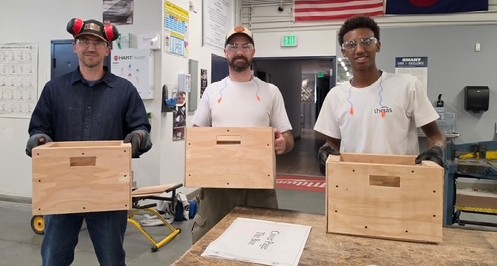
The Colorado Adult Education Coalition (CAEC), in partnership with the Colorado Building and Construction Trades Council, Sheet Metal Workers Local 9, and MC3 Certified Trainer Jess St. Peter, successfully launched its first Construction to Career Pathways Program.
The inaugural cohort brought together adult learners from diverse backgrounds and life experiences who shared a common goal: building a pathway toward a meaningful career in the skilled trades. The program was a tremendous success. Fifty percent of participants who completed the program connected with a union apprenticeship opportunity or employment, demonstrating the power of connecting adult education, workforce preparation, industry, and apprenticeship. Through career exploration, construction-focused learning, workforce readiness, and direct exposure to the building trades, participants gained knowledge and connections that can support their transition from education into sustainable careers.
CAEC is incredibly proud of our participants and grateful to our labor and industry partners who helped make this first cohort possible. This is what education-to-career pathways look like in action: learning, opportunity, connection, and economic mobility. We are excited to continue building pathways that connect Colorado’s adult learners with Registered Apprenticeship and careers in the skilled trades.
A very special thank you to CAEC Board Member Jess St. Peter, a 30-Year Veteran of the Construction Trades for believing in our learners and helping them take their next steps toward apprenticeship and meaningful careers in the skilled trades.
| |
|
Stronger Together: CAEC, COABE, and MPAEA Form Strategic Partnerships Just in Time for Adult Education and Family Literacy Week
As we prepare to celebrate National Adult Education and Family Literacy (AEFL) Week, exciting momentum is building across our field. The Colorado Adult Education Coalition (CAEC), the Coalition on Adult Basic Education (COABE), and the Mountain Plains Adult Education Association (MPAEA) have joined forces to strengthen advocacy, expand professional resources, and amplify the voices of adult learners across the region. This multi-level collaboration connects state, regional, and national networks, ensuring that adult education programs receive the visibility, support, and tools needed to change lives and strengthen local economies.
Why This Partnership Matters
Adult education is a critical bridge to workforce development, family stability, and economic mobility. By coordinating efforts across CAEC (State), MPAEA (Regional), and COABE (National), educators and programs benefit from:
- Unified Advocacy: Speaking with a single, powerful voice to local, state, and federal policymakers about the critical need for adult literacy, ESL, high school equivalency, and workforce training funding in Colorado and beyond.
- Expanded Professional Development: Sharing cutting-edge strategies in digital literacy, Integrated Education and Training (IET), and career pathways across state borders.
- Elevated Student Stories: Highlighting the transformative journeys of adult learners through joint media campaigns, student ambassador initiatives, and webinars.
A very special thank you to Sharon Bonney, COABE CEO, and Shaketta Thomas, COABE Board President, for their leadership and for initiating this meaningful new relationship. We sincerely appreciate their commitment to fostering connections that strengthen adult education, expand opportunities, and create new pathways for collaboration.
| |
Meet NAFTAE: The Voice of Adult Education
| |
Many of you know COABE as the national professional association supporting adult educators. This year, COABE launched the National Association for the Transformation of Adult Education (NAFTAE) to serve as the national organization dedicated exclusively to advocacy and public policy for adult education.
While COABE continues to lead professional development, member engagement, and field advancement, NAFTAE is focused on ensuring adult education has a strong, unified voice with policymakers at the federal and state levels. We work alongside educators, learners, state leaders, workforce partners, and advocates to strengthen funding, shape policy, build advocacy capacity, and elevate the importance of adult education nationwide.
Whether you're a seasoned advocate or just getting started, we'd love to connect with you. Sign up to receive our advocacy updates, action alerts, and our monthly Public Policy Pulse newsletter. You can also read the latest edition of Public Policy Pulse here: Latest Public Policy Pulse
Together, we can ensure adult education remains a national priority and that the voices of adult learners and educators are heard where decisions are made.
|
Delegation Tours Adams County Detention Facility Education Programs
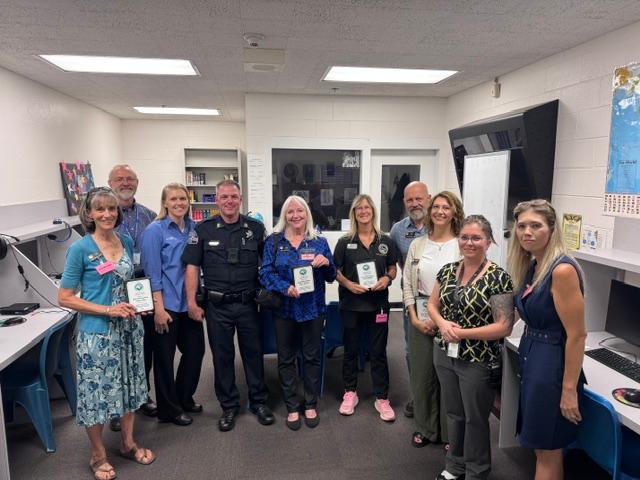
NAFTAE Colorado launched its late summer advocacy efforts with a landmark educational tour of the Adams County Detention Facility, bringing together a bipartisan group of Colorado legislators to highlight the impact of adult education in correctional settings. Participating legislators included: Senator Scott Bright (District 13), Representative Ava Flanell (District 14), Representative Eliza Hamrick (District 61), Representative Jacque Phillips (District 31), Representative Tammy Story (District 25), Representative Lori Garcia Sander (District 65).
During the walkthrough, legislators toured the facilities, observed a GED preparation class in session, and visited the facility library, where they had the opportunity to speak directly with former students about their educational experiences.
The visit reinforced the critical role correctional education plays in strengthening Colorado communities. Research consistently shows that individuals who participate in correctional education are less likely to recidivate, more likely to gain employment after release, and better prepared to contribute to the state's workforce. These programs also support Colorado's economy by connecting returning citizens to high-demand industries, career pathways, and Registered Apprenticeship opportunities while reducing long-term incarceration costs for taxpayers.
Seeing these educational programs firsthand demonstrates that literacy and education are among the most effective tools for rehabilitation. When we invest in adult education within our correctional facilities, we create opportunities for individuals to rebuild their lives while strengthening our workforce, improving public safety, and generating long-term savings for Colorado taxpayers.
NAFTAE Colorado extends its appreciation to the legislators, facility leadership, instructors and students who participated in this important event and remain committed to advancing policies that expand access to high-quality adult education for all Coloradans.
A very special thank you to Amanda Thomas, GED Instructor at Adams County Detention Facility, NAFTAE Colorado State Advocate Adult Education Fellow for coordinating this venture. Amanda you truly are a diamond in the rough!
|
Next Stop: Meeting with Governor Jared Polis
Following the successful Adams County visit, NAFTAE Colorado is heading to the State Capitol in September for Colorado Adult Education Family Literacy Week to meet directly with Governor Jared Polis and officially accept the executive proclamation designating AEFL Week 2026 across Colorado.
Governor Polis’s connection to this cause runs deep in 2009, as a member of Congress, he co-sponsored the original federal resolution establishing national AEFL Week. Meeting with Governor Polis following our Adams County tour allows CAEC to bring real-world facility success stories straight to state leadership while accepting the Governor's proclamation ahead of September.
|
Taking Colorado’s Voice to Washington, D.C.
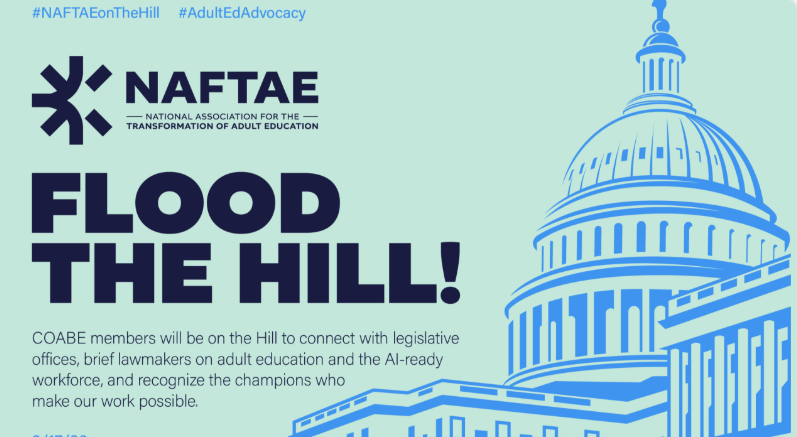
Our state advocacy won't stop at the Capitol! During AEFL Week (September 13–19), NAFTAE Colorado joins national partners in Washington, D.C., on September 16 and 17 for COABE’s annual Flood the Hill event. During these two days in D.C., CAEC will meet directly with Colorado’s congressional delegation to:
- Advocate for Federal Funding: Push for expanded investment in Title II Adult Education State Grants (AEFLA) and the Adult Education WORKS Act.
- Elevate Local Impact: Share insights from Colorado’s adult education workforce partnerships and correctional facility programs directly with federal lawmakers.
- Amplify Learner Voices: Bring Colorado adult learner experiences and success stories straight to national policymakers.
| |
The Digital Literacy Gap: Why Adult Learners Need More Than Enrollment
Author: Diana Aqre
You are sitting at your desk, looking at enrollment numbers and wondering why a strong marketing campaign brought in so many adult learners, yet onboarding numbers stayed low. The people who signed up were the right audience; otherwise, they would not have clicked on advertisements for free online adult education. So what happened?
What’s often overlooked is that enrollment in online courses is just the first step—and for basic digital literacy learners, it can hide a host of barriers. Many adults who sign up may not realize that activities like navigating websites, managing logins, or using multiple browser tabs are fundamental to success. These hidden challenges can feel overwhelming and discouraging, causing new learners to disengage before they even begin the coursework.
Recognizing these invisible barriers is crucial for educators and administrators who want to truly support adult learners on their digital journeys. In fact, according to the Organization for Economic Co-operation and Development (OECD), approximately 25% of adults in OECD countries—including the United States—lack even the most basic digital problem-solving skills (OECD, 2019). This means that a significant portion of prospective learners face challenges with essential tasks such as using email, searching for information online, or filling out online forms, making the need for digital literacy support even more urgent.
But we are not helpless. Digital literacy has been widely studied, including its effect on human development and economic opportunity. After spending a year working with adult learners who lacked basic computer skills, I saw the same needs appear again and again: understanding basic digital tools, creating simple digital workflows, managing email and online forms, studying online, and completing everyday tasks on a computer.
From that experience, I created an online course in both Spanish and Arabic for people who did not have computer navigation skills. My goal was not to make them experts, but to help them reach a basic level of proficiency—enough to get them over that major hump that keeps so many from moving forward. You can go here https://www.technologyeducation.online/ to view these courses, or keep reading for the skills that I saw help adult learners move toward work, reduce dependence on human services, conduct their own job-search research, follow the news, and enjoy the practical benefits of personal computing.
Lesson 1: Ergonomics
Believe it or not, ergonomics have a big effect on how well adults learn. Getting into uncomfortable positions will quickly fatigue a beginner and hold back their learning. I always started with comfortable set-ups and ensured that when they got home to continue learning, they had a distraction-free, comfortable chair and desk that angled their body upright and didn’t strain their back or neck.
Lesson 2: Right Click
Right-click and multiple mouse clicks were the number one lever for people who did not have basic computer education to bring them into modern computer use. Interestingly, people were unsure of the physical aspects, how to use the fingers, eyes, all of the motor qualities, eyes, thinking, and fingers to put them together. It took practice, and people need practice. There is mouse practice here if you see any of your students need this. Triage this problem right away!
Lesson 3: Copying and Pasting Text
Copying and pasting text is vital in today’s world of applications, forms, and doing research, writing, and compiling information and URLs. The most important use of this was right-clicking on a link and pasting it into the URL box. A vital skill in online research that basic learners needed to know to develop.
Lesson 4: Understanding File Folders
File Explorer and Finder in Macs were the next necessary component of online computing. Clients of any age or demographic category- moms, grandmas, and small business owners- the people I worked with the most, needed to know how to download, save, and relocate files later. This one is key. We also learned how to do it on mobile phones as well as sync online folders when the student had more advanced abilities.
Lesson 5: Opening and Navigating Multiple Windows
The ability to use two windows simultaneously is especially important for adult learners because it mirrors the way tasks are handled in most jobs and everyday life. Many essential activities—from job searching to budgeting—require looking up information in one place while working in another. For adults returning to education or adapting to new technology, mastering this simple skill increases efficiency, reduces frustration, and builds confidence. It also lays the groundwork for more advanced digital problem-solving, making it a foundational step on the path to full digital participation.
Just try not double-clicking for a day – a test of your compassion
Bridging the digital literacy gap for adult learners is ultimately an act of compassion. For those of us who move easily between windows or right-click without thinking, it’s easy to forget just how intimidating these basic actions can feel. If you want to truly grasp the barriers your learners face, spend a day without right-clicking or navigating between two windows. True support means meeting people at their starting point, showing patience, and remembering that digital confidence takes time. When we lead with empathy and practical help, we open doors for adults to grow, learn, and participate fully in the digital world.
Get the full course in three languages at https://www.technologyeducation.online/
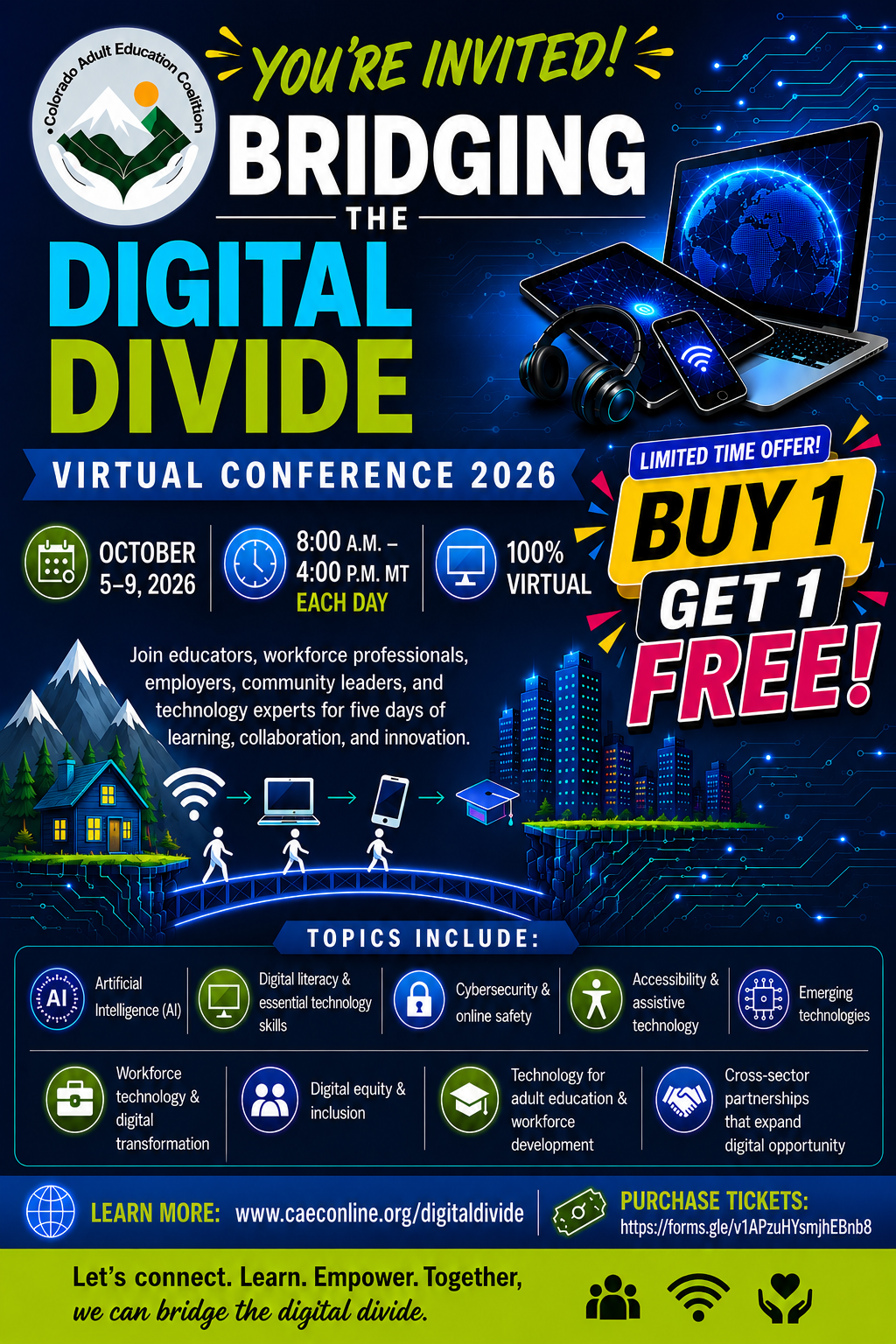
You can also learn more about digital literacy initiatives through the Colorado Adult Education Coalition, which will be having a digital literacy conference in August.
| | |
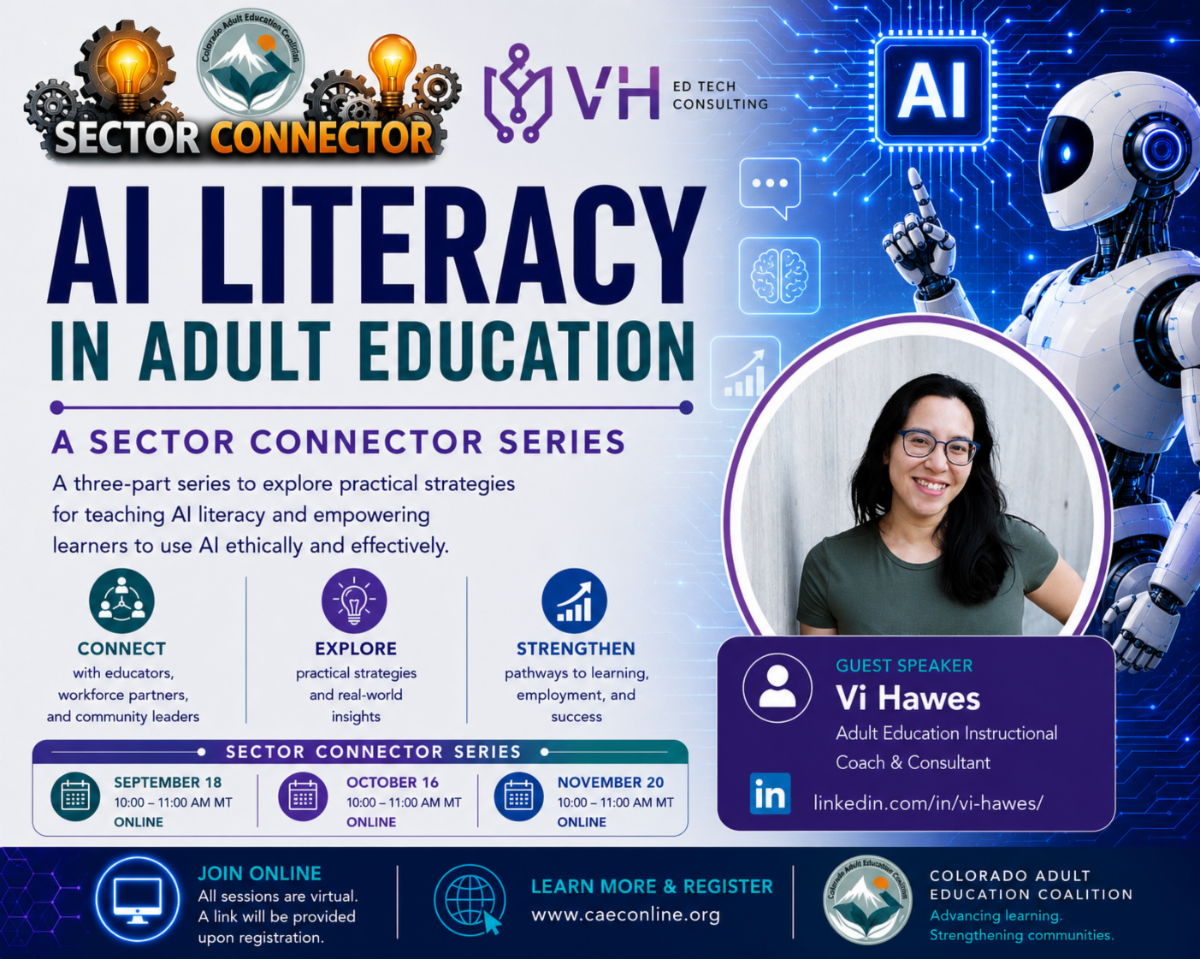
AI Literacy in Adult Education
Sector Connector Series
Join CAEC's three-part Sector Connector Series to explore practical strategies for teaching AI literacy and helping adult learners use AI responsibly and effectively. Featuring Vi Hawes, this virtual series brings together educators, workforce partners, and community leaders to share real-world practices that strengthen learning, employment, and career pathways.
📅 September 18 • October 16 • November 20 | 10:00–11:00 AM MT
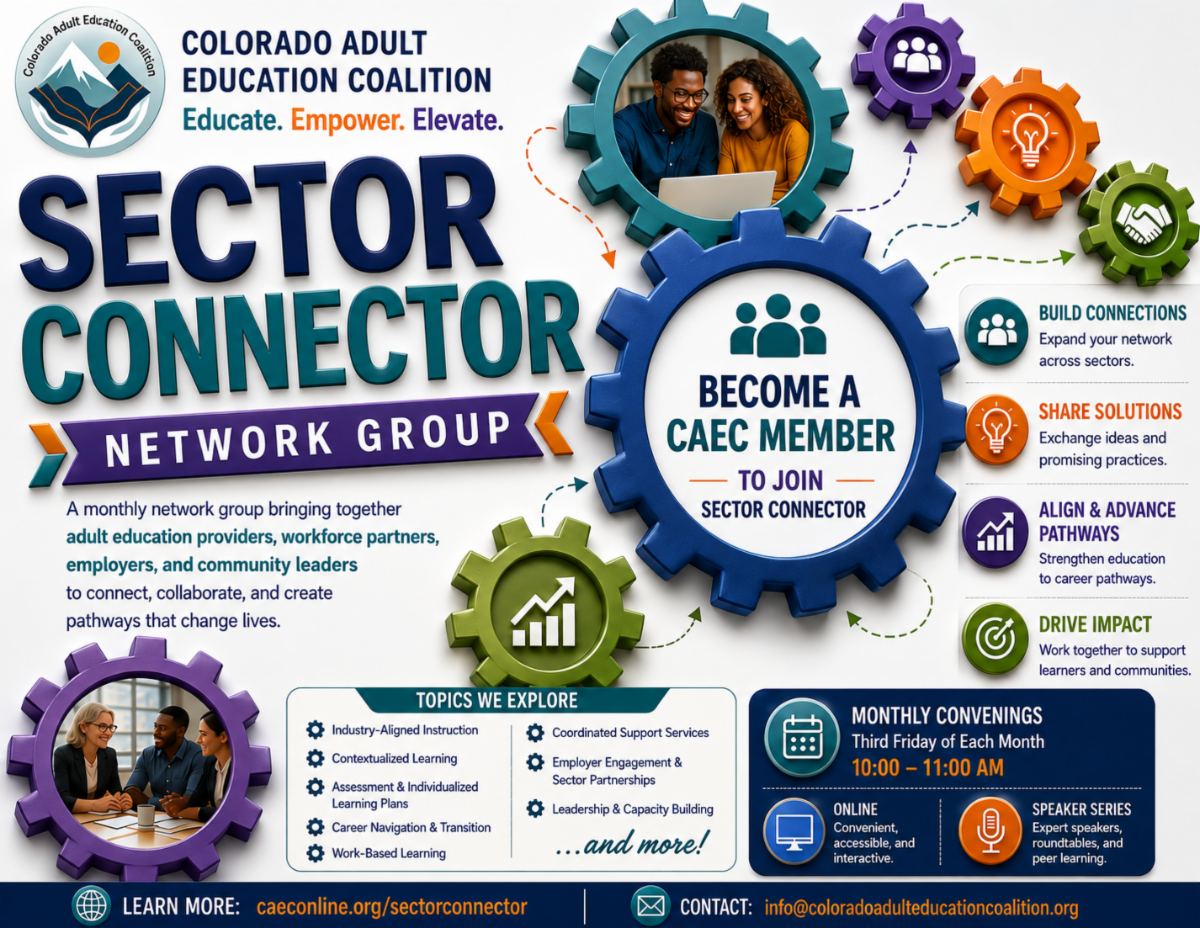
Learn more and register at www.caeconline.org. Become a CAEC member to participate in Sector Connector and connect with professionals advancing adult education across Colorado.
| |
Resources & Tools
Title: English for Specific Careers: Soft Skills for Nursing Assistants.
Module 1: Going for an Interview
Activity 1: Introducing Yourself
Overview
Course & Unit: Nursing Assistants – Module 1: Going for an Interview (Activity 1: Introducing Yourself)
Objective: Help students learn how to introduce themselves professionally to potential employers.
Key Components & Steps
Orientation & Context
-
Explain the purpose of the course ("Soft Skills for Specific Careers") and list the module names (Going for an Interview, Getting the Job, Training and Safety, On the Job, Handling Complaints, Performance Evaluation).
Preparation & Worksheet Activities
-
Brainstorm professional background information to share during interviews (e.g., education, reasons for choosing the career, professional skills, work experience).
-
Guide students through a Personal Skills Questionnaire where they identify personal traits/skills, write short self-descriptions, and state reasons for their career choice.
Self-Introduction Practice
-
Provide optional sentence starters ("I would like to be a...", "I would be good at this because...").
-
Have students practice a 60-second self-introduction in pairs without directly reading off their notes.
- Partners ask clarifying questions and give constructive feedback on skills or educational background.
Repetition & Reflection
- Rotate partners so students can practice their introductions multiple times.
- Conclude with a class reflection on any noticeable improvements over each attempt.
For more information reach out to Bethany Macarus at bethany..m@burlingtonenglish.com
| | "Celebrating Adult Education and Family Literacy Week by honoring the educators, learners, and partners who strengthen families, expand opportunities, and build brighter futures across Colorado." | | | | |