BLACK MATERNAL HEALTH WEEK |
|
|
|
|
|
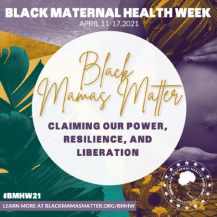
April 11-17, 2021
#BMHW21
Claiming Our Power, Resilience, Liberation
|
#BMHW21 is a week of education and advocacy around the experiences of Black Mamas. Through a series of digital and community events, BMHW will uplift Black-women led entities to focus on the root causes of poor maternal health outcomes while also leaning on Black voices to drive conversation around tangible community-driven policy, programs, and solutions.
|
|
#BMHW21 will be a week of awareness, activism, and community building intended to:
- Deepen the national conversation about Black maternal health in the US.
- Amplify community-driven policy, research, and care solutions.
- Center the voices of Black Mamas, women, families, and stakeholders.
- Provide a national platform for Black-led entities and efforts on maternal health, birth and reproductive justice.
- Enhance community organizing on Black maternal health.
|
|
Learn more about #BMHW21 HERE, including information
|
|
BLACK MATERNAL HEALTH CONFERENCE |
|
|
|
|
|
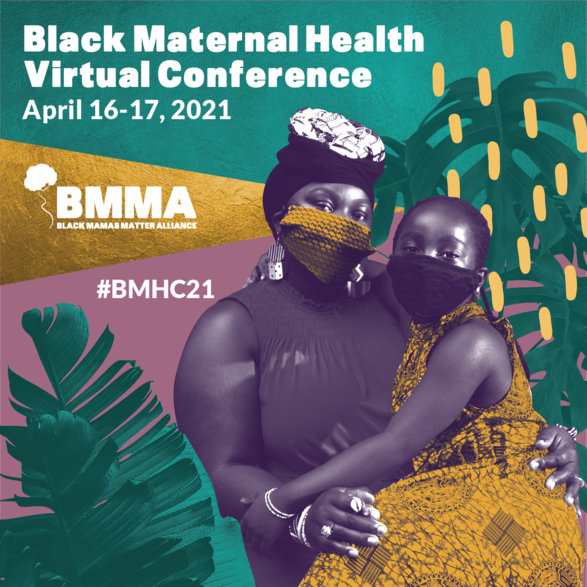
April 17-17, 2021 / Virtual
#BMHC21
|
#BMHC21 is the premiere assembly for Black women, clinicians, professionals, advocates, and other stakeholders working to improve maternal health using the birth justice, reproductive justice, and human rights frameworks. This year’s virtual conference will offer a national space for learning, rich discussions, and mobilization to transform Black maternal health, rights, and justice.
|
|
#BMHC21 will be segmented into five tracks: Holistic Care & Clinical Innovation, Policy/Advocacy, Research, Culture Shift (Creative), and Special Topics. The goals of BMHC21 include:
- Building the capacity of Black leaders in maternal health to shape programs, policy, and care and engage in evidence-based advocacy.
- Disseminating best practices to address critical issues in Black maternal health from different sectors including research, care, policy, and culture shift.
- Growing a community and network of stakeholders committed to improving Black maternal health.
- Cultivating a space of love, respect and listening that centers the voices and experiences of Black Mamas, Black Birthworkers, Black scholars, and Black Women leaders.
|
|
Learn more about #BMHC21 HERE. Download the agenda HERE. |
|
BLACK MAMAS MATTER ALLIANCE |
|
|
|
|
|
Black Mamas Matter Alliance is a Black women-led cross-sectoral alliance. BMMA centers Black mamas to advocate, drive research, build power, and shift culture for Black maternal health, rights, and justice. BMMA envisions a world where Black mamas have the rights, respect, and resources to thrive before, during, and after pregnancy. BMMA is proud to host Black Maternal Health Week and Black Maternal Health Conference. |
|
BMMA's goals are to:
-
Change Policy. Introduce and advance policy grounded in the human rights framework that addresses Black maternal health inequity and improves Black maternal health outcomes.
-
Cultivate Research. Leverage the talent and knowledge that exists in Black communities and cultivate innovative research methods to inform the policy agenda to improve Black maternal health.
-
Advance Care for Black Mamas. Explore, introduce, and enhance holistic and comprehensive approaches to Black mamas’ care.
-
Shift Culture. Redirect and reframe the conversation on Black maternal health and amplify the voices of Black mamas.
|
|
Learn more about BMMA HERE. |
|
BLACK MATERNAL HEALTH
FACTS & FIGURES
|
|
|
|
NOTE: All data in this section is from the Centers for Disease Control and Prevention. |
|
Maternal and Infant Mortality
- Approximately 700 women die each year in the United States as a result of pregnancy or its complications
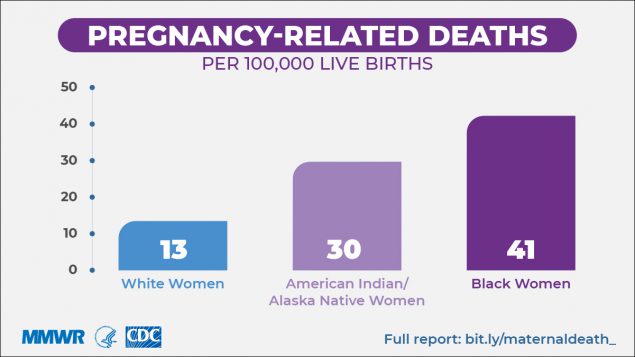
- Black women in the United States are 3-5 times MORE LIKELY to have a maternal death than White women.
- Black infants in the United States are almost TWICE AS LIKELY to die as white infants. The infant mortality rate is 5.8 per 1,000 live births. Black infant mortality is almost DOUBLE at 10.8 deaths per 1,000 live births.
|
|
Maternal Mental Health (MMH)
- Mental health conditions are the MOST COMMON complication of pregnancy and childbirth, affecting 1 in 5 childbearing people during pregnancy or first year following pregnancy.
- Black mothers are MORE likely to experience MMH conditions but LESS likely to get help.
- Barriers to accessing care for Black women include social and cultural stigma, logistical challenges such as transportation and lack of childcare, and racial bias in the healthcare system.
|
|
BMMA Partners
Making a Difference
Shades of Blue Project
Center for Black Women's Wellness
|
|
Breastfeeding
- Only 66% of Black infants are breastfed, compared to more than 82% of White and Latinx infants.
- Black infants have a significantly lower rate of breastfeeding.
- At 3 months, breastfeeding rates are 58% for Black infants and 73% for White infants.
- At 6 months, breastfeeding rates are 45% for Black infants and 62% for White infants.
- Hospitals in areas with higher percentages of Black residents were less likely to provide adequate breastfeeding information and support to new mothers.
|
|
BMMA Partners
Making a Difference
Black Mother's Breastfeeding Association
Black Girls Breastfeeding Club
Chocolate Milk Cafe
Mamatoto Village
|
|
COVID-19
- African Americans comprise 13% of the total U.S. population but make up 30% of the COVID-19 cases.
- Multisystem inflammatory syndrome in children (MIS-C) is a rare but severe condition occurring approximately 2-4 weeks after the onset of COVID-19 in children and adolescents. More than 70% of reported cases of MIS-C occur in children who are Hispanic or Latinx or non-Hispanic Black.
- Pregnant people with COVID-19 are at increased risk for severe illness compared to non-pregnant people. Additionally, pregnant people with COVID-19 might be at increased risk for other adverse outcomes, such as preterm birth.
|
|
Learn more about racial and ethnic disparities in maternal health HERE.
|
|
BLACK MATERNAL HEALTH MOMNIBUS |
|
|
|
|
|
To combat the maternal health crisis in the United States, Congress has introduced legislation that will comprehensively address all aspects of maternal health. Each of the twelve bills in the Momnibus was introduced as a standalone bill by a Member of the Black Maternal Health Caucus. A summary of each of the bills can be found HERE. |
|
The Black Maternal Health Momnibus Act will:
-
Make critical investments in social determinants of health that influence maternal health outcomes, like housing, transportation, and nutrition.
-
Provide funding to community-based organizations that are working to improve maternal health outcomes and promote equity.
-
Comprehensively study the unique maternal health risks facing pregnant and postpartum veterans and support VA maternity care coordination programs.
-
Grow and diversify the perinatal workforce to ensure that every mom in America receives culturally congruent maternity care and support.
-
Improve data collection processes and quality measures to better understand the causes of the maternal health crisis in the United States and inform solutions to address it.
-
Support moms with maternal mental health conditions and substance use disorders.
-
Improve maternal health care and support for incarcerated moms.
-
Invest in digital tools like telehealth to improve maternal health outcomes in underserved areas.
-
Promote innovative payment models to incentivize high-quality maternity care and non-clinical perinatal support.
-
Invest in federal programs to address the unique risks for and effects of COVID-19 during and after pregnancy and to advance respectful maternity care in future public health emergencies.
-
Invest in community-based initiatives to reduce levels of and exposure to climate change-related risks for moms and babies.
-
Promote maternal vaccinations to protect the health and safety of moms and babies.
|
|
Learn more about the Momnibus HERE.
See the listing of almost 200 organizations supporting the Momnibus HERE.
|
|
ADDITIONAL LEARNING OPPORTUNITIES |
|
|
|
|
|
Maternal Mental Health NOW
Perinatal Mental Health Conference for
Black Birth Workers, Clinicians, & Providers
4-Part Virtual Conference
April 30; May 7, 14, 21
|
|
Maternal Mental Health NOW is hosting a 4-day virtual conference to increase the capacity and competency of Black clinicians and providers in Los Angeles County, the most populous county in the country with over 10 million residents.
The goal of the conference is that Black families will find specialized perinatal providers who look like them and with whom they can relate. This includes:
- Presenting foundational knowledge on perinatal mental health care while centering the Black experience.
- Assisting the community in building concrete skills and tools to more adequately address the mental health needs of Black women and birthing people.
- Aiming to address the specific needs within the Los Angeles County area.
|
|
Learn more about the conference HERE.
|
|
|
|
U.S. Department of Health & Human Services
Culturally and Linguistically
Appropriate Services (CLAS)
FREE 2-hour Webinar
|
|
The U.S. Department of Health and Human Services is offering a free 2-hour learning opportunity addressing cultural competency and humility, person-centered care, and implicit bias across the continuum of maternal health care. Topics include:
- Introduction to Culturally and Linguistically Appropriate Services (CLAS) in maternal health care.
- Self-awareness about beliefs, values, privilege, power, bias, and stereotypes.
- Awareness about a patient or client's cultural identity.
- Providing CLAS in maternal health care.
This program is accredited for 2 hours for physicians, physician assistants, nurse practitioners, nurses, certified nurse midwives, and certified midwives. Other professionals, as well as students, may earn a Statement of Participation.
|
|
Learn more about the course HERE.
|
|
Improved maternal health benefits the whole society.
-- Isabelle Lovin
|
|
Working with Policymakers to Address Maternal Mental Health Conditions |
|
MMHLA -- founded in 2018 -- is a nonpartisan 501(c)3 non-profit organization
dedicated to promoting the mental health of childbearing women in the United States
by advocating for universal education, screening, referral, and treatment
of postpartum depression and related maternal mental health (MMH) conditions.
Our vision is that all childbearing women in the United States will be educated about and screened for maternal mental health conditions and have access to resources for recovery.
|
|
|
|
|
|
|