|
A large California city mired in budget difficulty looks to its government-run asphalt plant to help solve its fiscal woes. Sound familiar? But it's not the City of Los Angeles, which is seeking to amend its charter to create a legal loophole to sell taxpayer-subsidized asphalt into the commercial market.
This eerily similar situation arose in 2006 with the City and County of San Francisco, which ordered up a detailed study of its own government-run asphalt plant and came to a very different conclusion. In short, San Francisco government leaders found they could save money by shutting down the plant and buying from the commercial market at lower prices and with better quality. The reform-minded mayor back then? Gavin Newsom.
As is often said, history doesn't repeat itself, but it certainly does rhyme.
Like the City of Los Angeles, the City and County of San Francisco dates producing its own asphalt for its own uses many decades. In the case of San Francisco, that history goes all the way back to 1909. In 1954 the San Francisco Department of Public Works (SFDPW) opened a batch plant on 1801 Jerrold Street to serve city maintenance crews, and made modest investments and upgrades to the facility over the years, including a major renovation in 1991. By the 2000s the plant was showing its age, and SFDPW was under pressure to be more efficient with its limited resources devoted to maintain approximately 900 streets.
SFDPW proposed to upgrade the plant to increase capacity, and presumably efficiencies, but the San Francisco County Board of Supervisors was skeptical, withholding funding until a detailed analysis of the plant and other asphalt-procurement options could be done.
That landmark report, issued in October of 2006 by the Department of Public Works, signaled the beginning of the end for the Jerrold Street facility. The report found the plant was inefficient and required the city to subsidize it, year after year, with no end in sight. Further, the report found the municipal plant produced asphalt that was much more expensive than what could be readily obtained on the private market. The report does not examine the quality of the asphalt produced at the municipal plant compared to the private market, mostly focusing on hard costs, including salaries, costs to operate and trucking.
"The original analysis prepared by DPW in FY 2002-03 projected that the Plant could realize net revenue of $911,000 by FY 2005-06 on production and sales of 85,000 tons of asphalt," the report states. "Current FY 2005-06 projections forecast a shortfall of $107,372 on 31,863 tons of asphalt production."
And this came after DPW already invested heavily in new silos installed in 2004 with the stated intent to improve the efficiency, flexibility and capacity of the batch plant. Those efficiencies never materialized.
The report examined several scenarios, including shuttering the plant, a public-private partnership, further boosting plant capacity and more utilization of municipal asphalt by city departments. Ultimately, it was determined that SFDPW did not have the estimated $1.2 million in additional funds that would be required to invest in the plant to keep it viable, and given the track record of previous upgrades, it was not clear that would solve the problem.
"The Plant will not be able to turn a profit, or even break even, with tonnage production at projected levels of street resurfacing funding," the report concluded, noting that "procuring asphalt from private producers would save the City funds."
The city plant closed in about 2010, and the property was eventually turned over to another city department. San Francisco has been procuring asphalt from private sources ever since.
So what does the San Francisco municipal asphalt plant experience have to teach the City of Los Angeles? For one, no serious examination of the efficiency and quality of the Los Angeles-owned asphalt plant No. 1 on Olympic Boulevard has been conducted, except for a few pointed memos by former City Controller Ron Galperin around 2016 and 2017. HIs analysis was focused on a major overhaul of the Olympic Boulevard plant that eventually ballooned cost more than $31 million, well over its original budget.
"The project costs have significantly increased from the 2014 estimate of $17.7 million to the current cost of $38 million," Galperin wrote the city's Public Works Department in a March 21, 2017 memo demanding more information about the plant.
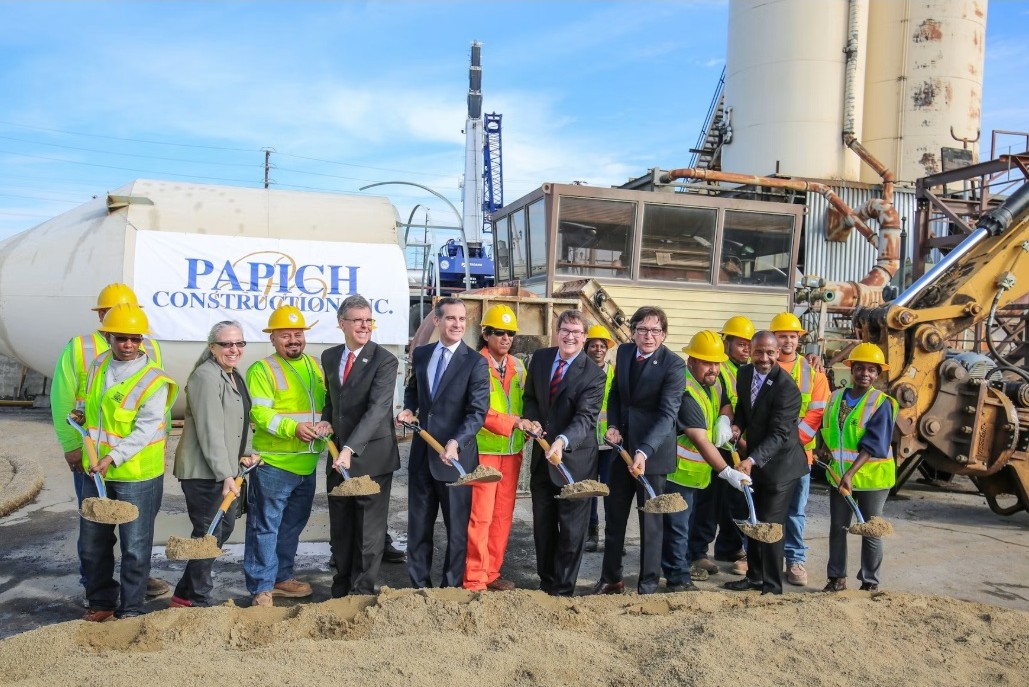
The plant upgrade "will save taxpayers around $5 million a year," boasted a 2017 press release issued by then-Mayor Eric Garcetti's Office for the new plant's groundbreaking. In the press release he is quoted as saying, "This new plant is a clear example of how L.A. is taking big steps to improve services while keeping our commitment to minding the bottom line and protecting the environment in everything that we do." The press release states the upgrades "will increase production from 175,000 tons per year to as much as 700,000 tons, at a savings of $28 per ton."
Multiple sources indicate the plant is only operating at a fraction of that capacity. A 2023 city report noted of the plant, "Since the start of its commissioning in 2019, the Asphalt Plant No. 1 has produced between 280,000 to 320,000 tons of hot mix asphalt (HMA) annually." Industry watchers assess the plant is operating at much less than those levels today.
And it is not clear under any scenario that it could improve efficiency and quality anywhere near what is widely available from multiple private sources around the region. Another city-owned asphalt facility on Sherman Way in North Hollywood is a rusted relic and has not operated in years.
If the City of Los Angeles is serious about addressing its massive budget shortfall, estimated at $263 million after surpassing $1 billion last year, its Bureau of Street Services asphalt plant operations, at minimum, require close and objective scrutiny. A good starting point might be to review the experience of the San Francisco Department of Public Works. When faced with a remarkably similar situation, San Francisco opted to get out of the asphalt business and never looked back. Several other cities across the country have since done the same.
A previous Asphalt Insider article on this topic is HERE. An article about the sharp decline in City of Los Angeles street maintenance work by city forces is HERE.
|