The Pensioner: Looking Forward
|
|
Welcome to the digital MPERS newsletter! The Pensioner: Looking Forward contains news, updates, and important information for active employees of the Missouri Department of Transportation, the Missouri State Highway Patrol, and MPERS.
|
|
MPERS will be hitting the road this month, making stops in Lee's Summit and West Plains. If you are currently eligible to retire or will be before December 31, 2028, consider attending one of these half-day sessions. If you prefer to attend a virtual seminar, we have you covered! |
|
|
|
Where:
MoDOT Kansas City District Office
600 NE Colbern Road
Lee's Summit, MO 64086
When:
Wednesday, April 12, from 8:00 a.m. – 12:00 p.m.
or
Thursday, April 13, from 8:00 a.m. – 12:00 p.m.
Registration deadline:
April 5, 2023
|
|
|
|
Where:
West Plains Civic Center
110 St. Louis St.
West Plains, MO 65775
When:
Tuesday, April 25, from 8:00 a.m. – 12:00 p.m.
Registration deadline:
April 18, 2023
|
|
|
|
Where:
Online via GoToWebinar
When:
Tuesday, April 4, from 12:30 p.m. - 4:30 p.m.
Registration deadline:
April 3, 2023
|
|
The Value of Your Benefit |
|
When someone talks about “the value of your benefit,” what comes to mind? Is it the dollar amount? Perhaps the “value” is financial security for your family and your future? |
|
Longevity risk is the fear of living longer than expected, thus outliving the resources that were set aside for retirement. Market risk correlates to the longevity risk because most employers and employees participate in a defined contribution plan such as a 401k. In a defined contribution plan, stock market volatility (market risk) may increase or decrease the financial resources established as retirement income. |
|
Because MPERS is a defined benefit plan, there is no longevity risk with regards to the pension earned for future retirement. Your future retirement benefit is a lifetime benefit, regardless of how long you live. If you married and selected a joint and survivor payment option at retirement, once you pass away, the benefit is payable to your surviving spouse for his/her lifetime as well. |
|
In addition to a non-existent longevity risk, there is minimal market risk. MPERS has a very diverse investment portfolio that is allocated to weather stock market volatility (market risk). If the market has one bad day, month, or year, it will not deplete the System’s investment funds. Your future retirement benefit is safe regardless of how the market performs. |
|
Even though there is little tangible downside to the benefits described above, there are still individuals who think that they could fare better if their retirement benefit was a traditional 401k. But what would a MoDOT or Patrol employee have to contribute to their retirement savings to receive an equivalent value that a defined benefit plan like MPERS provides? |
|
It will be different from member to member, but to give you an idea, let’s look at Jane, a Year 2000 Plan member, as an example. Please keep in mind this is just an example. Your individual circumstances will impact the outcome of this calculation.
In the March newsletter, we looked at the benefit formula which multiplies years of service by a multiplier set by law by final average pay. Let’s review.
At retirement, Jane will have 29 years of service and final average pay of $3,500. The Year 2000 Plan multiplier is 1.7% for the base benefit and .8% for the temporary benefit. Jane will receive the temporary benefit for 11 years until she turns 62.
|
|
If Jane collects a retirement benefit for 30 years and receives a 1.5% cost-of-living adjustment annually, over the course of those 30 years she will have collected around $864,411.34 in benefits. Remember, the Year 2000 Plan is non-contributory, therefore, Jane has not contributed any of her salary to her retirement benefit. |
|
If MPERS deployed a defined contribution plan such as a 401k, how much of Jane’s paycheck would have to be contributed to reflect a balance of $864,411.34 at retirement? |
|
Let’s assume the following about Jane:
- Her current Deferred Comp account balance is $0
- Her annual salary is $42,000
- Her contributions as an active employee will earn a return of 5%
- She will receive annual salary increases of 1.5%
- She will retire in 29 years (that’s 29 years to save)
- She anticipates needing retirement income for 30 years
- She assumes that in retirement, the annual rate of investment return is 4%
- She assumes an annual rate of inflation of 2%
|
|
Considering the above assumptions, Jane would have to contribute $565 per pay period (or $1,130 monthly) to her 401k to have close to $864,000 at retirement. At the beginning of Jane’s career, this is almost 32.3% of her salary. Because Jane assumed she would receive 1.5% annually in salary increases, towards the end of her career, $565 per pay period is approximately 21.3% of her salary. |
|
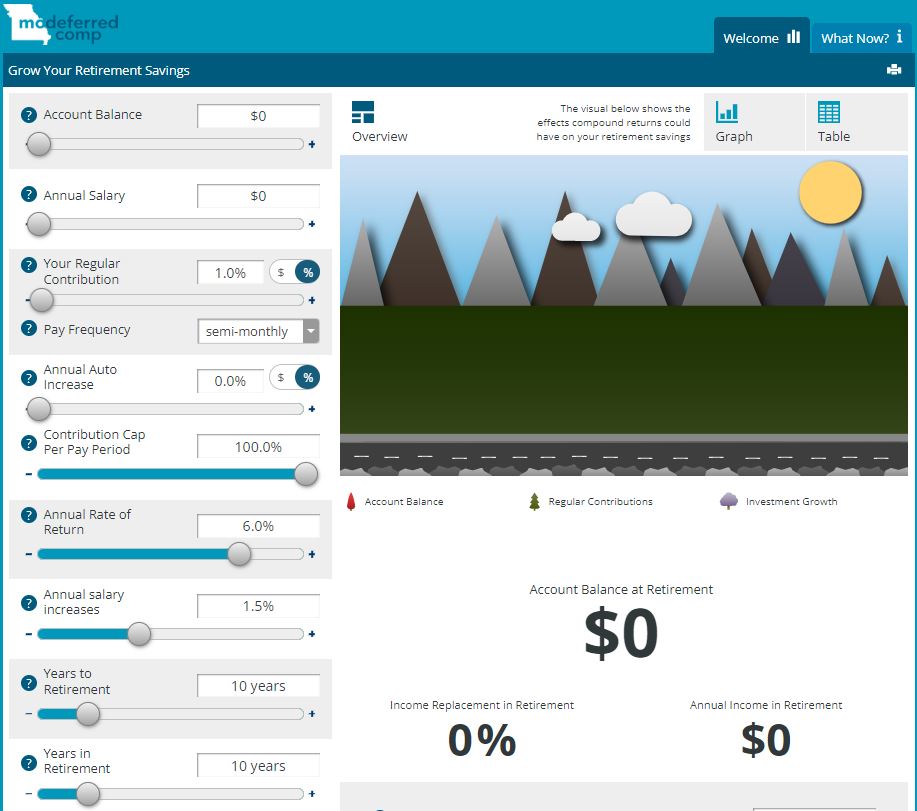
A helpful tool to explore how much in retirement savings you may need is the Grow Your Retirement Savings calculator offered by Mo Deferred Comp. It allows you to input a variety of factors such as your current Deferred Comp account balance, current annual salary, your regular Deferred Comp contributions and increases, desired annual income in retirement, etc. Manipulating these factors in the calculator can give you an idea of the amount of income replacement your Deferred Comp account may provide in retirement. |
|
|
|
|
Without the MPERS defined benefit pension benefit, your retirement income would be heavily reliant upon your deferred compensation account or other 401k set up for your retirement. Once the account balance has been paid out, no further payments will be made. The source of retirement income would no longer exist. In addition, the per paycheck dollar amount that would have to be made to come close to the benefit MPERS provides wouldn’t be practical for the majority of MPERS members. |
|
Your monthly retirement benefit from MPERS supplemented by your Deferred Comp account can help you have a comfortable and reliable income in retirement. |
|
Financial markets were hit with a new round of volatility last month, with this one coming from the banking sector and the closure of Silicon Valley Bank and Signature Bank. These shocks to the economy are stressful and present challenges for all investors.
Do not forget that MPERS assets are diversified across a wide range of assets to help mitigate the negative impact of events such as this. Furthermore, as beneficiaries of the System, these market events have no bearing on the benefit you are receiving or will receive. You can count on vested benefits for your lifetime.
As of March 30, the overall portfolio is up an estimated 4.5% for Fiscal Year 2023 (July 1 – March 30).
|
|
MPERS Receives Certificate of Transparency |
|
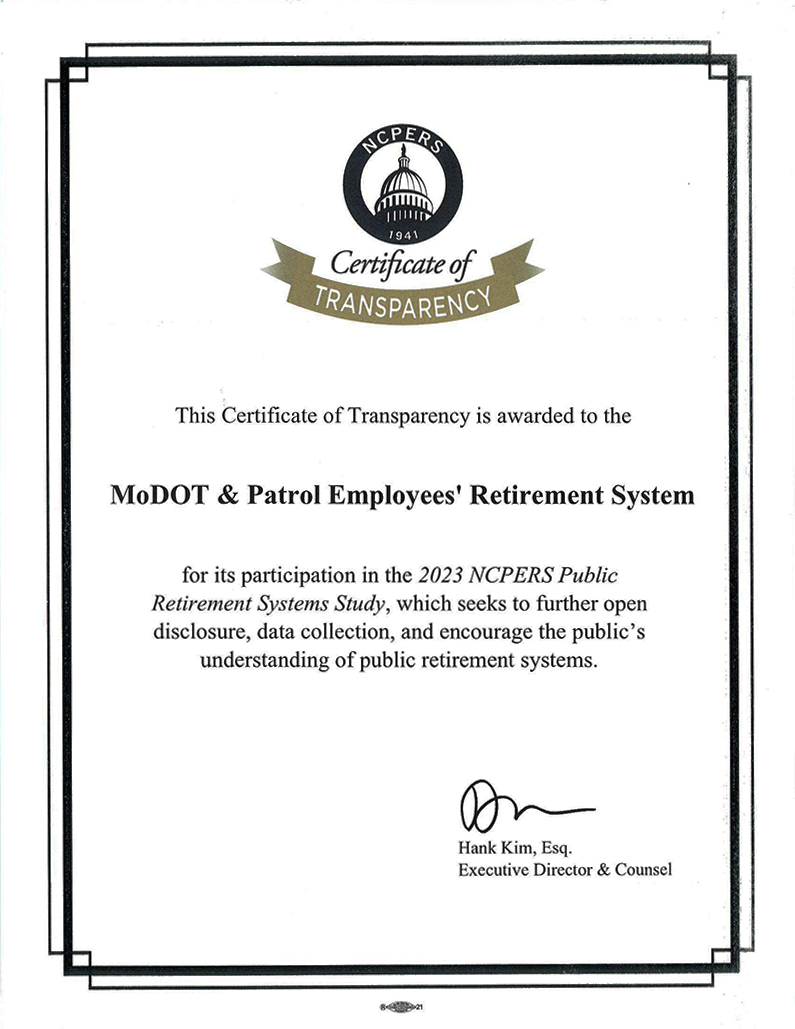
The National Conference on Public Employee Retirement Systems (NCPERS) recently recognized MPERS with a Certificate of Transparency for participating in the 2023 NCPERS Public Retirement Systems Study. This certificate acknowledges MPERS' commitment to furthering openness between public pensions and the public.
MPERS was one of 195 plans that participated in the transparency study.
Founded in 1941, NCPERS is the largest trade association for public sector pension funds, representing approximately 500 funds throughout the US and Canada. They are a unique, non-profit network of public trustees, administrators, public officials, and investment professionals who collectively oversee nearly $4 trillion in retirement funds.
|
|
- 4 - Pre-retirement webinar for Closed Plan/Year 2000 Plan members, register here
- 12 - Pre-retirement seminar for Closed Plan/Year 2000 Plan members, Lee's Summit, register here
- 13 - Pre-retirement seminar for Closed Plan/Year 2000 Plan members, Lee's Summit register here
- 20 - Mid-career webinar for Closed Plan/Year 2000 Plan members, register here
- 25 - Pre-retirement seminar for Closed Plan/Year 2000 Plan members, West Plains register here
- 30 - Deadline to submit step 1 - Notice of Retirement for June 1 retirement
|
|
We value your feedback!
What would you like to see in The Pensioner: Looking Forward?
|
|
|
|
|
|
|