Issue 58

July 30, 2026

Time to Read: 6 minutes


-Hot Take-

Running a machine shop isn’t hard because of the work. It’s hard because you’re forced to solve a hundred crises before lunch.

Joke of the Week

Knock, knock.

Who’s there?

Setup sheet.

Setup sheet who?

Exactly.

Ask a CAM Pro

Real shop problems. Answers from people who have been there.

How do I prepare for automation-driven CAM workflows?


Automation in CAM is not a button you turn on. It is the result of consistency. If your tools, posts, naming, and process vary from job to job, automation just repeats chaos faster. The goal is to build a workflow where common decisions are standardized, so programming becomes selecting and verifying instead of reinventing.


Start by standardizing your tooling and holders.

Automation depends on predictable tool assemblies. Define approved cutters, holders, tool numbers, stickouts, and gauge lengths, and keep them consistent across machines where possible. If every programmer models tools differently, simulation and collision checking become unreliable.


Lock down your post processors.

A stable, documented post is the foundation. Make sure each machine has a proven post, with controlled revision changes and a clear owner. Automation breaks down when posted output varies unexpectedly between programmers or versions.


Create template-based setups.

Build reusable setups that include work offsets, coordinate system conventions, safe planes, fixture models, probing routines, and common operation sequences. Templates should reflect how the shop actually runs jobs, not how someone thinks it should run them.


Build a clean tool library strategy.

Use a master library with approved tools, then create smaller subsets by machine group, material, or job family. Consistent naming, accurate tool parameters, and complete assemblies make automated selection and verification possible.


Standardize manufacturing data.

Keep material names, machine definitions, fixtures, workholding, and machining resources consistent across the organization. Automation engines rely on structured data to make repeatable decisions. Inconsistent naming or missing information reduces the effectiveness of automated programming.


Define machining standards that can be repeated.

Write down default stock allowances, stepovers, stepdowns, lead-in styles, linking rules, and finishing passes for common materials. The more decisions you remove from “personal preference,” the easier it is to automate and the more consistent the results.


Use consistent model inputs and geometry prep.

Automation needs clean geometry. If model prep, stock definition, or feature naming changes every time, automated toolpath generation will be inconsistent. If model prep changes every time, automated toolpath generation will be inconsistent.


Add verification into the process, not as an afterthought.

Automated toolpaths still need reliable checks. Standardize simulation settings, collision objects, and stock carry-forward so verification is fast and repeatable. Automation should reduce risk, not hide it.


Start with job families, not one-offs.

Pick a repeat part type, like similar pockets, similar brackets, or similar prismatic work, and build automation around that family first. Once the workflow is stable there, expand it. Trying to automate everything at once usually stalls.


Train around exceptions and ownership.

Automation works best when the team knows what is standardized and what still requires judgment. Assign owners for tool libraries, posts, templates, and revision control, and set a change process so improvements are controlled.


Bottom line:

Automation-driven CAM is built on standards. If you standardize tools, posts, templates, and machining rules, automation becomes a multiplier for speed and consistency instead of a multiplier for mistakes.


Have a programming question?


Send it in for the next edition of Ask a CAM Pro!

Shop Floor Debate

What is the most underrated skill on a CNC shop floor?

Last week's debate: Half of the shops responding can only see their workload about two weeks ahead.

From the Floor

We Took Any Job and We Got Burned


“When I first started the shop, we had zero customers and no clue what our ideal job looked like. Every call and every walk-in got a yes. That meant the weird jobs, the rush jobs, and the ‘can you fix my neighbor’s tractor part?’ kind of stuff.


Unfortunately, the rent still had to get paid. Some of the jobs blew up in our faces. We took on parts that were not a fit for our process, customers who wanted the world for pennies, and those jobs where halfway in you just knew you should have said no."


–Shop Owner

Video of the Week (Powered by GibbsCAM)

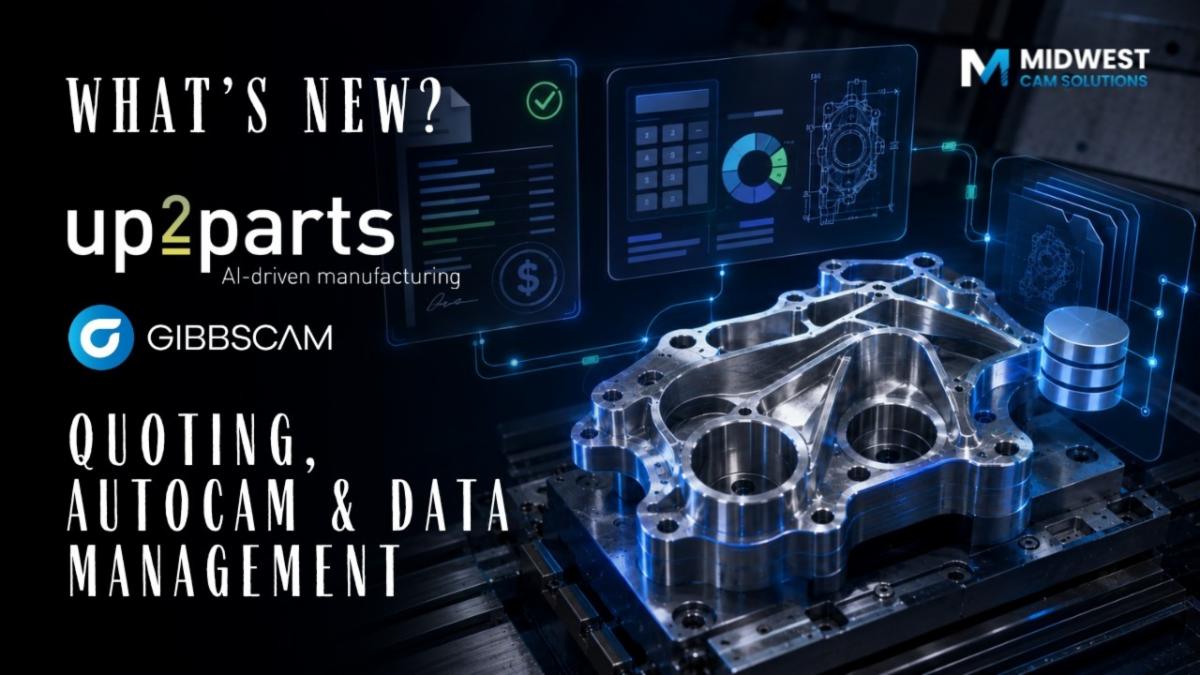
up2parts for GibbsCAM: AI-Powered Manufacturing from Quote to CAM

In this June 2026 release, discover how up2parts works with GibbsCAM to organize manufacturing data, analyze part geometry and tolerances, calculate cycle times and costs, and automatically create CAM programming proposals. More releases, updates, and enhancements are planned as the integration continues to develop.

CAMedy Central

Industry Intel

Mill-Turn Machines Boost Efficiency and Precision

SPINNER North America's mill-turn machines combine turning and milling into a single setup, reducing errors, saving shop space, and boosting spindle time by eliminating the need to move parts between separate machines.


E.U., Japan, South Korea, Switzerland Spared Added Tariffs

New U.S. tariffs of 10%-12.5% imposed on 60 countries over forced-labor manufacturing concerns won't be stacked on top of existing duties for the E.U., Japan, South Korea, Taiwan, and Switzerland, thanks to their prior trade agreements with the U.S.


Phillips Federal Adds Hybrid and Additive Manufacturing Navy Training

Phillips Corporation's Federal Division, working with BlueForge Alliance, delivered 12 hybrid CNC/metal-additive systems and 12 Markforged X7 composite 3D printers to the Navy's Danville, Virginia schoolhouse to train sailors in hands-on part fabrication and repair for fleet readiness.

Industry Growth (Open Jobs)

A few hot openings across the industry this week:


CNC Programmer - Cretex Medical Component & Device Technologies - Wadena, MN


CNC Machinist - Caztek Engineering - St. Paul, MN


CNC Programmer (CAD/CAM) - Owen Industries - Carter Lake, IA


Regional Applications Engineer - Maintecx Machine Tool - South Dakota


Machinist - Terhorst Manufacturing - Minot, ND


Robot/Cobot Programmer - Duo Lift Manufacturing Co., Inc. - Columbus, NE


Lead Machinist & CNC Programmer - Gravity Manufacturing - Pittsburg, MO


Machinist - National Beef - Liberal, KS

Trade Show & Event Radar

Date

Show

Location

Sept 5

Minnesota Manufactured Day

Minnesota State Fair

Falcon Heights, MN

Sept 14-19

IMTS

Chicago, IL

Oct 6-7

Top Shops Conference

Cleveland, OH

Oct 21

GibbsCAM 2027 Rollout

with Midwest CAM Solutions

Brooklyn Park, MN

Oct 21-23

FABTECH

Las Vegas, NV

Oct 28-29

MD&M Midwest

Minneapolis, MN

Nov 11-13

Titans of CNC Boombastic Show

Flower Mound, TX

Did someone forward you this newsletter?

Subscribe to get your own copy every week.