WEL NEWSLETTER January 2026, Vol. 15, No. 10 | | |
Hello,
Happy January! It has been a cold and snowy time in Toronto this month. I started off the year at the cottage with my mom, Sammi, and of course Charlie, bringing in the New Year and enjoying the winter wonderland that is our northern Ontario. Its so much nicer than the slush that happens in Toronto.
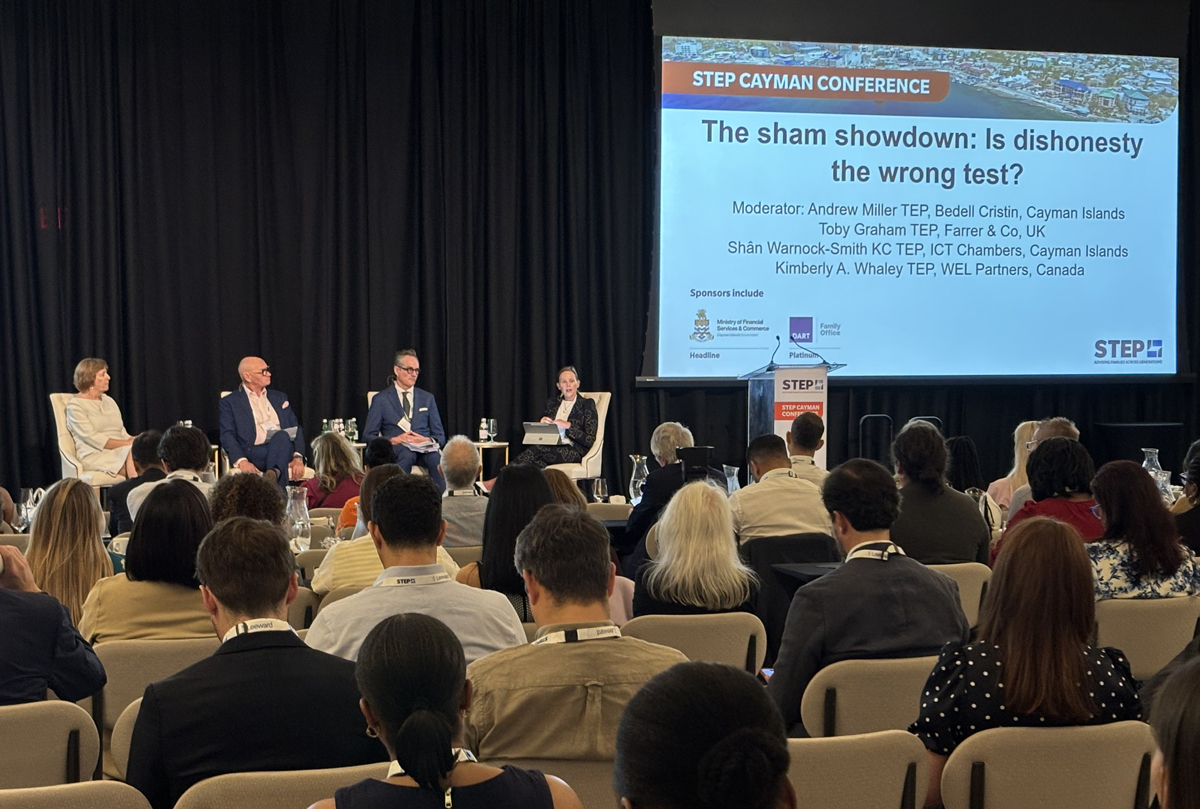
| I was honoured to have been invited to participate at STEP CAYMAN with colleagues Toby Graham, and Shan Warnock-Smith in a debate chaired by Andrew Miller. The debate involved the following question: Is the sham test a vital loophole from another era? Does the dishonesty element of the sham trust analysis make trusts harder to attack – in other words, a win for settlors; or too easy to abuse which is a headache for trustees. Should we keep the high bar to prove sham; or rethink to stop trusts being treated like personal bank accounts? | |
The debate was super fun and interesting and the results were: 51:49 in favour of leaving the Snook Test unchanged.
Grant Swedak helped me prepare for this presentation in offering up the Canadian Perspective on Sham Trusts (link to Grant’s paper). Also, see our four blogs posted on the issue of Sham Trusts:
Bryan attended the conference with me, and we were treated so well by the local Caymanians having been hosted by Saffery Trust (Cayman Limited) to a wine tasting led by Henry Warnock-Smith and the Cayman Wine School; Walkers Farm to Fork Feast; & R&H Trust and Corporate. We thank you for such warm and welcoming hospitality.
I would personally like to thank our Highschool co-op student Davis Falkiner who has been with us for 4 months and is now finished his time with us. What a delightful young man! No doubt we will be seeing Davis make his mark on the world in upcoming years. Davis was diligent, present, clever, kind, respectful and keen to learn. We wish you all the luck in your continued studies, goals and aspirations Davis!
I hope you are enjoying this cold snowy winter we are having!
Next month in our Valentine’s Edition, I will have an adventure to share with you, stay tuned.
Until then,
Enjoy the Read,
Kim
| | 1. STEP CAYMAN ISLANDS CONFERENCE | | |
Kimberly Whaley had the honour of taking part in the 2026 STEP Cayman Conference. Kim, alongside Toby Graham (TEP, Farrer & Co, UK), Shân Warnock-Smith (KC, TEP, ICT Chambers, Cayman Islands), and moderated by Andrew Miller (TEP, Bedell Cristin, Cayman Islands), were focused on the topic of Sham Trusts and whether the current sham test a vital safeguard or a loophole from another era.
For more information on the 2026 Cayman Conference, please visit the following link:
https://stepcayman.com/events/step-cayman-islands-conference-2026
| | 2. LAW SOCIETY OF ONTARIO: THE ANNOTATED POWERS OF ATTORNEY FOR PROPERTY AND FOR PERSONAL CARE 2026 | | |
On January 21, 2026, WEL Partners’ Nima Hojjati had the opportunity to speak at the Law Society of Ontario’s Annotated Powers of Attorney for Property and for Personal Care 2026. Nima, alongside David Freedman (C.S., TEP, Queen’s University), concentrated on the topic of Agency versus Delegation, focusing on legal distinction between fiduciary discretion and delegable ministerial acts within the context of Powers of Attorney for Property.
For more information on this event, or to purchase the course on the LSO website, please visit the following link:
https://store.lso.ca/the-annotated-powers-of-attorney-for-property-and-for-personal-care-2026
| | 3. CAMBRIDGE FORUM: ASIA-PACIFIC WEALTH ADVISORS, BANGKOK | |
On February 8 to 10, 2026, Kimberly Whaley is thrilled to be attending the Cambridge Forum for Asia-Pacific Wealth Advisors. The Forum will bring together participants to examine critical developments in estates, trusts, and tax law, exchanging valuable insights, delving into modern solutions, and formulating strategies to navigate the evolving landscape of challenges faced on behalf of their clients.
For more information on the Forum, please visit the following link: https://cambridgeforums.com/forums/fawa
| | 4. WELCOME TO OUR ARTICLING STUDENT: JESSICA HOMER | |
WEL Partners welcomes Articling Student, Jessica Homer. Jessica received her Bachelor of Laws (LLB) from the University of Law in London, England. Following her time in the UK she went on to qualify her law degree in Canada by completing the Global Professional Master of Law Program at the University of Toronto, Faculty of Law. Before joining us, Jessica fostered her interest in estate matters as a legal assistant at a boutique estate litigation firm. Welcome Jessica!
| | II. WEL SHOUT OUTS & CONGRATULATIONS | | OBA RANDALL ECHLIN AWARD FOR EXCELLENCE IN LABOR & EMPLOYMENT LAW | | (i) SAUNDERS v. VAUTIER WHILE PARTIES ENGAGED IN LITIGATION | | |
By Albert H. Oosterhoff
1. Introduction
Can a sole beneficiary who is of full age demand payment of the residue from the executor when she is engaged in litigation with the executor. That is the issue raised in Pitt v Beattie.[1]
2. Facts
The testator, Brian Beattie (‘Brian’) died in May 2020. His brother ‘Ian’ was appointed estate trustee. Brian’s Will left the residue of his estate in trust for the Plaintiff, Ms Pitt, until she attained age 25. She is now 23 years old but is entitled to the property under the rule in Saunders v Vautier,[2] since she is of full age and not otherwise under any disability. However, she brought an action against Ian and his two children in which she alleges that Ian sold the major asset of the estate, a parcel of real property, to his two children in an improvident sale without exposure to the market, and at an undervalue.
Ian acknowledges the Plaintiff’s entitlement to receive funds before she reaches age 25 under the rule in Saunders v Vautier. He released $100,000 to the Plaintiff and is willing to distribute another $200,000 to her, provided the Plaintiff executes a partial release concerning Ian’s management of the estate funds.
The Plaintiff then brought this motion seeking a partial distribution of the estate in the amount of $300,000 as its sole beneficiary. Ian opposes the motion on the ground that the rule in Saunders v Vautier does not permit a beneficiary to bypass the administration of the estate. He argues that the amount to be paid to the Plaintiff cannot yet be determined because the amount of the residue is unknown and because funds need to be retained until judgment is rendered in the action and to pay his costs as estate trustee.
3. Analysis and Judgment
Justice Nicholson began his analysis by noting that a beneficiary is not entitled to be paid his share of the estate until the executor is prepared to distribute the estate. Nor is he entitled to receive an interim distribution.[3] The court only has jurisdiction to intervene in the exercise of a discretion by an executor or trustee in the following situations: (1) a mala fides exercise of the discretion; (2) a failure to exercise the discretion; and (3) a deadlock between executors or trustees about exercising a discretion.[4] His Honour noted that, as distinct from another case,[5] the estate trustee did not refuse to make a distribution unless the beneficiary signed a partial release. Rather, he refused to make a distribution in the amount claimed by the Plaintiff. Thus, there was no male fides on the part of the estate trustee.
His Honour further noted that an estate trustee is generally entitled to be fully indemnified from the estate for all reasonably incurred legal costs, including litigation costs, unless the estate trustee acted unreasonably or in his own self-interest. In this case the Plaintiff is impugning the actions of estate trustee on the ground that they were done in his own and his children’s interest. If the Plaintiff is successful, it is likely that her costs will have to be paid by the defendants. On the other hand, if the defendants should succeed, it is likely that the Plaintiff will be ordered to pay their costs.
Justice Nicholson held that the estimation by the estate trustee of future legal costs does not amount to ‘security for costs’ but constitutes a legitimate holdback. He noted that estate trustees have significant leeway in maintaining such a holdback. Further, he concluded that it would be speculation on his part to assume what the outcome of the trial will be and what order the court may make about the costs.
His Honour went on to hold that the estate trustee was entitled to determine the amount to be distributed. He also held that the two offers the estate trustee made to the Plaintiff, one of which was unconditional and the other conditional on the Plaintiff’s execution of a release cannot be characterized as holding the Plaintiff hostage, as it was in the Brighter case.
Finally, his Honour held that the rule in Saunders v Vautier does not trump the discretion of an estate trustee who exercises his discretion reasonably and where the amount of the residue remains uncertain.
Consequently, his Honour dismissed the Plaintiff’s motion.
--
[1] 2025 ONSC 5654.
[2] (1841), 4 Beav 115, 49 ER 282 (Rolls Ct), affirmed 1 Cr & Ph 240, 41 ER 482 (Ch Div), discussed in Buschau v Rogers, 2006 SCC 28.
[3] Citing, inter alia, Furfari v Furfari, 2016 ONSC 4882, para 30, per Wilton-Siegel J; Bank of Nova Scotia Trust Company v Charles, 2021 ONSC 1361.
[4] Parson v McGovern, 2014 ONSC 1785, para 26, per Smith J.
[5] Brighter v Brighter Estate, 1998 CarswellOnt 3113, para 9, per Sheard J. In that case the executor distributed the shares of two beneficiaries unconditionally, while insisting that the dissenting beneficiary sign a release and waive the passing of accounts before he would be paid his share.
| (ii) WILL INTERPRETATION USING ARMCHAIR PRINCIPLE | | |
By Albert H. Oosterhoff
1. Introduction
After so many cases at the appellate level which have held that the armchair principle should be applied as a matter of course when interpreting wills, it beggars belief that some judges continue to ignore that principle and that some lawyers continue to argue that the principle should not be applied. That argument was made again by the parties in Haddock v Haddock.[1] Thankfully the court rejected the argument in this case.
2. Facts
The Testator, Audrey Lillian Haddock died in May 2022. She was predeceased by her husband and by one child, who died without issue. She was survived by three children, William, Susan, and Thomas, and named the three as joint executors in her Will made in 2012. The Will made a gift of one investment account for the benefit of the Testator’s grandchildren equally. It contained the following provision regarding the Testator’s cottage property:
If I still own the cottage located at 96 Gilmour Point, Apsley, Ontario K0L 1A0 at the date of my death, title to the property shall be transferred to my son, THOMAS STEPHEN HADDOCK; provided that the value of said cottage property as determined by a qualified appraiser and the cost of said appraisal shall be deducted from my said son’s share of my Estate.
The Will left the residue equally between the three surviving children.
Two qualified appraisers valued the cottage at $1,375,000. However, the residuary estate apart from the cottage was only $796,688.64. This would give each child a share of $265,562.88, less additional taxes and estate administration costs.
The children disagree about the effect of the Will in light of the fact that the appraised value of the cottage is greater than Thomas’s share of the residue. Thomas argues that he is entitled to the cottage, provided that the appraised value of the cottage is deducted from his share only up to the value of his share of the residue. But William and Susan argue that the Will requires Thomas to pay the full appraised value of the cottage from his share of the estate plus any shortfall that exceeds his interest. They brought this application for the court’s opinion, advice and directions.
The parties submitted that the court can only apply the armchair rule if the language of the clause fails adequately to make the Testator’s intention clear!
3. Analysis and Judgment
Justice Akbarali began her analysis with a discussion of the modern legal principles that govern the interpretation of a will. For this purpose, she referred specifically to the leading case in Ontario, Ross v Canada Trust Company,[2] as well as to Trezzi v Trezzi[3] and Dice v Dice Estate.[4] These cases all hold that when interpreting a will, the court must determine the testator’s actual or subjective intention about the distribution of her property. For that purpose, the court is not just entitled to sit in the testator’s armchair but must do so from the outset of its deliberations. In other words, the court should not first determine whether the language of the Will is clear and unambiguous, and if it is, end its deliberation. It must consider that language in the context of the circumstances of the testator when she made the will. On this point see also Zindler v Salvation Army,[5] and Hicklin Estate v Hicklin.[6] The only extrinsic evidence the court may not normally consider is direct extrinsic evidence of the testator’s intention.[7]
Her Honour then considered the evidence of surrounding circumstances. She held that certain letters from family members and neighbours about the Testator’s intentions were inadmissible because they were direct extrinsic evidence and hearsay.
Justice Akbarali found that the Testator would have been aware that William and his wife had purchased their own cottage, and that Susan lived in Alberta and had limited opportunity to use the cottage. She would also have known that Thomas used the cottage regularly and liked it. She also found that the Testator wanted the cottage to be kept in the family and that it made the most sense for Thomas to receive it. Moreover, when she made the Will, it was likely that Testator expected that Thomas’s one-third share would be adequate to cover the value of the cottage, and that, in the result, each child would benefit equally under her Will.
Justice Akbarali found that the language of the Will supported the extrinsic evidence that the Testator intended to treat her children equally. While the Testator did not consider the possibility that the value of the cottage would increase significantly, that does not alter her intention to benefit her children equally. Thus, she found that the Testator did not intend that William and Susan’s shares should be reduced by the shortfall between the value of Thomas’s share and the value of the cottage. In consequence, she held that Thomas is entitled to the cottage if its value is returned to the estate. Thus, if Thomas wants the cottage, he must pay the outstanding balance. If he does not, the gift to him fails and then the cottage must be sold, and the purchase price will fall into residue.
On the issue of costs, her Honour found that the application was the consequence of the failure of the Testator to address the possibility that Thomas’s share might be insufficient to cover the value of the cottage. Therefore, it was appropriate that the estate pay the substantial indemnity costs of the Applicants. Since Thomas was unsuccessful, she ordered that he pay his own costs.
---
[1] 2025 ONSC 6287.
[2] 2021 ONCA 161.
[3] 2019 ONCA 978.
[4] 2012 ONCA 468.
[5] 2015 MBCA 33, para 14.
[6] 2019 ABCA 136, paras 76, 89, 93, 94.
[7] Citing Kurt v Kurt and Sullivan, 2023 ONSC 6599, paras 30, 32.
| | (iii) DYING WITHOUT A WILL: HOW ONTARIO’S INTESTACY RULES AND PREFERENTIAL SHARES SHAPE ESTATE DISTRIBUTION | | |
By Grant Swedak
When someone dies without a will, the law steps in to decide who inherits, how much, and in what order. This post unpacks Ontario’s intestacy regime under the Succession Law Reform Act,[1] from the rigid hierarchy of consanguinity to the often-misunderstood mechanics of preferential shares and spousal entitlements.
Introduction – What is Intestacy?
Simply put, intestacy is a sort of default distribution scheme established by the legislature and common law principles which is imposed on one’s Estate where they die without a valid will. Intestacy may also occur where there is a valid will, but one or more provisions of the will does not provide for adequate dispose of the asset/ residue. This is referred to as partial intestacy.
Partial intestacies may arise in several scenarios; one example may be as follows: suppose a will divides the residue of an Estate equally into three shares. The three shares are directed to be distributed, one each, to the testator’s three children. Unfortunately, however, one of the testator’s children predeceases them and there is no alternative provision or gift over provided for that share of the residue. In this case, the Court may find that a partial intestacy has arisen.
For more reading on where partial intestacies may arise, consider checking out a previous blog of mine which can be found here.
The Law:
The law of intestacy is primarily governed by Part II of the SLRA.[2] Part II of the SLRA contains sections 43.1 – 49. The two most important aspects of intestacy are the distribution scheme itself and the availability of preferential shares via ss 45, 46, and 47 of the SLRA.
1. Distribution Scheme of Intestacy:
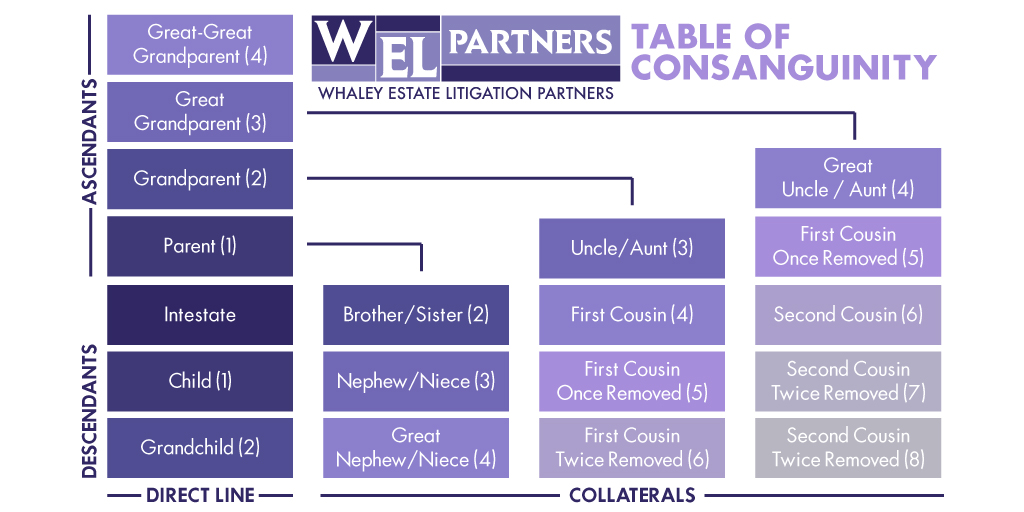
The distribution of assets under intestacy is largely governed by section 47 of the SLRA.[3] The distribution is bound to follow the table of Consanguinity.[4] In plain English, the table of consanguinity is a legal chart used to measure how closely two people are related by blood by counting the number of generational steps between them. The fewer the steps to a common ancestor and back down, the closer the legal degree of relationship. Below is a visual representation:
| |
The highest priority is given to the surviving spouse holding the same meaning of section 1 of the Family Law Act.[5] An important corollary is that given the definition within section 1 of the FLA, common law spouses are not entitled to benefit from intestacy.
The next priority, as per section 47(1) of the SLRA, flows to the “Issue” of the deceased. The term “Issue” refers to the lines of descendancy of a given person (i.e. children, grandchildren, great grandchildren, etc..).
After the Issue, the priority begins moving up to the parents as per section 47(3) of the SLRA.
Where there is no spouse, no issue, or parents, section 47(4) of the SLRA then looks to siblings.
If there are no siblings, the next priority goes to nieces and nephews as per section 47(5) of the SLRA.
The final degree of Consanguinity is stated in section 47(6) of the SLRA which just looks for a general next of kin. If a person dies intestate and there is no surviving spouse, issue, parent, siblings, nieces, nephews, or next of kin, the property will escheat to the Crown as per section 47(7) of the SLRA and the Escheats Act, 2015.[6]
2. Preferential Shares:
First, it is critical to note that preferential shares only apply to persons who have died on or after April 1, 1995.[7] Preferential shares occur only where the intestate is survived by a spouse AND issue as per section 45(1) of the SLRA. This is logically coherent for if the deceased were to die intestate, without issue, there would be no need for a preferential share as the spouse would inherit the entirety of the Estate.
Per section 45(1) of the SLRA, preferential shares may only be applied to Estates that exceed the value of said preferential share. Once again, this is logically coherent for if the Estate’s total value was less than the preferential share amount, the surviving spouse would be entitled to inherit the entirety of the Estate via the preferential share.
A preferential share entitles a spouse, prior to any distribution to the issue, an amount of 200k (if the deceased died before March 1, 2021) or 350k (if the deceased died after March 1, 2021).[8] Further, the distribution of the Estate following the preferential share will vary depending on the amount of issue.
Where there is a spouse and only one issue, the spouse is entitled to a preferential share AND one-half of the remaining Estate after the preferential share payment.[9] For clarity, suppose a deceased died after March 1, 2021, leaving behind an Estate of $1,000,000. The surviving spouse would be entitled to their preferential share of $350,000. After the preferential share is deducted, the Estate would have a balance of $650,000. If there is only one issue alive, then the $650,000 would be divided among the surviving spouse and issue, bringing the surviving spouse’s inheritance to $675,000 and leaving the sole issue with $325,000.
Where there is a spouse and more than one issue, the surviving spouse will receive their preferential share and one-third the remaining Estate after the preferential share payment.[10] For clarity, let’s use the $1,000,000 Estate example again. In this case, the surviving spouse’s preferential share of $350,000 is immediately deducted off the top once again – leaving $650,000. In this example, suppose there are three issue. In this case, the surviving spouse is entitled to one-third of $650,000, being $216,666. In total this leaves the surviving spouse with $566,666. As for the three issue of the deceased, the remaining two-thirds ($433,332) will be distributed equally among them, leaving each issue with $144,444.
Final Remarks
Ultimately, intestacy is a blunt legal instrument that substitutes legislative policy for testamentary intention. The Succession Law Reform Act imposes a rigid hierarchy of entitlement. Beginning with legally recognized spouses, followed by issue and other blood relatives as determined by the table of consanguinity, often producing outcomes that diverge sharply from what the deceased may have expected or wanted. Notably, common law spouses are excluded entirely, and partial intestacies can arise even where a will exists but fails to dispose of all assets.
Preferential shares further complicate the landscape by materially altering the division of an Estate where a spouse and issue survive. Depending on the date of death and the number of surviving issue, a spouse’s entitlement may substantially reduce what ultimately flows to children or grandchildren. Taken together, these rules highlight both the technical complexity of intestacy and the real financial consequences that can result, reinforcing the importance of careful, comprehensive Estate planning to avoid unintended and often irreversible outcomes.
---
[1] Succession Law Reform Act, R.S.O. 1990, c. S.26. (“SLRA”)
[2] SLRA, at Part II.
[3] SLRA, at section 47.
[4] SLRA, at section 47(6).
[5] Family Law Act, R.S.O. 1990, c. F.3, at section 1. (“FLA”)
[6] Escheats Act, 2015, S.O. 2015, c. 38, Sched. 4.
[7] Succession Law Reform Act, RSO 1990, c S.26, s 45, as enacted by An Act to amend the Succession Law Reform Act, SO 1994, c 27, in force 1 April 1995.
[8] As per SLRA, at section 45(5) and O. Reg. 54/95: GENERAL, at section 1.
[9] SLRA, at section 46(1).
[10] SLRA, at section 46(2).
| | (iv) DECODING ESTATE TRUSTEE RESPONSIBILITIES: A LEGAL PERSPECTIVE FROM NEUBAUER v. NEUBAUER | | |
By Mark Polese
Historically, courts will scrutinize all actions taken by an estate trustee with respect to the administration of an estate if a beneficiary takes issue with that administration. As such, it is important for a prospective executor to understand their role as estate trustee and how their decision-making may be viewed by a court of law. The overarching guiding principle for an executor’s conduct is that they must always act in the best interests of the beneficiaries to that estate.[1] However, it is not always clear how a given court will rule on individual decisions. As such, it can be important to look to recent decisions where the court must grapple with the conduct of an executor to get an idea as to the attitude of Canadian courts towards impugned executor conduct. One such case that is instructive on this topic is the recent British Columbia Supreme Court decision of Neubauer v. Neubauer.[2]
Background
This decision arose out of the context of a challenge to the will of Gary Neubauer (“Gary”), who passed away on April 20, 2024. The challenger of the will is Gary’s daughter, Angela Neubauer (“Angela”). In his will, Gary left the residue of his estate to his wife, Joyce Neubauer (“Joyce”). Joyce has two of her own children, unrelated to Gary, while Gary had two biological children, Angela and Derek.
On drafting his will dated April 13, 2023 (the “Will”), Gary advised the notary drafting it that he and Joyce intended to create “mirror wills”, providing that the remainder of the property would be divided equally between the four children after the later of them died. A mirror will is a pair of nearly identical wills made by two people (usually a couple) that "mirror" each other's wishes, typically leaving everything to the surviving partner and then to shared beneficiaries (like children) if both pass away. However, the Will as drafted appears to leave the remainder of the estate to Joyce without limitation. Angela seeks to challenge the Will on that basis in the larger application.
In the Will, Gary had appointed the husband of one of Joyce’s daughters, Colin McCarthy (“Colin”) to be the estate trustee of the Will. As part of his duties as estate trustee, Colin sought to sell Gary and Joyce’s home in Squamish, British Columbia (the “Family Home”), which was the principal asset of the estate.
The Family Home was initially appraised at a value of $1.5 million. An offer on the Family Home was ultimately accepted by Colin for $1.45 million. In this interim application, Angela sought to remove Colin as estate trustee and enjoin the pending sale of the Family Home. Angela objected to the sale on two grounds: first that Colin was in a conflict of interest with the buyer of the Family Home, and second, that more value could have been obtained in the Family Home had repairs been completed on it prior to going to market. Additionally, Angela argued that, generally, Colin was not a suitable estate trustee, and she asked for a corporate trust company to be substituted pursuant to s.158(3) of the BC Wills, Estates and Succession Act (“WESA”).[3]
Issues
The Court laid out four distinct issues that arose out of Angela’s interim application:
- Was the sale of the Family Home “improper” because it was not arm’s length?
- Was the sale of the Family Home “improvident” such that better value would have demonstrably been obtained if it was either put on the market for longer or if repairs had been completed?
- Should the sale of the Family Home be stopped?
- Should Colin be removed as Estate Trustee?
Analysis
Issue 1: Was there a conflict of interest with the sale?
Angela claimed that Colin was in a clear conflict of interest based on Colin’s own evidence that he had recognized the name of the buyer of the Family Home from when he started working at the District of Squamish thirteen years prior. The estate argued that there was no conflict of interest, as Colin had not had any business dealing with the buyer, and had no communication with them before or after the sale.
The Court took the view that, given the relatively small size of the Squamish community, merely being acquaintances is not the same thing as being not at arm’s length. Therefore, a reasonable person apprised of these facts would not think that Colin’s relationship with the buyer would result in him potentially accepting anything less than what he thought would maximize the return to the estate.
The Court did hint however, that if they were in a larger community, such as Vancouver, they potentially could take a differing view with respect to their prior relationship, however limited it may be.
Issue 2: Was the Sale Improvident?
When an Estate trustee sells an asset of an estate, they have an obligation to get good value from the sale.[4] While price is certainly central to value, timing and conditions are also relevant considerations. Although the court plays a role in ensuring an estate trustee has discharged this duty, it will give considerable deference to their judgment. If courts are to intervene too often, it could make these types of transactions more difficult and will divert an estate’s limited resources to litigation. Therefore, a judge will not intervene in an executor’s judgment calls about value, if they exhibit the kind of prudence, one would expect them to exercise with their own property.
Here, evidence was presented that the Family Home needed major repairs. The estate did not have much in the way of additional cash funds to pay for repairs or improvements, as the Family Home was essentially the only notable asset to Gary’s estate.
Colin did obtain a professional appraisal, which estimated the value of the Family Home without the repairs to be around $1.5 million as of September 12, 2025. Notably, this appraisal was based on a direct comparison approach, which relied in part on older sales of equivalent properties. The court here additionally went as far to take judicial notice that the real estate market had slowed down in B.C..
As such, the Family Home was listed for $1.499 million, and an offer was received and accepted by Colin for $1.45 million. The court held that the difference between the appraised value and the offer is not unusual enough to be the basis for interference by a court.
The Court did note that Angela’s most persuasive argument is that the Family Home may have been sold for a higher value if money was invested into repairs. However, the Court found that the estate did not have the resources necessary to enact these repairs. Therefore, it was reasonable for the estate to go through with the sale in these circumstances.
Again, the Court did hint at the fact that, were there clear evidence that the repairs would have in fact yielded a higher return, and were there resources to enact those repairs, then the estate trustee may very well have been compelled to do so.
Issue 3: Should the Sale be Enjoined
Despite its findings on the first two issues, the Court still underwent the analysis for awarding an injunction from RJR-Macdonald.[5] The test from RJR-Macdonald provides that in order to be awarded an injunction, the party seeking it must establish that there is (1) a serious issue to be tried, (2) that they would suffer irreparable harm if the injunction is not granted, and (3) that the balance of convenience between the harm suffered by the parties favours the injunction.
The Court found that Angela was successful in establishing that there was a serious issue to be tried, as this is a low standard essentially meaning that case is not doomed to fail. Additionally, the Court also found some evidence of irreparable harm, as there would be no way for her to obtain more value from the estate if the Family Home was sold for too little.
However, the Court held that her injunction request fails at the third stage of the RJR test. The irreparable harm goes both ways as if the sale were delayed, the condition of the Family Home would deteriorate, and it was unclear whether the market would improve. Therefore, the weight of irreparable harm is greater on the parties against whom the injunction would be brought. As such, the Court opts not to award an injunction and allow the sale to go through.
Issue 4: Legal Test for Removal of an Executor
The court cited s.158(3) of WESA[6] where it stated:
(3) Subject to the terms of a will, ... the court, by order, may remove or pass over a person otherwise entitled to be or to become a personal representative if the court considers that the personal representative or person entitled to become the personal representative should not continue in office ..., including, without limitation, if the personal representative or person entitled to become the personal representative, as the case may be,
...
(f) is
i. unable to make the decisions necessary to discharge the office of personal representative,
ii. not responsive, or
iii. otherwise, unwilling or unable to or unreasonably refuses to carry out the duties of a personal representative,
to an extent that the conduct of the personal representative hampers the efficient administration of the estate, ...
Applying this to Colin’s actions as estate trustee, the court did not find that there was “clear and cogent” evidence of acts or omissions that endangered the administration of the estate. Further, although Colin may not have acted perfectly, the Court still needed to give weight to the deceased’s right to decide who would be executor. Additionally, in considering the beneficiaries, it was also a consideration of the court that it would ultimately be the beneficiaries that would have to pay for the cost of a professional trust company, and that cost would be substantial. Therefore, the Court held that it would not remove Colin as estate trustee.
Final Thoughts
While this decision does clearly indicate that a court will be hesitant to interfere with the administration of an estate and will give deference to an estate trustee for judgment calls, there does remain some ambiguity as to the scope of that deference. Multiple times throughout this decision it is hinted that, were the circumstances slightly altered, the outcome may very well have been different. To me, this case illustrates the prevalence of how difficult it can be to anticipate a court’s holding, which ultimately goes to considerations that must be considered when deciding whether or not to litigate.
--
[1] Evans v. Gonder, 2010 CarswellOnt 1240; 2010 ONCA 172
[2] Neubauer v Neubauer, 2025 BCSC 2584 (CanLII), <https://canlii.ca/t/khc1j>,
[3] Wills, Estates and Succession Act [SBC 2009] CHAPTER 13
[4] Supra note 2 at para 15
[5] RJR-MacDonald Inc. v. Canada (Attorney General), 1994 CanLII 117 (SCC), [1994] 1 SCR 311, https://canlii.ca/t/1frtw
[6] Supra note 3 at s.158
|
| (v) THE MINIMUM EVIDENTIARY THRESHOLD: APPLY OR NOT TO APPLY? THAT IS THE QUESTION | | |
By Jessica Homer
In O’Brien v. Deslippe [1], one of the issues the court set out to answer was whether the minimum evidentiary threshold applied to the within application. [2]
The Facts
The facts take place within the Estate of Brian O’Brien (the “Deceased” or “Estate”). Shane O’Brien (the “Applicant”) and Carole Deslippe (the “Respondent”) together (the “Parties”) are children of the Deceased. In March 2007, the Deceased executed a Will (the “March 2007 Will”) naming his wife, who predeceased him, as Estate Trustee, and the Respondent in the alternate. [3] In March 2022, the Deceased passed and in December 2022 a certificate of appointment of estate trustee was issued to the Respondent. [4]
Various issues have plagued the estate administration – however, most notably, there has been no challenge to the Deceased’s will. [5] The most litigious of issues in the Estate relate to a condo property held jointly by the Deceased and the Respondent, to which the Applicant alleges the Respondent holds on resulting trust for the Estate. [6] As agreed by the Parties, the condo issue will be converted into an action and proceed to trial. [7] As a result, the Applicant now wishes for other issues to proceed to the same trial whereas the Respondent contends that the within application is part and parcel a motion for directions under Rule 75.06 of the Rules of Civil Procedure, and as such, the minimum evidentiary threshold applies. [8]
What is the Minimum Evidentiary Threshold?
The Court of Appeal in Neuberger v. York [9], involved the legal issue of issue estoppel. Nevertheless, the court made comment that where an interested person challenges the validity of a will, they must meet a minimum evidentiary threshold. [10]. Meeting the minimum threshold is a preliminary requirement that the court must be satisfied of before it will grant orders regarding the validity of testamentary instruments. [11]
The threshold demands that the interested person must “adduce, or point to, some evidence which, if accepted, would call into question the validity of the testamentary instrument that is being propounded”. [12]
Consideration of the threshold which historically was more routine and still is in most common law jurisdictions, seems to have picked up traction following this decision. Rule 75.01 [13], which states:
75.01 An estate trustee or any person appearing to have a financial interest in an estate may make an application under rule 75.06 to have a testamentary instrument that is being put forward as the last will of the deceased proved in such manner as the court directs. [14]
The Developing Threshold Analysis
In a will challenge, and thus contrary to the facts in O’Brien v. Deslippe, the court cites Giann v. Giannopoulos [15], where the Honourable Justice Myers explains why the minimum evidentiary threshold exists in a proceeding involving a will challenge:
The common law and the Rules of Civil Procedure have responded to guard against the threat of abuse caused by the absence of the deceased. In cases such as this, an initial hurdle is perfected to test an applicant’s allegations before risking allowing him or her to use the cost and delay of the civil litigation process to punish the rest of the family. It is not a high hurdle. It can be readily surmounted with evidence adduced by the applicant to show that there is a real basis for the claim or, in legal terms, that there is some prima facie merit to the allegations made. [16]
Analysis
In determining whether the minimum evidentiary threshold applied to the facts, the court began by ascertaining the nature of the application.
First, the court determined that the Applicant did not bring a motion for directions under Rule 75.06, but instead an application under Rule 14.05 which was commenced by notice of application. [17]
Specifically, the court noted that:
(a) The relief sought in the notice of application was indicative of Rule 14.05(3)(b) to (e), matters that proceed by application. [18]
(b) Notwithstanding the fact that some of the relief sought by the Applicant may be available per Rule 75.06, that did not automatically convert the application into a Rule 75.06 motion for directions, where the threshold would apply. [19]
(c) “Reference to the specific statutory provisions in the notice of application is required… but is not determinative of the nature of the proceeding at hand” [20]. Therefore, despite the notice explicitly stating Rule 75.06 as a ground for the application – the court highlights that the same paragraph also mentions four other provisions of the Rules as grounds, where Rule 14.05 is the first of which to be cited [21].
(d) The Applicant’s request for “further directions” noted in the amended notice of application does not mean that the application is truly a motion for directions under disguise [22].
(e) The use of the word “directions” is not exclusive to rule 75.06, it is found in other sections of the rules approximately 118 times. [23]
Therefore, the court found that the Applicant brought a Rule 14.05 application, which unlike a motion for directions under Rule 75.06, does not require a minimum evidentiary threshold. [24]
The second reason why the court found that the minimum evidentiary threshold did not apply here was because the application did not involve a will challenge, an indicative requirement for its application. [25]
Final remarks on the issue by the court
Counsel for the Applicant submitted that “if a threshold applied to all forms of estate litigation, that would have been make clear in at least one of these decisions offered by the Respondent”. [26] The decisions relied on by the Respondent were Neuberger v. York, Seepa v Seepa 2017 ONSC 5368 and Johnson v Johnson 2022 ONCA 682, as cases relevantto this threshold issue, but distinguishable from the case at hand in that they all involved will challenges. [27]
Lastly, in circling back to one of the main purposes of establishing the minimum evidentiary threshold, which broadly speaking is to help protect against the cost and delay of civil litigation, the court highlighted that the Parties in this matter had already agreed for two issues to proceed to trial and thus to incur those costs and delays. [28]
Takeaways
O’Brien v. Deslippe is yet another decision speaking to the minimum threshold in motions for directions under Rule 75.06 and how the court will take a broad and all-encompassing approach to determining the nature of an application. This decision also highlights the vitality of statutory authorities in persuading the court that established thresholds should apply to different forms of estate litigation. That is, persuasive statutory authority that is not entirely distinguishable from the facts at hand.
---
[1] 2026 ONSC 58 (CanLII)
[2] ibid at para 28.
[3] ibid at para 5.
[4] ibid at para 19.
[5] at para 8
[6] at para 9
[7] at para 10
[8] at para 11
[9] 2016 ONCA 191 (CanLII)
[10] see Whaley Estate Litigation Partners on Will & Estate Challenges at Ch.8
[11] ibid.
[12] note 9 at para 89.
[13] note 10.
[14] Rules of Civil Procedure, R.R.O. 1990, Reg 194, Rule 75.01.
[15] 2023 ONSC 5412.
[16] ibid at para 14.
[17] note 1 at para 35.
[18] ibid at para 37.
[19] ibid at para 38.
[20] ibid at para 39.
[21] ibid.
[22] ibid at para 40.
[23] ibid at para 42.
[24] ibid at para 43.
[25] ibid at para 44.
[26] ibid at para 46.
[27] ibid at para 47.
[28] ibid at para 49.
|
| (vi) SOLICITOR AND ATTORNEY FOR PROPERTY CHASTISED BY THE COURT FOR MISAPPROPRIATION OF FUNDS OF INCAPABLE PERSON | |
By Gabriella Banhara
In Sullivan v. Culic et al[1] (“Sullivan”), 2026 ONSC 23, the court granted interim relief sought by the Applicant regarding her father’s property, Mr. Owers, a person under disability and an incapable person so found, with respect to property and person. The proceedings were prompted due to serious allegations of misappropriation against his attorney for property, Mr. Culic.
Background
Mr. Owers, aged 84, suffered from vascular dementia and was determined to lack capacity to make decisions regarding his personal care and property on November 28, 2023. Mr. Owers had two adult children, Kelly (the “Applicant”) and a son, Rob.[2] Mr. Owers moved into a long‑term care facility following his diagnosis.[3]
Rob was described as having “frequent interactions with the criminal justice system” and was often homeless. [4] He was estranged from Mr. Owers prior to his incapacity and was also estranged from the Applicant.[5]
Mr. Owers had a personal relationship with Mr. Culic, who was described as a “friend of the family”, and his lifelong lawyer.[6]
In 2018, Mr. Owers appointed Mr. Culic as his primary attorney for property and the Applicant as the alternate. For personal care, he appointed the Applicant as his primary attorney and Mr. Culic as the alternate.[7]
By November of 2024, Mr. Owers’s real property had been sold and approximately $405,000.00 in proceeds had been placed in Mr. Culic’s law firm trust account. Mr. Owers also held RBC investment accounts valued at about $700,000.00.[8]
In April of 2025, Mr. Culic told the Applicant that the funds would be invested through a private loan at 12% interest, to be secured by a collateral second mortgage. He did not disclose that he was the borrower or that an initial advance had already been taken on Mr. Owers’s funds, which were held in trust by Mr. Culic’s law firm, in November of 2024. There was no indication that the loan had been formalized or secured by any mortgage on his property.[9]
In July of 2025, Mr. Culic sought RBC’s permission to withdraw funds from Mr. Owers’s investment accounts for a loan at 12%. Mr. Culic alleged that the loan was for an individual that was described as close to Mr. Owers. He further explained that the loan was to be used to finance renovations to the individual’s personal residence. RBC refused to disburse the funds because Mr. Culic failed to provide a legal opinion demonstrating compliance with section 37 of the Substitute Decisions Act.[10]
Mr. Culic then demanded that RBC close Mr. Owers’s investment accounts, transfer $150,000 of Mr. Owers’s funds to his law firm in trust, and transfer the remainder of the funds to a different bank.[11]
By August of 2025, the Applicant learned that Mr. Culic was the borrower for the earlier advance and the intended borrower for additional withdrawals. Around the same time, Mr. Culic insisted on the payment of $150,000.00 to him in trust. After repeated requests, he delivered an accounting that raised concerns of transfers totaling approximately $118,000.00 to himself and his firm. Mr. Culic asserted that he had used these funds to finance his renovations. The records also indicated that he had been providing Rob with cash from Mr. Owers's accounts as “support”, despite there being no court order or formal agreement for such support.[12]
The Applicant moved to amend the application to add Rob as a respondent, which was unopposed, and sought interim relief relating to the control and disclosure of Mr. Owers’s funds.[13]
Analysis
The parties proposed a consent interim order (“Order”) that did not include the removal of Mr. Culic as Mr. Owers’s attorney for property. This raised significant concerns for the court, which expressed serious reservations about Mr. Culic’s conduct, particularly regarding undisclosed self-dealing and “his level of desperation and urgency” to gain access to Mr. Owers’s funds.[14] However, the court acknowledged that the Order would significantly limit Mr. Culic’s access to Mr. Owers’s assets, including his investment account.
The Order stipulated that the funds held in trust by Mr. Culic’s law firm be transferred to the Applicant’s counsel and further required Mr. Culic to provide additional disclosure as requested by the Applicant.[15]
The only account that Mr. Culic was entitled to access was Mr. Owers’s RBC chequing account, from which the consent terms provided for continued payments to Rob in a fixed, bimonthly amount of $1,500.[16] The court also permitted Rob to be added as a party to the proceeding.
The Law Society of Ontario’s Disciplinary Action
In the wake of Sullivan, The Law Society of Ontario (the “LSO”) filed a Notice of Motion seeking an interlocutory suspension or restriction of Mr. Culic's license to practice law. This motion is based on allegations of misconduct, including misappropriation of trust funds, improper client relations, misleading conduct, breach of confidentiality, and failure to maintain professional standards. The LSO argued that there is a significant risk of harm to the public or the justice system if the order is not granted.
Conclusion
The court's decision to limit Mr. Culic's access to Mr. Owers's assets and require further disclosure highlights the need to protect vulnerable individuals. Similarly, the LSO’s suspension of Mr. Culic’s license reinforces the commitment to ensuring justice and maintaining public trust in the legal profession.
---
[1] Sullivan v. Culic et al, 2026 ONSC 23
[2] Ibid at para 3
[3] Ibid at para 3
[4] Ibid at para 5
[5] Ibid at para 6
[6] Ibid at para 4
[7] Ibid at para 4
[8] Ibid at para 10
[9] Ibid at para 8
[10] Ibid at para 11
[11] Ibid at para 13
[12] Ibid at para 18
[13] Ibid at para 20
[14] Ibid at para 24
[15] Ibid at para 25
[16] Ibid at para 21
| | (vii) A PRIMER ON STATUTORY GUARDIANSHIP UNDER THE SUBSTITUTE DECISIONS ACT | | |
By Oliver O'Brien
Statutory guardianship is a creature of Ontario’s Substitute Decisions Act (“SDA”).[1] It provides that the Public Guardian and Trustee (the “PGT”) may be appointed as a guardian for someone incapable of managing their property who did not grant a Continuing Power of Attorney.
This blog will highlight the key mechanisms of statutory guardianship and how it differs from standard court-ordered guardianship.
Statutory Guardianship
The PGT becomes an incapable person’s statutory guardian in one of two ways:
-
First, if a person is a patient in a psychiatric facility and a certificate is issued under the Mental Health Act,[2] certifying that the patient is incapable of managing property, the PGT de facto becomes the person`s statutory guardian.[3]
-
Second, if a capacity assessor issues a certificate of incapacity stating that the person is incapable of managing property, the PGT becomes the person’s statutory guardian of property.[4]
After becoming a person’s statutory guardian of property, the PGT must ensure that the person is informed that the PGT has become the person’s statutory guardian of property and that the person is entitled to apply to the Consent and Capacity Board for a review of the assessor’s finding that the person is incapable of managing property.[5]
Under the SDA, a capacity assessment under section 16 cannot be carried out if a Continuing Power of Attorney is known to exist.[6] If a capacity assessment takes place and the person is found to be incapable of managing property then subsequently a power of attorney is found, the statutory guardianship is terminated and the attorney becomes the statutory guardian, once the power of attorney document and a written undertaking signed by the attorney to act as set out in the power of attorney are provided to the PGT.[7]
Replacement of Statutory Guardian
An incapable person’s spouse or partner, a relative, an attorney under a continuing power of attorney or a trust corporation (if the incapable person’s spouse consents in writing) may apply to the PGT to replace the PGT as statutory guardian.[8] The application to the PGT must be accompanied by a management plan.[9]
The PGT shall appoint the applicant as the incapable person’s statutory guardian of property if the PGT is satisfied that the applicant is suitable to manage the incapable person’s property and that the management plan is appropriate.[10] The PGT must also consider the incapable person’s wishes and the closeness of the applicant’s relationship to the person.[11] As a condition to an appointment to replace the PGT, the PGT may require the applicant post security.
If the PGT refuses the application for a replacement, there shall be written reasons given to the applicant.[12] If the applicant disputes the refusal by giving the PGT notice in writing, the PGT shall apply to the court to decide the matter.[13] It is worth noting that a person can always bring a guardianship application to unseat the statutory guardian and is not restricted to applying to the PGT as a replacement.
Temporary Appointment following PGT Investigation
Under the SDA, the PGT is obligated to investigate allegations that a person is incapable of managing property and that serious adverse effects are occurring or may occur.
If as a result of the investigation the PGT has reasonable grounds to believe that the prompt appointment of a temporary guardian of property is required to prevent serious adverse effects, the PGT shall apply to the court for an order appointing it as temporary guardian of property. The court may appoint the PGT as temporary guardian for a period not exceeding 90 days.[14]
In F.L. v. Oliver,[15] the Ontario Superior Court considered the decisional capacity of a 67-year-old blind and hearing-impaired man, F.L.[16]
F.L. was assessed by a designated capacity assessor under the SDA who found that F.L. had never personally managed his own finances and that he was incapable of managing his property.[17] The assessor concluded that F.L. lacked the ability to realistically appraise risk and the likely outcome of decisions about his property given his belief that he was the victim of overwhelming state abuse, which in turn caused him to distrust the help that was offered and to prevent him from engaging in any meaningful way with his finances.[18]
Following the issuance of a Certificate of Incapacity, the PGT received notice and assumed statutory guardianship of F.L.’s property. Pursuant to the guardianship, F.L. received OAS, CPP, and GIS which was more than twice his previous income.[19]
Differences between Statutory Guardianship and Court Guardianship
Involvement of the Court
As noted above, statutory guardianship arises without a court order when a person is found incapable of managing property through a capacity assessment conducted by a designated capacity assessor. In this regard, statutory guardianship is generally limited to property; it is not a mechanism for making substituted decisions regarding an individual’s personal care.
Court‑appointed guardianship is made pursuant to an Order of the Court following an application. As part of this process, the applicant must file evidence of incapacity and, typically, a detailed or guardianship plan. The court considers the person’s wishes, the availability of less‑restrictive alternatives (such as powers of attorney), and whether the proposed guardian is suitable. The resulting order precisely defines the guardian’s powers and duration.
Scope of Authority
Importantly, both types of guardianship require the guardians to act as fiduciaries. Namely to act in the incapable person’s best interests, to avoid conflicts of interest and to keep accurate and contemporaneous records.
In statutory guardianship, the PGT initially manages the incapable person’s property, with a focus on preservation of assets, payment of liabilities, and meeting basic financial needs. Replacement guardians must adhere to an approved management plan and provide accounts as required. The PGT retains investigatory and supervisory functions and may seek court directions if issues arise.
In court‑appointed guardianship, the guardian’s role is defined by the order. For property, the guardian manages finances in accordance with the court‑approved management plan. For personal care, the guardian may make decisions about health care, nutrition, shelter, clothing, hygiene, and safety, again guided by prior capable wishes as well as the court-approved guardianship plan.
Concluding Comments
The PGT can be appointed in certain circumstances to manage the property of individuals found incapable of doing so. Whereas statutory guardianship touches upon similar functions and duties as a Court-appointed guardian, the mechanisms for their appointments and role are distinct under Ontario’s SDA.
--
[1] Substitute Decisions Act, 1992, S.O. 1992, c. 30
[2] Mental Health Act, R.S.O. 1990, c. M.7
[3] SDA at section 15.
[4] SDA at section 16.
[5] SDA at section 16(6).
[6] SDA at section 16(2)(b).
[7] SDA at section 16.
[8] SDA at section 17(1).
[9] SDA at section 17(3).
[10] SDA at section 17(4).
[11] SDA at section 17(5).
[12] SDA at section 18(1).
[13] SDA at section 18(2).
[14] SDA at section 27.
[15] F.L. v. Oliver, 2024 ONSC 478 (CanLII).
[16] Ibid. at para 16.
[17] Ibid. at para 37.
[18] Ibid.
[19] Ibid. at para 39.
| | IV - “THAT’S SO HIGHSCHOOL” | | |
MY FINAL WEEKS OF CO-OP AT WEL PARTNERS
By: Davis Falkiner
As my co-op placement at WEL Partners comes to an end, I would like to take a moment to acknowledge the valuable experience and skills I have gained along the way. My name is Davis Falkiner, and I have been a co-op student here for approximately four months, with my final weeks now approaching.
Initially, I chose co-op simply as a way to fill some of my class periods. However, it quickly became an opportunity that taught me more than many traditional classes. WEL Partners has allowed me to develop new skills through a variety of office-based assignments. While some tasks can be repetitive at times, I have had many interesting and rewarding experiences throughout my time here.
One of the highlights has been sitting in at meetings, which can range from one to three hours and are always informative. Each meeting helped me better understand how cases operate and the level of detail and organization required. I have also participated in several company events, including “lunch and learn” sessions that occur every few weeks. These sessions cover important topics ranging from useful online tools that improve efficiency to personal investment tips that support financial well-being.
In addition, I have attended team-building activities, holiday events, and the recent Secret Santa lunch. These events create an inclusive environment and help bring everyone together as a team. If given the opportunity to take another co-op placement at WEL Partners, I would say yes without hesitation. WEL Partners has provided opportunities unlike any job I have had or any course I have taken during my time at school. While it will be difficult to leave, I am grateful for everything I have learned over the past several months.
| | |
Cambridge Forum: Asia-Pacific Wealth Advisors
February 8 to 10, 2026
Attending: Kimberly Whaley
https://cambridgeforums.com/forums/fawa
Estates, Trusts & Pensions Journal Conference
February 19 to 20, 2026
Attending: Bryan Gilmartin
Location: Peter A. Allard School of Law, University of British Columbia
https://etpj.allard.ubc.ca/
Osgoode Hall Law School: Managing Consent & Capacity
March 11, 2026
Chair: Kimberly Whaley
https://osgoodepd.ca/professional-development/short-courses-and-conferences/managing-consent-and-capacity-issues-in-wills-and-estates-practice-2026/
Capacity Australia 9th International Conference: Marrakesh, Morocco
Predatory Marriage solutions from a Lawyer's Perspective and Ageism
April 6, 2026
Speaking: Kimberly Whaley & Bryan Gilmartin
https://capacityaustralia.org.au/product/capacity-australia-9th-international-conference/
Law Society of Ontario: Six-Minute Estates Lawyer
Financial Interest and Standing in Estate Litigation
April 15, 2026
Speaking: Kimberly Whaley
https://store.lso.ca/the-six-minute-estates-lawyer-2026
Osgoode Hall Law School: Passing of Accounts
April 20, 2026, from 2:00pm to 5:00pm
Chair: Kimberly Whaley
https://osgoodepd.ca/professional-development/short-courses-and-conferences/passing-of-accounts-and-fiduciary-accounting-2026/
2026 Cambridge Forum on Estate Planning & Litigation
April 26 – 28, 2025
Cambridge, ON
https://www.cambridgeforums.com/forums/eplf/
Institute of Law Clerks of Ontario (ILCO) Annual Conference
May 11-13, 2025
Speaking: Kimberly Whaley
TBD
STEP Global Conference, Dubai
November 16 to 18, 2026
Conference Chair: Kimberly Whaley
| | VI. IN CASE YOU MISSED IT - RECENT BLOG POSTS | | WEL NEWSLETTER January 2026, Vol. 15, No. 10 | | | | |