The RNA Transcript, January 11, 2021 |
|
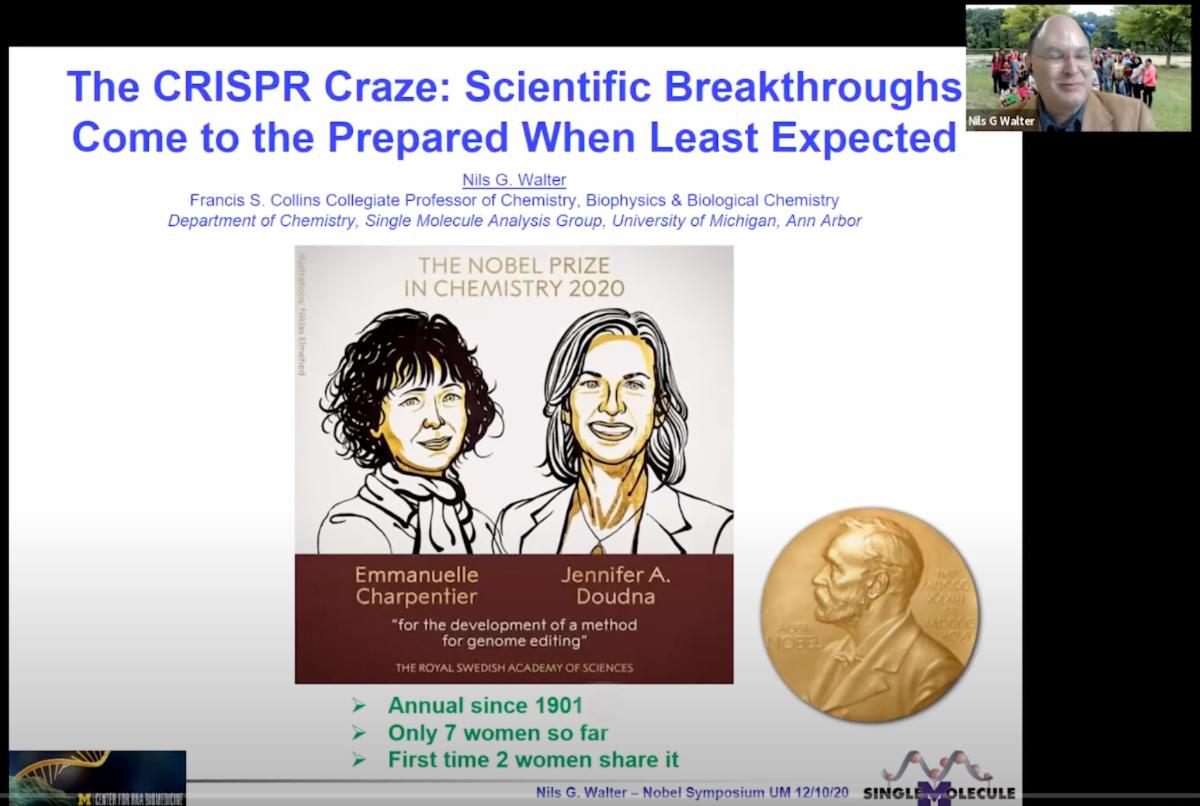
The 2020 Nobel Prize of Chemistry recognizes Emmanuelle Charpentier, Max Planck Unit for the Science of Pathogens, Berlin, Germany, and Jennifer Doudna, University of California, Berkeley, USA, “for the development of a method for genome editing.”
Every year, the University of Michigan Complex Systems invites U-M faculty to comment about the Nobel Prizes awards. In this recorded lecture (37 min.), "The CRISPR Craze: Scientific Breakthroughs Come to the Prepared when Least Expected," Nils Walter, Ph.D., Francis S. Collins Professor of Chemistry, Biophysics and Biological Chemistry, co-director of the University of Michigan Center for RNA Biomedicine, presents the history of the CRISPR discovery.
Starting in 1987 in Japan, CRISPR systems have been observed and studied independently and at times simultaneously by several research groups around the globe (Spain, France, The Netherlands, USA, Sweden, Austria, and Germany). This led the foundation for the 2012 breakthrough by Charpentier and Doudna to harness a CRISPR system (Cas-9) to cleave and modify DNA at specific sites. This genetic editing discovery is currently revolutionizing therapeutics and foundational research, while raising essential ethical questions.
|
|
Postdoctoral Fellow
Department Molecular, Cellular, and Developmental Biology
Principal Investigator/Faculty Dr. Monica Dus
College of LSA
"My research is aimed at understanding how metabolism modulates the control of brain RNAs. Currently, I am investigating how dietary sugar impacts dynamic neuronal RNA modifications which are necessary to maintain proper glucose homeostasis."
|
|
Tuesday, January 12, 5:00 pm | Harvard Medical School Initiative for RNA Medicine Seminar
“Processing, conformation and function of circular and long ncRNAs”
Ling-Ling Chen, Ph.D., M.B.A., Principal Investigator, Shanghai Institute of Biochemistry and Cell Biology, (Center for Excellence in Molecular Cell Science), Chinese Academy of Sciences
|
|
Tuesday, January 12, 7:00 pm EST | 2021 Institute for Basic Science-Seoul National University Mini-Symposia on RNA Biology & Therapeutics
This is the first mini-symposium of a series. More information is available on the registration page.
Presentations by Joan A. Steitz (Yale), Yoosik Kim (KAIST), and Sun Hur (Harvard)
|
|
“Ribosome collisions and sites of quality control revealed by ribosome profiling”
“CRISPR screening to identify biologically important microRNA targets”
|
|
Friday, January 15, 10:00 am | U-M Molecular, Cell & Dev Biology, College of LSA
"Genetic Determinants of the Development and Evolution of Drosophila Pigmentation"
Abigail Lamb, Advisor: T Wittkopp
|
|
Monday, January 18, 3:00 pm | U-M Health Sciences 2021 MLK Keynote
"Where Do We Go From Here: Body Politics and Movement Towards Racial Empowerment"
Monique Butler, M.D., U-M Kinesiology alumna and Chief Medical Officer for HCA Healthcare North Florida Division
|
|
Monday, January 18, 3:00 pm | U-M Human Genetics, Medical School
ZOOM MEETING ID: 947 7324 2869
"Molecular and Functional Characterization of Conserved and Divergent Features of Mammalian Spermatogenesis"
Adrienne Sam, Advisor: S Hammoud
|
|
Tuesday, January 19, 3:00–4:00 pm | Harvard Medical School Initiative for RNA Medicine Seminar
"Revealing Hidden Biology with Spatial, High-Plex Transcriptional Profiling on the NanoString GeoMx Platform"
Sarah Warren, Ph.D., Senior Director, Translational Science, R&D, NanoString Technologies
"Enabling spatial mapping and quantification of RNA in situ with RNAscope, miRNAscope, and BaseScope"
Emily Martersteck, Field Application Scientist, Bio-Techne
|
|
Tuesday, January 19, 5:00 pm | Harvard Medical School Initiative for RNA Medicine Seminar
“Processing, conformation and function of circular and long ncRNAs”
Ling-Ling Chen, Ph.D., M.B.A., Principal Investigator, Shanghai Institute of Biochemistry and Cell Biology, (Center for Excellence in Molecular Cell Science), Chinese Academy of Sciences
|
|
Monday, January 25, 9:00–10:00 am EST (please note the time change) | U-M Center for RNA Biomedicine, RNA Innovation Seminar Series
"The RNA exosome complex: the Dr Jekyll and Mr Hyde of RNA degradation"
Keywords: molecular mechanisms, RNA, ribosome, biochemistry, cryo-EM, X-ray crystallography
|
|
Our members' publications are available through Altmetric. Five queries are currently available: "RNA," "microRNA," "Transcriptome," "Translation," and "Molecule." Please make sure to have at least one of these key words in your title or abstract. Below is a recent highlight.
|
|
Amilorides inhibit SARS-CoV-2 replication in vitro by targeting RNA structures, Martina Zafferani, Christina Haddad, Le Luo, Jesse Davila-Calderon, Liang Yuan-Chiu, Christian Shema Mugisha, Adeline G. Monaghan, Andrew A. Kennedy, Joseph D. Yesselman, Robert R. Gifford, Andrew W. Tai, Sebla B. Kutluay, Mei-Ling Li,
Gary Brewer, Blanton S. Tolbert, Amanda E. Hargrove, bioRxiv, 06 December 2020, https://doi.org/10.1101/2020.12.05.409821
Summary and Outlook
In summary, we herein identified drug-like small molecules that reduce SARS-CoV-2 replication and are the first antivirals to target the conserved RNA stem loops in the 5’- end region of SARS-CoV-2. Work is underway to further characterize the mode of action of these ligands, particularly putative impacts on RNA:protein interactions and specific steps in the viral replication cycle. Once characterized, we expect these amiloride-based ligands to serve as chemical biology tools to help understand CoV RNA molecular biology, such as N-dependent genome packaging and other cellular stages of the viral RNA replication process. Importantly, we have established an efficient framework to identify novel RNA-targeted CoV antivirals that will serve not only the SARS-CoV-2 pandemic but future coronavirus pandemics.
|
|
Manganese (Mn), primarily acquired through diet, is required for brain function and development. Epidemiological studies have found an association between both low and high levels of Mn and impaired neurodevelopment in children. Recent genetic studies have revealed that patients with congenital Mn deficiency display severe psychomotor disability and cerebral and cerebellar atrophy. Although the impact of Mn on gene expression is beginning to be appreciated, Mn-dependent gene expression remains to be explored in vertebrate animals. The goal of this study was to use a mouse model to define the impact of a low-Mn diet on brain metal levels and gene expression. We interrogated gene expression changes in the Mn-deficient mouse brain at the genome-wide scale by RNA-seq analysis of the cerebellum of mice fed low or normal Mn diets.
|
|
|
|
SHARE YOUR NEWS AND COMMENTS
|
|
|
|
|
|
|