Volume 5 Issue 12 | December 2024 | |
Warm fall temperatures have kept us in the garden late this year. For some, December offers the first opportunity to find a comfortable spot and enjoy offseason armchair gardening. Read on for some garden inspiration. | |
The Root of It newsletter ends with our monthly quotation. If you find your newsletter has been clipped by your email provider please click HERE for a webpage version of the newsletter. | |
|
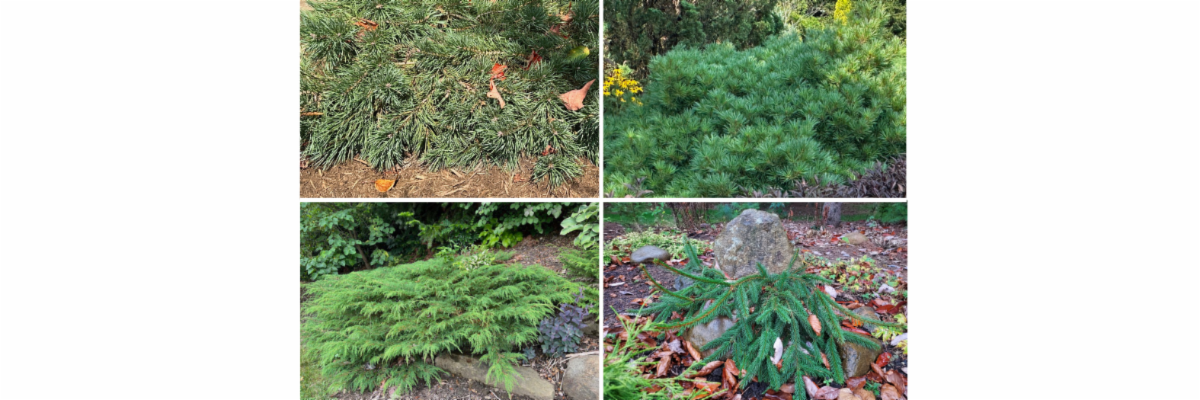
Clockwise from top left: Hillside Creeper Scotch Pine (Pinus sylvestris 'Hillside Creeper'), Ground Hugger White Pine (Pinus strobus 'Ground Hugger'), Gold Drift Norway Spruce (Picea abies 'Gold Drift'), Russian Arborvitae (Microbiota decussata)
photos by E Barth-Elias and K Edgington
| |
|
Annuals are toast, perennials asleep, shrub and tree branches bare. What a great time to look at garden beds with fresh eyes! Are the bones in place? Without some evergreen help, beds that are lush during the growing season may be bare-ground-boring during the cold half of the year. Evergreen (conifer) groundcovers are garden work horses, providing year-round textural display. Junipers, low-growing staples, are tough and carefree. But if you’re thinking, “That is so THEN!”, beautiful new cultivars have hit the market. Check out chartreuse All Gold (Juniperus conferta ‘All Gold’) and Tortuga (Juniperus communis ‘Tortuga’) with its wispy, even fluffy, demeanor.
If you haven’t already met, I’d like to introduce you to a few other outstanding conifer groundcovers.
Meet Hillside Creeper Scotch Pine (Pinus sylvestris ‘Hillside Creeper’). This gem offers undulating, ground-hugging branches with blue-green needles. As Scotch pines age, their rust-hued bark exfoliates—just beautiful!
Then there’s Ground Hugger White Pine (Pinus strobus ‘Ground Hugger’). The long, wispy needles of white pines add grace to any garden. The low growth of this one makes it a show-stopper.
The spruce family offers Gold Drift Norway Spruce (Picea abies 'Gold Drift'). Often staked and used as a vertical specimen, when left to ramble, Gold Drift makes a striking groundcover. Lime green early spring foliage turns to vibrant yellow during late spring and summer, providing a great pop of color.
Russian arborvitae (Microbiota decussata) isn’t an arborvitae at all, and has been around for ages. You may know it as Siberian cypress. It’s wispy branches and carefree nature make it a great addition to the border. AND it grows in shade as well as sun. What’s not to like?
As the demand for smaller scale conifers grows, more and more diminutive cultivars will be developed. Yes, they are harder to find, and you may need to ask your nurseryman to procure them for you or grab them online. Yes, they are slower growing than their deciduous cousins, but in the plant world patience is the name of the game. Now’s the time to check out your garden beds and see where you could use some conifer help. Look Around!
K Edgington
| |
Leaf Brief - Prickly Pear If You Dare | |
|
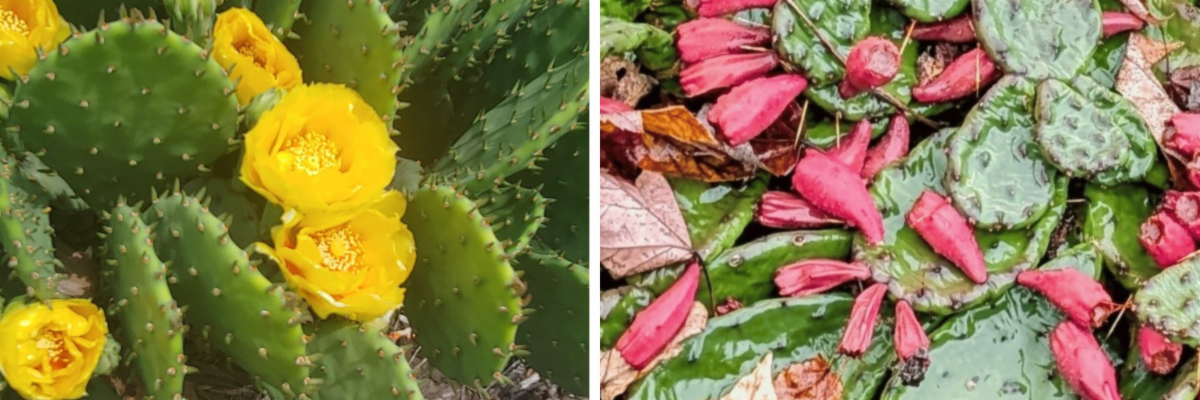
The flowers and fruits of Eastern prickly pear
photos by Amy Stone (OSU Extension) and J Gramlich
| |
|
Succulents, especially cacti, have been all the rage for the last few years. And for good reason—ease of maintenance, lots of variety, and the deer don’t touch them! As Ohio gardeners, we don’t have to miss out. We have our own native cactus, called the Eastern prickly pear (Opuntia humifusa).
Opuntia humifusa (seen occasionally as Opuntia cespitosa, and formerly as Opuntia compressa) has fun common names like devil’s tongue and Indian fig. It is native to the eastern half of the United States and southern Canada where it thrives in sandy, well-drained soil, stone quarries, or stony outcroppings, and is the only wide-ranging species of prickly pear cactus in eastern North America. It can grow in zones 4-9 thanks to specialized freeze-resistant chemicals in the cell walls that help it survive temperatures as low as 10 degrees Fahrenheit.
It is rare in Ohio, mostly found in the northwest and southern parts of the state, and has been spotted in gardens in Cuyahoga County and in Holden Arboretum’s Myrtle S. Holden Wildflower Garden. Click HERE for an Eastern prickly pear range map. You might be one of those intrepid Summit County gardeners with the right soil mix to coax this baby along.
The Eastern prickly pear is clump-forming with oval to round, blue-green pads (nopales), but does not have the needle-like spines of its cousins. It grows 6-12 inches tall and 1-1.5 feet wide, but will keep sprawling if well situated. The epithet humifusa means sprawling in Latin. As expected, it requires full sun and little water and is extremely drought-tolerant. Like others in the cactus family, the Eastern prickly pear has adapted to conserve water, so good drainage is paramount.
In June or July, you are in for a treat when bold, yellow flowers, some with orange centers, form around the end of the leaf pads. By fall, edible fruits have formed. They can be harvested when they deepen to a dark reddish-purple; but if not, will persist all winter. After removing the skin, the fruits are primarily used in syrups, jellies, and candies. The pads can be peeled and cooked or eaten raw in salads. Both are high in vitamins, minerals, and fiber and are a staple of Mexican cuisine.
Prickly pears spread in the wild when animals eat the fruits and disperse the seeds. The segmented branches can break off and easily root to form their own plant nearby or float downstream during floods. It may also be propagated by stem cuttings or by seed. Plants may be difficult to find locally but seeds and plants can be found online. Be sure to wear sturdy gloves when handling this cactus. Fine hair-like spines called glochids are difficult to see and remove from skin.
While prickly pear may be uncommon locally, primarily due to our clay soil, you may have a small sandy or rocky area or container to do a little experimenting. That’s what makes gardening fun and continuously fresh. We can always find something new to learn and try.
OPUNTIA HUMIFUSA: North Carolina State Extension
J Gramlich
| |
Creature Feature - The Cutest Killers | |
|
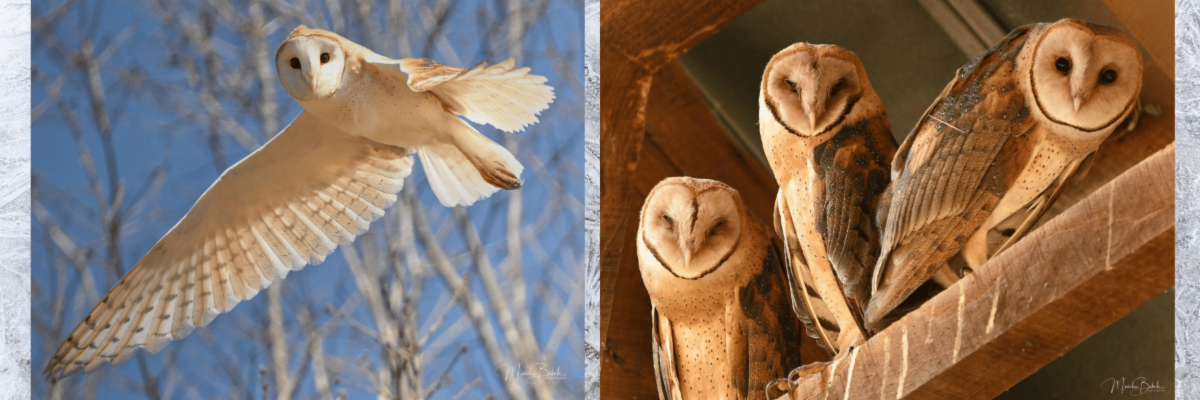
The deceptively tranquil beauty of barn owls
photos by Monika Bobek
| |
|
One might surmise that a creature with a heart-shaped face has a loving, gentle, disposition. One would be wrong. Despite its “I HEART” look, the barn owl (Tyto alba) is an incredible assassin, a raptor designed to capture and kill live prey. A small example of nature’s sense of humor…
The order Strigiformes (owls) consists of two families, true or typical owls (Strigidae) and barn owls (Tytonidae). The roughly 250 species of owls are mostly true owls, characterized by round faces. Fewer than 30 owl species are barn owls, which have heart-shaped faces (facial disk). Interestingly, barn owls are found in more locations than any other owl—every continent except Antarctica.
Barn owls are medium-sized (less than a foot long), and white to brownish colored, with dark eyes and long beaks, but no ear tufts. Color and size vary by species, although backs generally have tawny markings. Underbellies are white—possibly to help dissipate their dark shadow moving across the ground. Nicknames for barn owls include such non-cuddly monikers as night owl, death owl, ghost owl and monkey-faced owl. The barn owls’ fondness for hanging out in abandoned barns and buildings, church steeples and silos probably contribute to their spooky reputation. But they're still cute…
Just what makes them so good at killing?
Begin with that adorable facial disk, the feathers of which direct sound to their inner ears, located behind their eyes. This gives barn owls better hearing than any other animal measured. (We humans get a similar but not nearly as effective result by cupping our hand around our ear in the direction of a noise.) Owl ears are asymmetrical, which helps locate noise. Those ears are also particularly attuned to high-frequency sounds (made by small mammals running in terror through grass). Experiments have shown barn owls capture prey in total darkness.
But their vision is pretty good too. A barn owl’s night vision is extremely sensitive to movement, allowing them to quickly detect panicking prey. Barn owl feathers enable silent flight, and relatively large wings supporting their light body (they weigh one pound) allow them to fly at slow speeds and hover over grasslands or meadows. Barn owls have long legs perfect for snatching prey out of thick grass. Their super sharp talons may kill the prey during the snatch. If the mouse, vole or bunny isn’t dead from that, the owl finishes it off with a peck from its beak. Down the (owl) hatch the whole morsel goes, with inedible bones and fur coughed up later as pellets. Yum!
But it’s not all bones and blood for our barn owl friends. These cute little killers have a gentler side. They generally mate for life (although there is new evidence that suggests Dad may have a chickie or two on the side) and stay in the same territory. Breeding one to three times per year (between March and August in colder climates), the owls reuse or “borrow” nests rather than build. In addition to human structures, they nest on cliffs, haystacks, caves and riverbanks. Mom lines the nest with shredded pellets, and lays from 4-7 eggs, which hatch in about a month. Newly-hatched owlets are helpless (altricial), and Mom broods them for the first few weeks (keeping them warm with her brood patch—a bare patch of skin on her belly). Dad brings food and Mom feeds the babies. (Ok, it’s not all so cuddly—if a chick dies Mom feeds it to the others.) Owlets fly at around two months of age and will stay at or near the nest for several weeks. See these cuties HERE.
Barn owls are big talkers—but don’t listen for them to give a hoot. Their screechy scream inspired their “screech owl” nickname. This 2 second “advertising call” is generally made by the male in flight. A softer, purring call is used by males to ask a female back to his pad (nest site), and by the female to ask for food. Barn owls may hiss when angered or frightened. Listen HERE.
Barn owls are ruthless killers, but they are ruthless killers of rodents, so despite the spooky, screechy stuff they’re nice to have around. Unfortunately, changes in agricultural practices and land use over the past several decades have reduced the open grasslands and meadows where barn owls hunt. Loss of habitat and other factors have impacted the barn owl population—they are currently considered “threatened” in Ohio. In 2013, the Ohio Department of Natural Resources began efforts to install and monitor barn owl nest boxes. Read about it HERE. The Wilds, a wildlife conservatory in southeast Ohio, is also helping. See THIS. Perhaps you will join the effort to make sure these cunning little cuties continue to kill...
C Christian
| |
Join writer Emma Barth Elias as she explores some common gardening mistakes and how to avoid them. Look for more OOPS! moments in future issues. | |
|
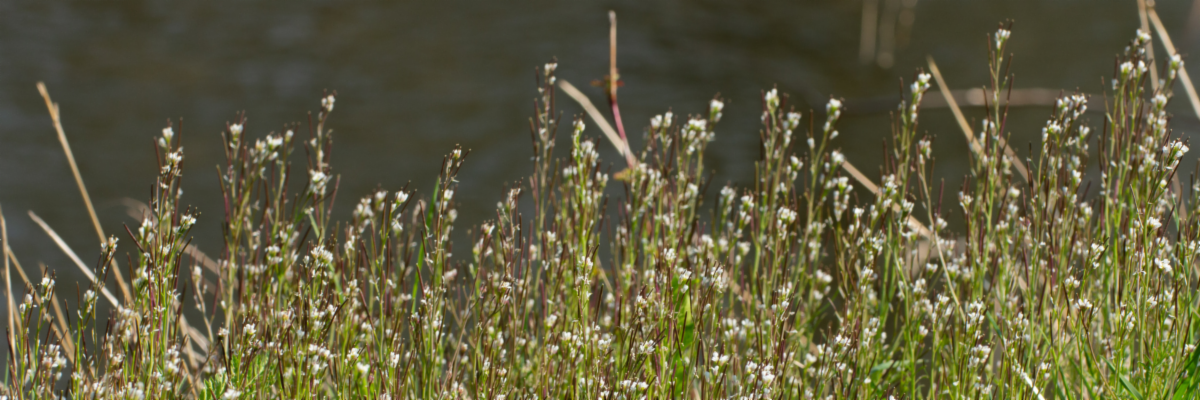
Hairy Bittercress going to seed
photo by E Barth-Elias
| |
|
We all make mistakes! Even the most experienced green thumbs fall prey to classic errors. It’s easy to do, and honestly, it’s ok! If we look at gardening as a big experiment, problems like ignoring soil quality, planting too close, and letting weeds run wild are not life or death situations (at least not ours). However, paying attention and keeping some rules in mind can save significant time and money, ultimately producing a lush, resilient garden.
Know thy soil!
While visiting your friend’s garden you notice that her Fabulous Hydrangea, the one you both purchased two years back, is more than twice the size of yours and covered in huge healthy blooms! What? It appears that your Fab Hydrangea is not a slowpoke, but it and the plants surrounding it are victims of a failure-to-thrive situation. What on earth happened?
The results of a soil test provide the answer—the soil in that bed is deficient in phosphorus. The time to test soils is BEFORE planting, so issues can be corrected, and plants get off to a good start. A soil test will provide a detailed analysis of your soil’s pH, nutrient levels, and organic matter, providing a clear picture of what amendments are needed. And, knowing the pH and other soil qualities will determine which plants can be successfully grown on that site.
A soil test should be the first order of business when planting a new bed. Learn about interpreting soil tests HERE.
Wait, not so close!
Snow in July? No … but what is that strange white stuff coating the Monarda? And there it is on the vegetables! Powdery mildew has infested the garden beds.
Plants that are too closely planted compete for sunlight, water, and nutrients. The poor airflow between these plants creates a cozy environment for diseases and pests—and vegetables such as tomatoes and cucumbers are especially at risk. It is tempting to plant tree and shrub borders densely for immediate impact, but what a shame to have to remove plants when they are at their best because they don’t have the space to thrive. Although trees and shrubs never stop growing, their growth slows down as they mature, and planning for that mature size means that the border or bed will be healthy and attractive for years to come.
Follow the spacing instructions! Those guidelines on seed packets and plant tags aren’t just suggestions—they’re your ticket to long term health, productivity, and beauty. Bonus: proper spacing makes it way easier to weed, water, and prune.
Don’t let weeds go to seed!
Weeds happen! Some find pulling them therapeutic; others, not so much. But here’s the deal: weeds are troublemakers. Not only do they steal nutrients and water from your plants, but they can spread like wildfire. Some weeds, like hairy bittercress, use a sneaky trick called ballochory, a ballistic seed dispersal system, to launch their seeds far and wide.
Remove weed seed heads before they mature. Dispose of them in the compost (or the trash for invasive weeds)—seed heads left on the ground can mature and germinate. Perennial weeds deserve special attention. Do snip the seed heads, but, better still, remove the plants including their roots to stop the spread in its tracks. While some gardeners swear by pulling 100 weeds a day during the growing season, any effort helps keep the garden in check. Scientists have discovered that some broadleaf weed seeds can remain viable for 40+ years in the soil. Save yourself some grief—make sure your garden weeds are deadheaded.
So, put these keys on your gardening keychain: a good understanding of your soil and its needs, proper spacing for plant health and beauty, and control of weeds by timely deadheading. You will unlock the door to a more sustainable and enjoyable gardening experience.
E Barth-Elias
| |
|
‘Tis the season. Whether that phrase engenders grins or grimaces, we know there are expectations involving gifts, both giving and receiving. For us gardeners, one giver is often overlooked. This particular gift-giver won’t put its name on any package. Indeed, its gifts are so commonplace that we often take them for granted. But the next time you go outdoors, say thanks to your garden for its many blessings.
You’re healthier because you garden. Research has convincingly established that the physical act of gardening keeps us strong. It requires exercise, which we need at all life’s stages. Most gardening is done outside, where the sun helps us manufacture vitamin D, which is essential for bone health, helps prevent cancer, and helps keep our mental faculties sharp as we age. Certain elements in soil can chase away the blues by triggering the release of serotonin, a "happy" chemical that counteracts depression and strengthens the immune system.
All that is icing on the pumpkin, however. Our generous gardens feed us. Most of us don’t—can’t—grow all that we need to eat from our back yards. Yet what we do produce is most nutritious. Because they’re so fresh and grown with minimal chemical use, our harvests are the best for us. Speaking for myself, I can only enjoy tomatoes from my back yard, or a nearby garden. I’ll make an exception for farmers markets, which are fresh from someone else’s nearby garden. Time is the enemy of nutrition and flavor. No grocery store tomato is as juicy, sweet or flavorful as the one picked fresh and warm from the summer sun.
That’s a lot of giving. But it barely dents the pile of offerings heaped on us from our gardens. Some folks don’t grow food but rise every morning eager to step outside and look at the beautiful scenery around. You don’t eat out of your flower patch, but you are gaining powerful health benefits by immersing yourself in the beauty of nature.
The exceeding beauty of the earth, in her splendour of life, yields a new thought with every petal. The hours when the mind is absorbed by beauty are the only hours when we really live. (Richard Jefferies, "The Pageant of Summer") This quote begins a 2018 article from Frontiers of Psychology, a British publication that focuses on mental health. It reports on a Wildlife Trust study termed “30 Days Wild.” The campaign asked people to engage with nature in one or more of four ways over the course of a month: noticing (like watching a flitting butterfly), sharing (describing what you saw), doing (creating a pollinator patch), and connecting (reaching out on social media). The impact of nature on people’s health was significant and long-term.
Of course, science only confirms the simplest of facts: Nature is good for us. But our gardens aren’t done showering us with bounty.
Gardens teach. Anytime we seek to grow anything, we must arm ourselves with knowledge: about plant types and families, botanical Latin, soil chemistry, insects and diseases. The list goes on. The point is that no one who treats gardening with the respect and attention it deserves is unchanged by the encounter. We are inevitably enriched, our horizons expanded in every direction. Gardening makes us better people. What a gift!
S Vradenburg
| |
|
December Checklist:
- Lightly prune evergreens and use trimmings as inspiration for centerpieces, garlands, mantle décor, etc.
- Consider gardening gifts such as terrariums, houseplants, and garden tools for the plant lover.
-
Inspect houseplants for pests. MANAGING INSECTS ON INDOOR PLANTS: University of Minnesota Extension
- Take stock of your garden: what worked, what didn’t, and what can be improved next year.
- Get garden organized—inventory seed collections and plant tags and update garden changes. There are lots of calendars, journals and apps to help.
- Take advantage of a sunny day to complete fall cleanup. Collect leaves off turf, bring in hoses, and turn off water to outdoor faucets if you haven’t already.
- Provide food and water for birds.
J Gramlich
| |
More learning opportunities:
| |
|
If all you ask of a garden is What? then all you'll probably get in reply is a planting list. But ask, instead, Why? How? When? and, most of all Who? and then you're in a for a nice, long conversation.
Vivian Swift: Gardens of Awe and Folly: A Traveler's Journal of the Meaning of Life and Gardening.
| |
We invite you to share The Root of It with your friends and family. If you would like to subscribe to our mailing list please visit our website, scroll to the bottom, and follow the link under Join our email list. | |
The Root of It staff: Karen Edgington (Editor), Emma Barth-Elias (Photo Editor), Nichole Callicutt, Carolyn Christian, Jennifer Gramlich, Sarah Vradenburg, and Geoff Kennedy (Technical Advisor) | |
We Would Like your Feedback
Contact us at: newsletterscmg@gmail.com
To discontinue receiving this newsletter please click on the UPDATE YOUR PROFILE link below. You may then choose what types of information you would like to receive from us.
| | | | |