Our office focuses on implementing report recommendations from the last 30+ years that guide UH Mānoa in becoming reflective of Hawaiʻi's language, culture, values, and knowledge systems from which all people learn, connect, grow, and heal:


  • Hawaiʻi-Guided Student Success
  • Hawaiʻi-Grounded Staff and Faculty Development
  • Cultivating Hawaiʻi Environments 
  • Hawaiʻi-Reflective Community Engagement


We cannot do this work alone. It is our mission to foster the potential within each of you to positively contribute to our collective kuleana to make UH Mānoa reflective of Hawaiʻi. These monthly newsletters, with written reflections that cover the preceding month's happenings, are meant to keep you connected, highlight your work and continue to inspire you.

NHSS Lei Panel

Na Keaupuni Davis

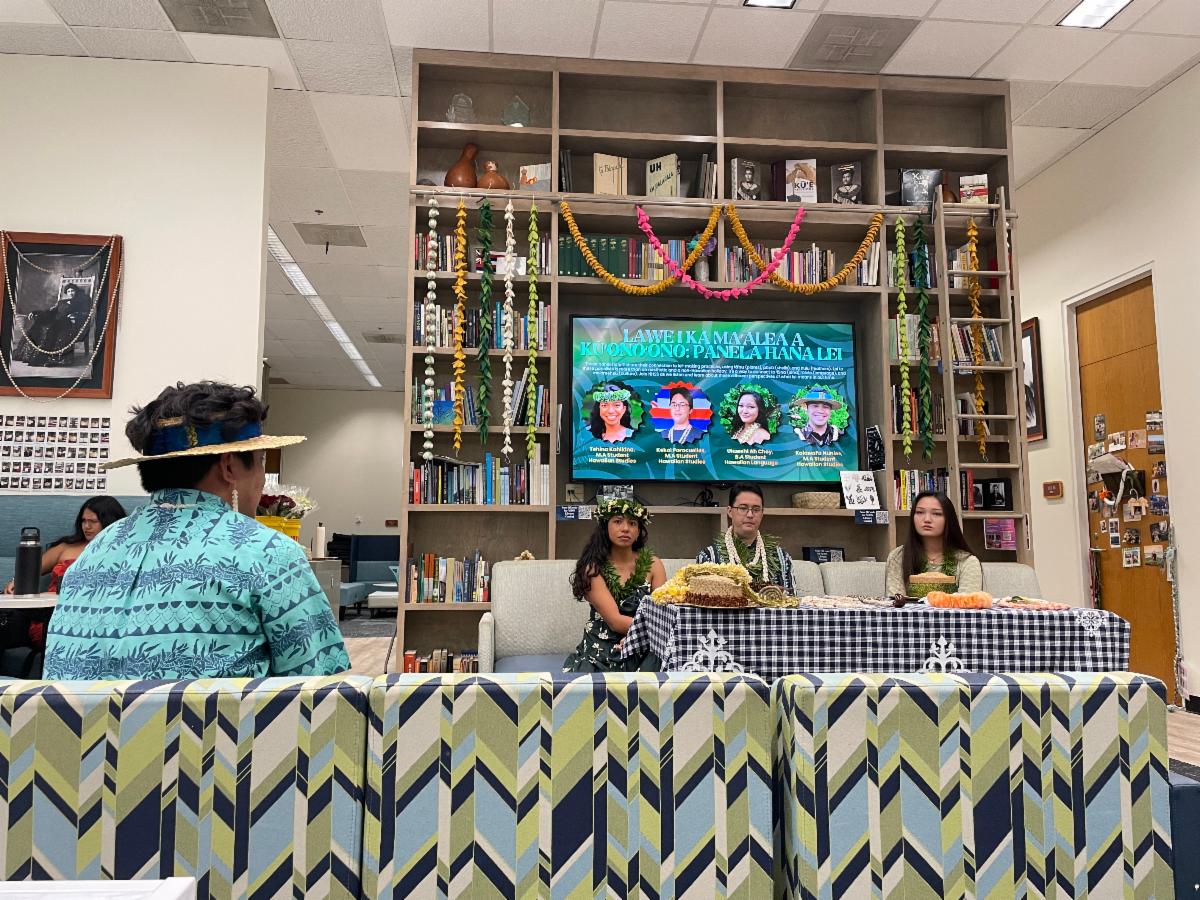
The NHSS May Day Lei Panel, featuring (right to left) Uluwehi Ah Choy, Kekai Paracuelles, Tehina Kahikina, and moderator Kalawaiʻa Nunies.

On a beautiful May Day, I had the opportunity to sit in on a meaningful panel hosted by Native Hawaiian Student Services (NHSS) as part of their weeklong celebration, Puʻupuʻu Lei Pali i ka ʻĀʻī: Celebrating Lei in Hawaiʻi. Throughout the week, NHSS created space for students and community members to engage in student-led screen printing, crochet puakenikeni, and various lei-making workshops. These events reminded us that lei are not only objects of beauty or celebration, but also living expressions of ʻike, pilina, ʻāina, and kuleana.


One of the highlights of the week was a panel featuring Kānaka hana noʻeau practitioners: lei lāʻau practitioner Tehina Kahikina, an MA student in ʻIke Hawaiʻi (Hawaiian Studies); lei pūpū practitioner Kekai Paracuelles, also an MA student in ʻIke Hawaiʻi; and lei hulu practitioner Uluwehi Ah Choy, a BA student in ʻŌlelo Hawaiʻi. The conversation was thoughtfully moderated by Kalawaiʻa Nunies, an MA student in ʻIke Hawaiʻi, whose humility, care, and ʻike helped bring these practitioners into dialogue with one another. Together, they offered rich manaʻo on the moʻokūʻauhau of their lei practices, the challenges facing ʻāina and lei materials, the importance of building and nurturing pilina with people and place, and the kuleana they carry from those who came before them to those who will inherit this ʻike in the future.


Several themes from the panel left a lasting impression on me, especially the way each practitioner spoke about their moʻokūʻauhau with lei. Uluwehi shared about her family’s lei-making traditions and the importance of passing this ʻike on to her own students. Her manaʻo made clear that teaching lei is not simply about transferring technique. It requires discernment, patience, time, and a deep understanding that this ʻike carries responsibility. For Uluwehi, choosing a student is not casual; it is a serious commitment because the student must be prepared to mālama that knowledge for future generations.


Tehina’s lei moʻokūʻauhau is rooted in hālau and in the teachings of her Kumu Hula, Maelia Lobenstein-Carter. Through her reflections, Tehina reminded us that lei knowledge is held not only by people but also by ʻāina. The ʻāina itself becomes a kumu, teaching through the mea kanu available in a place, the moʻolelo carried by that landscape, and the kamaʻāina who hold deep ʻike ʻāina. Her words encouraged us to think about lei as a practice of attentiveness. To gather, create, and wear lei responsibly, we must first learn how to listen to place.


For Kekai, I had the opportunity to interview him after the workshop. His lei moʻokūʻauhau begins with his family, for knowledge of mea kanu and where it is from. Raised in Haleʻiwa, he explains, “A lot of my lei knowledge comes from my ʻohana,” recalling how his family yard, filled with abundant flowers, became one of his earliest classrooms for learning lei pua and lei lau. From this foundation, his practice later shifted toward lei pūpū during his senior year of high school, marking not a departure from his earlier lei knowledge but an extension of it into another material genealogy. His relationship to lei is also shaped through hānai ʻohana and intergenerational mentorship. I asked him to tell us a little more about his lei pūpū moʻokūʻauhau through the ʻohana Niʻihau. He spoke about how much he treasures his pilina to his hānai ʻohana. He mentioned the day he connected to Mama Awapuhi Kahale, the daughter of renowned lei pūpū master ʻAnakē Kaleipua Pahulehua: “I was very fortunate to connect with her at a pūpū workshop at Kapiʻolani Park during a Kamehameha Day Hoʻolauleʻa and since that day my pilina with her has continued strong to the point that she refers to me as her hānai son and I call her my hānai Mama.”


Through these relationships, Kekai’s lei practice is rooted in more than technique; it is sustained through pilina, talk story, service, and kuleana to those who carry this ʻike before him. His moʻokūʻauhau of lei therefore shows how cultural knowledge is not only inherited by bloodline, but also cultivated through place-based upbringing, chosen kinship, mentorship, and continued responsibility to protect the ocean and pūpū sources that make lei pūpū possible.

ʻAha of Imperative #1 Champions

Na Dr. Kawehionālani Goto

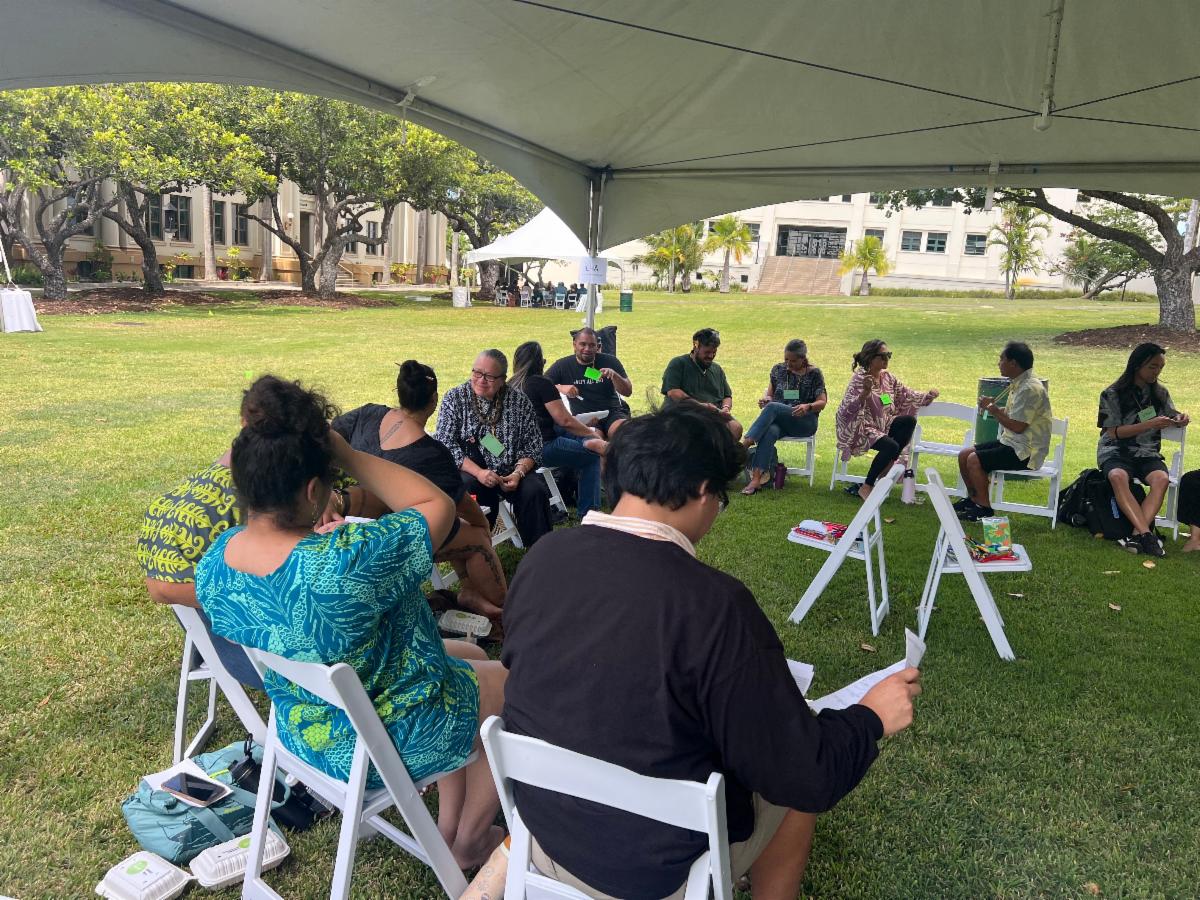
Pilina Circles in the morning started the day with gathered Imperative #1 Champions.

Imperative #1 of our systemwide strategic plan envisions our campuses as a premier integrated higher education system, advancing the quality of life for all the people of Hawaiʻi through robust educational offerings and world-class discovery while modeling how institutions must fulfill responsibilities to indigenous people and place in the 21st century. 


I highlight the term modeling in this vision as staff and faculty from across our 10-campus system gathered on March 21-22, 2026 to understand the genealogies, unpack the histories, and set the course for actualizing imperative #1 objectives through showing up and modeling what that system as a community could look like. 


As part of this work, Ākea Kiyuna from Hawaiʻi Community College and I will be co-leading a committee on professional development to glean Hawaiʻi-grounded lessons from the hi/stories of our campuses to draw out insights on foundational knowledge for all people across our system. As learned at the ʻaha, a successful system-wide baseline for cultural professional development must function as an authentic invitation that honors individual campus autonomy rather than a standardized compliance-driven mandate that micromanages local expertise. To reflect on this experience, how can we boldly restructure our system-wide policies and hiring qualifications so that cultural alignment is treated as foundational for leadership and employment, rather than an optional afterthought? 

Kahana Valley Professional Development

Na Hope Matsumoto

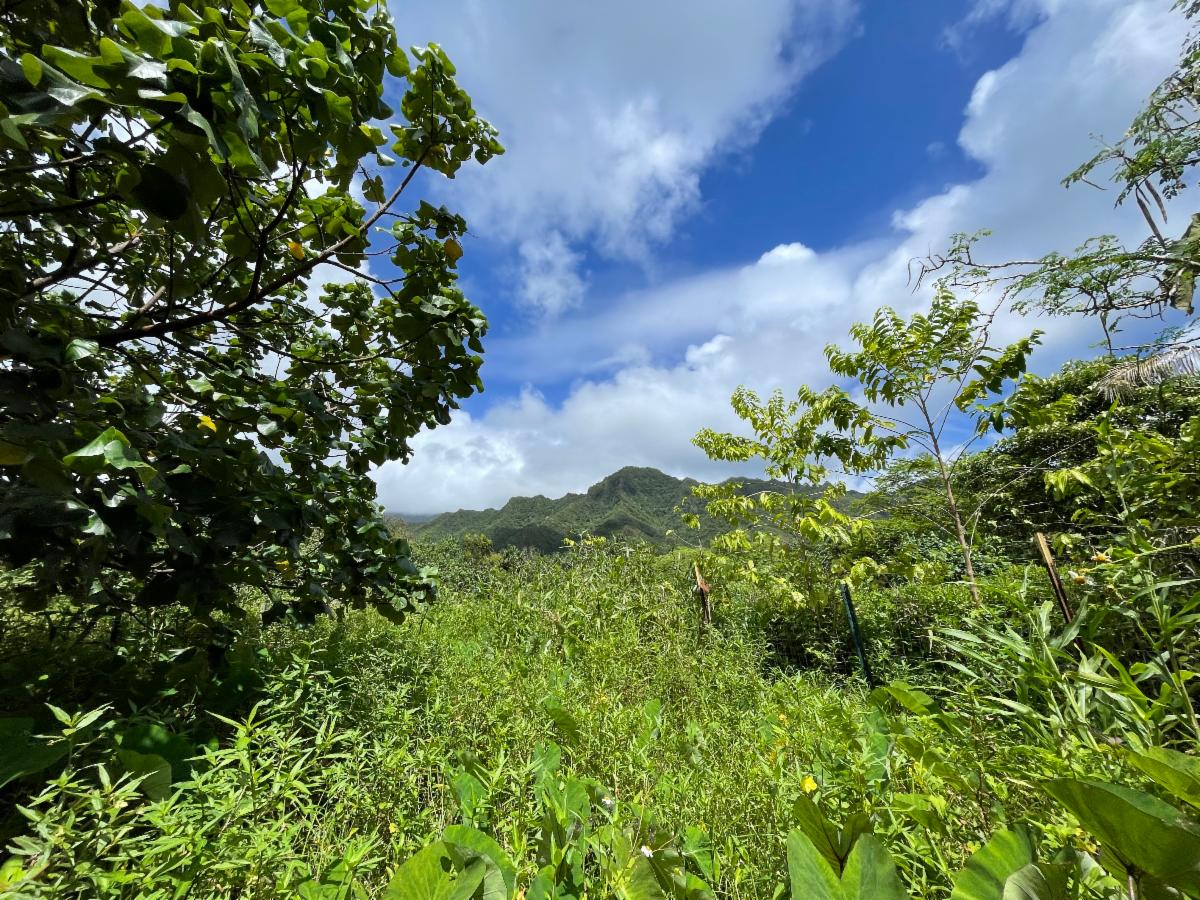
A loʻi kalo in Kahana full of weeds before our team got to weeding. 

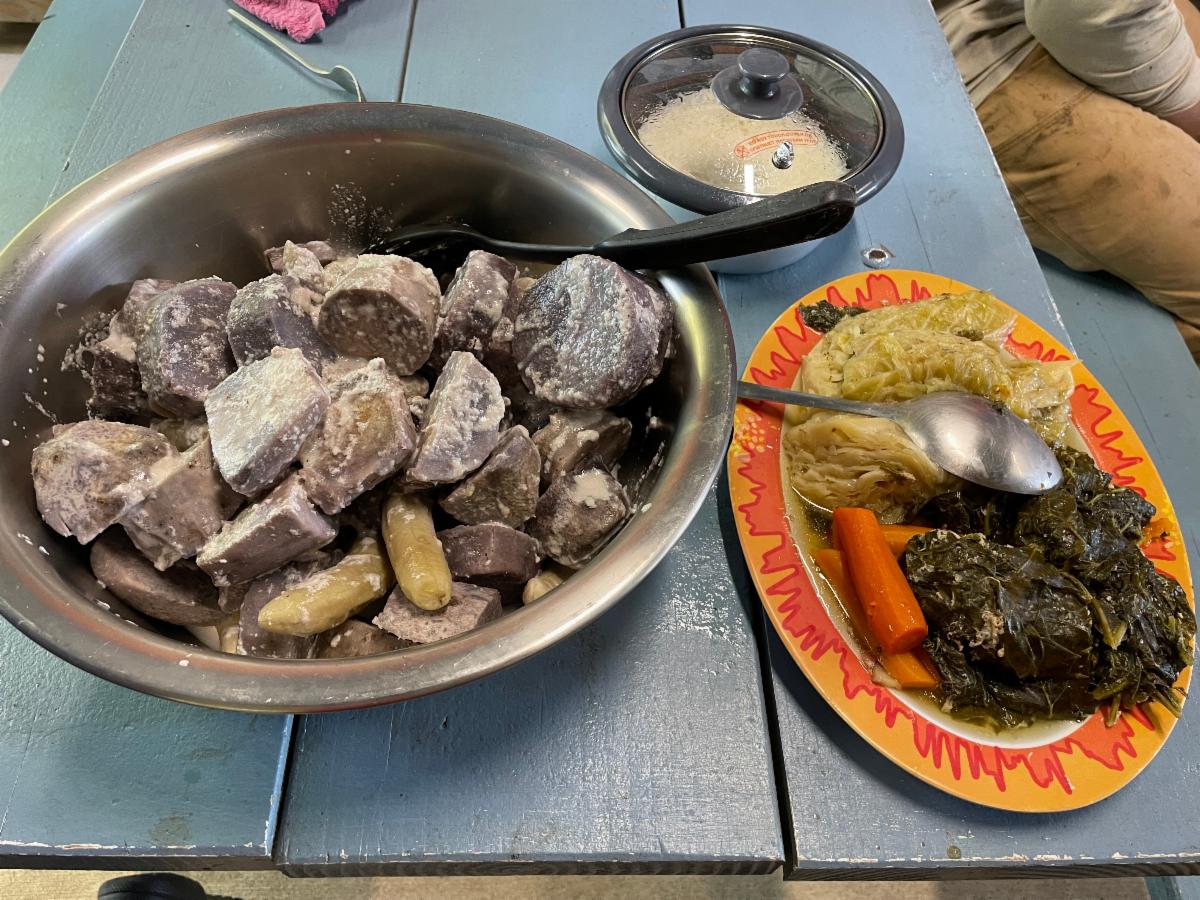
A large bowl of fresh faʻalifu (a dish made with kalo, green banana, and coconut) and a plate of greens, including cabbage, carrots, and laupele—a very nutritious lunch prepared by Aunty Grace and Papa Jim!

Beneath the Mauli moon on May 14, our team attended a professional development in Kahana Valley, where the ʻāina hosted us and taught us among the diverse area of Koʻolauloa, Oʻahu. We had the honor of visiting Papa Jim Anthony and his wife Aunty Grace, whose yard she keeps immaculate! When we arrived, Aunty Grace was boiling a pot of kalo and squeezing fresh coconut that Papa Jim had just scraped for our lunch. After a tour around the yard teeming with plants like tapioca and the magnificent ylang-ylang tree, we were able to spend time weeding in the loʻi, among both Palauan and Hawaiian taro. 


But before the machete grew too comfortable in my hand, we were planting a new kind of tree that I’d never met before—poumuli. As I learned from Papa Jim, these are important trees because they grow straight up for the first 15 years, then grow outwards in girth for the next 15 years, making them excellent posts for hale (house structures). We also had the chance to replant papaya trees, and I could almost smell their sweet flowers that will bloom in the sunshine and rain. Perhaps the most instructional part of our professional development was our lunch—where among the plate of home-cooked greens, I was able to try the plant laupele for the first time. I kuʻu wahi manaʻo (in my humble opinion), it’s so much better than spinach! Mahalo again to Aunty Grace and Papa Jim for cooking, hosting, and teaching us so much about the beloved ʻāina that you folks cultivate in Kahana. Aloha nō! 

Ea Mai ʻEiwa, Patterns of Practice at Bishop Museum

Na Hope Matsumoto

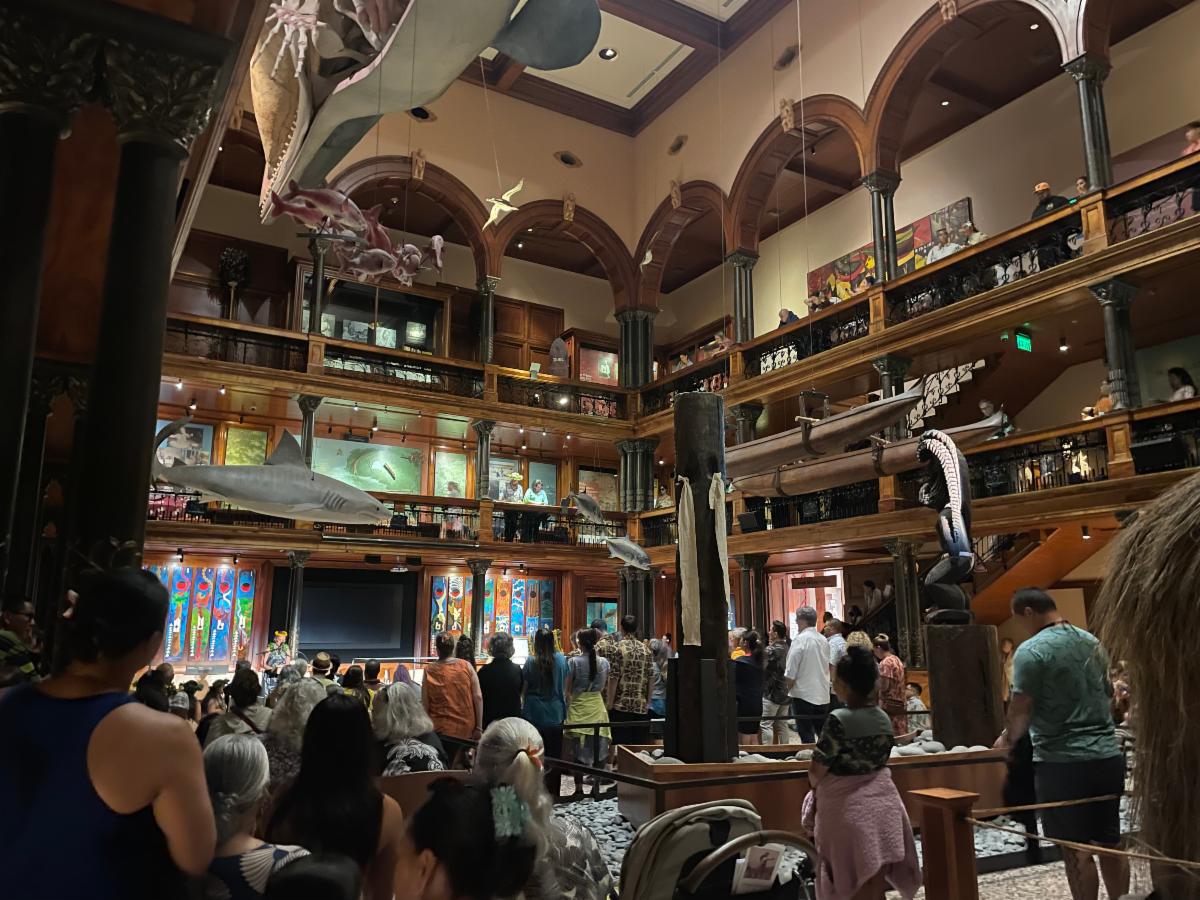
Hawaiian Hall at Bishop Museum full of people who gathered to attend the talks and performances of Ea Mai ʻEiwa. 

On May 8, 2026, the halls and galleries of Bishop Museum rang with performances of Ea Mai ʻEiwa, an exhibition honoring Nālani Kanakaʻole (1946-2026), Sig Zane, and Kūhaʻoʻīmaikalani Zane of Hilo, Hawaiʻi. Listening to the voices and implements resound in Hawaiian Hall brought a new sense of depth to the artistry featured within the gallery. The panel on ʻAʻahu Design & Theory was moderated by Kūhaʻoʻīmaikalani Zane and featured ʻIliahi Anthony, Manaola Yap, Keʻano Kaʻupu, and Kekuhi Kanahele. This panel discussion brought forth sensory details and nuances of craft, like the wafting smell of ʻōlena (turmeric) that stains lasting memories. ʻIliahi spoke about how maintaining ʻaʻahu is not just about the time spent making it but also about knowing how to prepare and care for the resources needed. Additionally, our coworker Kekuhi shared that you must have a relationship with your resources in order to harvest those materials. After this night of performances, I am reflecting on how to honor the pilina with my craft in multiple aspects of my life. As the panel members affirmed, practices of maiau are important because ʻaʻahu are larger than life, and akua don’t visit mōkākī. 


Visit the Bishop Museum exhibition website here.

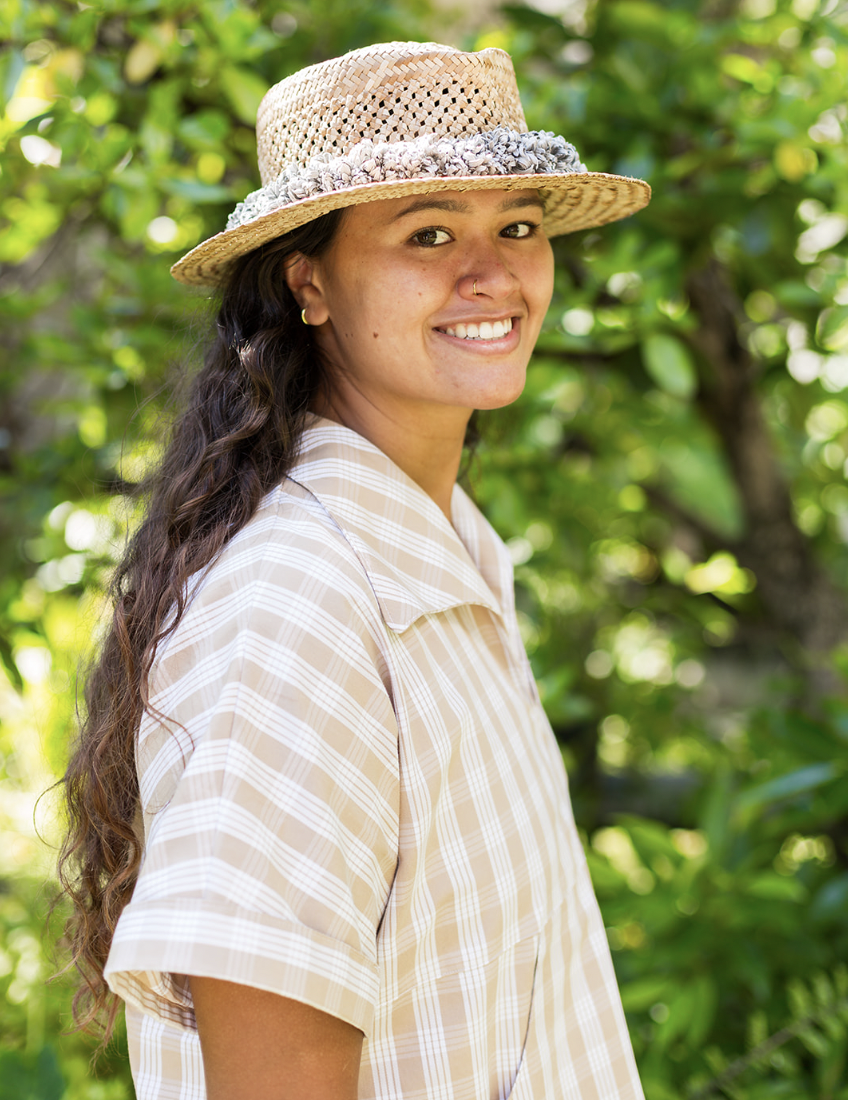
Maile Wong, this month's lamakū feature.

Maile Wong


Birthplace/Hometown:

Mānoa, Oʻahu


High School:

Kamehameha Schools Kapālama


UHM Degrees: 

BA in Botany (ʻ23)

BA in ʻŌlelo Hawaiʻi (ʻ23)

PhD in Botany (ʻ28)


Current Occupation:

PhD Candidate - NSF GRFP Fellow


What inspired/inspires the path for your academic major? 

Some of my earliest memories are from ʻāina: sinking into loʻi for the first time as a third grader in Punaluʻu, the smell of rich humus, scored by the squawking of parrots, during summers at the Lyon Arboretum nature camp, but most of all, tending a small garden behind our home with my sweet grandma. Lilikoʻi woven through the fence, puakenikeni limbs sprawled toward the sun, tomatoes, herbs, squash. Everything beautiful, and everything edible. I remember nibbling on the cilantro as we weeded. 


I offer these memories to underline my understanding of ʻāina as “that which feeds.” ʻĀina does not exist without kānaka, nor can we exist without ʻāina. We are deeply connected, biophysically and metaphysically. This pilina is the umbilical cord through which we are fed and in return feed ʻāina. This pilina is the inspiration for the path I am currently on in botany. I didn’t become connected to ʻāina through my academic career; rather, my journey working on ʻāina brought me to botany and ʻōlelo Hawaiʻi. My academic journey is complementary and in many ways secondary to the lessons I learn from ʻāina and from ʻāina people. This perspective is common for many ʻŌiwi at the university. However, my pathway might still be termed “non-traditional” for the years I spent out of school, working on ʻāina and establishing these pilina. 


From my first ʻāina-job in Kapalai, where Hoʻokuaʻāina grows the gummiest moi kea, to the Waipao, where Hui Kū Maoli Ola is a kīpuka of unbelievable native plant diversity grown for the community to plant and care for, to Puʻulani at Kākoʻo ʻŌiwi, where I planted the kumu- and laʻa- lāʻau that I still care for today, and all the places in between. These ʻāina have fed me, and through my work I hope to feed them.


What are your future goals in your work? 

My future goals are to funnel resources into our kaiāulu, facilitate connection, and remove barriers so ʻāina people can continue their work unhindered. My dissertation project is titled “I Malu Kākou i ka Hālau Loa.” This references the system my work supports (the “hālau loa,” or a forest that shelters and is tended by kanaka) and a vision held by the community of mahiʻai my research supports: to grow, extend, and connect the hālau loa across our pae ʻāina so that our ʻāina can be momona. My goal is to support and resource this vision.


In a conversation with Dr. Noʻeau Peralto, he likened this resource funneling to the ʻiole who chewed through the huihui kōkō a Makali‘i kau i luna. The chief Makaliʻi taxed his people beyond their limits and strung their food up in kōkō, or nets, in the sky. It was the ʻiole, or rat, that climbs the rope and chews through the sennit, sending the food tumbling back down to the people. By definition of this moʻolelo, I want to be a rat. Many meʻe Hawaiʻi were tricksters– sly and cunning.  I hope that through the work I do at this institution and beyond, I become more sly and perhaps cunning in order to free up the resources held in institutions for the benefit of the kaiāulu. 


However, in the words of Audre Lorde, “the master’s tools will never dismantle the master’s house.” The role of researching and working in the academy is strategic, but it is one strategy of many in a mosaic of strategies to achieve ea. “Survival is not an academic skill. It is learning how to take our differences and make them strengths.” I hope to contribute the cunning I cultivate at UH to support our collective push toward ea, enmeshed in community efforts, mahiʻai, grass-roots initiatives, and aloha ʻāina. 


How do you see your time at UH shaping the way you aloha ʻāina? 

My decision to attend UH is a function of my decision to stay in Hawaiʻi after attending 3 semesters of college in North America. I began my UH career at WCC in 2019 while working full-time. By virtue of location, UH and its affiliated institutions are uniquely positioned to offer post-secondary education to Kanaka ʻŌiwi who want to grow in aloha ʻāina practice. Being able to stay home sharpened the way I aloha ʻāina, because I pursued an education supplemented by work, extra- and co-curricular activities. However, in many ways, advocacy and resistance to UH activities while at UH shaped the way I aloha ʻāina. 


My first class at UH Mānoa was POLI SCI 301: Indigenous Politics through the Kekaulike Bridge Program. This class began July 8th, 2019, and on July 17th, 2019, 38 kūpuna were arrested at Puʻuhuluhulu opposing the desecration of Mauna Kea by TMT. We departed classes where time was spent discussing chapters from “A Nation Rising,” to protest, to organize, and to put into practice what we were learning, but UH, as an institution, felt like an opposing force. 


Advocacy within my home department has felt similar, participating in surveys and focus groups to increase access to culturally grounded field-based courses, writing letters of support for Kanaka ʻŌiwi faculty candidates, justifying and rejustifying why Hawaiian Studies-Mālama ʻĀina courses should count as electives for botany, and justifying community-driven research methodologies in spaces where applied science is frowned upon. 


I have found incredible mentorship at UH from advocates and change-makers. Mentorship from those who envision a different future for UH has shaped the way I aloha ʻāina. Additionally, as a second-language learner who began learning in earnest in kula nui, I am grateful for the ʻike I was granted learning from kumu ʻōlelo Hawaiʻi. This and other knowledge gained from Hawaiian scholars and allies at UH have undoubtedly shaped the way I aloha ʻāina.  


Like the many advocates working toward change at UH Mānoa, including those in the NHPOL office, I envision a future where UH is an ecosystem in which aloha ʻāina flourishes rather than the fire in which aloha ʻāina is forged.


What does UH Mānoa as a Hawaiian place of learning mean to you? 

The UH system is singular in its ability to offer a post-secondary education in ʻike Hawaiʻi and ʻōlelo Hawaiʻi.  UH Mānoa also educates the most Kānaka ʻŌiwi post-secondary students of any four-year university in the world. These facts underscore the kuleana that UH Mānoa has to become a Native Hawaiian place of learning. 


UH Mānoa has historically extracted from communities and Hawaiians, and continues to. UH is on stolen land. These facts underscore why doing that “becoming” has proven challenging.  Despite eleven years of listing "Becoming a Native Hawaiian Place of Learning" as a strategic goal in the UH strategic plan, the university has continued to engage in practices that extract from ʻāina and the Hawaiian community. Strong advocacy within UH from the initiative’s supporters (primarily Native Hawaiian faculty, administrators, and students) has been tremendous; however, UH Mānoa’s declared intentions mean little while the institution remains recalcitrant to radical change and accountability.


UH Mānoa becoming a Native Hawaiian place of learning means aligning the institution's power with the political goals of the Hawaiian community and opposing projects that extract from Hawaiʻi, such as the Thirty Meter Telescope and AMOS-STAR. It means actively leveraging power, research, and funds to positively impact Hawaiʻi’s community and ecosystems. While UH faculty and researchers spearhead projects like these, UH Mānoa has yet to leverage its institutional power in support of Native Hawaiians, even when it is clear what Native Hawaiians are asking for and need. 


An earnest movement toward becoming a Native Hawaiian place of learning starts with direct, resourced, and radical institutional change. Without funding community-driven research, without engaging with ʻike Hawaiʻi on equal footing to western science, without listening and taking action on the community input, this push toward becoming a Hawaiian place of learning risks becoming a settler move toward innocence, and what Tuck and Wang describe as “a metaphor.” 


The Native Hawaiian place of learning I envision has contributed to restoring Hawaiʻi's political sovereignty, has leveraged its power to demilitarize Hawaiʻi, has resourced the restoration of ʻāina and wai, supports communities, and combats inequity. This place is led by ʻŌiwi and is for ʻŌiwi. This place prioritizes research that is community-driven and community accountable. Whether that place will be UH Mānoa, e koe aku ia. But that doesn’t mean we shouldn’t try. 

Instagram  Email  Web