800 Vinial Street, B408
Pittsburgh, PA 15212
Phone: 724-831-8353
October 2019
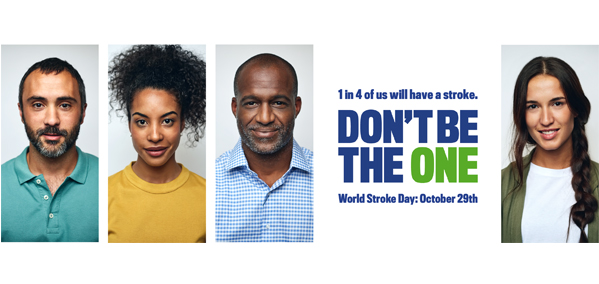
World Stroke Day, October 29
Our focus in this month's edition covers stroke, the relationship of stroke and communication, and World Stroke Day, October 29.

The World Stroke Organization asks " Why stroke matters" in their pamphlet covering World Stroke Day:

"A stroke can happen to anyone, at anytime and anywhere. Today stroke is the leading cause of disability worldwide and the second leading cause of death, but almost all strokes could be prevented."

They go on to say:

> This year 14.5 million people will have a stroke, 5.5 million people will die as a result.

> 80 million people have survived stroke worldwide.

The WSO says that one of four people will have a stroke. Stroke is also the one of the main causes of aphasia.

In summary:
> One in four people will have a stroke;
> One in three stroke survivors will have aphasia.

I am "one";
I am one in four: a stroke survivor;
I am one in three : an aphasia survivor.

Who are you?
How can stroke affect communication? 
Editor's Note: Regarding I am "one" , please read the story about my stroke.

According to several sources, including stroke.uk , about a third of stroke survivors may experience aphasia after stroke: that is, difficulty with speaking or understanding what others say. 

That was me after my stroke in October 2010.  

  • I was able to create very short sentences, but not much else. 
  • I had expressive aphasia and often could not find the word or sound that I wanted to say. 
  • I had problems understanding what was said to me. For me to respond to another person was very difficult. 

So, in essence, I had aphasia, poor word recall, slow cognition, attention issues, and lack of faith in my speaking and listening skills.  

How did I remedy this? 

I worked with Bill Connors at aphasiatoolbox, using his Aphasia Sight Reader and Verbal Working Memory programs. (FYI - We discussed the ASR program in last month's newsletter.)

Within the ASR program, we worked on semantics, verbing, sentence generation, and more. Together, we worked aggressively to reclaim my speech and language and by ability to converse with others.  

This was the timeline for my recovery and reconnection:

Phase 1:  
Timeline: July 2011 thru July 2012
We worked for a full year on exercises that helped my memory, cognition, sentence structure, word recall.  

Phase 2: 
Timeline: March 2012 through Sept 2012
We worked on semantic exercises that helped my writing. And, I wrote every day!

Are YOU a stroke survivor with aphasia? apraxia? dysarthria? 

If you are, and you have the same goals that I did for my recovery, please join me for my  Level One Conversation group on Mondays and Wednesdays at 12 pm ET. Contact me at sharon@aphasiatoolbox.com and I will send you a link individually. 

> The Level One group is for individuals who can say one word or short sentences.  We have room for up to four individuals.

> The Level Two group is for individuals who can say much more by creating longer sentences. This group is full.

Visit our web sites to learn about how we can help your aphasia recovery:

Bill Connors was interviewed by Kaide Jackstadt
Bill Connors was interviewed by Kaide Jackstadt on "Clinic Chats" .

Clinic Chats is an Apple podcast with host Kaide Jackstadt, Speech Pathologist. The full name of the podcast is: Clinic Chats: The Speech Therapist's Private Practice Podcast. 

Podcast Description: Specializing in Aphasia with his extensive knowledge and experience, Bill Connors, owner of AphasiaToolbox joins me to discuss treatment, teletherapy, and resources for clinicians. He is a leader in teletherapy and expanding his brand and company in a multitude of ways.  

Podcast Duration: 1 hr
Podcast Date: October 9, 2019
Podcast Link:  https://buff.ly/2Or3QTO

Everything SLP
If you are a Speech Pathologist who has created materials for treatment and practice, consider selling them at  www.EverythingSLP.com  .  The process is easy and the payout is better than TPT.  Turn your creative, hard work into passive income$$$ .  Contact Erin St.Myer at info@everythingSLP.com . or call 724 831 8353 .


Good News!
Scientists have come a step closer to understanding how we're able to understand spoken language so rapidly, and it involves a huge and complex set of computations in the brain. In a study published today in the journal PNAS, researchers at the University of Cambridge developed novel computational models of the meanings of words, and tested these directly against real-time brain activity in volunteers. September 30, 2019

Neuromodulation is the use of electrical, magnetic, or chemical stimulation to modulate nervous tissue function. Research studies with promising results from novel treatments using neuromodulations are emerging. October 08, 2019

Filtering out distractions might be more important for the brain than highlighting important information.
September 29, 2019

A new research project run in partnership between the Irish Heart Foundation and the National University of Ireland, Galway (NUI Galway) aims to raise awareness and understanding of aphasia – a highly distressing and hidden side effect of stroke. July 3, 2019

This article (in Stroke Connection, Fall 2019) discusses the high and low techology of augmentative and alternative communication for aphasia.