|
A news junkie, I read, daily, the 'Times/Sunday Times,' the 'Guardian/Observer,' 'Mail,' and the 'Argus' - both to keep up with crime in Brighton, where I set my novels, and because I think it is vital to support local papers - they provide a unique accountability for councils, emergency services and so much else, and are dangerously undervalued.
Peter James
Dateline Charlottesville, VA
| | |
In This Issue
- BoSacks Speaks Out: What Gannett’s Moves Means on the Ground for Local Papers
- Gannett is cutting $100 million and rethinking subscriptions to curb falling revenue
| | |
BoSacks Speaks Out: What Gannett’s Moves Means on the Ground for Local Papers
https://www.bosacks.com/
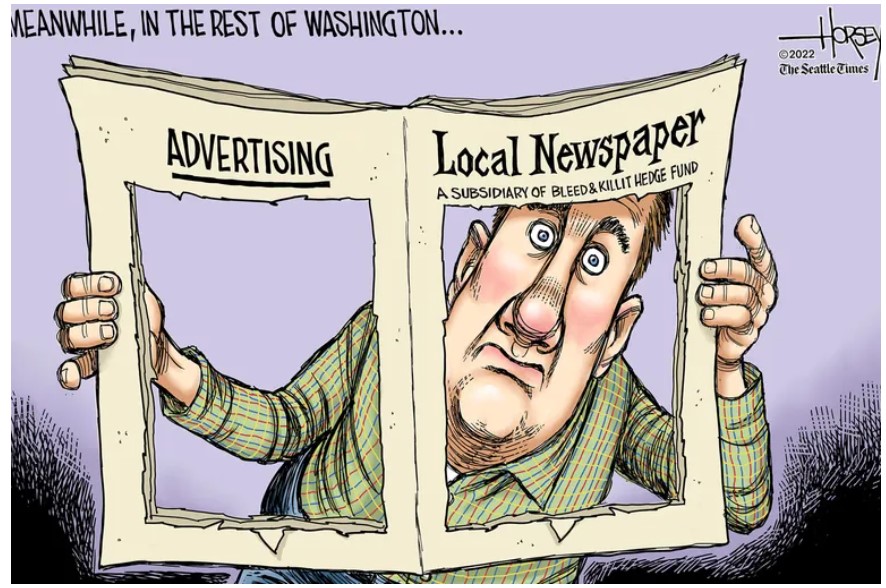
The latest wave of newsroom contractions isn’t just another chapter in the long saga of media consolidation; it’s a quiet dismantling of local journalism’s connective tissue. As you know, I take this personally as a former publisher of several local publications.
Gannett’s recent moves, from voluntary buyouts to centralized content strategies, are reshaping the landscape not with a bang but with a slow, methodical retreat. Editors are vanishing, coverage is thinning, and the once-vibrant pulse of community reporting is being replaced by templated stories and syndicated BS filler.
These aren’t just staffing decisions; they’re existential ones. When a newsroom loses its editors, it loses its memory, its nuance, and its ability to hold power to account. From my perspective, all things counterproductive to a thriving community.
This erosion cuts especially deep for those of us who’ve spent decades championing local papers not just as news sources, but as cultural luxuries, tactile, intimate, and rooted in place. A local paper isn’t just a delivery system for information; it’s a ritual, a shared experience, a mirror held up to the community. It’s where the high school sports scores live alongside the town council drama, where obituaries are read with reverence and classifieds with curiosity. Strip away the editors and the local voices, and you’re left with a hollowed-out product that knows the zip code but not the soul.
Meanwhile, the print product, already beleaguered, is being pushed further into obsolescence. With large printing plants shuttered and markets shifted to USPS delivery, deadlines are creeping earlier, and papers are arriving later.
The Phoenix-to-Vegas move, with its 117 layoffs, is emblematic of a broader trend: print as an afterthought, a relic to be managed rather than a service to be optimized. For subscribers, this means waking up to yesterday’s news, if it arrives at all. For publishers, it’s a bet that timeliness no longer matters in a world of digital immediacy. But for communities, it’s a loss of rhythm, ritual, and relevance.
| | |
On the digital front, the strategy is clear: fewer subscribers, more revenue per head. Cheap introductory offers are out; annual plans and targeted price hikes are in. The result? A 15% year-over-year drop in digital-only subscribers, offset by a rise in the average revenue per user (ARPU).
Management insists growth will return in “a few quarters,” but the short-term effect is unmistakable, fewer casual readers, less spontaneous engagement, and a narrowing of the audience to those who can afford to stay. It’s a model that prioritizes margins over mission, and in doing so, risks alienating the very communities these papers were meant to serve.
Content itself is shifting, too. High-engagement verticals like sports and entertainment are being elevated, while resource-intensive local watchdog work is quietly sidelined.
The hiring of a former People editor to steer entertainment coverage is more than a staffing note; it’s a signal. National clicks are being prioritized over local truths. The stories that require time, trust, and tenacity are being crowded out by those that promise traffic and shareability. It’s not that entertainment doesn’t belong in the mix; it’s that it’s becoming the mix, at the expense of civic depth.
| | |
And then there’s AI, the double-edged sword of modern media. Gannett is leaning into automation not just to streamline workflows but to monetize its vast network of local sites. Licensing deals with platforms like Perplexity and experiments with generative answer engines like Taboola’s DeeperDive are reframing journalism as a data asset.
But while AI can summarize, optimize, and even mimic, it cannot replace the lived experience of a local reporter, the institutional memory of an editor, or the trust built over years of community engagement. Automation may save costs, but it cannot save credibility.
Financially, Gannett posted a $78.4 million profit in Q2, even as revenue fell nearly 9% year-over-year. The company is guiding toward a down 2025 with hopes of improvement in 2026, a bet that price hikes, automation, and licensing can outrun audience loss and print retrenchment. But for many communities, the near-term reality is stark: fewer editors, thinner pages, and a print product that arrives late and says less.
This isn’t just a business strategy, it’s a cultural shift. And for those of us who believe in the irreplaceable value of truly local news, it’s a call to arms.
Because if we don’t fight for the soul of local journalism, we may wake up in a world where the news knows everything about celebrities and nothing about our own neighborhoods. And that, to me, is not just a loss, it’s a betrayal of what journalism was meant to be.
And yet we have to admit that there is no cure for greed.
| | |
Gannett is cutting $100 million and rethinking subscriptions to curb falling revenue
With profit up but year-over-year revenue down, the country's largest newspaper chain looks to raise prices and lean on AI
By: Angela Fu
https://www.poynter.org/business-work/2025/gannett-earnings-call-gci-media-company/
After a difficult first half of the year, Gannett, the largest newspaper chain in the country, is executing $100 million in cuts and rethinking its subscription strategy, executives announced Thursday.
The company ended its most recent quarter with a profit of $78.4 million, up from the $13.7 million profit it posted during the same period last year.
However, total revenue fell 8.6% year-over-year to $584.9 million. To address this issue, Gannett recently began making cuts with the goal of saving $100 million. Those reductions include closing two of the company’s largest print facilities, shifting some of its markets to mail delivery and automating and outsourcing certain parts of its business.
“This is a moment to tap into AI-driven automation across our workflows and back office processes, which is expected to unlock an additional layer of operation efficiency,” Gannett chief financial officer Trisha Gosser said during an earnings call Thursday.
The $100 million cost reduction program likely includes recently announced companywide buyouts. In a memo to staff announcing the buyouts last week, CEO Mike Reed wrote that Gannett needed to cut costs given “static revenue trends.” He added that the company would “continue to use AI and leverage automation to realize efficiencies.”
| | |
Gannett is also changing its subscription strategy in an effort to reduce churn, executives said Thursday. Like many news companies, Gannett has tried to entice new readers by offering extremely cheap, introductory subscriptions. For example, one introductory offer gives USA Today subscribers daily delivery Monday-Friday for $9.99 a month for the first three months. That strategy led to high subscription rates, but many readers left after the introductory offers expired.
Instead, Gannett will focus on annual subscription offers, executives said. The company will also start raising prices in markets with higher engagement instead of offering similar prices nationwide and introduce pay-per-article options for occasional readers.
“That means some pain in the short term, but this is an intentional, necessary shift that is already starting to show positive signs of improvement,” Reed said during the earnings call Thursday.
Since joining Gannett as chief content officer in 2023, Kristin Roberts has emphasized increasing audience engagement. On Thursday, Roberts said that Gannett would continue to focus on “highly engaging verticals” like sports and entertainment. She noted that the company recently hired former People editor-in-chief Wendy Naugle as the executive editor of entertainment for the USA Today network.
The changes in subscription strategy mean it will take “a few quarters” for digital-only subscriptions to return to year-over-year growth, Gosser said. As a result, Gannett revised its financial forecasts, predicting that total revenues will decrease slightly this year and that the company will end fiscal year 2025 with a loss. The company expects revenue to be flat and net income to improve in 2026, in part due to the company’s $100 million cost reduction program, Gosser said.
| |
In addition to using AI to further cost savings, Gannett is looking to use the technology to expand revenue opportunities. The company announced a deal with AI-powered search engine Perplexity Wednesday, which allows the search engine to license Gannett’s content. Gannett has also started implementing measures to prevent AI companies from scraping its content and collecting data without permission.
In response to an investor question, Reed said he believes AI companies are now more open to striking fair deals with media publishers. That is in part because many AI companies are entering the search business, where up-to-date information is much more necessary, he said.
“There’s definitely a very momentous shift happening (and) moving towards content creators and AI platforms coming together to figure out fair deals,” Reed said. “Over the next 12 months, as we finish this year and get into the next year, we hope there’s quite a few more deals to do.”
| | |
"The Industry that Vents Together Stays Together"
Responses to all Articles and Bo-Rants are greatly encouraged
and may be included in " BoSacks Readers Speak Out"
All news items and the various opinions expressed in this newsletter are not necessarily the opinion of, nor in agreement with the opinions of BoSacks. They are just interesting thoughts and other opinions that BoSacks thinks you should know about.
After all, as the Japanese proverb goes:
"If you believe everything you read, perhaps you better not read."
"Heard on the Web" Media Intelligence:
Courtesy of The Precision Media Group.
Print, Publishing and Media Consultants
193 Brookwood Drive, Charlottesville VA 22902
Contact - Robert M. Sacks 917-566-7437
BoSacks@aol.com
www.bosacks.com
WHO IS BOSACKS ?-
http://www.bosacks.com/who-is-bosacks
|
| | | |