|
Heron and Frog: Take 2
by John B. Smith
| | Since observing the encounter between green heron and frog on the ChicoryLane lower vernal pool and writing about it in our May Extra, I have found both images of and reflections on that encounter on my mind. Its significance would not register on many scales of importance. But I can’t shake the sense that I saw something important, something primal, and I should, in some sense, come to terms with it. | | So, this is Take 2 of what is going on in my mind regarding this event. I am not a profound thinker so much of what I say will probably be self-evident. And, frankly, it’s self-indulgent. To probe for any notion of meaning in this event, the main mechanism I rely on is empathy: What was going on in the minds of those two creatures during that 10-minute encounter? Of course, this is all speculation, but my musings seem to me to have some degree of validity to them. I offer them as plausible, lowest-common-denominator inferences that might approximate something like those animals’ experiences. I suspect any writer could do something similar. Make what you will of my naïve, presumptuous efforts. But be forewarned: if any of this you find distasteful, please stop reading. | | |
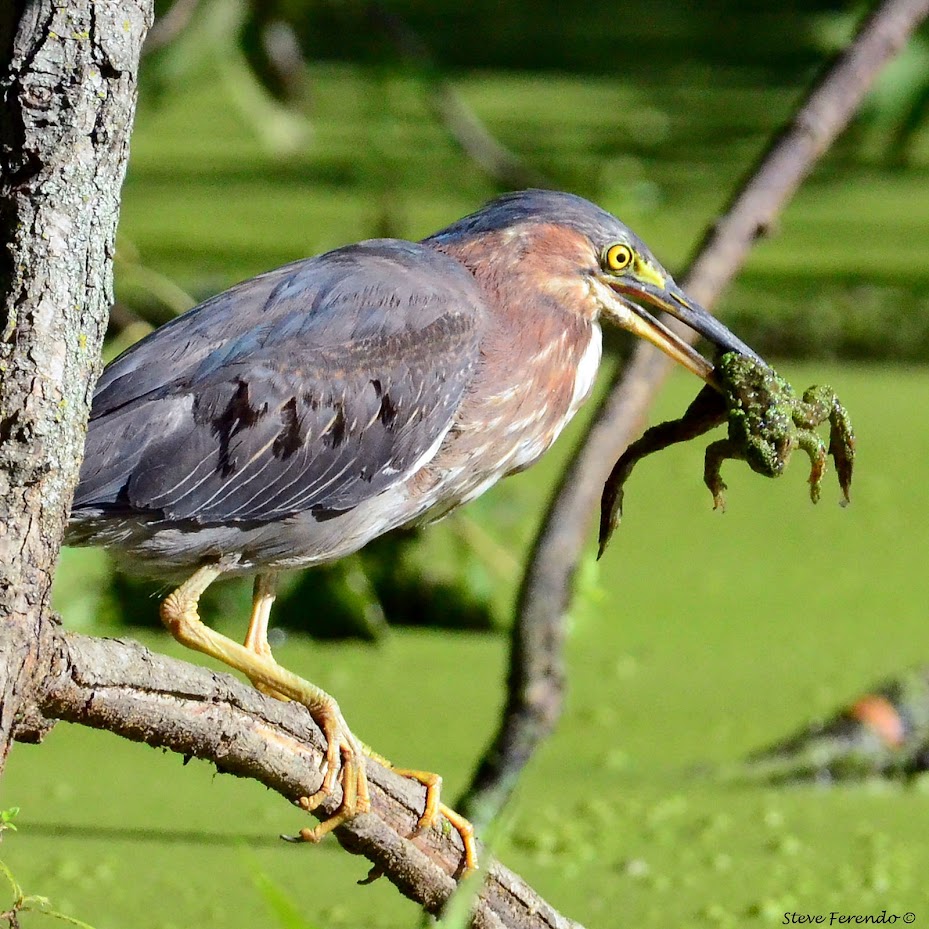
To remind you of this encounter: my attention was caught by a sudden movement as the heron did a neck strike, almost like a snake, and snatched the probably unsuspecting frog by one front leg. This was followed by several minutes of rapidly dunking the frog in the water bottom first, then after shifting its hold to a rear leg, dunking it headfirst at a slower, more intentional pace. Next the bird hunched over the frog, the color of the frog changing from green to white as the bird rotated its body. It then shrank in size as the bird gradually swallowed it.
So how did the heron think about the frog? Perhaps it had some sense of exercising its hunting skills in the capture, but I suspect it was just another day at the food bank as far as it was concerned. Just another typical predator-prey encounter for the bird, similar to so many others. The bird was clearly sentient in its stalking, planning, and execution of the act. But, ultimately the frog was probably just protein for the predatory bird: not an animal of any great individual significance.
What was the experience for the frog? Well, first it was in the role of prey. Whereas some prey may occasionally escape, not so in this encounter. In 10 minutes it would be dead. It was literally an existential moment for the frog. The frog may have been dead when the swallowing began, but I suspect the dunking may have disoriented it but may not have rendered it unconscious. Picking up the narrative when its head was in the heron’s mouth and headed toward the gullet: Was it in pain? Was it frightened? Was it dark as it was slowly muscled down the gullet? Was it still conscience? Was it slowly enveloped in a darkness of receding sensation and awareness?
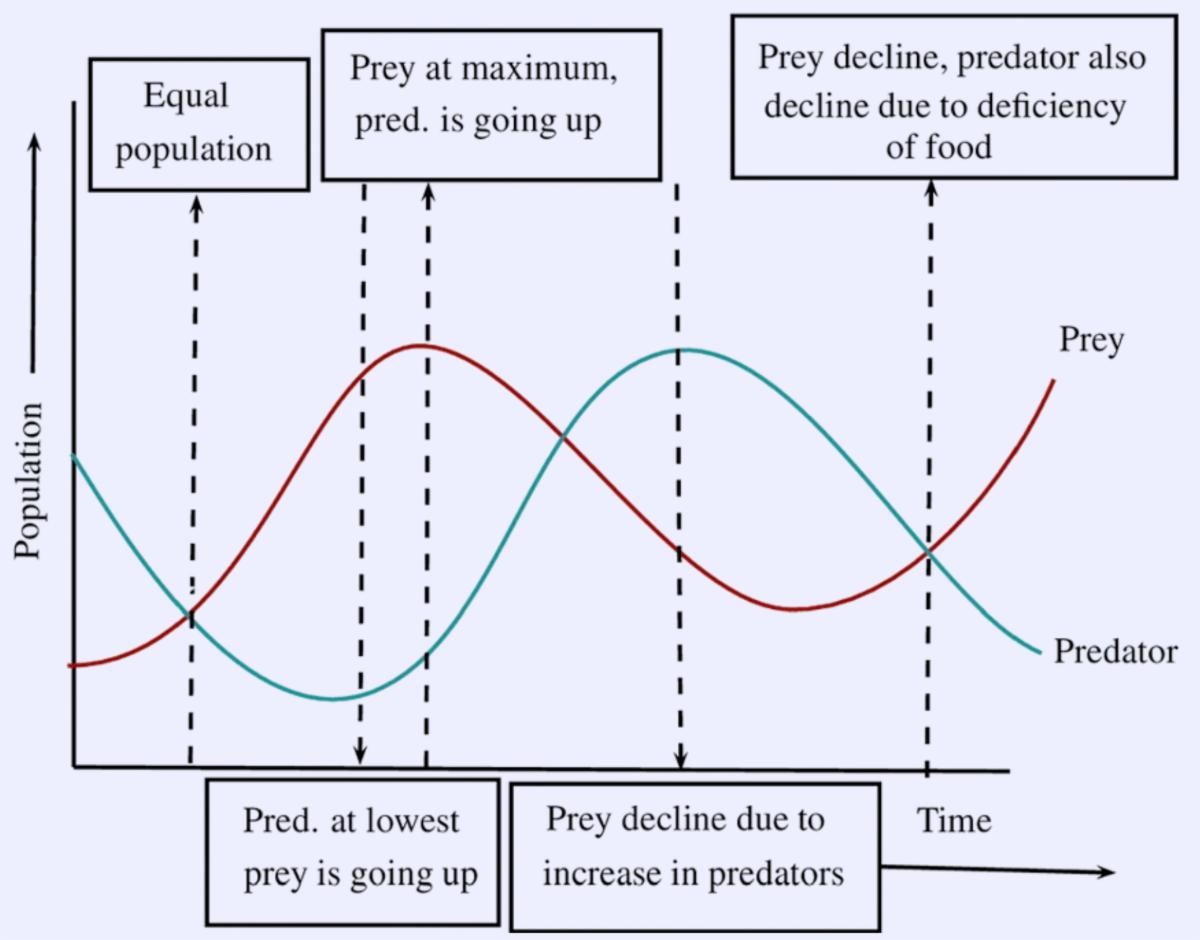
Frog and heron are on different sides of an evolutionary layer. Predator and Prey. Both sentient. Both protein, but only the frog played prey in this account. The heron will likely live for many future days before it, perhaps, becomes prey for a larger hawk, owl, or eagle. Or, if lucky, it may die of old age. But the predator-prey relationship extends throughout the animal kingdom. Down through rabbits and foxes, mice and cats, . . . , through various pairs of micro-organisms. Up through lions and gazelles, whales and zooplankton, etc. It’s successive layers from top to bottom, or as the saying goes, It’s turtles all the way down!
| | |
What we get a glimpse of in this encounter is a pattern that is pervasive for much of the animal kingdom. Its role in ecological evolution is enormous. Energy and complex organic molecules are shifted up the hierarch of layers. When we envision this broad, complex pattern after seeing it in a single pair of predator/prey organisms, we are looking at one of life’s fundamental processes. It’s not pretty, but there is a kind of beauty in it. It’s a beauty in its simplicity yet enormous extent. It’s a beauty that arises out of information and understanding. It is not joyous, but it is profound and it is brutal with respect to the individual organisms within its roles.
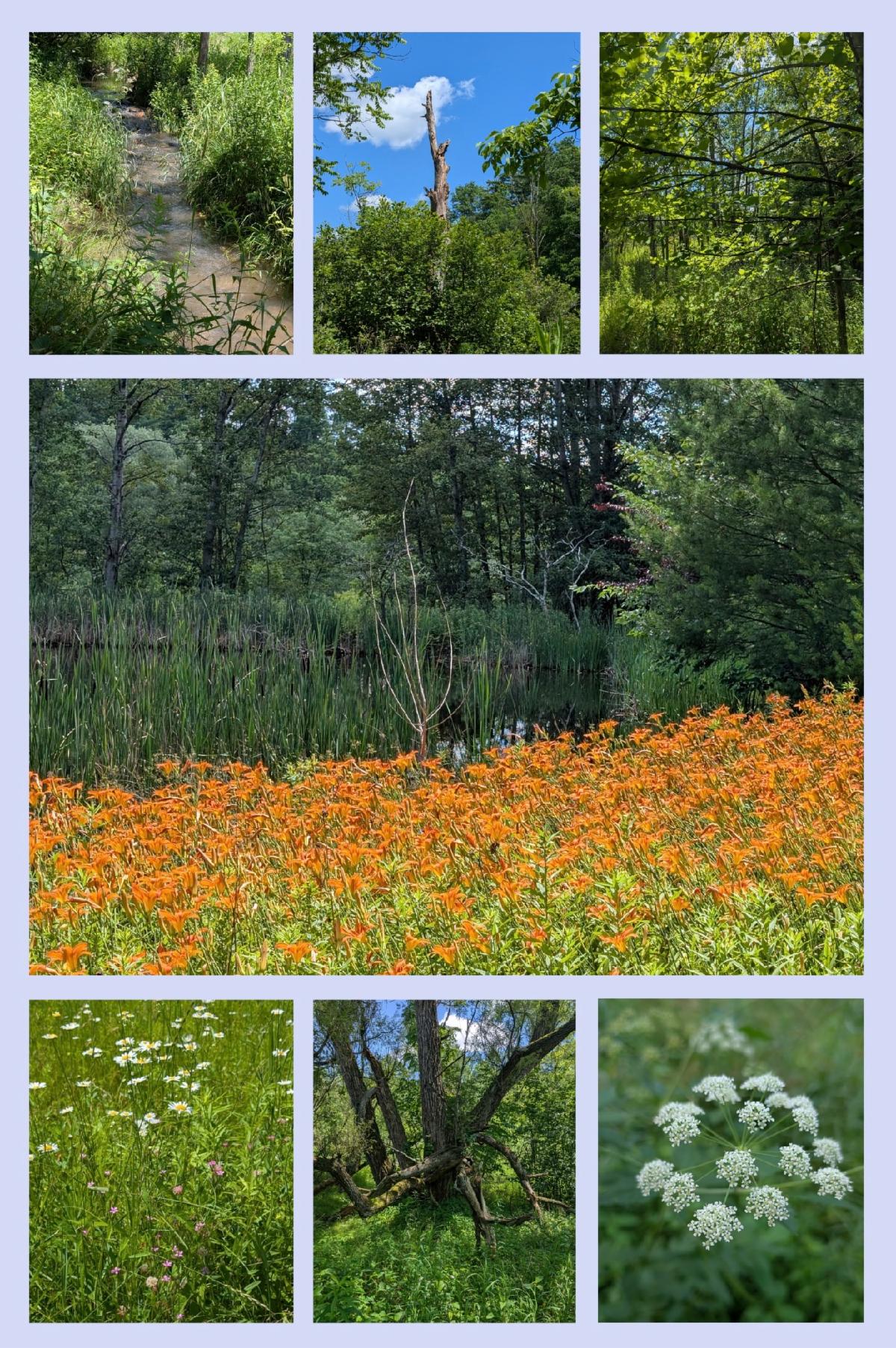
With respect to ChicoryLane, we might consider this as half the story. Another notion resides in its landscape – or the Land, in the sense of Aldo Leopold. Not balanced and sensuous like a formal garden, even one in the nineteenth century notion of a naturalized landscape, but an unfolding of our attempt to see what is here and to help this land become a better version of itself. I often go to a random spot in ChicoryLane in our Gator, turn off the engine, and wait. Usually within 15 minutes something will catch my attention. It may be a favored Baltimore Oriole or a wind-hovering Kestrel. Or it may be just the crowded abundance of the natural landscape - a wild mixture of native grasses, shrubs, and assorted trees. The density and diversity of the plants in many places is unusually high – a half-dozen species of grasses merging and mingling, diverse shrubs, sometimes in small clumps, trees scattered along a stream.
| | |
These places and these experiences I experience as beautiful. These places are places I choose to be in and enjoy being there. My mind wanders, with other thoughts sliding in and out of what I am seeing and feeling. This is a different and direct experiential form of beauty. Significant in its meaning for the observer. No idealization to remove the rough edges of the physical world. But, providing much to enjoy and take pleasure in. And, sometimes, to lose oneself in.
Two notions of beauty in one place. One awful in its profundity and extent through much of life on earth, abstract as well as literal, almost like a physical or mathematical model. The other sensuous, direct, experienced. Not a Disney creation with edges rubbed smooth and goodwill winning out most of the time. Rather, full, overgrown, real. Both views are present in ChicoryLane. Two sides of a single coin: often experienced separately, but when combined they provide for a more complex whole.
Images
Top Section: Heron and Frog, National Park Service; Lotka-Volterra Predator Prey Model, M. Akram & A. Luqman, Granulation of ecological networks under fuzzy soft environment, (8/20200), Springer Soft Computing.
Bottom Section, beginning top left: ChicoryLane stream southwest, obelisk, sycamore, daylilies at pond, daisies and Deptford pinks, crack willow, water hemlock
| | | | |
ChicoryLane is an ecological reserve near Spring Mills protected by a Conservation Easement held by Clearwater Conservancy. Its 68 acres are actively managed for conservation.
The landscape is natural and scenic. It includes wetlands and meadows, streams, remnant and successional forests, and a grassland. This diversity of habitats is especially inviting to birds and butterflies. A system of mowed trails makes most of the property accessible to walkers.
| | | | |