| | |
Sylvia Woods Harp Center
May 2026 Newsletter
| | |
Many of the Celtic harp players in the 17th and 18th centuries were blind. The Irish harper and composer Turlough O'Carolan (1670-1738) was blinded by smallpox in his teens. His music is still widely popular today.
The Scottish harper and poet Roderick Morison (circa 1646-1713) also became blind due to smallpox. The Scottish Gaelic word "dall" means blind, so Roderick was, and still is, known by several names: An Clàrsair Dall (The Blind Harper), Rory Dall, or Blind Rory. He is also called "Gaelic Scotland's last minstrel."
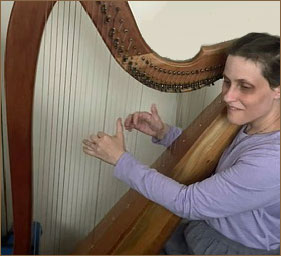
Over the past 40 years, I have taught four blind harp students. I am always astonished at how well they can find their way around the harp. My current blind student, Jessica Raichle, lives in Denver, Colorado, and has been taking online lessons with me for about a year. We both greatly enjoy our weekly meetings. I'm happy to say that Jessica has written an article for me, which you will find further down in this newsletter.
| | |
Jessica recently told me that three of my books are currently available in braille from the National Library Service for the Blind and Print Disabled (NLS), a free program of braille and audio materials sponsored by the Library of Congress.
Teach Yourself to Play the Folk Harp (BRM32681)
50 Irish Melodies (BRM35992)
40 O'Carolan Tunes (BRM32673)
Other braille harp books in the NLS collection include:
Complete Method for the Harp by David Watkins (BRM28394)
Harp Exercises for Agility and Speed by Deborah Friou (BRM32677)
Suzuki Harp School, Volumes 1 and 2 (BRM37794 and (BRM37795)
Old Tunes for New Harpists by Mildred Dilling (BRM20205)
Little Harp Book by Marcel Grandjany (BRM26987)
To Bend the Knotted Oak by Maureen Brennan (BRM32675)
A Ceremony of Carols for harp and SSA Choir (BRM33995)
A Ceremony of Carols for harp and SATB Choir (BRM30503)
I have been in communication with Katie Rodda, a Senior Accessible Music Librarian at NLS. Here are her answers to some of my questions.
How do blind people order the braille books?
Our program serves residents of the US and US citizens living abroad. To order them, they need to be registered with the talking book and braille library program in their state (here is a complete list of programs). Once registered there, they can order music materials directly from us to be sent in the mail. They can also download them through our online digital library, BARD. Comparable programs to ours also exist in many other countries.
How do you decide which music books will be transcribed?
This is a mixture of patron requests and noted gaps in the collection. We do our best to fulfill patron requests and then add more books in a given area or by a particular composer if we feel the collection is "light" in that area.
Please note that NLS does not transcribe music; it contracts transcriptions to certified transcribers. If you need a transcription with a quick turnaround time, you may want to reach out directly to Braille Music Transcribers. However, you will be required to pay to have the transcription created.
Braille Music Transcribers [HTML]
Braille Music Transcribers [DOCX]
Braille Music Transcribers [BRF]
Katie Rodda mentioned that she would like to add more harp music to the library's braille collection, so she wants to know which books the blind harp players would like transcribed. She will then begin by putting about 3 to 5 of them into the current schedule.
HERE IS HOW YOU CAN HELP!
If you are blind or have a blind harp student, please email me at sylvia@harpcenter.com and tell me a bit about yourself and list a few of my compositions or arrangements, or music by other harpists, that you would like transcribed into braille. I will then compile a list of the most requested publications to send to NLS.
| | |
In July of 2013, I received an email from Larry Smith, who was the chair of the Music Braille Technical Committee of the Braille Authority of North America (BANA). He asked if they could transcribe my 50 Irish Melodies book into braille. I gave him permission and asked if he would write an article for my newsletter about braille music. Here is the "Braille Music in Brief" article that he sent to me at that time.
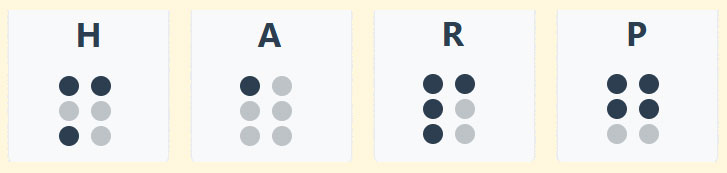
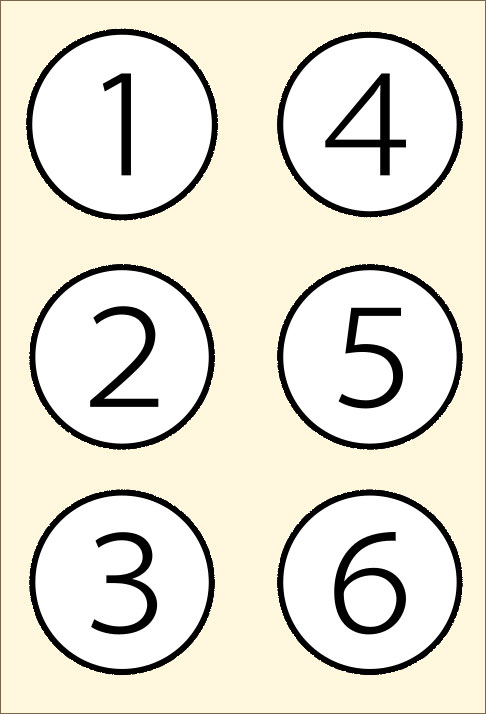
The braille cell. All braille consists of characters called cells, each of which is one of the possible combinations of six dots (or not-dots) arranged in two columns of three. There are 63 combinations, plus the space containing no dots. For reference, the six positions are numbered downward 1-2-3 in the left column and 4-5-6 in the right column.
Music in braille. Print music is a graphic presentation that is viewed all at once. Braille music is a narrative that is read by the finger, one cell at a time, and assembled in the reader’s mind from the details. All of the information is there; it is not necessary for the braille reader to know what print music looks like.
Notes. A note consists of the letter name of the note, given in dots 1-2-4-5 of the cell, plus a rhythm value given in dots 3-6 of the same cell. The octave in which the note occurs is given in dots 456 of the preceding cell.
Rests. A rest is indicated by a cell in one of four patterns of dots, none of which can be mistaken for a note.
Bar lines. Measures are separated by a blank cell.
Modifiers. Some signs, such as accidentals and accents, are written before the notes that they modify. Other signs, such as fingerings, slurs, and ties, are written after the notes with which they are associated. Dynamics and other instructions are written before the notes on which they are to take effect. The order of signs is very strictly defined, since the meaning of a particular cell depends upon context.
Keyboard and harp music. Music that is printed using the grand staff is brailled in two successive lines, the first containing the right-hand music and the second the left-hand music. The combination is called a parallel, and is always introduced by the appropriate measure number at the margin, both hand-lines being indented from there.
-- Larry Smith
Jessica told me another interesting fact about braille music. When we see a C chord written in printed music, we see C, E, and G notes sitting on top of each other. But in braille, chord notes are written as intervals, instead of note names. In the bass clef, the intervals go up, so a C chord is written as "C, 3rd, 5th." In the braille treble clef, the intervals go down: "G, 3rd, 5th." Both versions represent the three notes of a C chord: C, E, and G. I found this fascinating. Jessica said that it is very helpful on the harp because her fingers know the spacing of the intervals.
Check out the Braille Music page on Wikipedia to see examples of braille music notes and symbols.
| | |
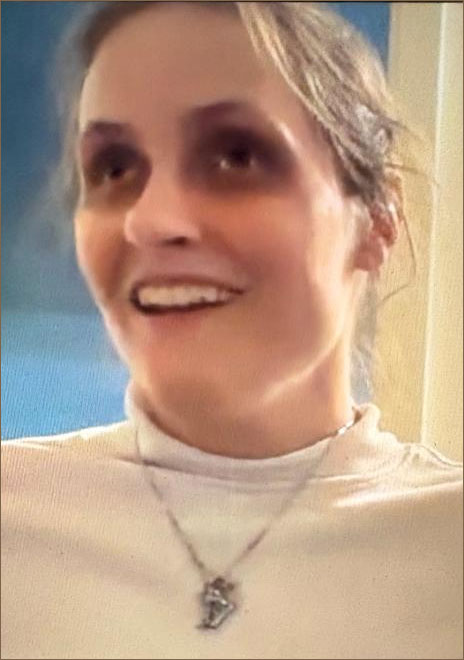
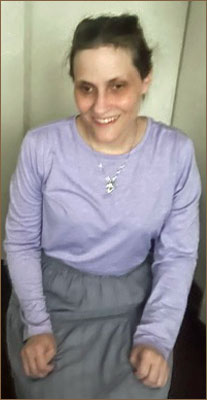
If you walk into a room and see me, it’s likely you won’t notice anything different about me. Maybe you won't even think about it until I (or someone else) informs you that I am blind.
Many people who consider themselves "totally blind" may actually have some level of light perception, even if it isn't very usable. However, I have none whatsoever. When asked, "What is it like to be blind?", I say, "I guess you can say I see black," but I "see" a lot in my mind's eye.
| |
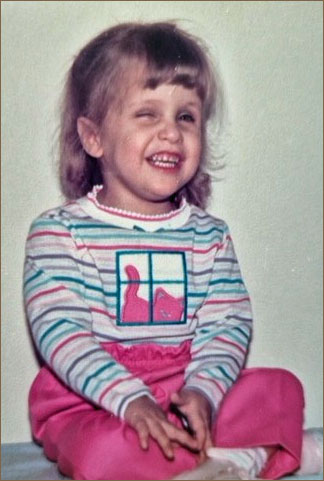
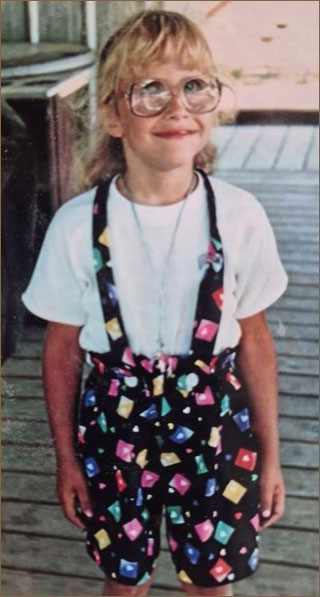
I was born in 1984, three months premature, weighing 2 pounds, 4 ounces. I was placed in an incubator for the first month and a half. I learned a few years ago that my parents couldn't even touch or hold me during that time. Due to the high level of oxygen, I developed Retinopathy of Prematurity (ROP). My parents were told I could lose my sight at any time, or it might never get worse at all.
When I was two, I developed acute glaucoma; my premature birth caused scar tissue in my eyes to block the ducts. My dad was in the Air Force, and I needed surgery ASAP. I was flown with my mom and a nurse from Minot, North Dakota, to Texas in a military jet. I lost the sight in my right eye from retinal detachment, and the sight in my left eye was not very good. Without Coke bottle glasses, I couldn't tell if my hand was in front of my face. With my glasses, I could read some print, though I often needed a magnifying glass as well.
| |
At age seven, the retina in my left eye began to detach. Two surgeries were performed within a month, but I completely lost my sight. I was unable to attend grammar school, but my teacher worked with me once or twice a week for about 90 minutes after school. I was mad that summer because I had to go to a special summer school for blind and visually impaired kids to focus on learning braille. But I learned braille pretty quickly and ended up loving it. I don't consider it "another language." It's just another way of writing, but it takes up a LOT more space!!
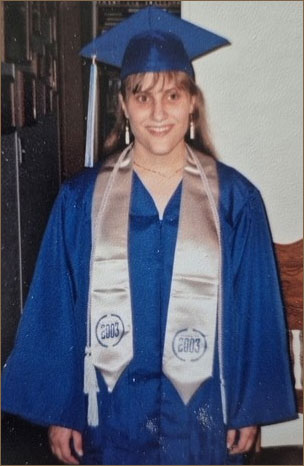
After I lost my sight at age seven, my first question to my parents after the surgery was, “Do I get a dog now?” Unfortunately, the answer was “no” because most guide dog programs require applicants to be at least 16 or 18 years old. But two weeks after graduating from high school, I received Shelby, a golden retriever guide dog from Leader Dogs for the Blind. I had her for 10 years, and she was an amazing guide. I think she could read my mind. When I was in college, some mornings I’d go to the dining hall for breakfast, and other days I’d go straight to class. It surprised me how often Shelby seemed to know what I wanted to do without me telling her.
One last tidbit before I go into my "music story." Many people comment on how pretty my eyes are. But what they see isn’t my actual eyes, but prosthetics. They are not full prosthetics; they are similar to contact lenses, just very thick, and you can't see through them. Two years after I lost my sight, I was approved to have them made because I would have had facial deformities from the atrophy of my eyes after the surgeries.
| |
My Music Story
I've been singing for as long as I can remember. I've participated in some sort of choir since fifth grade.
One day, about six months after losing my sight completely, I came home from school to find a keyboard my great-grandparents had purchased for me, along with the news that I would be taking piano lessons. My lessons only lasted about six months because I got bored. I think I was moving faster than my teacher expected. From then on, I learned by ear whatever grabbed my attention, and my dad taught me how to play "The Rose."
In sixth grade, I started learning how to read braille music. I joined the band and wanted to play the flute, but I was told I had to pick an instrument that was one-handed so I could read the braille music at the same time. I was NOT happy, mainly because the choice was not MINE. I did study flute with the band teacher the following summer, but stopped when school started. Choir was where I really loved to be!
In eighth grade, my dad asked me to write a song. What I came up with was pretty silly, and I don't remember the melody or many of the words. When I was in ninth grade, a young girl played a harp solo in a church service. I also recalled seeing/hearing the harp in a film when I was younger. That Christmas, I wrote my first "real" song about Jesus' birth. The choir teacher helped me with an accompaniment, and later I created one for myself.
| |
In eleventh grade, things weren't going so well at the public school I attended. My only special education class involved meeting with my Visual Impairment Specialist to work on ways to be more independent as a blind person. The previous spring, I had been to a music festival at the Wisconsin School for the Blind and Visually Impaired in Janesville, and I LOVED IT!!! I requested to attend that school and began my studies there the day after Easter in April. It was one of the most exciting days of my life. I was there for the last quarter of my junior year and throughout my entire senior year. Students lived on campus during the week and were sent home by chartered buses or planes every weekend. It would have been about a five-hour drive from my home to the school, so I flew both directions in a tiny plane. Unfortunately for me, my stop was the last one going home, and the first going back Sunday night!
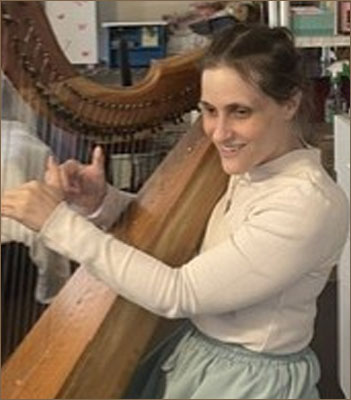
Once I learned how to use the Internet on my own, I drove my technology teacher crazy when I decided to research the harp: how to get one, and how to start lessons. I found the harp maker David Kortier, and my parents agreed to take me to his shop in Duluth, since it was the closest option. I rented a small harp from him for six months, carrying it back and forth on the plane to school. I took my first lessons with a local teacher. When I made a trip back to see David and explore my options for a larger harp, he suggested a used one he had in stock and set up a payment plan for me. He also fixed the harp a month later when a crack in the neck split apart. Thank you, Mr. Kortier, for being so kind to a stranger who walked into your shop just "wanting to look.”
| |
My first harp teacher was Beth Thompson from the Rice Lake, Wisconsin area, where my family lived. During college and later, I studied with Diane Schneider, Sister Melinda Gerke, and Anne Morse-Hambrock. I now take online lessons from Sylvia Woods. I couldn’t have progressed to the degree I have without all of my teachers’ help, support, and encouragement.
I earned a BA in music from Carthage College in Kenosha, WI. I composed my first two harp solos while there. My senior recital was a mix of piano, harp, and a short lecture on the Mass with demonstrations of the parts. I accompanied the first half on the piano, and the second on the harp, with the audience singing along. It was an amazing experience! Thank you, Carthage!!
Six months after I finished my degree, I attempted to enter religious life and become a nun. I enjoyed my time in a monastery because life was always predictable. But, due to health issues, I had to leave after about ten months.
| |
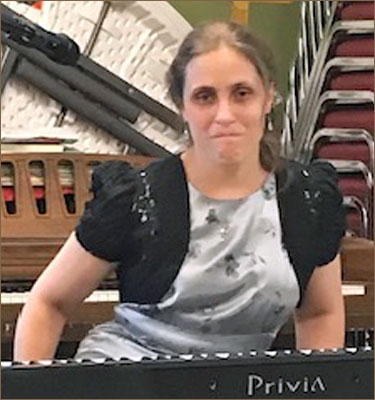
Now I sing in my church choir and have the privilege of playing solos and some harp accompaniments. This past Christmas, I composed my first choral piece for harp and flute, and the choir did a great job! I put together a concert for residents at my apartment building a few years ago, and I play background music for some of the get-togethers, mostly at Christmas. I'm always open to new opportunities. During COVID, I was so excited to attend the Sommerset Folk Harp Festival online; it had been a distant dream until then.
When I first started playing the harp, my parents weren't enthusiastic and kept telling me, "They won't have harps everywhere you go for you to use, but they'll have a piano or keyboard." Now they love my playing and often ask me to play for their retirement community.
| |
How do I "know my way around the harp"? I use bump dots, which are dome-shaped dot stickers, to mark C and F strings on the soundboard. I pay close attention to both the sound and to how my body feels in relation to the instrument. I also work on being patient with myself when things aren't going the way I want them to. If my muscles tighten up, playing can get a bit messy, and I need even more patience.
How do I learn music? Mostly by ear. I do sometimes use braille music, but I've found it is pretty difficult with the harp. I also input braille music into Sibelius and listen to it that way. I've found several apps that allow me to import downloaded MP3s I've purchased and I slow the music down. One thing I dream of is being able to go to any website or store and purchase the music I want in an accessible format without having to pay more or take extra steps to get it there. (For example, I paid around $60 for Sylvia's 40 O'Carolan Tunes book in braille.) Maybe AI will be a huge step forward in that direction!
Let me give you a small illustration of accessibility: Before I went to the school for the blind, I had to order braille and/or recorded books to borrow from the state Braille and Talking Book Library, which is sponsored by the Library of Congress. When I toured the school, I went into the library there and sat on the floor right inside the door, just pulling books off the shelves. I was so excited because I COULD READ THEM ALL!!! It was like being in my own "candy store"!
What are my struggles? Sensory overload and sensitivities can make life very difficult on an almost daily basis. About ten years ago, I learned I cannot eat wheat, so along with sensory difficulties, eating can be a struggle. I can get overwhelmed rather easily. I deal with depression and anxiety. But I don't let these things stop me, unless I realize I'm reaching my limit; then I slow down, take a break, and then go at life again!
What are my dreams? I would love to be more involved in the harp community. I'm not sure how to make that happen, since I DO need help and support. While online events are amazing opportunities, I also find them pretty exhausting and sensorially overwhelming. I dream of attending harp events in person with the right support. I am also looking forward to the chance to try playing the pedal harp, to see how difficult (or not) it may be for me, not because of the blindness, but more because of musculoskeletal conditions. I want to contribute to the world!
|
| |  | Living Independently. In 2011, I attended the Independence Training Program for adults at the Colorado Center for the Blind for 11 months. They teach people how to get around independently with a white cane, use public transportation, develop homemaking skills like cooking and cleaning, use technology, and read and write braille. I live by myself now but have a caregiver who comes several days a week. This assistance is not due to blindness but to other physical and mental health conditions. Her help has truly given me more freedom instead of restricting it. I am able to spend more time focusing on what truly matters to me because I don’t have to expend as much energy on day-to-day concerns. Even though I chose to apply for the services, it took me several years to truly be OK with the choice I had made, especially after discovering I wasn’t on the physical disability program, but the mental health one. Now I am on the program for the ID/D (Intellectual and Developmental Disability) community. I am humbly proud of myself for learning to go after what I believe will serve me best, not basing my life decisions on what other people may think.
What do I do in my spare time? I love reading. I'm working on learning languages, usually ending up with just enough to get me in trouble. From time to time, I make jewelry or rosaries. I give support to my friends when they need it. I play with my pet dog, Sophie.
I try to stay active in helping others. I am on the Advisory Council for the Denver IDDEAS (Individuals with Developmental Disabilities Equity and Access Solutions) program under the Denver Human Services (DHS) department. The Council helps guide DHS’s vision of a connected, supported, safe, and well community for all Denver residents.
How did I find Sylvia? Well, I've been calling her for at least twenty years, asking questions, and seeing if she has ideas for solutions to the difficulties I've faced. Thanks to a grant from the Denver Start Program, I've been taking lessons from her for the past year and have really enjoyed them. She is such a great cheerleader, and I always feel so encouraged at each lesson. I am so much more confident now about not giving up on my dreams but going after them!
I am grateful that Sylvia asked me to write this article. I truly pray it will help and inspire others. Thank you, Sylvia, for the opportunity!
-- Jessica Raichle
| | |
All of the books and PDFs in this month's sale include Turlough O'Carolan's tune Blind Mary. They also include lots of other great folk songs.
(A SILLY NOTE: Obviously, these are not braille volumes. They are regular printed music and PDFs!)
To get the 15% discount, enter the code word Mary in the "Enter Promo Code" box on your shopping cart page and click "Enter Code" by May 31, 2026. See the "How to get the 15% discount" section at the bottom of this newsletter for more information.
| | |
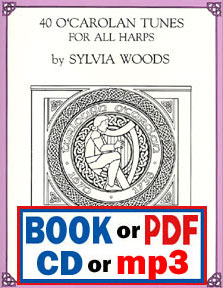
40 O'Carolan Tunes
including 2 arrangements
of each piece
by Sylvia Woods
Book, PDF, CD, or mp3
15% off with Mary code
------------------------------
| | |
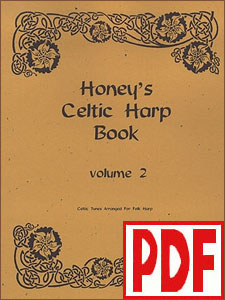
Honey's Celtic Harp Book Vol. 2
including 20 Celtic tunes
by Therese Honey
PDF
15% off with Mary code
------------------------------
| | |
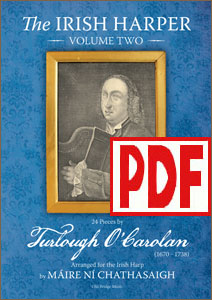
The Irish Harper Vol. 2
includes 24 pieces by
Turlough O'Carolan
by Máire Ní Chathasaigh
PDF
15% off with Mary code
------------------------------
| | |
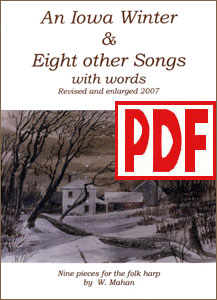
An Iowa Winter
9 songs for intermediate harp
and voice
by William Mahan
PDF
15% off with Mary code
------------------------------
| | |
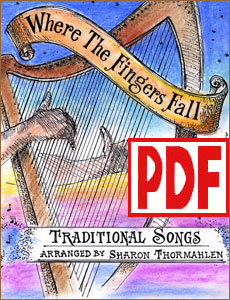
Where the Fingers Fall
including 14 traditional tunes
by Sharon Thormahlen
PDF
15% off with Mary code
------------------------------
| | |
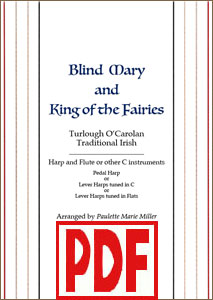
Blind Mary and
King of the Fairies
for harp and flute
by Paulette Miller
PDF
15% off with Mary code
------------------------------
| |
How to get the 15% discount
| | |
15% off select sale items when you use the code word Mary
Our newsletter promo codes are redeemable online and are only valid for the products listed above in the monthly sale section. They are not valid for phone or email orders. This month's code word is Mary.
Here's how to get your newsletter discount at harpcenter.com:
#1. Put the items you want to purchase in your cart.
#2. On the page where you view the items in your cart, type this month's code word Mary in the "Enter Promo Code" box and click "Apply."
The actual price of the featured sale products on this page will then automatically change to reflect the discount. For example,
Unit Price: $9.95 (the original price)
Total Price: $8.46 (the discounted price)
You'll also see a note below the Promo Code box that shows the name of the promo code you entered and the percentage discount.
REMEMBER: You must enter this month's code word Mary in the Promo Code box and click "Apply" on your shopping cart page by May 31, 2026, to get the discount!
If you forget or have trouble adding it to your order, email Sylvia immediately.
This offer expires at the end of the day on 5/31/26.
| | |
Sylvia Woods Harp Center
Lihue, Kauai, Hawaii
| | | | |