|
|  |
|
Retail Beat
updates for retailers + key business partners
December 9, 2024
| |
Minnesota's retailers report a level of optimism relative to holiday spending this year, however they are keeping an eye on winter weather and its impact on consumer spending. See below for our full report. | |
|
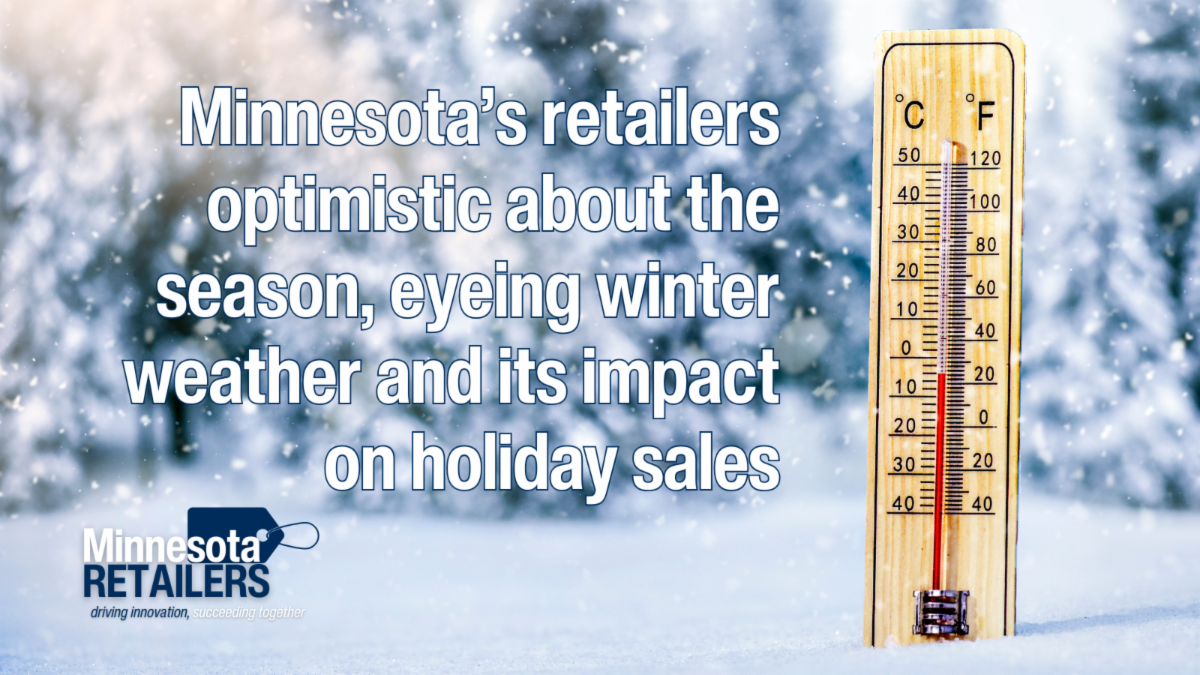
Minnesota retail Thanksgiving weekend report: Optimistic results, eyeing winter weather and its impact on holiday sales | |
Minnesota Retailers conducted a survey and held conversations with retailers across the state to assess consumer activity during the critical Thanksgiving weekend shopping period. The feedback highlighted optimism with an eye on weather as the holiday shopping season gains momentum.
Key Insights
1. Slightly Better-Than-Expected In-Store Traffic and Online Sales
Retailers generally reported slightly stronger-than-anticipated in-store traffic and e-commerce sales over the Thanksgiving weekend. This encouraging trend demonstrates Minnesotans' ongoing support for our retailers and consumers' confidence in the economy.
2. Impact of Shorter Holiday Season
A shorter holiday season is tempering enthusiasm among some retailers. With fewer days between Thanksgiving and Christmas this year, retailers are feeling the pinch. As one retailer put it: "We are missing one week of the holiday season, and if we don't get snow, we won't get into that Christmas spirit."
3. The Role of Snow and Holiday Spirit
Little snow at this point has become a watch point. Snowy weather often triggers a festive atmosphere that drives robust gift-giving and holiday shopping. Without it, retailers are watching purchasing and the weather's overall impact on seasonal sales.
This observation aligns with research by University of Minnesota economists, who discuss the critical role of winter weather on Minnesota’s economy, particularly in driving tourism and related spending. More on their insights can be found here: Winter weather’s impact on Minnesota tourism and economy.
4. Promotional Timelines
Many Minnesota retailers ran sales ahead of Thanksgiving, but on a shorter timeline compared to national trends. While retailers across the country started promotions sometimes six to eight weeks before Thanksgiving, Minnesota businesses reported limited their pre-holiday sales to three to four weeks.
Looking Ahead
The Thanksgiving weekend showcased some encouraging in-store and online traffic. However, the shorter season and lack of holiday spirit-inducing snow are challenges could affect overall holiday season sales this year. Retailers are cautiously optimistic but emphasize the need for strong consumer engagement in the coming weeks to meet holiday expectations.
| |
NRF chief economist says ‘conditions are shaping up for a successful holiday retail season’ | |
From the National Retail Federation, December 5, 2024
Strong results during the third quarter and continued growth in key economic data since then have set the stage for a solid holiday season, National Retail Federation Chief Economist Jack Kleinhenz said today.
“Even though the traditional kick-off to the holiday season started with Black Friday, this holiday shopping season was already in full swing,” Kleinhenz said, noting that many shoppers started earlier because a late Thanksgiving has left five fewer shopping days before Christmas than last year. “Based on data seen so far, conditions are shaping up for a successful holiday retail season.”
“U.S. economic growth remained strong in the third quarter, with gross domestic product expanding more than many estimates of the economy’s long-run potential capacity,” Kleinhenz said. “Personal consumption continues to provide the horsepower behind the economy, as it has throughout this expansion.”
Kleinhenz’s comments came in the December edition of NRF’s Monthly Economic Review, which said NRF stands by its forecast that retail sales during the November-December holiday season will grow between 2.5% and 3.5% over 2023. A near-record 197 million people shopped during the holiday weekend from Thanksgiving through Cyber Monday, and 58% of holiday shoppers had started by early November.
“Consumers’ view of the economy has improved and they remain supportive of retail sales,” Kleinhenz said, adding that the University of Michigan’s consumer sentiment survey climbed for the fourth consecutive month to 71.8 in November, reaching its highest level since April. Core retail sales – based on Census Bureau data but excluding automobile dealers, gasoline stations and restaurants – were up 5.4% unadjusted this October compared with October 2023.
READ MORE
| |
Minneapolis City Council changes course on Labor Standards Board, sustaining Frey’s veto | |
From MinnPost, Winter Keefer, December 6, 2024
When the Minneapolis City Council passed its resolution to create a city Labor Standards Board, the motion passed in a 9-3 vote, a council supermajority. When Mayor Jacob Frey vetoed this resolution, proponents of the board as currently outlined in the council-passed resolution needed this supermajority to hold in an override vote.
But at the council’s regular meeting this week, council members Jamal Osman and Andrea Jenkins changed course, sustaining the mayor’s veto. These council members joined Michael Rainville, LaTrisha Vetaw and Linea Palmisano in their opposition to the resolution.
Shortly after the council vote that sustained the mayor’s veto, Osman released a statement about his changed vote.
“While I initially voted for the Labor Standards Board, I expressed concern over the limited opportunities for residents of Ward 6 and the East African community to engage in the process and learn about what was proposed,” Osman wrote.
The lack of a formal public comment period for the final Labor Standards Board resolution was a major point of contention leading up to the council’s initial vote on creating the board.
“By sustaining the veto, I’m not only amplifying community voices; I am both pro-worker and pro-small business,” Osman wrote. “In the pursuit of a fair and balanced Labor Standards Board, I am supporting a public comment for community members to come and let us know how you want to be reflected in this resolution. I invite my colleagues to open your minds and open your hearts.”
In her weekly newsletter to constituents, Jenkins said her thought at the time of the first vote was that she would support the resolution, “then work to improve it over time.”
“I did not know the mayor would veto the measure, however, once he did that presented an opportunity for us to work with constituents from the small-business community, many of whom are women and people of color,” Jenkins wrote. “What I’ve heard from folks is they do not feel they have had a voice in how the Labor Standards Board was drafted. There were repeated asks for public hearings to understand those concerns but those requests were denied.”
Work to establish the board will continue in January, she said. The veto by Frey was not an outright “no” to a city Labor Standards Board. But the mayor also wants the makeup of the board to differ from the language passed by the council in its now-vetoed resolution. Rather than the council appointing 12 board members and the mayor appointing three, the mayor wanted to see 50/50 split between appointments. He has also said he would like to see a 50/50 split between employees and employers and require a supermajority consensus before bringing recommendations to council. He also has urged the council to hold a public hearing on the issue.
READ MORE
| |
Minneapolis Works Together statement on sustained labor standards board veto | |
December 5, 2024: Today, the Minneapolis City Council sustained a veto from Mayor Frey
of the Labor Standards Board. Angie Whitcomb, on behalf of the Minneapolis Works Together Coalition which includes the Minneapolis Regional Chamber, Minneapolis Downtown Council, Hospitality Minnesota, Minnesota Retailers, and the Minnesota Licensed Beverage Association, shared the following statement:
Today is a victory for small businesses and the economic future of Minneapolis. We are grateful to the city council for sustaining the mayor’s veto of the Labor Standards Board, and for listening to the concerns of businesses, neighborhood organizations, and community advocates across Minneapolis.
This decision sends a strong message—one that considers the needs of small businesses, employees, and the broader community. As Minneapolis continues its recovery and revitalization, we must prioritize collaboration and fairness to ensure our city remains a place where businesses can thrive, contribute to vibrant neighborhoods, and create opportunities for all.
| |
US job market bounces back from impact of strikes, hurricanes | |
From Reuters, Lucia Mutikani, December 6, 2024
U.S. job growth surged in November after being severely hindered by hurricanes and strikes, but a rise in the unemployment rate to 4.2% pointed to an easing labor market that should allow the Federal Reserve to cut interest rates again this month.
The labor market's resilience is driving the economy through strong consumer spending, with the closely watched employment report from the Labor Department on Friday showing solid wage growth last month. The economy created 56,000 more jobs in September and October than previously estimated.
"The report should soothe bears and bulls alike," said Scott Anderson, chief U.S. economist at BMO Capital Markets. "The solid nonfarm payroll gain and strong earnings growth should keep the economic expansion on a sturdy foundation, even as a gradually rising unemployment rate moderates demand and inflationary pressures over time."
Nonfarm payrolls increased by 227,000 jobs last month after rising by an upwardly revised 36,000 in October, the Labor Department's Bureau of Labor Statistics said. Economists polled by Reuters had forecast payrolls would gain 200,000 jobs following a previously reported rise of 12,000 in October.
| |
Where is the U.S. labor market heading? Interpreting the mixed signals | |
From the Federal Reserve Bank of Minneapolis, November 19, 2024
Starting in January 2023, the U.S. unemployment rate steadily crept up through July 2024, before edging down in recent months (blue line in Figure 1). At 4.1 percent, the unemployment rate currently remains 0.7 percentage points above the January 2023 value of 3.4 percent. Strikingly, this increase has occurred without a discernable rise in layoffs (gold line). Media commentaries often note that both rising unemployment rates and rising layoff rates are indicators of a cooling labor market. These rates are expected to move together because unemployment reflects a scarcity of jobs and layoffs reflect employers cutting jobs. But recently, the two rates have diverged. So, what signals are we seeing in the labor market?
In this note, we provide a fresh look at labor market data, arguing that recent developments are in line with historical patterns around labor market cooling. Our main finding is that increases in unemployment are typically not due to increases in layoffs; rather, they happen because laid-off workers are less likely to quickly find a new job, more likely to stay in the labor force, and thus more likely to join a growing pool of unemployed people hunting for work.
A new dataset provides new labor market insights
In July 2024, we introduced the QLmonthly, a new dataset, updated monthly, containing time series on quits and layoffs resulting in nonemployment. The data are computed from the Current Population Survey (CPS) as described in our 2024 paper “Quits, Layoffs, and Labor Supply.” The CPS data offer a perspective not seen in the most-often-used series on quits and layoffs, the Job Openings and Labor Turnover Survey (JOLTS). Whereas the JOLTS tracks what happens to a job, the CPS tracks what happens to people. The CPS data have two advantages we exploit in our research. First, the data series extends back further, to 1978, while the JOLTS begins in 2000.1 Second, the CPS adds information about what happens to a worker after a layoff: Do they become unemployed or exit the labor force? Notably, CPS layoffs capture layoffs to nonemployment; laid-off individuals who quickly find another job are not included.
| |
With budget deficits on the horizon, state lawmakers react along party lines | |
From MinnPost, Peter Callaghan, December 5, 2024
It is the gift-giving season, and Wednesday’s Minnesota economic and revenue forecast had something for all the politicians to cherish — DFL and GOP both.
It was the same presentation, one that showed a narrowing surplus for the two-year budget that will be adopted this spring and then a sizable shortfall for the two-year budget after that. If the next Legislature does nothing more than keep current taxes steady and increase spending only in ways established by law, it would have $616 million extra come May. If the next Legislature, however, does not appropriate the $926 million in the inflationary increases estimated by MMB, the ending balance would rise to $1.54 billion.
And if the Legislature after that includes inflationary increases, it will be faced with a hole of $5.14 billion that includes estimated inflation of $2.2 billion.
Come January, the DFL Senate and the evenly divided House could make both those numbers worse — or better — depending on how they approach budget negotiations. Spend more now and the future deficit gets larger. Spend less now and, well, the opposite happens. In other words, the two budget periods are intertwined in ways that make them hard to separate.
But there is accounting, and then there is politics. After a lengthy presentation by state economists and budget officials, including advice to be cautious in spending and to begin looking at looming deficits soon, DFLers led by Gov. Tim Walz wanted to talk about the surplus part and Republicans had that whole deficit thing top of mind.
“As you can see, Minnesota continues to be in a strong place,” Walz said. “We put money into things that improved people’s lives and built for the future. I’m proud of the work we’ve done together, proud that we have once again made Minnesota a top state for children, for business, for health care and things that enhance the quality of life.”
In addressing future budgets, Walz worried more about what the next Trump administration might do that would affect the economy or reduce federal money flowing to the states. And he cited two expensive and growing areas of state spending that were of special concern — long-term care for vulnerable seniors and special education.
READ MORE
| |
Connect with Minnesota Retailers! | | | | |