NEMWI Weekly

Update 

December 8th, 2025

https://www.nemw.org/wp-content/themes/NEMW_ATTCK/images/nemw_logo.png
 

Affordable Clean Water Infrastructure Act Introduced in U.S. House


A bipartisan group of House members introduced the Affordable Clean Water Infrastructure Act on December 5 to expand assistance available under the Clean Water State Revolving Fund (CWSRF) in areas of low income and high need, especially rural and tribal communities. The bill was introduced by Great Lakes Task Force members Rep. Kristen McDonald Rivet (D-MI), Rep. Emilia Sykes (D-OH), and Rep. Tony Wied (R-WI) alongside Reps. Rob Bresnahan (R-PA) and Brian Fitzpatrick (R-PA).


The bill would raise the amount a state can offer of its CWSRF capitalization grants as additional subsidization. State revolving funds primarily distribute money via low-interest loans, but additional subsidization includes grants, principal forgiveness, and other funding mechanisms to ease the burden on recipients. The maximum amount would rise to 50 percent of a state’s capitalization grant from a current level of 30 percent, while the minimum amount a state must offer for eligible projects would rise to 20 percent from 10 percent. Also, the bill would allow a state to make an additional 10 percent available for subsidization specifically for “rural, small, and tribal publicly owned treatment works.”


“Everyone deserves to have clean water. Too often, rural, poor, and tribal communities can’t afford important upgrades to their wastewater and stormwater systems,” said Rep. McDonald Rivet. “Our bipartisan bill unlocks important resources to ensure every family, regardless of their zip code, is supported by safe and reliable water infrastructure.”


“The Clean Water State Revolving Fund has funded water infrastructure projects across the country for the last 37 years,” Rep. Wied added. “I am proud to co-sponsor this legislation to reduce project costs for communities facing financial roadblocks and ensure that more funds are being utilized to support small and rural water systems.”


For more on Congressional action, see NEMWI’s Great Lakes and Water Legislation Tracker here.

Invasive Mussel Collaborative Hosts

Golden Mussel Webinar


The Great Lakes Commission and the Invasive Mussel Collaborative hosted a webinar on Golden Mussel Planning & Response on December 1. The invasive golden mussel (Limnoperna fortunei), native to China and Southeast Asia, was first discovered in October 2024 near the Port of Stockton in California. Since then, the state of California, the Lake Tahoe community, and neighboring states have undergone many precautions to reduce their spread. These mussels can tolerate brackish and freshwater temperatures of 0-35℃, and water depths to 20m.


Through climate matching analysis, the U.S. Fish & Wildlife Service has been able to understand where golden mussels are and the most vulnerable locations for the U.S. Golden mussels are not yet in the Great Lakes, but Dr. Katherine Wyman-Grothem spoke to the potential suitability of the region’s climate for golden mussels. “Under current climate conditions, there are substantial areas of moderate to high climate match along the southern and western sides of the basin,” she said, though she made a point to highlight that having an appropriate climate is not the only variable that will lead to an established invasive species.


Currently, in the U.S., invasive golden mussels have only been found in California. To manage populations and limit the spread of the invasive mussel, California local and state programs have increased ballast water treatment, watercraft decontaminations, and education outreach.


In early June, Rep. Josh Harder (D-CA) introduced the Golden Mussel Eradication and Control Act of 2025. If passed, the bill would appropriate $60 million over four years, starting in 2026. The Save Great Lakes Fish Act of 2025, introduced by Great Lakes Task Force co-chair Rep. Debbie Dingell and GLTF member Rep. Tim Walberg in November, aims to combat invasive zebra and quagga mussels in the Great Lakes. This effort to eradicate golden mussels is timely; while this invasive species is currently confined to California, there is the potential for it to spread quickly as other mussel species have if left unchecked.


The Invasive Mussel Collaborative, convened by the Great Lakes Commission, unites partners including federal and state agencies, research universities, non-profits, and indigenous nations to drive the development and implementation of invasive mussel control strategies for the benefit of the ecology and economy of the Great Lakes. Learn more here.


Reported by NEMWI Intern Christina Uytingco, University of Michigan

NEMWI To Host Event on

Great Lakes Marine Sanctuaries


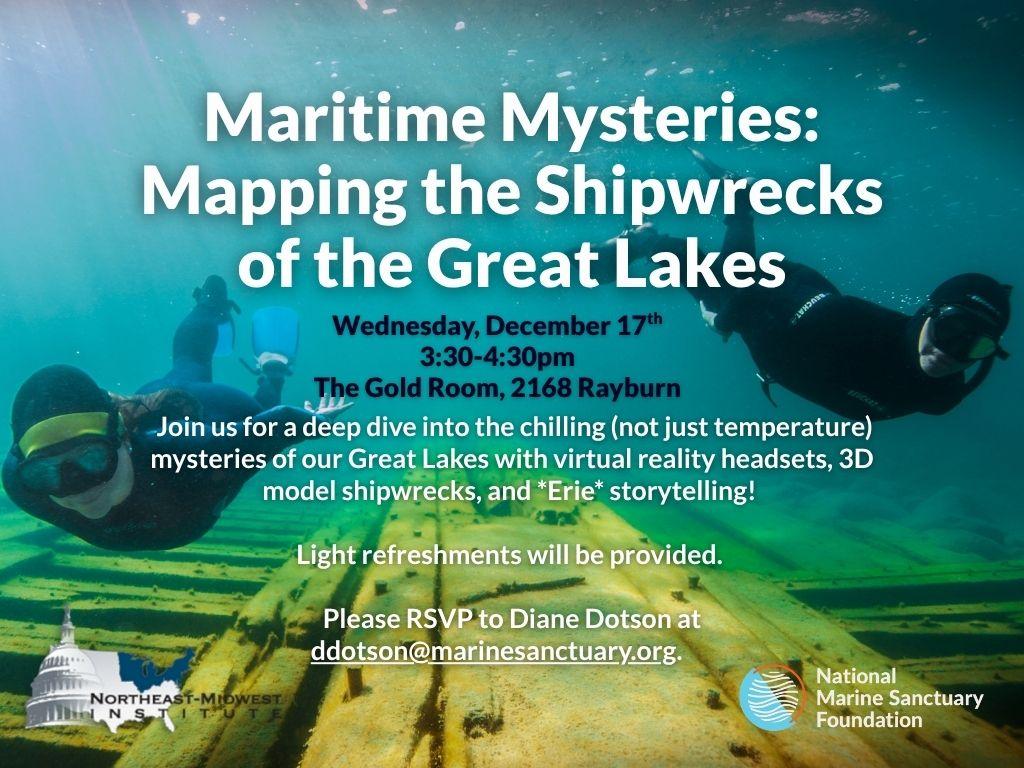
The Northeast-Midwest Institute and the National Marine Sanctuary Foundation will co-host a Congressional briefing on Great Lakes marine sanctuaries on Wednesday, December 17th, from 3:30-4:30 p.m. in Rayburn 2168. The briefing is a session of NEMWI’s Great Lakes Primer and Orientation Program, sponsored by the Erb Family Foundation.


Join us for a deep dive into the chilling mysteries of the Great Lakes with virtual reality headsets, 3-D shipwreck models, and *Erie* storytelling!


Covering about 10,000 miles of coastline, America’s Great Lakes serve as gateways for trade and tourism, centers for biodiversity and science innovation, and underwater museums for national maritime heritage. Only about 15% of these lakebeds are mapped to modern standards, leaving huge gaps in the data needed to create updated nautical charts, discover untold stories and shipwrecks, and manage the region’s extraordinary natural and cultural resources. The recent designations of national marine sanctuaries in the Great Lakes have led to intensive mapping efforts and new discoveries by NOAA and its commercial, academic, and federal partners.


The answers to many maritime mysteries lie in the depths of these largely unexplored waters, preserving evidence and glimpses into the past, for those who dare to discover. The briefing will focus on the network of America’s premier marine places in the Great Lakes and the new discoveries, innovative technologies, and immersive experiences benefiting their communities.


Light refreshments will be provided.


Please RSVP to Diane Dotson at ddotson@marinesanctuary.org.

Connect With the Northeast-Midwest Institute

on Social Media


The Northeast-Midwest Institute is on social media with new updates and information on its regional research and policy education program and with announcements for upcoming briefings and events. NEMWI is posting our research reports on current regional issues and ongoing policy education on the page to make keeping up with our policy work easier than ever. The Institute also is updating the page with announcements of upcoming policy briefings and webinars. NEMWI is excited for the opportunity to connect with as many people as possible. 


Please check out our LinkedIn here, our Twitter/X here, our Facebook here, and our Bluesky here. Be sure to like and follow us to keep up to date with NEMWI!


On Bluesky, also check out our Great Lakes feed at "NEMW Great Lakes Feed" and if you are a Great Lakes organization on Bluesky, contact Great Lakes Program Manager Alex Eastman at aeastman@nemw.org so that we can add your posts to the feed!


Great Lakes Events

(all times eastern)


Great Lakes Stormwater Management

Friday, December 19th | 1:00-2:00 PM | Virtual | Register here

Host: Great Lakes Stormwater Collaborative | Great Lakes Commission


This Week in Washington

In the House:


Committee markup of NDAA, PERMIT Act, and other bills

Tuesday, December 9th | 4:00 PM | H-313

Host: Committee on Rules


In the Senate:


No relevant hearings this week.

Northeast-Midwest Institute | nemw.org

Facebook  LinkedIn  X