The Ohio Water Resources Center Newsletter
Issue 9 | Volume 6 | September 2024
| |
|
The Ohio Water Resources Center (WRC) is excited to announce that the Second Annual Interdisciplinary Water Research Symposium will be held this year on November 8, 2024 at the Nationwide & Ohio Farm Bureau 4-H Center at The Ohio State University.
This event has been organized by students, for students, to promote collaboration between diverse disciplines within the field of water resources. Students will have the opportunity to present their research to fellow students, faculty, and community members through posters, oral presentations, or lightning talks. This event provides a medium by which students, faculty, and community members can exchange knowledge from diverse disciplines within water research. In addition, attendees will hear from an honorary keynote speaker and a career panel.
Registration and abstract submission are open. Undergraduate and graduate students performing water-related research at institutes of higher education are welcome to submit an abstract. Registration is open until October 25, 2024. Abstracts will be accepted until September 20, 2024. Due to our generous sponsors, the event is free and food will be provided. General registration and abstract submission is available on our website.
| |
Quantifying water flow pathway redistribution under agricultural drainage |
 | 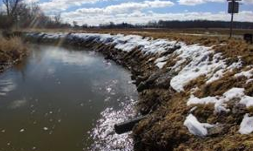 | Dr. Kennedy Doro, an associate professor at the University of Toledo, completed an Ohio Water Resources Center funded project via an Ohio Water Development Authority subaward. Artificial tile drainage outlets are channels for nutrient-rich water to enter local waterways, contributing to harmful algal blooms (HABs). Drainage water management (DWM) is a practice designed to reduce nutrient loading in agricultural fields by damming drainage networks and storing water in the field. This management method prevents water from exiting through tile outlets. However, rising groundwater levels in fields under DWM can activate other subsurface flow pathways, allowing nutrient-rich water to exit the field. The distribution of these pathways has not been widely studied. The goal of Dr. Doro’s project was to improve our understanding of nutrient export in DWM fields by investigating the location and distribution of flow pathways in DWM and estimating possible nutrient flux and sites of hydro stratigraphic variability.
Dr. Doro and his team developed a coupled surface-subsurface flow model that can be used to access the complex flow dynamics in fields with DWM. They used a combination of geophysical methods to characterize the stratigraphic variability, and spatial distribution of soil electrical conductivity. The coupled surface-subsurface flow model was used to model changes in soil saturation and subsurface water and nutrient flux.
Results showed low electrical conductivity in silty sand sediments in the field's northeastern section which may indicate preferential conditions for water to exit the field. The results emphasized the need to better understand the shallow subsurface geologic variability that controls complex subsurface flow dynamics in DWM fields.
| | | |
USGS-led study estimates lithium in groundwater that can be used for drinking water | |
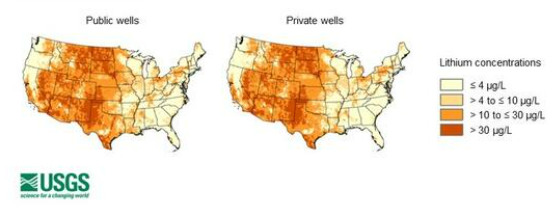
Lithium is a naturally occurring alkali metal found at varying levels across the country. While associations between low-level lithium exposure and some mental health benefits, as well as some negative impacts such as autism and variation in thyroid hormone levels exist, there is limited research on where and what concentrations of lithium occurs in drinking water. It is also unclear what levels of lithium lead to different health impacts. Lithium is not currently regulated in drinking water in the U.S, but it is included in the EPA list of unregulated contaminants to be monitored by public water systems under the fifth unregulated contaminant monitoring rule (UCMR5).
Recent research by the USGS New England Water Science Center, the Desert Research Institute, and public health experts from the University of Toronto estimates that in western and southwestern states lithium concentrations are 30 micrograms per liter or higher in public and private wells. This study focused on lithium occurrence due to natural processes.
The study, led by USGS, developed a machine learning model that used data from 18,000 wells to estimate lithium in groundwater across the U.S. The research identified 10 micrograms of lithium per liter of water as a health-based screening level (HBSL). HBSLs are non-regulatory, but may indicate a potential human-health concern. The results from this research will help public water systems better manage lithium levels in drinking water, and increase public knowledge of the possible health impacts from lithium exposure from drinking water.
| | | | |
|  |
|
Who's to blame for PFAS in our drinking water? Here's what hundreds of cities say
Via USA Today, August 14, 2024
Volunteers go fishing in Ohio River for science
Via WHAS11, August 21, 2024
Western Lake Erie algal bloom grows to 620 square miles, largest this summer
Via The Blade, August 19, 2024
Ohio man and business owner sentenced after dumping 7,000 gallons of ammonia into a river and killing over 43,000 fish
Via WTRF, August 14, 2024
| | |
Ohio EPA: Beneficial Use Designations Wave 3 WQS (OAC Chapter 3745-1)
The Division of Drinking and Ground Waters (DDAGW) announced that rules governing Surface Water Monitoring in chapter 3745-81 of the Ohio Administrative Code have been reviewed to satisfy the five-year rule review. DDAGW seeks comments on a plan to file Surface Water Monitoring rules. Comments are due by September 2, 2024 and can be submitted to DDAGW_Comments@epa.ohio.gov.
Ohio EPA: Operator Certification
Ohio EPA Division of Drinking and Ground Waters (DDAGW) is proposing to amend rules in chapter 3745-7 of the Ohio Administrative Code. An in-person and virtual public hearing on this proposed rulemaking will be held to consider public comments on September 23, 2024, at 10:30 AM. Stakeholders will be able to comment in-person within the DDAGW Summer Conference Room at the Lazarus Government Center, 50 West Town Street, Suite 700, Columbus, Ohio 43215. During the hearing the public can submit written comments that will be read into the record by the hearing host. Citizens who want to participate virtually or in person must register in advance. All comments at the hearing or in advance are due by close of business on September 23, 2024. In advance comments can be submitted to DDAGW_Comments@epa.ohio.gov.
Ohio EPA: Rules Regarding Per- and Polyfluoroalkyl Substances (PFAS)
Ohio EPA Division of Drinking and Ground Waters (DDAGW) announced that federal rules governing PFAS have been reviewed and will be implemented through the adoption of new rules and additions to existing rules. DDAGW is seeking input from stakeholders during the Early Stakeholder Outreach (ESO) review period, comments are due by September 20, 2024 and can be submitted to DDAGW_Comments@epa.ohio.gov.
| |
|
Call for Abstracts: Second Annual Interdisciplinary Water Research Symposium
The Second Annual Interdisciplinary Water Research Symposium is an event organized by students with the aim of fostering collaboration and knowledge exchange in the field of water resources. Abstract submission for student oral presentations, lightning talks, and poster presentations can be found here. Undergraduate and graduate students at institutes of higher learning in Ohio are welcome to apply. The deadline to submit an abstract is September 20, 2024.
Request for proposals: 2025 UCOWR/NIWR Annual Water Resources Conference
UCOWR and NIWR are requesting proposals for special sessions for the 2025 conference. Special sessions are an important component of the conference and provide an opportunity to delve into current perspectives on various water resources challenges. Sessions that cover a broad range of water-related research, management, extension, and education topics are welcomed. Proposals are due October 11, 2024.
| | |
|
Call for Proposals: Models to Predict the Removal of Emerging Micropollutants from Water by Novel Adsorbents in Fixed-Bed Column Processes
The U.S. EPA, through the Innovative Water Technology Grant Program, is seeking applications for research to develop, test and deploy predictive models for novel adsorbents and estimate the effectiveness of these adsorbents to remove emerging micropollutants in drinking water and wastewater treatment operations. Proposals are due October 2, 2024.
Request for Proposals: Water Resources Research Institute 104(b) Program
The Ohio Water Resources Center (WRC) is seeking research pre-proposals to address current water resources issues in Ohio. Priority is expected to be given to pre-proposals that address water technology, water resilience and security, water quality, and water reuse & the circular blue economy. Proposals from early career investigators will also be given priority. Pre-proposals are due September 26, 2024.
| | |
|
Conference: 2024 Understanding Algal Blooms - State of Science Conference
September 4, 2024 • Toledo, OH
Hosted by Ohio Sea Grant, the conference will highlight current scientific knowledge related to algal blooms. The event will be held in-person and will be livestreamed. Register by September 2, 2024.
Webinar: Diversity in Water Speaker Series
September 12, 2024 • Virtual
The Diversity in Water Speaker Series, held by Ohio American Water Works Association, invites leaders in Ohio's water industry from diverse backgrounds to discuss their careers, lend us their life lessons, and help lead the discussion on championing diversity within the water industry and in our day-to-day lives. Haishan Piao, Chief Engineer with the Greater Cincinnati Water Works will speak on her career on September 12, 2024 from 5:30-6:30. Register to receive the Zoom link
Conference: 2024 AWRA/UCOWR/NIWR Water Resources Conference
September 30-Octobter 2, 2024 • St. Louis, MO
Hosted by the American Water Resources Association (AWRA), the Universities Council on Water Resources (UCOWR), and the National Institutes for Water Resources (NIWR), the conference will be held in St. Louis, MO focusing on water-related research, management, extension, and education topics. Registration is open.
Symposium: Interdisciplinary Water Research Symposium
Nov 8, 2024 • Nationwide & Ohio Farm Bureau 4-H Center, OSU, Columbus, OH
The Second Annual Interdisciplinary Water Research Symposium is an event organized by graduate students with the aim of fostering collaboration and knowledge exchange in the field of water resources. Registration and abstract submission for student oral and poster presentations can be found here.
| |
|
Get in Touch
Email: OhioWRC@osu.edu
Website: https://wrc.osu.edu
Address: 473 Hitchcock Hall
2070 Neil Avenue
Columbus, OH 43210
| | |
| | | |