Forest Stewardship Logo Color 2021.jpg

Forest Stewardship Education Newsletter

November 2021

Assessing Post-fire Tree Mortality

Greetings from UC ANR


When we ask participants what specific forest stewardship topics they would like to learn about, increasingly, being able to know which trees will survive after a wildfire and how to assess post-fire tree damage, rises to the top. This should not come as a surprise given the nature and extent of wildfires in recent years. Many of our workshop participants have been through recent fires, and many are simply wanting the information to prepare for 'when, not if' a fire moves through their forested properties.


Fortunately, we have many experts within UC ANR and our partner organizations to provide us this information and to answer all of your questions. This newsletter provides you an overview of the topic, and will prepare you for an upcoming Follow-up Workshop specifically on assessing post-fire tree mortality and what to do about it, scheduled for January 11th, 5:30pm - 7:30pm. I will be sending out a registration link in December. So, be on the lookout for it!


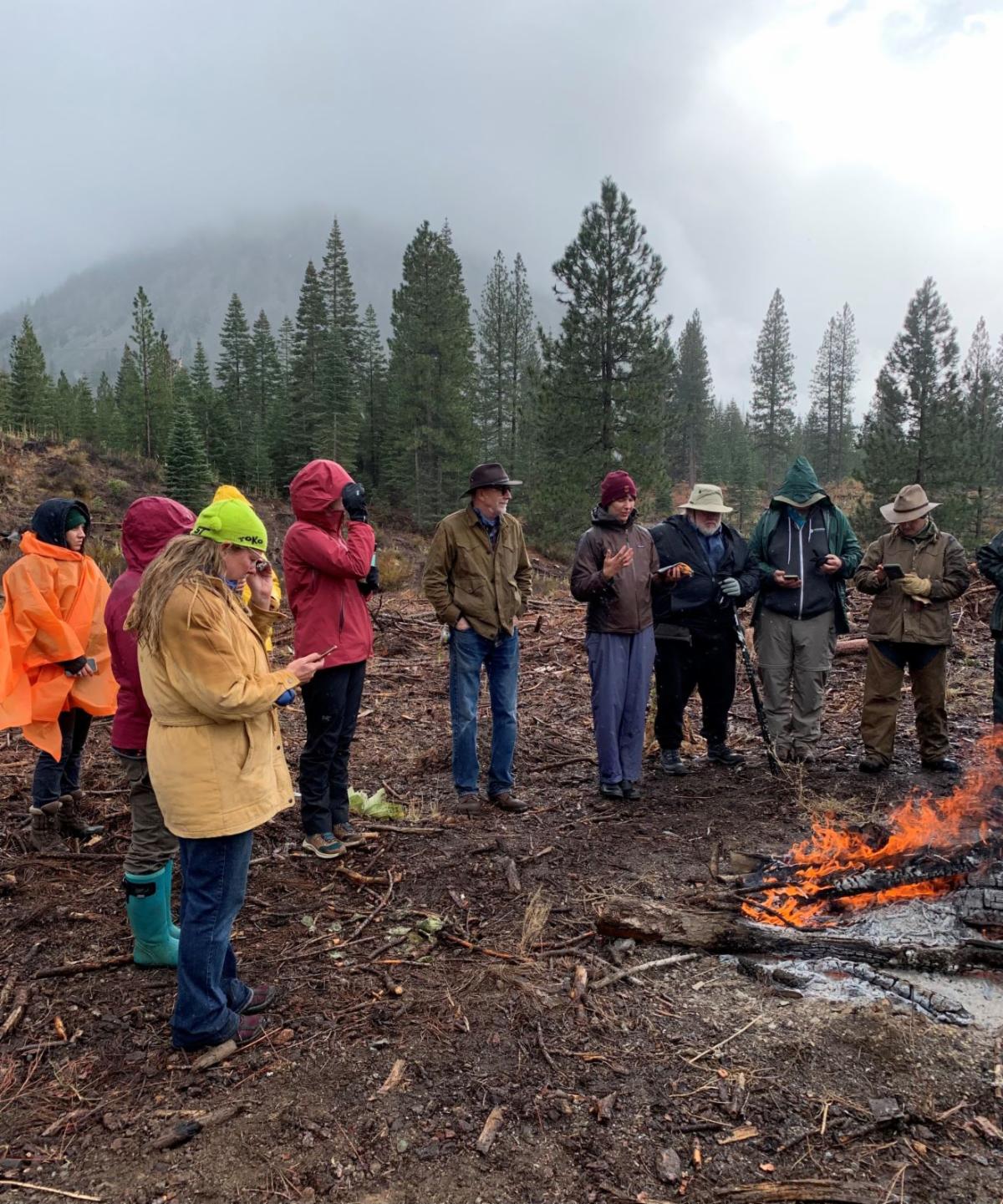
Lastly, I am scheduling new workshop co-horts starting in January 2022. If you missed your co-hort's field day, I will be reaching out to you to see if you would like to join another group in an area close to you. These field days are a lot of fun, even in the rain! Extra kudos to the Siskiyou co-hort who braved day one of the most recent 'atmospheric river' storm out in the woods!


Cheers,

Kim Ingram, kcingram@ucanr.edu

"How can you tell if a fire-damaged tree is going to die?"

Assessing tree mortality


Sometimes tree mortality is obvious. Other times, the remaining bit of green leads us to think that maybe a tree will survive. But how do you know? Factors such as the tree species, the size/age/vigor of the tree, the health of the tree before the fire, and the extent/location of the injury can play a role in fire survival. Measuring the damage caused by the fire to the cambium, crown, and roots gives us additional information to predict the survivability of a tree. Donald Owen, Daniel Cluck and Sheri Smith (2015), conducted an exhaustive study looking at how these factors effected conifer survival in the Sierra. (linked below)


Consider the cambium

The cambium is located just beneath the bark and consists of tissues which form the phloem (inner bark) and xylem (sapwood). Every year, the cambium layer produces a new layer of phloem and xylem. The phloem carries sugars made in the leaves down the length of the tree to the roots, and the xylem carries water and nutrients from the roots to the needles or leaves of the tree. The tree's outer bark protects it from injury. In the event of a fire, the extent of injury to the bark and cambium will effect a tree's survival rate.


Cambium at the base of a tree is especially susceptible to injury and visual inspection of cambial injury can help assess tree health. Depending on the tree species and the size/age/vigor of the tree, damage to less than 25% of the cambium layer can reduce the overall vigor of the tree, but may not kill the tree. As the percentage of damage increases, the tree's likelihood of survival decreases.


Large wounds to the cambium layer may not be lethal to the tree and overtime, may heal over. However, large wounds can also be entry points for pests and diseases.


What cambium should and should not look like

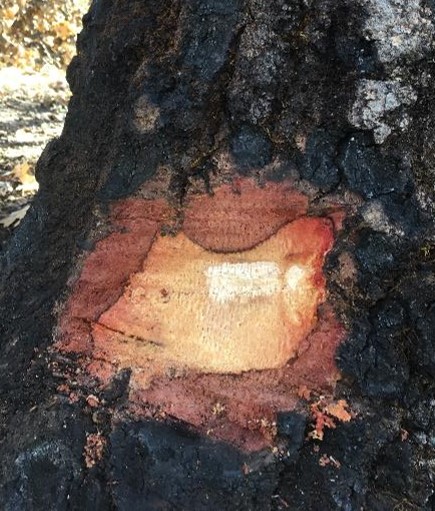
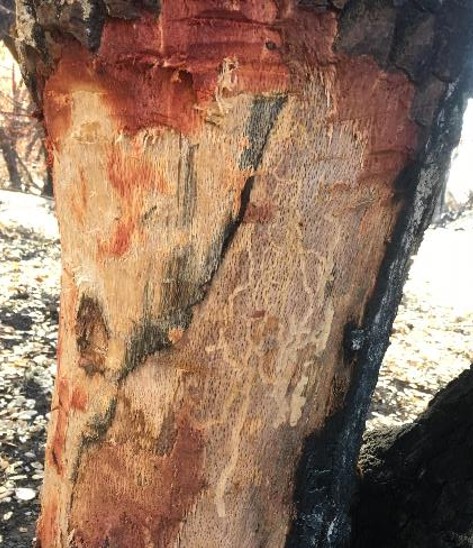
By carefully removing a section of outer bark, you can observe the cambium layer. Healthy cambium is creamy-white and moist. Cambium injured by fire will be darker in color or yellow and dry. It may also have a shrunken appearance or you may observe a heavy, concentrated pitch flow.


The thickness of a tree's bark can protect its cambium layer in some instances. However, if a tree's bark appears to be black, cracked and separated from the wood, you can assume the cambium is dead.


Forest Stewardship Series 5: Tree Growth and Competition
dead cambium.jpg

Crown, Leaf and Root Injury


According to Owen, et al. (2015), one of the most important variables to conifer survival from a fire disturbance is how much injury occurred to the live crown. Live crown is defined as all branches with green needles. Injury to live crown can occur from direct contact to flame and through convective or radiant heating from nearby burning vegetation. Assessing live crown injury entails having an estimate of the live crown ratio before the fire and comparing it to the live crown ratio after the fire. Live crown ratio is defined as the percentage of total tree height that supports live foliage. For some species such as ponderosa and Jeffrey pine with their more fire resistant buds and twigs, you may have to wait until spring when new foliage immerges to compare pre-post fire live crown ratios.


In a paper (linked below) by McCreary and Nader (2011), leaf damage to oaks is less important for tree survival than stem injury. Trees that have had most or all of their foliage burned off will likely recover if the cambium is intact. Additionally, many oak species that experience high severity burn damage (which could result in mortality of the above ground biomass) will re-sprout from their base after a fire.


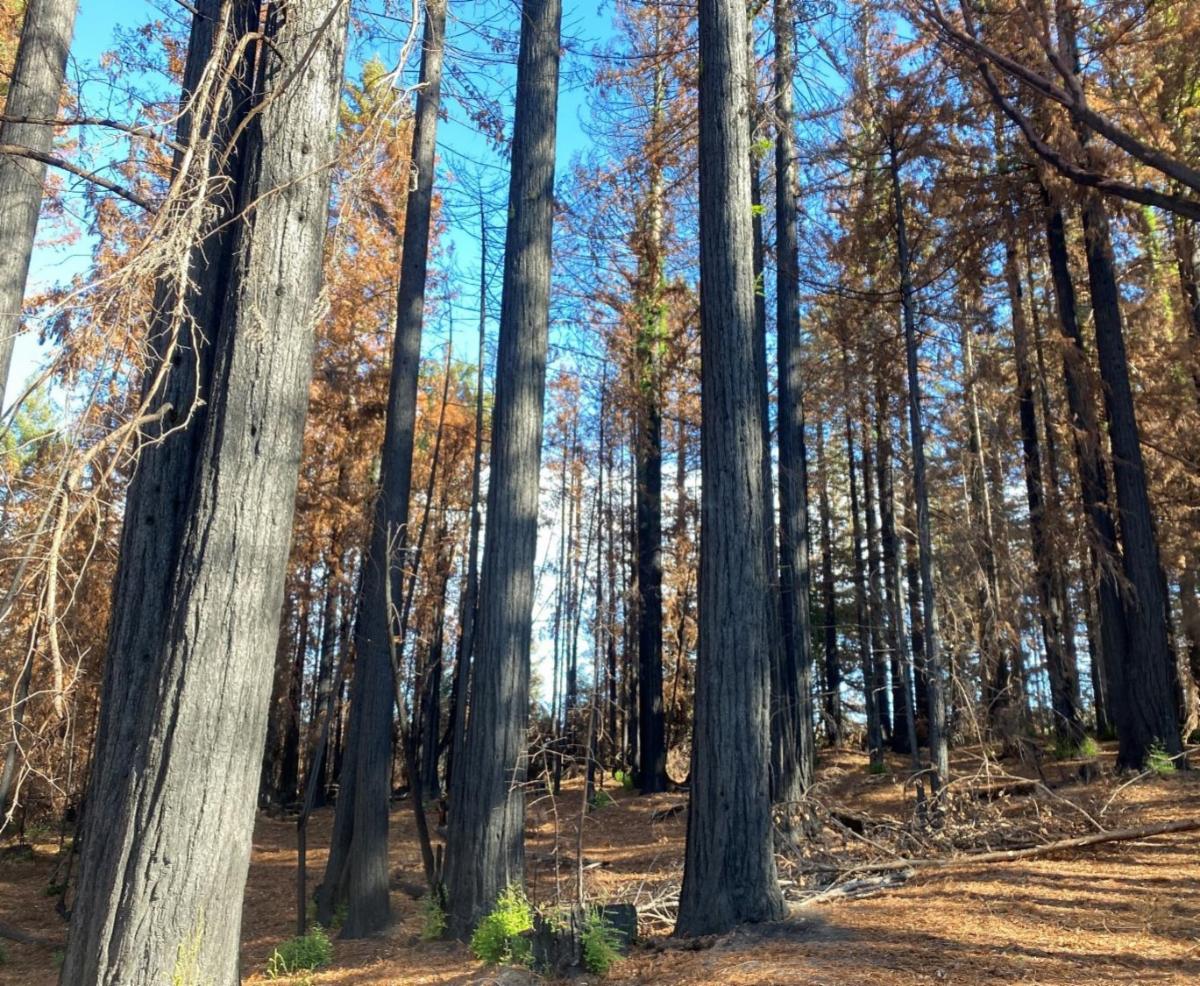
Redwoods have a similar strategy as oaks and will re-sprout from just about any part of the tree, often giving them a bottlebrush appearance when the canopy is completely or near completely damaged by fire and sprouts emerge from the branches and the main bole. Giant sequoia on the other hand, do not re-sprout after fire.


Similar to cambium and canopy damage, the more damage there is to a tree's roots, the less likely it is to survive. Smaller trees are less tolerant of root damage, while bigger trees can tolerate more damage to the roots. For tree species that re-sprout such as oaks, other hardwoods, and redwoods, extensive root damage can reduce or prevent re-sprouting and result in complete tree mortality. Even trees which seemed to survive a fire with their trunks and leaves/needles intact, may die when there is a high fuel load which leads to high, long lasting heat on the trees' roots.

Carlson 1.JPG

Tree Notes: Survival of Fire-Injured Conifers in California (2015)

Is That Tree Dead? Quantifying Fire-Killed Trees to Inform Salvage and Forest Management (2019)

Burned Oaks: Which Ones Will Survive? (2011)

Fire and bark beetle damaged oak tree.jpg

Post-Fire Insect and Pathogen Attack


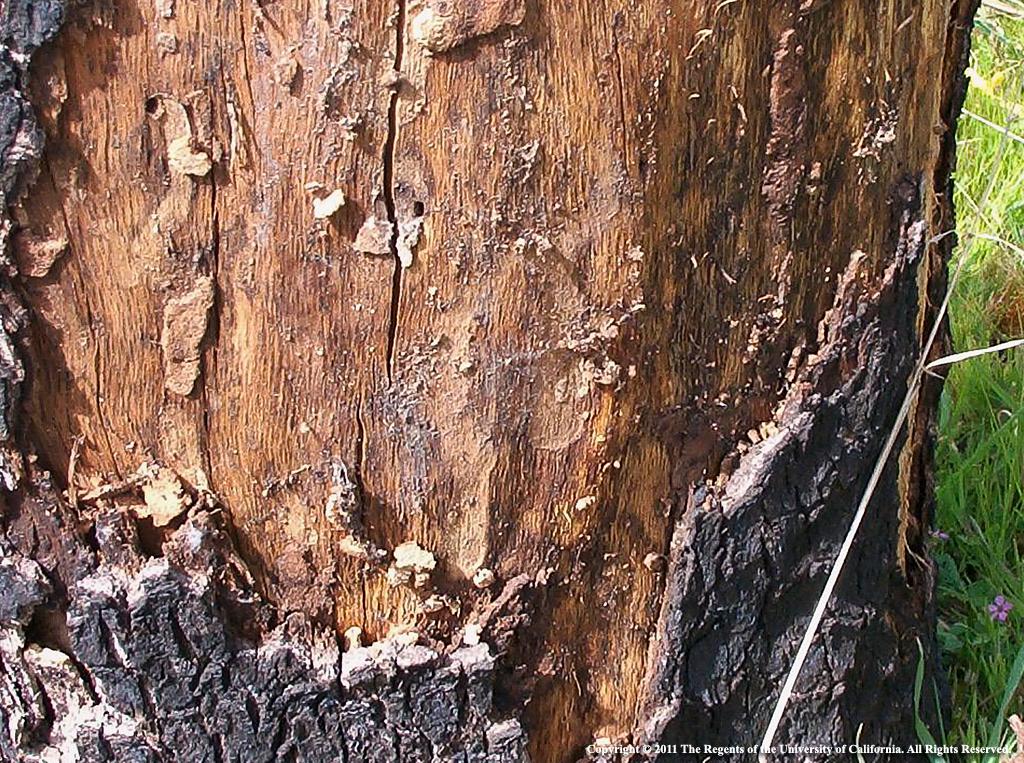
After a fire disturbance, injured trees experience diminished health and can be more susceptible to insects and pathogens. This can have long-lasting impacts, including eventual mortality. Various pests are attracted to fire disturbed trees and being able to identify the signs of infestations can also help in assessing the overall health of your trees over time.


Some symptoms to look for in conifers include pitch tubes, pitch streaming, and pitch granules. Seeing pitch does not necessarily mean the tree is dead or dying, but that it is actively defending itself against insect or pathogen attack. If you see dry boring dust with no pitch, that indicates the tissues in the cambium are dead and the tree may not have the ability to ward off an insect attack.


UC ANR's Statewide Integrated Pest Management Program has an excellent website that can help you identify pests and diseases and provides management options where possible.


The Oregon Department of Forestry has a good introductory video on bark beetles. Check it out below!

insect infestation.jpg

Assessing Tree Mortality


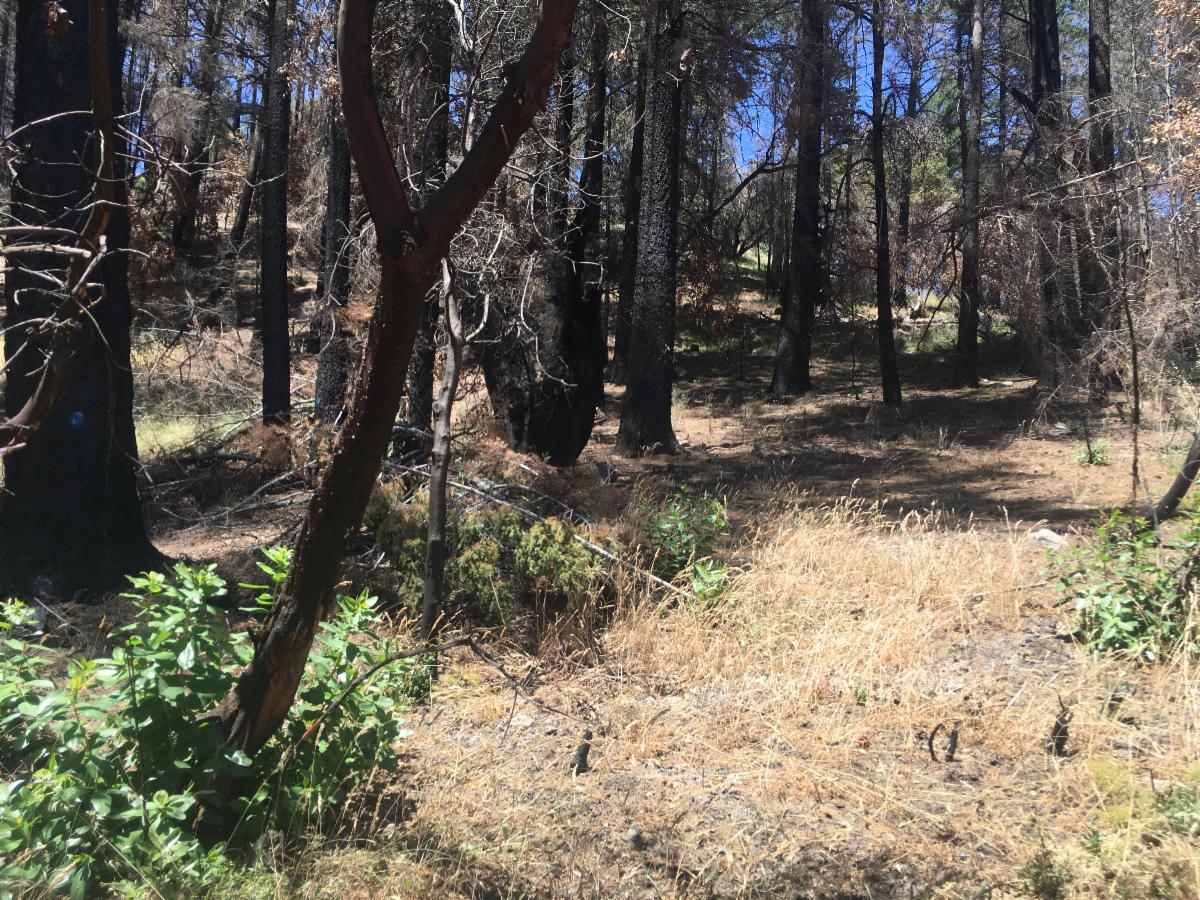
Many tree species native to California have evolved adaptive measures that help them tolerate damage from fire (e.g. thick bark and needles, self-limbing branches) or have developed fire embracing life history strategies (e.g. serotinous cones, re-sprouting) that will help them survive or recover from fire. However, even the most fire adapted trees can be overwhelmed by high intensity fire. When that happens, short and long-term impacts need to be assessed and will be addressed differently depending on the landowner's management goals.


The US Dept. of Agriculture, Rocky Mountain Research Station developed a bulletin in 2019 (linked above) that describes how to quantify fire-killed trees in an effort to inform forest management. The bulletin discusses the challenges of managing a forest that is a mosaic of live, dead and dying trees because each tree species responds differently to fire. There can be seemingly conflicting management priorities such as wildlife habitat, public safety, and economics and logistics. Resource managers have to make decisions promptly following a fire even though in some instances, it may take several years to fully understand the fire impacts.


There are modeling software programs available to resource managers to help quantify post-fire tree mortality, but they do have limitations. Another option by Smith and Cluck (2011) 'Marking Guidelines for Fire-Injured Trees in California', uses crown and cambium injury data in mortality probability tables to provide general recommendations.


For small private forest landowners, UC Cooperative Extension also has Forestry and Natural Resources Advisors and Specialist who can offer assistance and help determine if a tree should be removed or not.

assessing tree mortality.jpg

Redwood Forest Management

Oak Woodland Management

Post-Fire Resources

IMG_E2882.JPG

Upcoming workshops


  • December 7th Follow-up Workshop: Targeted Grazing, 5:30pm - 7:30pm via zoom


  • January 11th Follow-up Workshop: Assessing Post-Fire Tree Mortality and What To Do About It, 5:30pm - 7:30pm via zoom


  • January 20th - March 17th, Online and in-person field day (February 12th) in San Diego County


For more information on the workshop, and to share with a friend, please visit:

http://ucanr.edu/forestryworskhopregistration

Facebook  Twitter  Instagram