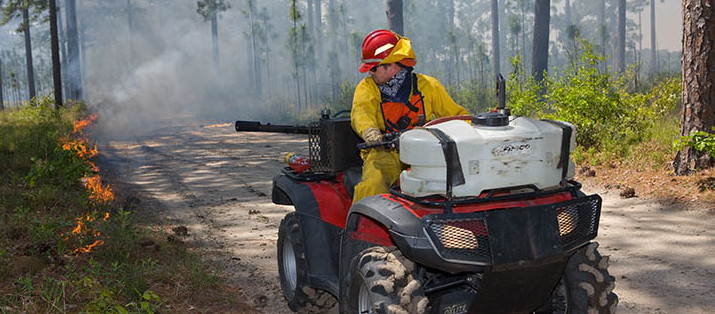
As we head into Spring, we'd like to share with you what we've been up to the last few months! Read about our Woods research projects, some of our important events and visiting prescribed fire partners, and how we are meeting our land and wildlife management goals. |
|
The Big Plot Boosts the Study of Forest Dynamics at Ichauway – Dr. Jeff Cannon |
|
Over the past 12 months, the Landscape Ecology Lab has been installing a new piece of research infrastructure, the Ichauway Forest Dynamics Plot, which will enable many new experiments on the ecology of longleaf pine and associated hardwood species. Within the nearly 40-acre plot, lab members tagged, inventoried, and mapped all trees with a diameter at breast height larger than 0.4 inches. The resulting data provides information on over 18,000 trees and is one of only two plots of its kind in the southeastern United States. Currently, the dataset forms the basis of new studies on fire mortality of pine and oak trees and combines traditional field-based measurements, terrestrial lidar scanning, and drone-based visual and thermal imagery. The establishment of the plot follows protocols set forth by the Smithsonian Institution Forest GEO Network which will allow comparisons among similar plots across the globe to increase ecological understanding of forest dynamics, climate change, and disturbance. You can see an animation of the establishment of the “big plot” here.
|
|
The Jones Center Welcomes Dr. Nicole Zampieri |
|
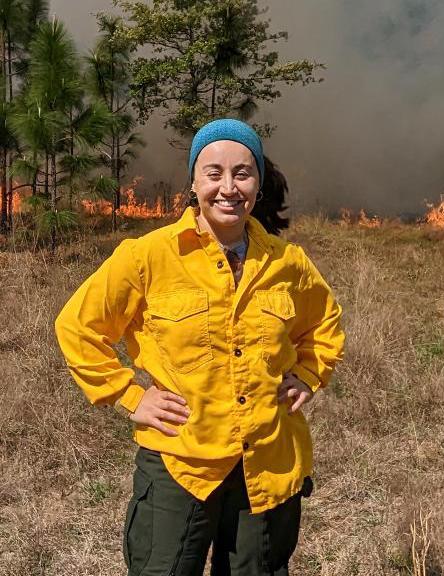
In February 2023, Dr. Nicole Zampieri joined the Jones Center Landscape Ecology Lab as a postdoctoral researcher with a shared appointment at Tall Timbers Research Station. Dr. Zampieri graduated from Florida State University in 2022 where she received her PhD in Geography under the direction of Dr. Stephanie Pau. Nicole’s dissertation work focused on how climate, fire, and hurricanes impact the structure of longleaf pine communities. Her expertise in these areas, as well as tree ring analysis, will contribute to important new research on the disturbance ecology of longleaf pine ecosystems. She is currently establishing new efforts to improve predictions of tree mortality.
|
|
Endangered Pondberry Needs to be Monitored and Conserved – Lisa Giencke |
|
The Plant Ecology Lab contributed to efforts to ensure the long-term viability of pondberry (Lindera melissifolia), a member of the laurel family that has been listed as federally endangered since 1986. Together with the Georgia DNR, the lab surveyed known sites of pondberry on public and private land across southwest Georgia. This was the first time some sites had been surveyed in nearly 15 years. Pondberry was still present at each site visited, which enabled the lab to contribute leaf samples to the Atlanta Botanical Garden’s DNA repository. This work will study genetic differentiation within and among sites and subpopulations, and aid in conservation of the species.
|
|
Ecological Silviculture Guides Longleaf Restoration – Dr. Josh Puhlick |
|
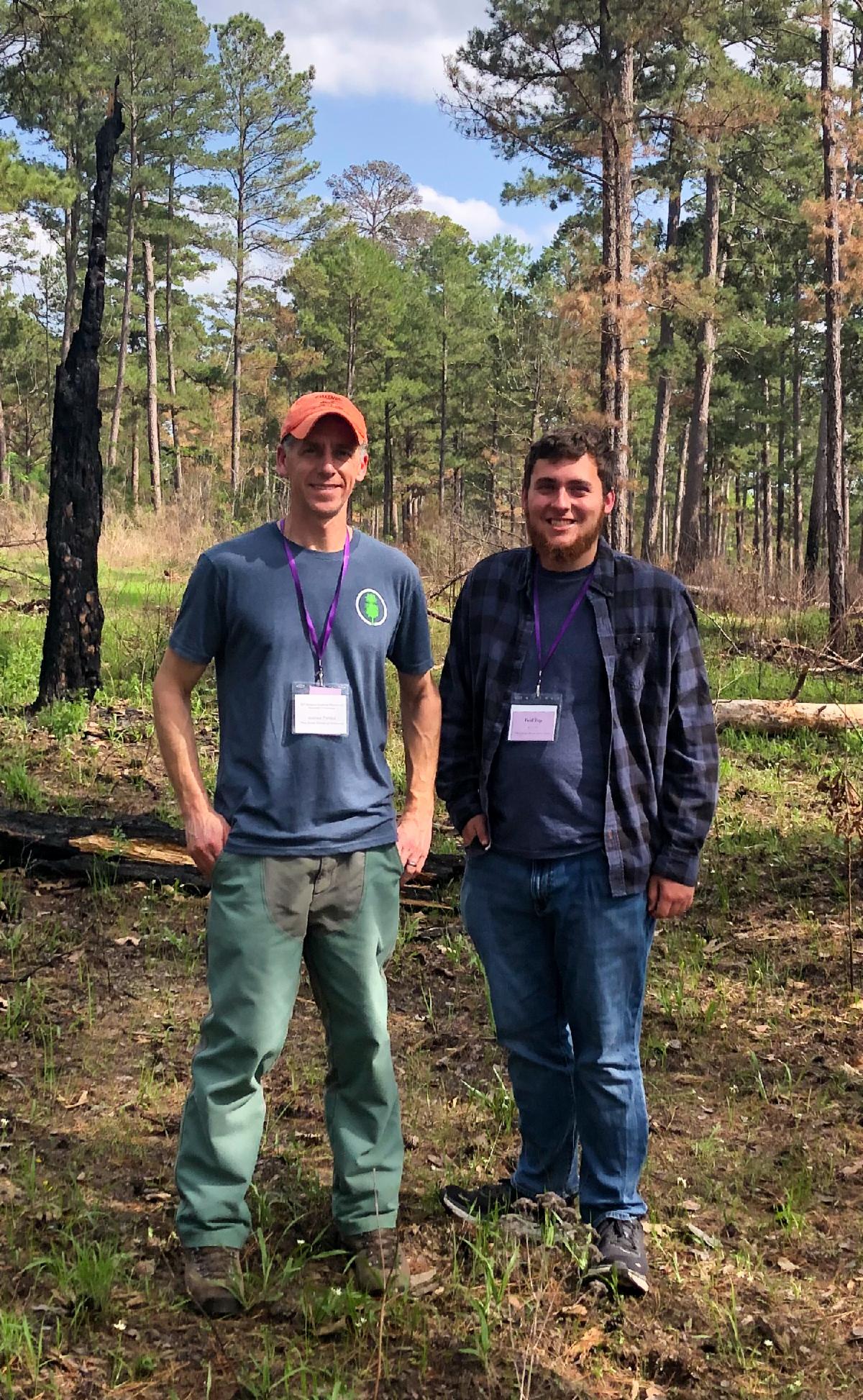
Two new research articles from the Ecological Silviculture Lab contribute to restoration efforts in longleaf pine forests. One article addressed the role that open pine systems could have in carbon markets and sequestering carbon. Another article introduced the Longleaf Tree-Ring Network and presented a review of dendrochronology studies involving longleaf pine. Josh Puhlick and two of his graduate students, Ian Goldberg and Gabe Nyen, presented their research at the Biennial Southern Silviculture Research Conference in Nacogdoches, Texas. Gabe’s research on longleaf pine plantation conversion to multi-aged longleaf pine stands was awarded third place among student poster presentations. Josh and Ian also attended a full day of field tours on university, state, and private lands, which included Boggy Slough Area — a conservation organization in east Texas directed and managed by Jones Center alum, Dr. Steve Jack.
|
|
Lasers Make Measuring Complex Forests More Accurate – Dr. Jeff Cannon |
|
A new research article from the Landscape Ecology Lab shows that advances in computational algorithms can lead to better monitoring of longleaf pine forests. More forest inventories are now completed with the aid of airborne measurements known as LiDAR (light detection and ranging). LiDAR measurements result in a 3-dimensional representation of a forest that can be used for inventory and monitoring. However, longleaf pine forests are diverse: they are variable, dissected by riparian forests, and interrupted by wetlands. LiDAR techniques that accurately inventory one longleaf pine stand may not work well in another. The study, led by Andy Whelan, the Landscape Ecology Research Associate, showed that incorporating additional information about three-dimensional structure from LiDAR scans improves predictions of timber volume without the need for separate methods for each stand type. The study makes it easier to monitor large tracts of diverse forests, and can improve conservation and research efforts across the region. You can read the original article, recently published in a top remote sensing journal Remote Sensing of Environment, and access a publication brief on the article from the Jones Center website.
|
|
Our New Facilities are Open and Contributing to Our Mission |
|
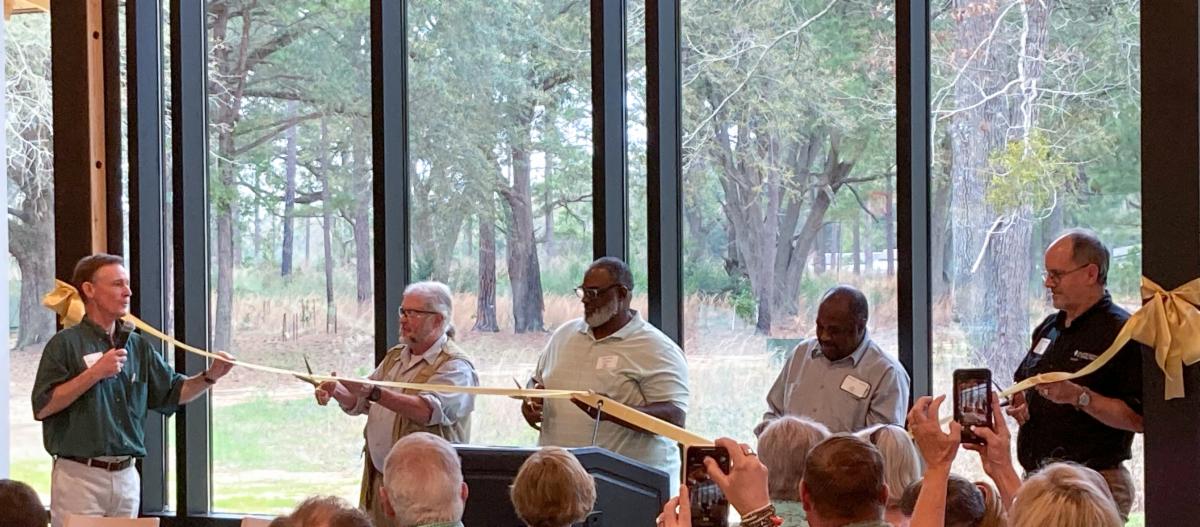
We are excited to announce the opening of our newly constructed Crossroads dining hall, guest cottages, graduate student and technician cabins and lodge, and new education classrooms. In celebration, we held a February ribbon cutting ceremony, dedicating the facilities toward our mission of understanding, demonstrating, and promoting excellence in natural resource management and conservation. Our director and three of our longest serving employees, with a combined service of over 110 years, cut the ribbon to officially open our new facilities! We enjoyed celebrating with the president, vice-president, and trustees of the Robert W. Woodruff Foundation, our alumni, local partners, and the teams of people who helped make our vision a reality.
|
|
We are Helping Our Partners Use Prescribed Fire on the Landscape |
|
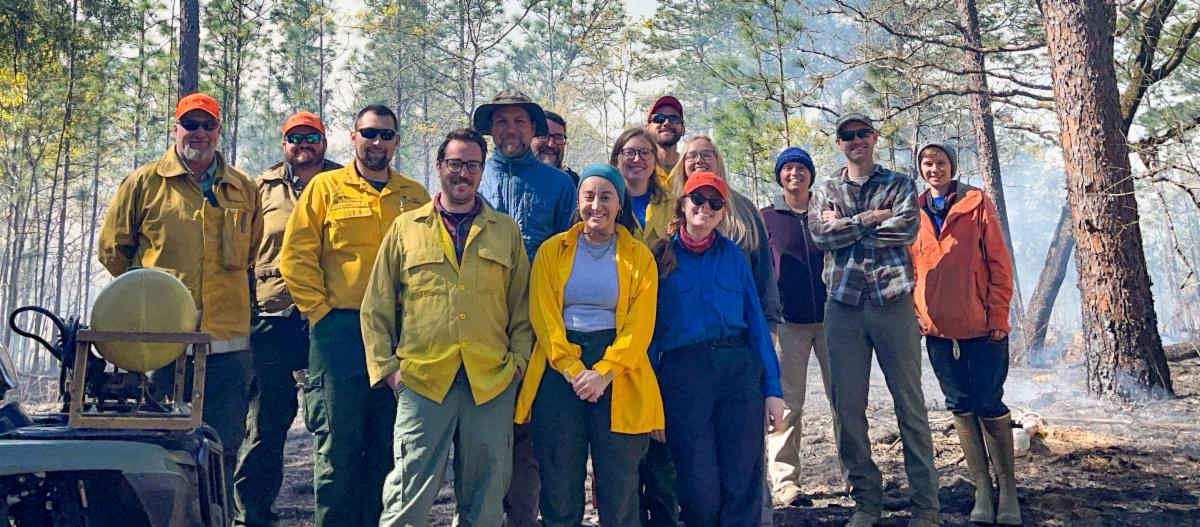
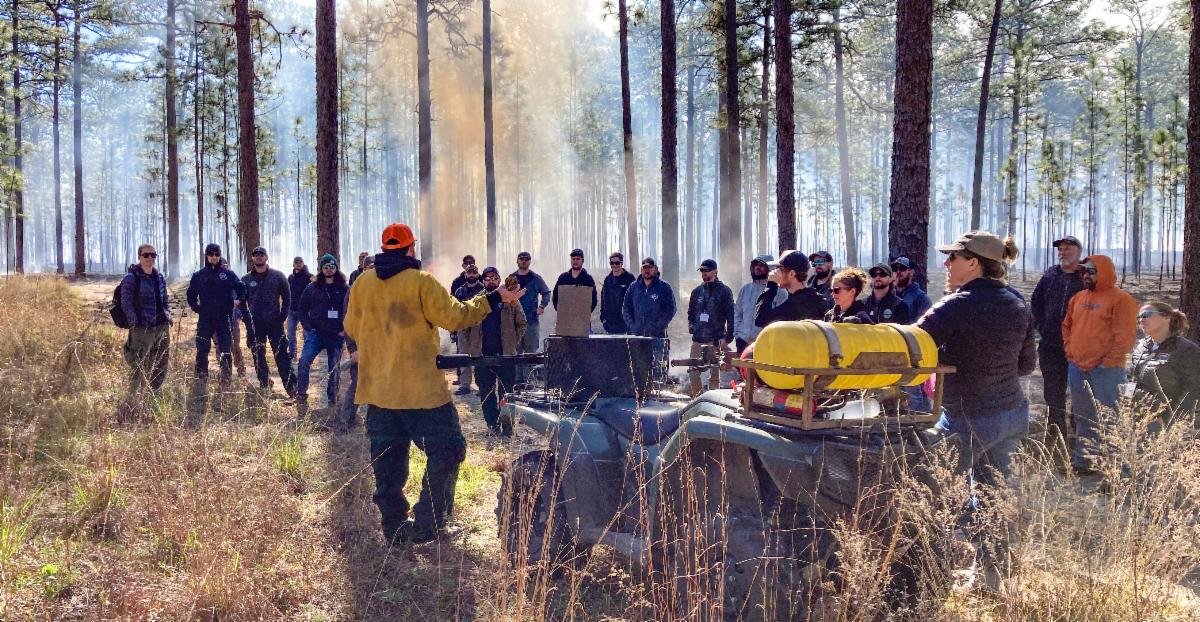
The Southwest Georgia Prescribed Burn Association recently hosted a Prescribed Fire Certification Course here at Ichauway. These courses provide an intensive training experience that deepens participants’ knowledge on topics such as fire behavior, fire weather, and burning techniques. It is also one of the steps to becoming a state certified burner.
|
|
The University of Georgia helps our future natural resource practitioners learn about how to apply fire as a tool for forest management, species conservation, and ecosystem restoration in the southeastern coastal plain. Their 6-day prescribed fire course brings students to The Jones Center at Ichauway, Tall Timbers Research Station, and the Okefenokee Swamp to learn about fuels, weather, fire behavior, and firing techniques.
|
|
Each year, the National Interagency Prescribed Fire Training Center brings wildland fire fighters from all over the US to the Southeast for prescribed fire training, including a one-day orientation at Ichauway. We provide their first look at southeastern ecosystems and fuel types as well as an overview of our burn program. The participants then move on to experience 10 to 12 days of hands-on burning on multiple sites across the southeastern US.
|
|
Prescribed Burners and Air Quality Managers are Working Together at Ichauway |
|
We recently hosted the fifth meeting of the Prescribed Fire and Smoke Management Summit. Representatives from the Environmental Protection Agency and state-level air quality and land management organizations regularly meet here, to increase cooperation and knowledge exchange across air quality and land management agencies that historically have not communicated or interacted much. This meeting focused on new tightened regulations around particulate matter found in smoke from prescribed fires and other sources. This meeting also saw recognition of retired Jones Center fire specialist Mark Melvin, whose vision and leadership made the first and subsequent summits a reality.
|
|
The Center Welcomed the Public to its First Open House in 4 Years |
|
The Center held its biennial Open House on March 25th. Despite threatening weather, about 630 visitors joined us for the day. Our scientists, research associates, graduate students, and technicians went all out to set up their labs to interpret their work and its significance to our guests. Visitors enjoyed relaxing in the Crossroads as they ate lunches from local food trucks, and enjoyed a butterfly house and craft making. Our wagon tours ran until early afternoon, until a line of thunderstorms made for a last few, very exciting tours! Thanks to all of our staff who worked tirelessly preparing and executing the event and thanks to all who attended the Open House. We look forward to seeing you again next time.
|
|
Prescribed Fire Seasons Starts Strong |
|
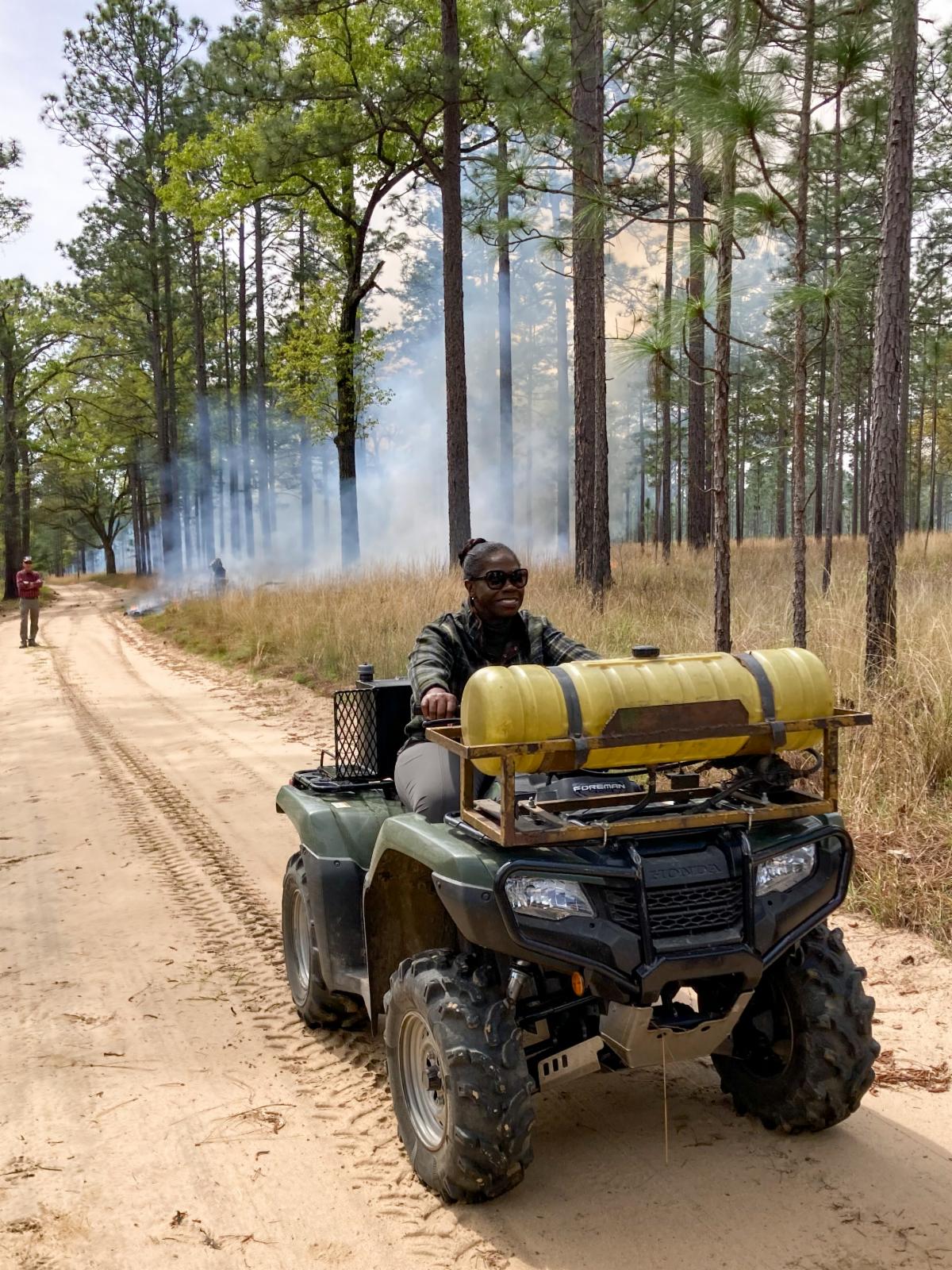
Prescribed fire activities have gotten off to a strong start with approximately 8,500 acres burned to date. We will continue burning throughout the year. Several different groups of visitors have had the opportunity to observe prescribed burns including the National Interagency Prescribed Fire Training Center and the Prescribed Fire and Smoke Management Summit. |
|
Deer Management Program Wraps up Another Successful Season |
|
The Center finished up another successful deer season. Together, Center employees and family harvested a total of 342 deer including 257 does and 85 bucks. The overall deer management goal for Ichauway is to maintain the population at a level that doesn’t damage native ecosystems. Conservation staff completed the annual deer spotlight survey in March and are working with Jones Center post-doc Daniel Crawford to standardize the analysis of spotlight data. |
|
Timber Harvest Completed, Helps to Meet Management Goals |
|
We recently completed a timber harvest on 300 acres of longleaf pine forest. There were several objectives associated with the harvest including wildlife habitat improvement, silvicultural treatments for research associated with the Ecological Silviculture lab, and the release and encouragement of longleaf pine regeneration. One aspect of the research project involves the pre-commercial thinning of longleaf pine saplings in an attempt to accelerate and improve the growth of natural longleaf pine regeneration. Some patches of regeneration were thinned by hand, while others were treated mechanically. We will monitor these treated patches over time. The harvest area is within a few of the Center’s quail courses and contains one red-cockaded woodpecker cluster with several natural cavities. |
|
Center Staff Mark Milestones and Promotions |
|
Bobby Bass was recently promoted to Senior Conservation Technician. Bobby celebrated his 30th anniversary at the Jones Center in February and continues to be a vital member of the Center’s conservation monitoring efforts.
|
|
Zach Henshaw recently completed his master's degree in Forest Resources and Conservation from the University of Florida and has been promoted to Conservation Forestry and Wildlife Biologist. He will have been with the Jones Center four years in May. |
|
|
|
Get notified about our next Open House
|
|
|
|
|
|
|
|