|
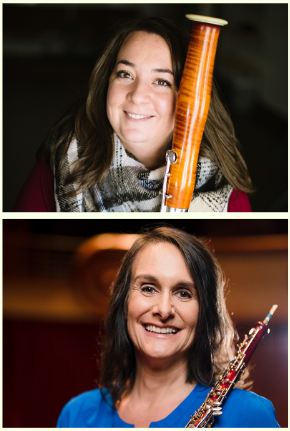
Sara Fruehe is a versatile educator and artist, currently serving as Assistant Professor of Bassoon at the Columbus State University Schwob School of Music. Renowned for her versatility, Dr. Fruehe’s career spans chamber, orchestral, and solo performance, as well as an ongoing commitment to expanding bassoon and chamber music repertoires.
A highly regarded clinician and masterclass presenter, Dr. Fruehe has been invited to teach and perform at universities and colleges across the U.S., in addition to serving as artist-faculty at the Schwob Summer Music Festival and IU Summer Music Clinic summer programs for high school students. Dr. Fruehe holds degrees from Indiana University (D.M. and B.M.) and DePaul University (M.M.). www.sarafruehe.com
Professor of oboe at the Schwob School of Music at Columbus State University and Co-Director of the Schwob Summer Music Festival, Susan Tomkiewicz is dedicated to advancing the repertoire of her instruments and committed to promoting musicians' health and wellness.
Susan is a Fox Artist and celebrated for her outstanding contributions to both performance and education in the world of music. With her deep-rooted passion for the oboe and English horn, Susan’s artistry has graced prestigious stages both nationally and internationally. As an artist, she embodies a commitment to excellence and innovation while consistently pushing the boundaries of her craft. Her captivating performances and visionary teaching approach exemplify the essence of a Fox Artist, leaving a profound impact on the double reed world. www.susantomkiewicz.com
What led you to become a professional musician?
Sue: Honestly, it was the only thing I was ever really good at. It was what I was drawn to and it was always my thing. I was orchestral bound for most of my education.
Sara: I think my first foray into music and what the arts can do is when I joined a youth orchestra in high school which showed me what I could do through this medium - meeting people and collaborating. I originally wanted to go into the sciences, but during my junior year of high school joining the Chicago Youth Symphony really opened my eyes. I still love science to this day, but music has really been the thing that fulfills and sustains me.
Who influenced you to become an educator?
Sue: I guess my teachers from my graduate program and my doctorate, in taking a deeper dive into pedagogy and having an opportunity to teach undergraduates. That opportunity showed me that teaching was a natural fit for me. I loved the higher education atmosphere.
Sara: I don't think I can narrow it down to one person. I think it was my community of supporters - my mentors, family, and friends who allowed me to explore my passion of music and the different areas of music — teaching, performing, and administration — then coming to the conclusion that teaching was what I love to do most.
How do you balance being an active performer and an educator at the University level?
Sue: Set aside time for maintenance practice. I play with the Columbus Symphony and my time definitely ebbs and flows. It is a delicate balance to have enough time for all of the things which includes non-music things.
Sara: Really it's by just doing my best and for me it's about planning and time management. I work to make sure I keep my focus on the things that my time and energy need. My students are my primary focus, and I am actually jealous that they have time to practice! My own personal practice time is primarily about being efficient and having a plan of action, with emphasis on drilling fundamentals.
How do you measure progress in your applied lessons? What does success look like?
Sue: The syllabus grows and grows - I have a well-tuned system over years of time. I have an applied grade sheet that I use every week. Fundamentals are SO important. Many students come into the program with some gaps that we need to make up. Some of the measures of success are simply grades on their weekly assignment preparation. It is also based on observing how students "click." Finding the right motivation for each student is key.
Sara: I think it is important that we recognize that every student is different and they are unique and at different places within their musical development. Every student learns and absorbs information differently. It is really important to me that I meet students where they are technically, musically, or in rhythmic development. Lessons emphasize fundamentals and the building blocks of bassoon and music making. Success is not a straight line, it zigs and zags and you have to work to make advancements — Success is you being better today from where YOU were yesterday.
What advice do you have for music teachers who are scared to start double reeds?
Sue: Call me. I would be so happy to help. Use your resources, and find out who is willing and able and available to help you. Sara and I would love to help, and there are also local people who can help. We want to help you be confident in starting students on double reeds, and be sure that students are fundamentally sound from the outset.
Sara: Just go for it and use your resources — those that you collected during your studies, what you find online, and also the people you meet. Sue and I would love to help and be an additional resource for directors and students.
What are your favorite resources for band directors?
Sue: We are continuing to build the websites for each of us to have resources. Our GMEA presentation from 2024 is available on our websites and we are also compiling private oboe teachers in the state to post there as well. We are currently working on a video series specifically for band directors. If you are looking for specific repertoire or if you have suggestions for resources that you need please let us know!
Sara: I highly recommend finding the double reed friends in your neighborhood. The double reed community is a really positive and supportive group of people and we really love what we do and if you get us started talking about all this, we might not be able to stop! Online resources are easy to access, and Sue and I have resources on our personal websites, and for bassoons this is also a great resource https://musicandthebassoon.org/.
|