RETIREMENT SECURITY MATTERS
A forum for retirement innovation information sharing focused on
states, supporters, and service providers.
Vol 31 | June 3, 2021
|
|
Greetings! welcome! to Retirement Security Matters – where we talk about retirement readiness innovation by states, supporters, and service providers.
|
If it’s June, this must be the welcome-to-the-doorstep-of-summer edition. (Can you believe it’s June?) Take off your mask, grab a cool beverage, and consider:
-
Auto-enroll rates – what’s optimal? Our Dr. Mingli Zhong tests the waters
-
New state metrics and a few cliff’s notes
-
Highlights from implementing states California, Colorado, Connecticut and Illinois and active governments New York State and New York City, North Carolina and Rhode Island
-
Grant’s Go To’s: Estimating Program Costs. Hint: it’s not a $64,000 question.
-
Hot Sauce – We’ve got a June 21-25 Don’t Miss plus some good thinking, research and advice. And, a book report. And a summer reading suggestion.
-
And finally, just because you are so very, very patient – Pix of the Week!
|
|
Auto Enroll: 3%, 5%, 7% – What’s Optimal? |
|
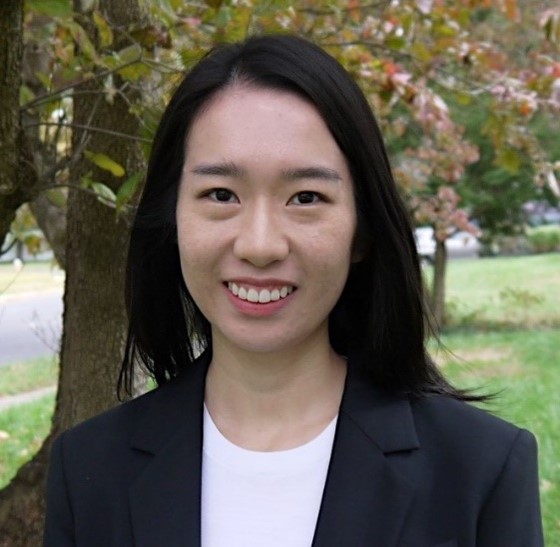
Dr. Mingli Zhong, Postdoctoral Fellow in Economics at the National Bureau of
Economic Research
|
|
We met Dr. Mingli Zhong when she was working alongside Dr. Olivia Mitchell and team at the University of Pennsylvania’s Wharton School, focused on retirement savings research. Since then Mingli has been on the move, but her focus is steady.
She asks important questions about how we can optimize the way we use automatic features in our retirement savings plans and programs. She’s also studying pandemic-related impacts on savers, going beyond top-level results to understand how this economy is differentiating between those of us that kept our jobs, and those of us who didn’t.
|
|
Mingli, you are a postdoctoral fellow at the National Bureau of Economic Research. How did you come to your current role and what are you working on?
Thank you for having me. In 2019 I was in the last year of my PhD program in applied economics at the Wharton School, University of Pennsylvania. I often found myself on the NBER website reading their latest working papers. One day I spotted a post-doc opportunity funded by the Social Security Administration where they were specifically looking for someone doing retirement policy. This felt like a really good match, because at that time I was looking for opportunities to continue doing my research full time. I applied and fortunately I got in!
You recently did some work focused on auto-enroll retirement programs where you were analyzing the optimal default savings rate. A lot of people want to know this answer! Let’s start by asking how you define “optimal.”
I love this space. I've been working on “optimal retirement policy” questions. First of all, there are a range of questions. What is the optimal initial default rate? What is the optimal automatic escalation arrangement? How do we optimally design our auto-enrollment retirement plans taking into account Social Security and other social safety net programs?
My starting point has been to understand what an optimal initial default rate is. You can see early results of this analysis in the just-published piece, Optimal Default Retirement Savings: Theory and Evidence from OregonSaves. In this research we define optimal as the rate that maximizes the total lifetime individual wellbeing. That definition includes all individuals eligible for a retirement plan. We include passive savers who stay at the program’s default rate, as well active individuals who save at a different rate or might opt out of the program altogether.
Very cool.
The way that I think that a default rate can improve individual wellbeing is through two channels. The first channel is for passive savers. Definitely some of them increase savings after they are automatically enrolled; that's how they save more. (Do you want the answer about optimal rates? Keep reading here!)
Dr. Mingli Zhong, thank you so much for sharing everything that you're working on with us. Would you like to know more? You can connect directly with Mingli Zhong here. xxx
|
|
*Fresh!* State Program Metrics - Auto IRAs |
|
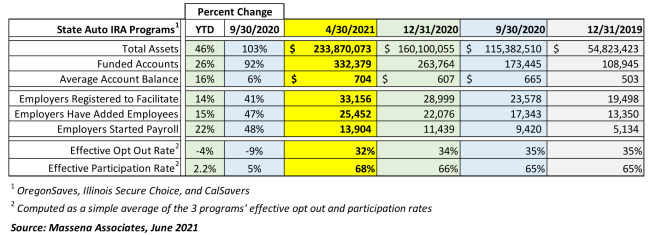
Let’s break this down. These figures capture April 30 data – a third of the way through 2021. We can see at that point assets across the three programs were up 46% for the year, to more than $233 million. Seven months ago, combined assets were $115 million, so they’ve doubled in less than a year. Funded accounts are over 332,000 – up 26% year to date and 4% in the month of April. (Some rough math would say that assets are getting a boost from market performance as well as ongoing contributions.) Average account balances are over $700. Oregon’s program has grown its funded accounts by more than 20% year to date; because of its earlier program start date average account balances are over $1,000.
Programs are focusing on thoughtful employer engagement. Since September 30, employer progress metrics (adding employees and starting payroll deductions) are up nearly 50%. Year to date programs have seen a 22% average increase – much of this is driven by employer activity in California but the Oregon and Illinois programs are also showing increases.
Employee opt out rates continue to inch downward. At September 30 they were 35%. They’re now averaging about 32%. That puts intended participation rates at 68%.
|
|
State Facilitated Retirement Programs - Fresh Highlights |
|
California (workforce 17.9 million) – The CalSavers Board met on May 19. The Board approved an interagency with the California Franchise Tax Board for enforcement services, and adopted a support position on AB 470. AB 470 would prohibit the use of resources, including assets in CalSavers accounts, to determine eligibility for Medi-Cal, the state’s Medicaid program. The agenda also included a draft strategic plan for 2021 through 2024.
The June 30, 2021 deadline for employers with more than 50 employees is fast approaching. We reported in February that three months after the first CalSavers deadline took effect, the number of registered accounts had increased by 108%, the number of funded accounts by 249%, and total program assets by 157%.
|
|
Colorado (workforce 3.2 million) – The Colorado Secure Savings Program Board met on May 26 and will be meeting again this week in executive session to consider proposals submitted for its Program Consultant and Investment Consultant RFPs. The program is scheduled to make “Intent to Award” announcements by June 15.
|
|
Connecticut (workforce 1.6 million) – The Connecticut Retirement Security Authority met May 21, 2021. The Board focused on procurement for investment consultant and legal services as well as program timeline and outreach. The program’s new target pilot start date is September 2021. The Board is working with AARP on a campaign to identify and engage employers.
|
|
Illinois (workforce 5.7 million) – A legislative proposal to expand the Illinois Secure Choice Retirement Savings Program to include businesses with at least 5 employees is now pending approval of the Governor. After passing in the House on April 14 with a vote of 106-02, the Senate passed HB 117 on May 28 with a vote of 42 to 15. Illinois State Treasurer Michael Frerichs was quoted as saying, “this commonsense change to existing law helps workers save their own money while reducing future pressures on state safety net programs.”
The expansion would open up the program to nearly a million additional workers in the state.
|
|
New York State (workforce 9.3 million) – AB 3213, a legislative proposal to ensure employees are automatically enrolled into the New York Secure Choice Savings Program passed in the Assembly on May 11 and has moved onto the Senate.
… Recall that …
New York City (workforce 3.9 million) – On April 29, 2021, the New York City Council voted in favor of a bill to establish a City-facilitated Auto IRA program. The Mayor is expected to sign it. According to a press release, the Program will require participation for private sector employers with 5 or more employees who do not already offer a qualified plan. Another bill established a Retirement Security Board, which would have up to two years to implement the program.
|
|
North Carolina (workforce 5.0 million) – On May 5, NC introduced HB 899 enabling a small business retirement savings IRA program. The bill currently has 36 sponsors with respectable bipartisan representation on the list.
|
|
Rhode Island (workforce 540,000) – on March 18 introduced SB640, an Act Relating to Public Finance -- Rhode Island Secure Choice Retirement Savings Program Act. This Act establishes the Rhode Island secure choice retirement savings program. Establishes a board which is a public corporation. Allows for creation of IRA-type retirement investments managed by the board. On May 13 the Senate Finance Committee recommended measure be held for further study.
|
|
Grant's Go-To's: Estimating Program Costs
|
|
How much does it cost to start a state-facilitated retirement savings program (SFRP)? How long will it take to break even and become self-sustaining? These are some of the key questions being asked by officials in states and municipalities that are considering, or already working to launch, SFRPs.
SFRPs incur costs before the first contributions ever come through the door. In addition to the costs of paying a program administrator (record keeper) to set up the infrastructure, initial program expenses also include the services of investment, legal and program consultants who advise program boards and staff on design, implementation and operations. Outreach to employers and workers, particularly important in the early stages of a program’s operation, add to the start-up costs as well.
The baseline scenarios of several states’ feasibility studies projected that …
|
|
The initial investment required is certainly a challenge that must be addressed when developing an SFRP. But what are the costs of not taking action to encourage more workers to save for their futures in retirement? Next time I’ll turn my attention to studies that have examined the “costs of doing nothing.”
Stay tuned! / Grant
|
|
Columnist and Senior Associate Grant Boyken is based in California. You’ll see his Golden State perspectives reflected here – along with 50-state insights into retirement security innovation around the country. He’s also a good sport when we mess with his head shot.
|
|
Retirement Security Lovers DO NOT MISS! June 21-25. Yours truly and a raft of more important and very interesting people will be speaking in a 5-part set organized by NAST. Want to attend but aren’t registered for NAST TMTS yet? Please reach out to Kari Arfstrom here for a special opportunity to join. Sessions include:
-
State Auto-IRAs Landscape: Building on the Trend with Andrea Feirstein, Peg Creonte, Treasurer Tobias Read, and Treasurer Dave Young
-
State MEPs and Marketplace Models in 2021 with Deputy Treasurer Michael Clasen, Claudia Armijo, Beth Halberstadt, David Lynch and Troy Tisue
-
Research & Innovation: Driving Future Success for State Retirement Programs with Courtney Eccles, Matt Golden, John Scott, and Stacey Tovrov
-
Turning Recommendations into Reality: How Research & Engagement Pushes Policy with Lisa Massena, Nicola Coakley, Ethan Conner-Ross, Treasurer Sarah Godlewski, and Treasurer Mary Morris
-
Federal Updates & Initiatives: National Retirement Work and the Impact on States with Katie Selenski, Angela Antonelli, Melissa Kahn and Michael Kreps
Please reach out to Kari Arfstrom here for a special opportunity to join. Yes, we said it twice.
-
Black Millennials’ Wealth is Sliding. We don’t want this to be true! Report says our black millennials now have half as much wealth as their parents and grandparents had at the same age. The Federal Reserve Bank of St. Louis called the situation “alarming” in its new report.
-
New from Rebecca Moore through PlanSponsor: What a Year Without Retirement Savings Can Do to Participant Outcomes. “Taking a break from contributing has a tremendous amount of impact.” Some scary stats, and some tips on helping participants get back on track. From the Nike school of thought (Just do it), this one might be the most effective: “We also encourage automatic enrollment and increasing deferral amounts automatically.”
What We’re Reading: In the Presidential biography zone, it’s An Honest President: The Life and Presidencies of Grover Cleveland by H. Paul Jeffers. Twenty-two presidents in, we have to say we’re feeling a little jaded about actual honesty. Episode 3 of the Very Presidential podcast by Ashley Flowers puts a little dent in his reputation. Sidebar: an interesting benefit of Jeffers’ book is the early introduction of Teddy Roosevelt as a co-legislator in G. Cleveland’s world.
Kicking around the unread books on our Kindle, we found The Collected Autobiographies of Maya Angelou. Once you pick it up, you won’t want to put it down. We found ourselves laughing out loud at points, and shaking our head at misadventures we could see coming. We thought we knew a bit about Maya Angelou and her exotic life, rubbing elbows with celebrities over decades and gently writing poetry on the side. We were so wrong. And this actually is honest. Sometimes brutally and necessarily so.
|
|
... and, Pix of the Week - Yes! |
|
Nothing beats a family photo with everyone in it! Here Mingli shares her husband Ting, her 4-year-old daughter Maddie, and her dog Eddie. We hear Eddie always refuses to look at the camera. #beautifulfamily
|
|
… on a walk with our own dog recently we discovered this: |
|
… is it modern art, or part of our paper milling history? Turns out that about the time of the 1888 election that brought Grover Cleveland to presidential office, a group of Californians “attracted by the awesome power of Willamette Falls” near Oregon City established the Willamette Falls Pulp & Paper Company. Paper milling had been going on nearby since the 1860’s and earlier but things were about to really take off.
|
|
Collectively the mills in sister towns Oregon City and West Linn employed most of the local population and produced newsprint that was shipped to Salt Lake City, San Francisco, LA, Japan, China, New Zealand and Australia. Paper companies came to include Crown Zellerbach for consumer goods (yes, T.P.) and specialty makers like Blue Heron Paper Company for bright papers and bags. |
|
|
The last local papermill was decommissioned in this decade and the land is now slated to become an interpretive park next to the falls. This month if you are lucky, you may find yourself on a beautiful June day enjoying a picnic alongside the beautiful, peaceful Willamette River upstream of the falls. |
|
And if you look downstream you’ll see a little white cloud over the water and enjoy the refreshing mist of the falls wafting back toward you. |
|
That’s it for this edition! ❤ Hug your people and change the world.
If you like this piece, please stick with us. We’ll be back in about two weeks. If you don’t like it, please unsubscribe below. Comments for us? Please let us know. Want your own subscription? Request one here. All information shared is from public sources or used with express permission.
|
|
Massena Associates provides process, policy, and implementation consulting on retirement savings programs and products.
Our clientele includes states, governments, policy organizations, and private sector providers. Our specialty – efficient, targeted results. We are an active speaker on retirement security topics, including state-facilitated programs, MEPs and more.
If you’d like to explore working together, we welcome the conversation. Connect with us here, and at 339-236-0684. |
|
Looking for a great retirement savings innovation resource? Led by Dr. Alicia Munnell, the Center for Retirement Research at Boston College develops and hosts terrific content and proprietary research related to states, financial security, social security, and more.
Pew’s Retirement Savings Project studies the challenges and opportunities for increasing retirement savings and is another great resource - check out the work of John Scott and his terrific team.
|
|
|
|
|
|
|