|
Don’t Guess, Diagnose: Pregnancy Testing Options for the Cow Herd
Dr. Ramiro Oliveira – Beef Cattle Production Systems
A cow’s job in a commercial cow-calf operation is to produce a healthy calf every year. However, without pregnancy diagnosis, producers may continue feeding and managing open cows for several months before discovering that those cows will not produce a calf.
Pregnancy testing provides information that can be used to make timely culling, marketing, feeding and replacement decisions. It can also help producers evaluate the success of the breeding season, estimate the upcoming calving period and identify possible problems involving bull fertility, cow nutrition, herd health or breeding management.
Late summer and fall are especially useful times to evaluate pregnancy status in spring-calving herds. Identifying open cows before winter can prevent producers from investing additional forage, supplemental feed and labor in females that will not generate income from a calf the following year. Pregnancy diagnosis can also be used to sort early- and late-calving cows into different management groups.
When Should the Herd Be Tested?
The correct timing depends on the method selected and the herd’s breeding records. In herds with a controlled breeding season (less than 90 days), pregnancy diagnosis can generally be done 28 – 45 days after the bulls are removed, depending on the method used.
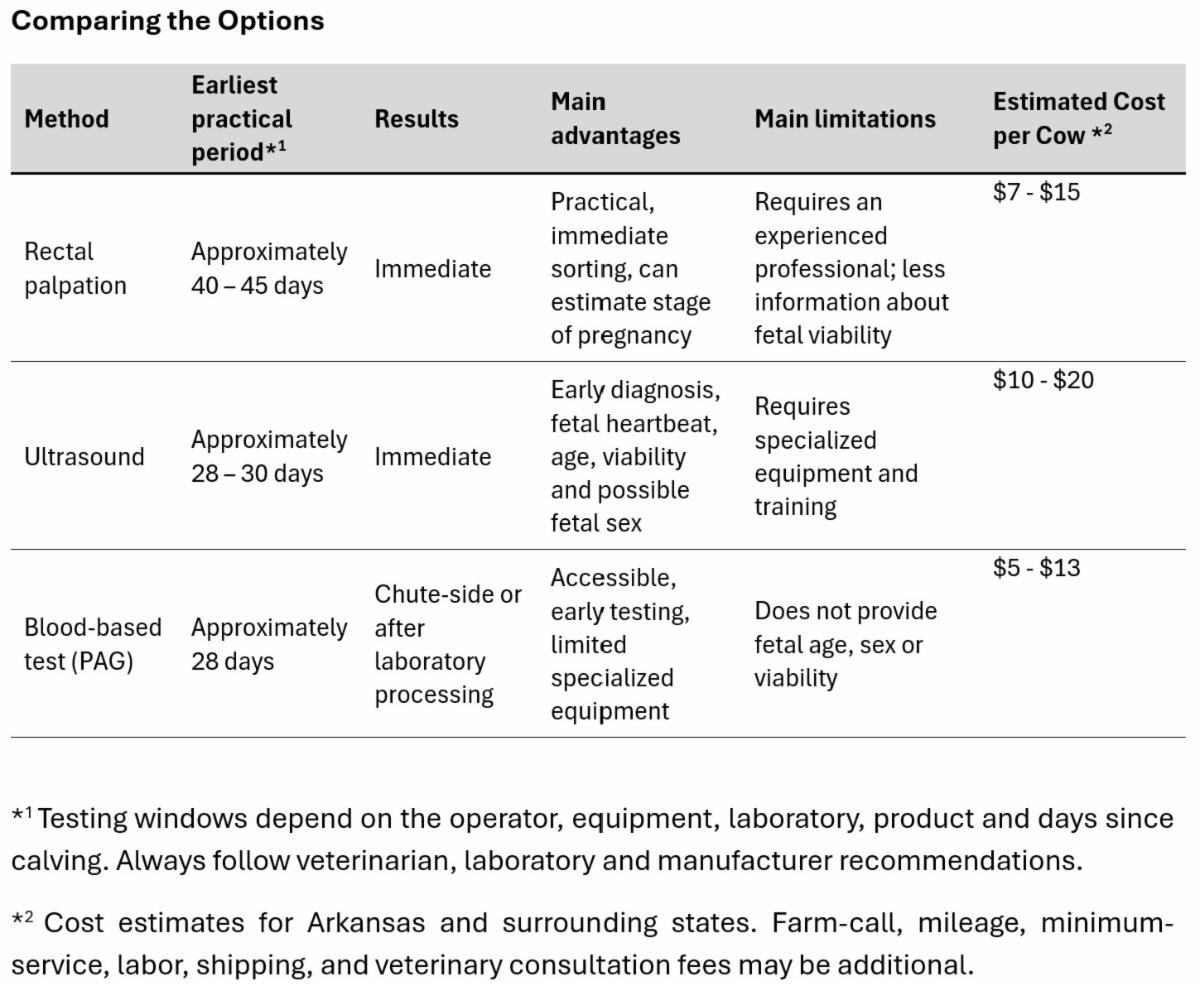
Transrectal ultrasound and most commercial blood-based tests can be used beginning approximately 28 to 30 days after breeding or bull removal. Rectal palpation is commonly performed beginning approximately 40 to 45 days after breeding, although the appropriate timing depends greatly on the veterinarian’s experience. Testing later in gestation may make pregnancy easier to detect, but it also delays decisions about open cows.
Useful times to pregnancy-test include:
- Shortly after the end of a controlled breeding season
- Before weaning or when cows are already being processed
- Before fall and winter-feeding expenses increase
- Before making culling and replacement decisions
- Following artificial insemination (AI) or embryo transfer (ET), especially when early identification of open females is important
Producers should record AI/ ET dates and the dates bulls enter and leave each pasture. Without those records, it becomes more difficult to select the correct testing date and estimate when cows are expected to calve.
Pregnancy-Testing Options
Rectal palpation
Rectal palpation is the most utilized method of pregnancy diagnosis. During rectal palpation, a veterinarian or other properly trained professional examines the reproductive tract through the rectal wall. Several landmark changes occur throughout gestation, including changes in uterine size, uterine fluid, fetal membranes, placentomes and the fetus can be used to determine pregnancy status and estimate the stage of gestation. More specifically, around day 40 – 45, there is distinct asymmetry between gravid and non-gravid uterine horns, which allow this method to be accurate when employed by a skilled examiner.
Palpation provides immediate results, allowing open and pregnant cows to be sorted as they leave the chute. It does not require expensive equipment and may be a practical option when a veterinarian is already scheduled to perform her health work.
The main limitation is that accuracy, particularly early in gestation, depends on the examiner’s training and experience. Palpation also provides less information about fetal viability and reproductive abnormalities than ultrasound.
Transrectal ultrasonography
Transrectal ultrasonography is a method that uses a probe placed in the rectum to produce an image of the uterus, fetus and surrounding reproductive structures. It’s a widely used method used by veterinarians and embryologists to identify pregnant females with high accuracy as early as 28 days post breeding, depending on the technician's experience and the quality of the ultrasound used.
Ultrasound provides immediate results and can offer information beyond a simple pregnant-or-open diagnosis. Depending on the stage of gestation, the examiner may evaluate fetal heartbeat and viability, estimate fetal age, detect twins and identify certain uterine or ovarian abnormalities. Fetal sex may also be determined during an appropriate window, generally around 60 to 90 days of gestation.
Ultrasound requires specialized equipment, training and experience. Availability and cost may vary among locations, but the additional information can be valuable when producers need accurate calving groups or want to distinguish artificial-insemination pregnancies from pregnancies produced by cleanup bulls.
Blood-based pregnancy testing
Blood tests detect pregnancy-associated glycoproteins, commonly called PAGs, which are produced by placental tissue and enter the cow’s bloodstream. Most commercial PAG tests are designed for use beginning approximately 28 days after breeding. Producers must also follow the product’s minimum interval after calving (> 70 days) because PAGs from the previous pregnancy can remain in circulation and affect results. The exact post breeding and postpartum requirements vary by product.
Blood-based pregnancy testing can be especially useful for producers with limited access to a veterinarian or ultrasound technician. Sample collection requires only a blood collection tube containing EDTA, a needle, and a syringe, and producers can be trained to collect samples correctly from the tail or jugular vein and tested by the chute-side or submitted to a laboratory. Chute-side tests can provide results in approximately 20 minutes, allowing pregnancy status to be determined right after cattle are processed. Alternatively, samples can be labeled, handled, and shipped to a laboratory for analysis, with results later matched to each animal’s identification.
Blood tests determine pregnancy status but do not estimate fetal age, confirm fetal viability, identify reproductive abnormalities or determine fetal sex. They should be viewed as an additional management tool that complements, not replaces, the herd veterinarian.
|