(Editor's Note: The author of this article - Bruce Campbell - is the author of "The Lac-Megantic Rail Disaster - Public Betrayal, Justice Denied. " He has been very involved in rail safety issues, and has undertaken great efforts to win justice for Canadian rail workers and citizens. RWU sponsored a speaking tour for Bruce in the U.S. in 2018. RWU has signed on to assist this important effort to end this ongoing injustice.)
|
|
Why Major Canadian Railways Must No Longer be Permitted to Police Themselves |
|
Major railways in Canada, alone among private sector corporations, have their own police forces with full investigative and jurisdictional powers over accidents on, or near, their property.
Investigators answer to their own police chiefs at the railways, and ultimately to corporation executives, for whom profit and shareholder value are paramount. The closest parallel is the military police whose law enforcement investigations are not independent but accountable to their military command structures.
|
|
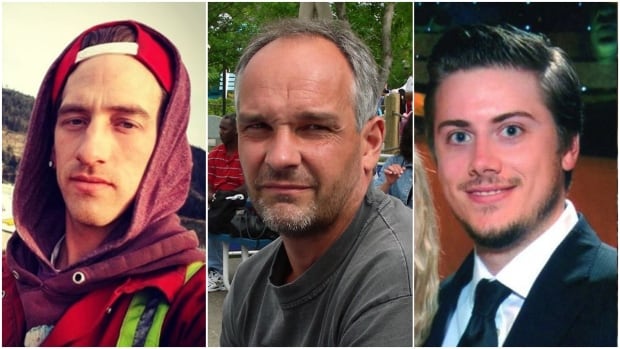
From left, trainee Daniel Waldenberger-Bulmer, engineer Andrew Dockrell and conductor Dylan Paradis were killed when their loaded Canadian Pacific Railway train derailed near Field, B.C., in February 2019. (Facebook, Heather Dockrell, Instagram) |
|
CP Rail Probe of B.C. Crash
Public awareness of the powers of railway police forces has grown in the wake of a runaway Canadian Pacific (CP) freight train crash near Field, B.C. in February 2019, killing three workers. The CP police investigation into the accident focused on the crew’s actions. It didn’t examine potential fault by the corporation. No details of the investigation findings were made public.
However, one of the CP police investigators assigned to the accident spoke out. Mark Tataryn told CBC’s The Fifth Estate that his superiors ordered him to stop investigating and prevented him from obtaining key records such as maintenance, safety and inspection reports. He alleged there was a coverup of potential negligence by the company.
Documents obtained by The Fifth Estate also revealed that CP Rail threatened the Transportation Safety Board (TSB) with a lawsuit after its lead investigator, Don Crawford, told CBC News:
“There is enough to suspect there’s negligence here, and it needs to be investigated by the proper authority.”
TSB Within its Rights
That means the TSB was within its rights to refer the case to an authority that could investigate criminal liability. A 2020 amended version of the memorandum removed the reference to potential criminality.
Canada’s Railway Safety Act is silent on how Canadian railway police should be governed and who is their ultimate boss. But they should be governed first and foremost by the law and their duty to uphold the public interest.
However, the law is murky. Railway police forces are paid by the corporation, giving its CEO ultimate control. That means the railway police chiefs follow corporate directives.
Presumably, this would also apply to CN and CP police chiefs operating in the United States, who, while not commissioned police officers in any American state, are ultimately accountable to corporate CEOs based in Canada.
|
|
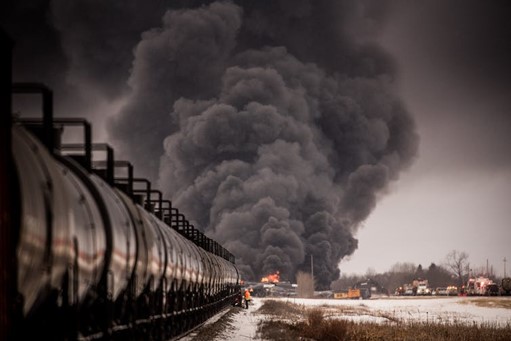
Smoke billows up from a derailed Canadian Pacific Railway train near Guernsey, Sask., in February 2020 THE CANADIAN PRESS/Matt Smith |
|
Situation Comparable in the U.S.
U.S. railway policing powers, also dating back to the 19th century, are broadly comparable to those of their Canadian counterparts. The U.S. has a state-based system, with most states having similar levels of railway police powers.
However, several sources have indicated to me that this practice has existed for so long that it has most likely slipped under the radar of American authorities. They have likely not considered the implications of CN and CP police chiefs — and indirectly their corporate bosses — exercising police powers in the U.S.
Calls for Action
The CP investigation into the Field, B.C. crash and other railway accidents have led to demands — from within government itself, railway unions and the public — to dismantle existing railway police powers.
A recent House of Commons Transport and Infrastructure Committee report recommended eliminating company policing power provisions from the Railway Safety Act to avert potential conflict of interest when private railway police investigate their own companies.
Several parliamentary petitions, including one filed by the mother of one of the Field victims, are calling for existing railway police to be brought under one independent public railway police regime, funded by the companies and accountable to an independent civilian oversight commission, similar to the British system.
|
|
Railroad Workers United
Solidarity -- Unity -- Democracy
|
|
|
|
|
|
|