Rail Workers Weekly News Digest
Number 3 - January 21st, 2020
|
|
Below is a series of articles compiled over the previous week.
They are of interest to railroad workers.
_____________________________________________
|
|
Article 1 -
TRAIN CREW NEWS
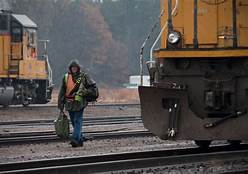
Technology could cut train crews from 2 to 1 but is it safe?
(Editor's Note: While some coverage of the workers' perspectiver is better than none at all, this article comes up short. It focuses on - and quotes - the industry position 2.5 times more than the workers' position. And it leaves out any discussion whatsoever about crossing incidents, derailments or other mishaps when the lack of a conductor could be catastrophic).
OMAHA, Neb. — How many people does it take to operate a locomotive? For the railroad industry, the answer is simple: One.
The industry is hoping this year's scheduled completion of an automatic railroad braking system will bolster its argument to reduce the number of crew members in most trains from two to just one. But labor groups argue that single-person crews would make trains more accident prone.
The $15 billion braking system, known as positive train control, is aimed at reducing human error by automatically stopping trains in certain situations like when it's in danger of colliding, derailing because of excessive speed, entering track under maintenance or traveling the wrong direction because of switching mistakes.
"Technology, in the form of positive train control, does a lot of the work — virtually all of the work — that a conductor does sitting in the cab," said Union Pacific CEO Lance Fritz.
For that reason, the industry says there is no need for more than one crew member to operate a train — a key issue in contract talks with railroad unions that began in November and could go on for years. Railroads tried unsuccessfully to reduce crew size in previous contract talks. "I'm 100 percent confident that we would not go down this path if we weren't certain that fewer people in the cab of the locomotive had no impact on safety," Fritz said.
Labor groups, however, argue that conductors provide a crucial safety backup in the cab as a second set of eyes to help monitor conditions and the train, and the automatic braking system isn't perfect.
"Positive train control only keeps trains from wrecking in certain circumstances. There is still a need for a second man in the crew,"
said Ron Kaminkow, an Amtrak engineer who serves as general secretary of the labor advocacy group Railroad Workers United
.
|
|
Article 2 -
RAIL SAFETY
Forecast for 2020: More Oil Trains, Fires, Spills, and the Rise of LNG by Rail
As 2019 drew to a close and the new year ramps up, a number of signs point to the growing risks of transporting oil and gas by rail, with little government oversight to speak of: from increasing oil train traffic into the U.S. to fiery oil train derailments and new approvals for moving liquefied natural gas (LNG) by rail.
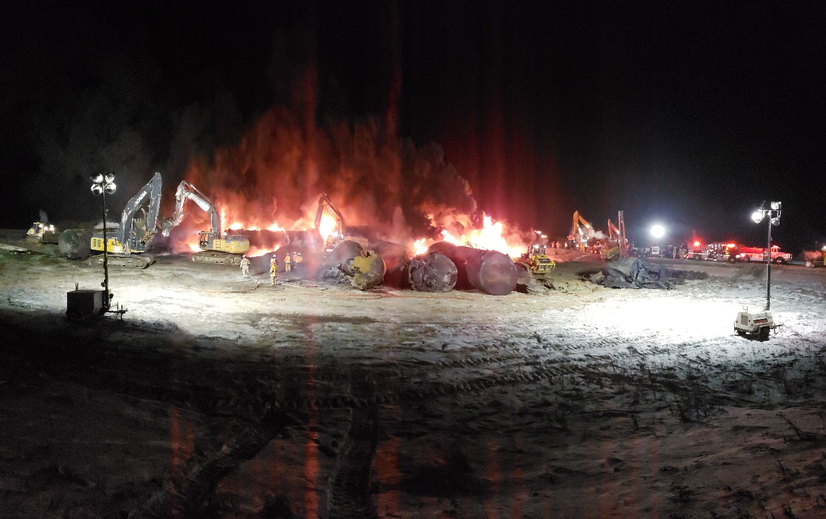
In early December, a train carrying oil from Alberta, Canada, and destined for Oklahoma, home to the biggest oil distribution hub in the U.S.,
derailed
shortly after departing from the loading facility. Many of the oil tank cars ruptured and spilled large amounts of oil, which caught on fire. The train spilled 400,000 gallons of oil and burned for 24 hours.
To put that in perspective, the 2010 pipeline spill of Canadian tar sands oil into Michigan's Kalamazoo River released just over
one million gallons
and took several years and over a billion dollars to clean up.
While this oil train derailment was another in a growing series involving large spills and fires, the event received little media coverage. The Transportation Safety Board of Canada assured the public that
“no waterways” were affected
, and by December 20, CBC reported that Canadian Pacific, the rail company that operated the train, had workers beginning to scrape away the contaminated soil.
Among the limited coverage of the incident, CTV News
reported comments
from “railway expert” Mark Hemmes, who said, “I’m always surprised when a derailment occurs and there’s a fire. That’s a very unusual situation.” Hemmes currently serves as CEO of a firm that monitors grain movements for the government. Sure, grain trains don’t catch fire when they derail, but oil trains usually do.
This is not the first oil train to derail in Canada. Starting in 2013 with the oil train accident in
Lac-Mégantic
, all four of the derailments involving unit trains of Canadian oil have involved major oil spills and most have involved fires that have burned for days.
|
|
Article 3 -
RAIL SAFETY
Commentary - LNG by rail: A disaster waiting to happen
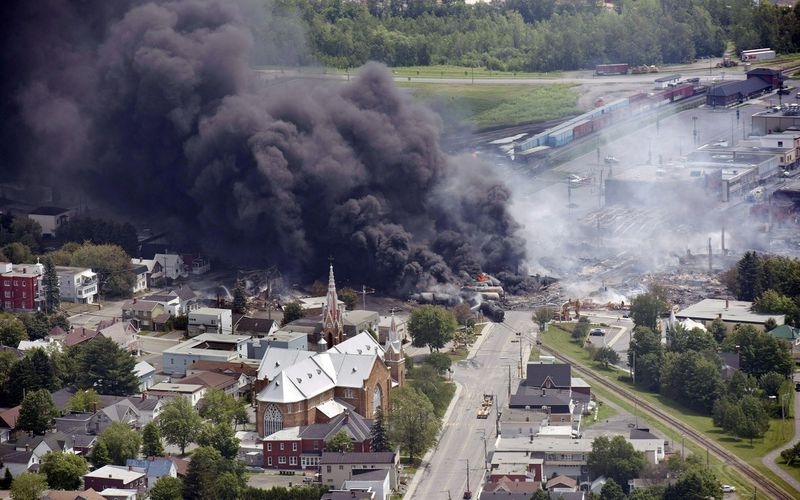
Nearly seven years ago, a small town in the Canadian province of Quebec suffered a disaster of historic proportions when an unattended freight train slipped down a hill and tank cars loaded with crude oil derailed in the downtown. Much of Lac-Mégantic was reduced to embers, consumed by fire and explosions with 30 buildings destroyed and 47 people dead in the half-mile blast radius. It was one of the worst rail disasters in that nation’s history, and a mere 600 miles from Maryland. Now, imagine that instead of crude oil, those tank cars were filled with volatile natural gas that has been cooled to liquid form. The resulting conflagration could have been even worse.
Those are the stakes involved with the transport of liquefied natural gas by rail, so it’s no surprise that Maryland Attorney General Brian Frosh is at the vanguard of 16 U.S. attorneys general who this week urged the Trump administration to withdraw a plan to allow bulk transport of LNG without additional safety measures. The opposing AG’s represent California, Delaware, Illinois, Massachusetts, Michigan, Minnesota, New York, North Carolina, Oregon, Rhode Island, Vermont, Washington, the District of Columbia and Maryland.
Even within the energy industry, there has long been debate over the safety of LNG transport given the realities of U.S. freight lines, which often run through highly populated areas and are far from accident free. Last year, trains were involved in
1,642 accidents and “incidents"
(such as derailments), according to the Federal Railroad Administration. LNG must be stored under extreme conditions to maintain its minus 260 degrees Fahrenheit temperature. When it escapes, it quickly returns to a gaseous state where it is highly flammable, odorless and potentially explosive. So instead of a small town in rural Canada, imagine a disaster happening in the
Howard Street Tunnel
in downtown Baltimore. The stakes are high. In 2001, a CSX derailment in the Howard tunnel unleashed a chemical fire that burned for most of a week. A cause was never found.
|
|
Article 4 -
RAIL SAFETY
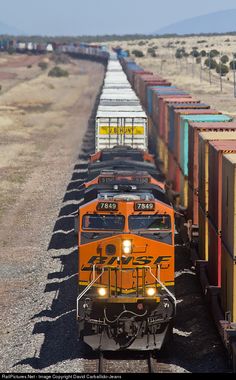
Fewer visual track inspections by BNSF means rail safety 'Russian roulette,' union says
A railroad workers union contends BNSF Railway's embrace of automated track inspections jeopardizes public safety, but the railroad counters that new technologies often are better at detecting defects than the human eye.
FARGO — A union claims that a test of automated track inspection techniques on BNSF Railway ultimately will mean fewer visual checks of lines in North Dakota and Minnesota, setting up "a game of Russian roulette with the general public’s safety.”
The automated testing initiative involves a suspension of inspection rules by the Federal Railroad Administration and will allow BNSF to make fewer human track inspections.
The testing program, now focused on 1,348 miles of track between Lincoln, Neb., and Donkey Creek, Wyo., that primarily transport coal, has been upheld by a federal appeals court that rejected the union’s legal challenge.
If the automated track testing pilot is successful, the program will expand to track segments that include lines running diagonally across North Dakota, from Minot to Moorhead, and in Minnesota from Dilworth to Minneapolis, according to the Brotherhood of Maintenance of Way Employes Division of the International Brotherhood of Teamsters, which opposes the automated inspection tests and claims they are unsafe.
Union leaders say they support use of new technology to inspect rail tracks that increase safety. But they are “alarmed that the testing of this new automated system of track inspection could potentially fail because BNSF Railway has reduced the number of visual track inspections that are crucial in catching any errors that the new system makes,” according to a statement to Forum News Service by David Carroll, the union’s general chairman, and John Mozinski Jr., vice chairman.
|
|
Article 5 -
FREIGHT TRAFFIC
North American freight-rail volume tumbled in Week 2
(Editor's note: For those that remember, it was about this time in 2008 when fright traffic began a precipitous drop. By the Fall, the stock market collapsed and the Great Recession was on. It is hard to estimate how much of this dramatic decline is due to PSR, the "trade war", or a faltering economy. Hold onto your hat!)
The U.S. freight-rail traffic slump is continuing, with volume down 9.6 percent to 501,624 carloads and intermodal units during the week ending Jan. 11 compared with the same week in 2019, according to
Association of American Railroads
(AAR) data.
Total carloads for the week fell 10.1 percent to 239,119 units, while intermodal volume declined 9.1 percent to 262,505 containers and trailers.
Three of the 10 carload commodity groups that AAR tracks on a weekly basis posted increases. They were chemicals, up 848 carloads to 33,764; miscellaneous carloads, up 765 carloads to 10,671; and petroleum and petroleum products, up 388 carloads to 14,303.
Commodity groups that logged decreases included coal, down 16,224 carloads to 70,831; grain, down 6,385 carloads to 18,304; and metallic ores and metals, down 3,333 carloads to 21,059.
|
|
Article 6 -
RAIL SAFETY
NJ law requires rail operators to remove vegetation near crossings
New Jersey Gov. Phil Murphy last week signed legislation that will require railroads to remove obstructive vegetation near grade crossings.
The new law aims to increase safety for trains, motorists and pedestrians crossing railroad tracks, Murphy administration officials said in a press release.
The bill requires railroad operators to destroy or remove obstructive vegetation upon and within railroad right-of-way at each intersection with a public road or highway, 300 feet from the edge of the public road or highway or such other distance that the New Jersey Commissioner of Transportation determines to be reasonably safe.
"Vegetation can pose a serious hazard to passenger and commercial train traffic, as well as those crossing railroad tracks,” Murphy said. “This legislation will improve safety on our railroads and hold railroad operators responsible for removal of obstructive vegetation at our many railroad crossings.”
|
|
Article 7 -
WORKER DIRECT ACTION
Kentucky coal miners block CSX train because they haven’t been paid
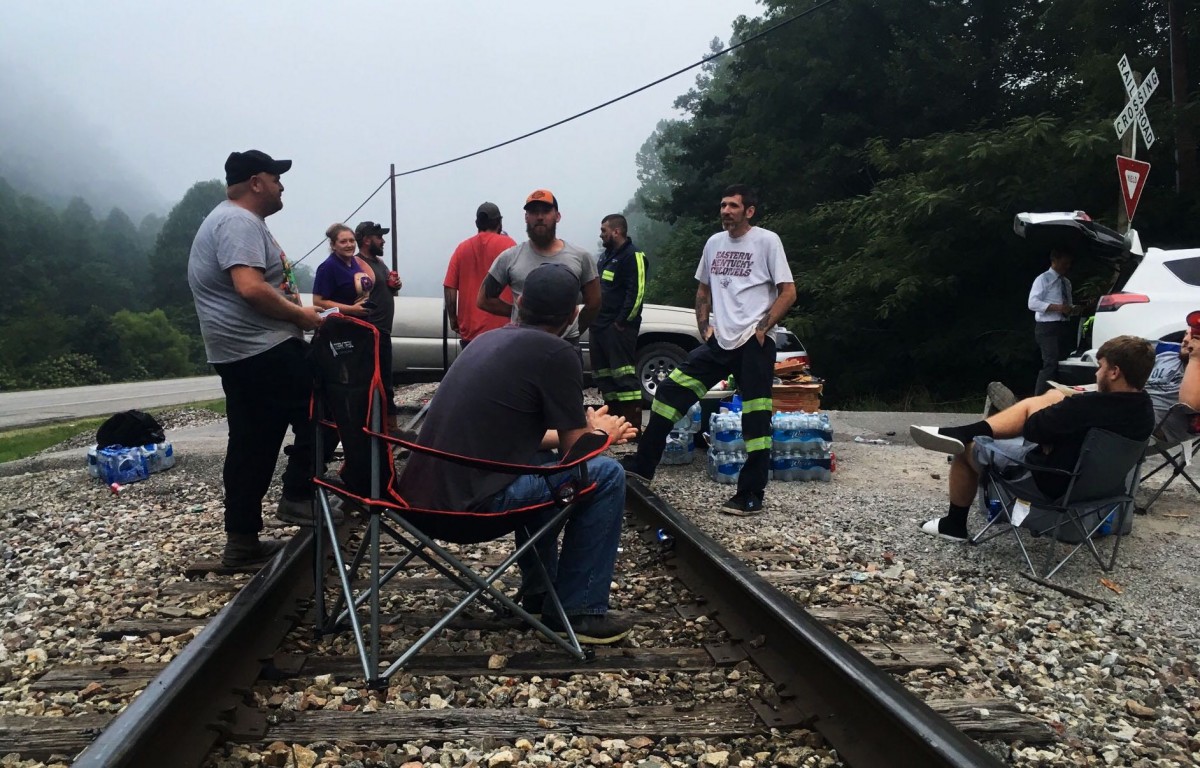
(Editor's Note: The photo at left is from a miners' action in 2019 that blocked the tracks for weeks, likewise demanding to be paid by the company Blackjewel. These miners deserve the support of every railroad worker).
The
Lexington Herald-Ledger
reports that a group of coal miners, all employees of Quest Energy (a subsidiary of American Resources Corporation, or ARC) are blocking a coal train from leaving a mine in protest of not having been paid since late December. The miners have calculated that each of them are owed between $2,000 and $3,000, approximately two weeks pay. Some miners said they had worked 17-hour shifts during this pay period.
ARC says many of these claims are wrong. The company said that it does not allow its employees to work 17-hour shifts, and that the most it owes any of the miners is for eight days of work.
ARC said “We value the employees greatly for their work and their future work. Given the challenging markets we are focused on ensuring the longevity of the employment for all the men and women of our organization.”
One of the miners said “We just want paid, that’s it. We don’t want to block this train, but it comes to a point that we have to. You go three weeks without a payday, you gonna let that train go through here so they can put the money in their pocket and just say to heck with us? No, they can’t do that.”
|
|
Article 8 -
DERAILMENT NEWS
Union Pacific train derails near Knapp, Wisconsin Sunday afternoon
Editor's Note: Given the rash of derailments in 2019, RWU will be keeping closer tabs on the industry this year and reporting regularly. All rails are encouraged to submit articles when you learn of a derailment. See button below).
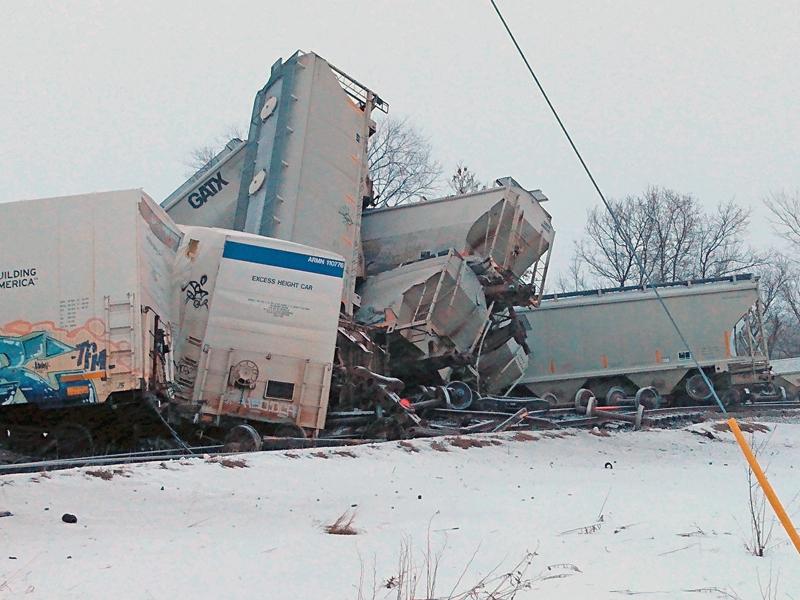
A Union Pacific train derailed Sunday afternoon near Knapp in the Town of Stanton by the 190th Street crossing.
The Dunn County Communications Center received a report about the train derailment about 4 p.m. January 12, according to a news release from the Dunn County Sheriff’s Department.
All together, 38 cars derailed carrying mixed freight, said Kristin South, a Union Pacific media contact who covers the states of Colorado, Idaho, Illinois, Minnesota, Montana, Tennessee, Utah, Wisconsin and Wyoming.
No one was hurt during the derailment, and no hazardous materials were spilled, South said.
The cause of the derailment is under investigation, and Union Pacific crews hoped to have the site cleaned up by late Monday, she said.
When the call first came in, there were concerns about the train cars carrying hazardous materials that could spill and might cause the area to be evacuated.
In fact, some of the cars were hauling liquid propane, but those cars were not involved in the actual derailment and did not pose a threat to the
|
|
|
|
|
|
|