News and information to help journalists serve the public and stay safe.
August 12, 2020
TOP STORIES
As racism and the treatment of people of color in and out of newsrooms has surged to the forefront of conversations, against the backdrop of a pandemic that disproportionately impacts people of color, journalists face many questions: When do ‘objectivity’ and ‘neutrality’ mask inequity? How do journalists move from covering protests to systemically telling stories that root out racist treatment in health care, education and other social spheres? And how can journalists practice antiracism in their everyday work?

Join us as Leah Donnella of NPR’s Code Switch, Cassie Haynes of Resolve Philly and Robert Samuels of The Washington Post discuss “What would antiracist journalism look like?”

Registration is open for this program, which will take place on Friday, Aug. 21, 2020.
How can news organizations close the gap between journalism and community?

To explore the question, the National Press Club Journalism Institute and PEN America co-hosted a program on Aug. 12 with moderator Jim Friedlich, executive director and CEO of the Lenfest Institute of Journalism, and panelists Denise Rolark Barnes, publisher of The Washington Informer; Cassie Haynes, co-executive director at Resolve Philadelphia; Darryl Holliday, co-founder and News Lab director at City Bureau in Chicago; and Tasneem Raja, editor-in-chief of The Oaklandside. 

The speakers shared lessons from their newsrooms on pandemic and protest coverage and also addressed opportunities for local newsrooms to build trust in their communities. 

Among their insights:

On equity as an institutional value

Holliday: I think realizing the full potential of healthy information ecosystems at this point, it begins with equity. ... So we think of it in three parts, equity as it relates to our work. The first is acknowledging history. The second is shifting power. And the third is embracing accountability.

Haynes: When you have this baked into your DNA as an organization, it's all the way down to the core. It's how you pay people. It's the benefits that you offer and the professional development that you provide your team — that is equity. 

On listening — and responding — to the community

Raja: People told us they really want to see more reporting that reflects the value of Oakland. They were tired of reporting on Oakland focusing on what's not working or what we already know is broken. They said: We love this city, we love Oakland, we want to see that reflected in coverage. So in our story budget, we have converted some of these desires, these values that we heard from our community, into what we call mission metrics and we apply those metrics to our stories so that we can say okay, our community told us … they want reporting that reshapes harmful narratives about Oakland communities. 

Holliday: I think this is a partnership: You know there are journalists and then there are the people who consume information. That Venn diagram does not have to be a Venn diagram, it can be more of a circle. There can be more partnership between many more people and journalists. 

On collaboration as learning

Barnes: I'm very optimistic; I'm learning a lot of new things. Publishers all across this country, many of us are working together. We're working with other media organizations, the Local Media Association, the NNPA, Facebook, Twitter, all of these institutions have recognized the importance of promoting and sustaining particularly local newspapers and Black newspapers. So we're back in school again in front row seats, understanding all the technology that allows us to reach a much broader audience, while continuing to inform our aging audience that still very much relies on the news that we've provided them, in our case for 55 years. 

On building trust

Friedlich: During COVID-19, the digital traffic to the Philadelphia Inquirer and to other major news organizations that we track has, in many cases, been up as much as five fold. The previous record in Philadelphia ... was the Eagles win the Super Bowl. And now it's COVID-19. And this was partly a desperate and important need for accurate news and partly that the print paper was either unavailable or people were afraid to go out and get it. So, there has been a sharp increase in use of our content. … That to me says that people still trust branded news or news from their community.

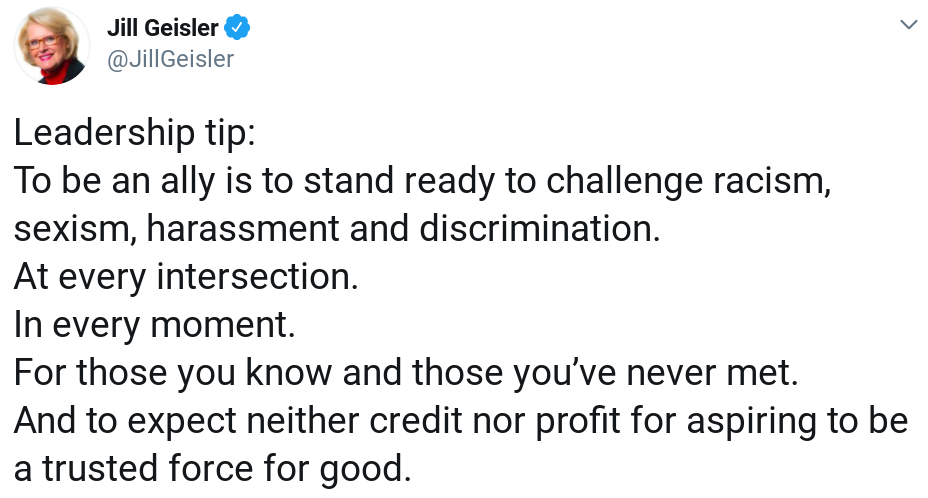
Don’t wait for women or journalists of color to be your radar. Stay vigilant about what’s happening in your team and newsroom. Watch for coverage that could become sexist or racist. Ask yourself: Whose voices are missing from this reporting? Who will be most affected and how are they represented? Be conscious of who is in the room during news meetings, who is speaking out, and who is silent. Listen, learn, read. And be prepared to go deep to root out systemic discrimination. 

Advice from Jill Geisler, Bill Plante Chair in Leadership & Media Integrity, Loyola University Chicago, Freedom Forum Fellow in Women’s Leadership
Do you qualify as an ally? Join Jill for the next Freedom Forum Institute Power Shift Project program on August 20 at 1 p.m. EDT. Registration is now open.
Burnout. It’s real, and chances are you’ve experienced one or more symptoms since the COVID-19 pandemic upended work as we knew it. 

Knowing the signs of burnout is one thing. Recognizing and doing something about yours, though, can take work — a daunting endeavor if you’re already exhausted, on edge or enthusiasm-zapped. 

Here are signs your flame might be flickering — and how to find a spark: 

  • You’re avoiding work. Maybe you’re procrastinating more, avoiding co-workers or ignoring email. It may stem from feeling like you need to be part of every conversation, especially when working from home. Try turning off Slack, email or other notifications when you need to focus your attention, and talk to your team about why you’ve taken a step back. 
  • The quality of your participation has changed. You might be speaking up less or seeing your routine tasks as mundane or unimportant in light of the circumstances. Revisit your job description and workload with your supervisor. They may not know the invisible work you’re doing from home, and you could explore tasks that better suit your talents.
  • You feel increased cynicism or depersonalization, which can appear as anger or irritability toward coworkers, sources or clients. Create boundaries, take your earned time off, and set a daily out-of-office message when the workday ends. 
  • You feel unappreciated or disconnected. Ask yourself: Are you taking on work because someone asked you to, or did you invent a need? Talk to your supervisor, or suggest your team hold a regular virtual coffee break. Connecting with work friends can help ease burnout.

Read on for more self-care tips, or share your own.
This newsletter is written & edited by the National Press Club Journalism Institute staff: Beth Francesco, Holly Butcher Grant, and Julie Moos. Send us your questions and suggestions for topics to cover.

Get this from a friend? Subscribe, and view the archives.