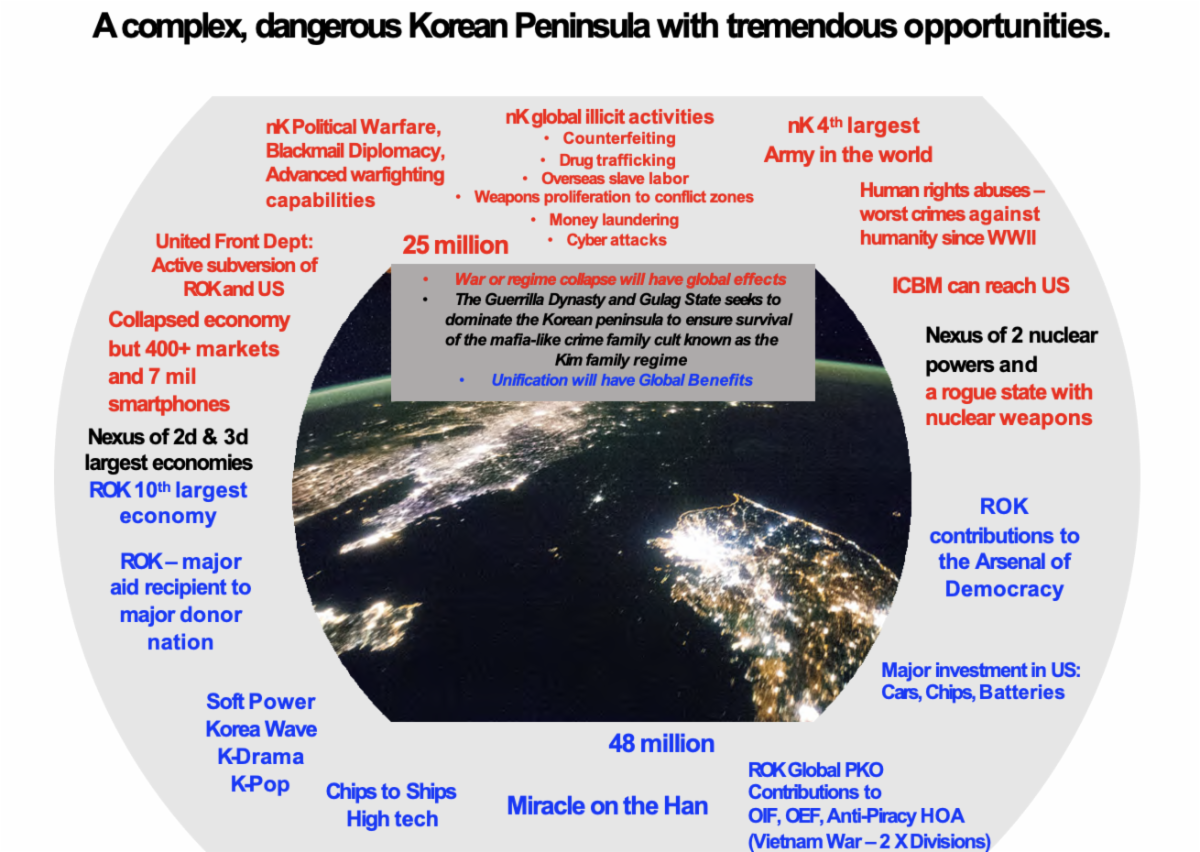
|
Quotes of the Day:
"I'm waiting. No one is going to come., but I still wait. No one even knows I am here, but I'm waiting all the same."
Han Kang, Nobel Prize in Literature, 2024
"My mother was the most beautiful woman I ever saw. All I am I owe to my mother. I attribute all my success in life to the moral, intellectual and physical education I received from her."
– George Washington
"But luxury has never appealed to me, I like simple things, books, being alone, or with somebody who understands."
– Daphne du Maurier
1. Inside the Trump Admin's Secret Battle Plans for North Korea
2. Watch: North Korea Blows Up Parts of Roads Connecting to South Korea
3. Partisans Report North Korean Troops in Training Area Near Mariupol
4. Russia is Forming a Battalion of North Korean Soldiers Due to Severe Manpower Shortages, Intel Sources Say
5. N. Korea blows up inter-Korean roads, cuts off land routes with South
6. Pyongyang slams U.N. special rapporteur's report on N. Korea's human rights
7. N.K. leader holds security meeting to discuss S. Korea's alleged drone flights over Pyongyang
8. Exclusive: Nobel economist says strongman Park's policies sparked S. Korea's explosive growth
9. Starlink services may be available in S. Korea next year: sources
10. S. Korea voices regret over Russia siding with N. Korea in drone row
11. S. Korea picks adviser for oil, gas exploration in East Sea
12. Defense chief apologizes over 'Silmido' unit for 1st time
13. Exclusive: South Korea spent $2.5 m on unused North Korean customs facilities
14. <Inside N.Korea> After COVID, Defectors Forcibly Repatriated from China Face 5-10 Years of Harsh Punishment; Families Also Exiled Under Guilt-by-Association
15. Russia urges S. Korea to avoid provocations amid N. Korea's drone allegations
16. Defense innovation: What is to be done?
17. N. Korea threatens war
18. N. Korean regime orders road inspections, eyes foreign connections
19. Former US Official: “North Korea’s Artillery Fire Preparation Order Is Part of Intimidation Diplomacy”
20. State Department: “If North Korea Sends Troops to Russia, It Shows Russia’s Desperation”
21. War talk rises as North Korea accuses Seoul of stealth drone infiltration
1. Inside the Trump Admin's Secret Battle Plans for North Korea
I sure would have liked to have seen the "holiest of secret plans." But I never did. Did they even exist?
It pains me to read this. Either someone is talking out of school or someone does not know what they are talking about.
I am also not surprised because it is likely the reporter was talking to someone who does not know the basics of unconventional warfare planning or who does not have an understanding of the nature, objectives, and strategy of the Kim family regime.
But the relationship between SOF and the CIA in this case reminds me of the Cold War and the NATO area of operations. The CIA was supposed to have created the networks behind the Iron Curtain that were to be exploited by SOF in wartime for conducting unconventional warfare. After the wall came down it was learned that the networks were non-existent just as they were non-existent in southern Iraq in 2003. They did exist in northern Iraq because SOF and the CIA were able to sustain a long term relationship with the Kurds and local forces because of the sustained US contacts going back to Provide Comfort. And this is the lesson, no networks will exist unless there is the ability to gain and sustain contact and build lasting relationships to be activated and exploited when in the national interest.
If this reporting is accurate the other thing it reveals is the continued (historical) lack of coordination between SOF and the CIA in the "shared battlespace" of unconventional warfare. The comments about SOF and the CIA (critical of the weakness of the "other") illustrate our national weakness in planning and prosecuting unconventional warfare.
But the fundamental question that should be asked is what is the ROK/US alliance doing to nurture, develop, influence, and support potential resistance among the Korean people in the north? Policy makers and political leaders should be demanding answers from the CIA and SOF.
“Unification Options and Scenarios: Assisting A Resistance,” International Journal of Korean Unification Studies Vol. 24, No. 2, 2015, 127–152
https://repo.kinu.or.kr/bitstream/2015.oak/8908/6/0001477395.pdf
Commander Frederick Vincenzo, “An Information Based Strategy to Reduce North Korea’s Increasing Threat - Recommendations for ROK & U.S. Policy Makers,” Center for New American Security, October 3, 2016, pages 1-15.
https://www.cnas.org/publications/reports/an-information-based-strategy-to-reduce-north-koreas-increasing-threat
Jieun Baek, “A Policy of Public Diplomacy with North Korea: A Principled and Pragmatic Approach to Promote Human Rights and Pursue Denuclearization,” Harvard Belfer Center, August 2021, pages 20-28.
https://www.belfercenter.org/publication/policy-public-diplomacy-north-korea
"Should The United States Support Korean Unification And If So, How?" International Journal of Korean Studies, Vol. XVIII, No. 1, 2014 139-156
http://icks.org/n/data/ijks/1482467285_add_file_7.pdf
George Hutchinson, “Army of the Indoctrinated: The Suryong, the Soldier, and Information in the KPA, Committee for Human Rights in North Korea,” April 26, 2022, Read Chapter 5 & 6 pages 57-88.
https://www.hrnk.org/uploads/pdfs/Hutchinson_KPA_web_0426.pdf
Suki Kim, “The Underground Movement Trying to Topple the North Korean Regime,” The New Yorker Magazine, November 16, 2020
https://www.newyorker.com/magazine/2020/11/23/the-underground-movement-trying-to-topple-the-north-korean-regime
Robert Collins' Pattern of Collapse in north Korea
https://smallwarsjournal.com/jrnl/art/pattern-collapse-north-korea
Lastly, let me say that unconventional warfare and support to resistance is not an immediate war winner and is unlikely to cause the coup de main so many wish for. It is a long term proposition that requires investment in the appropriate expertise that requires a lot of time though often relatively minimal resources. However, given the time and investment it can pay huge dividends in various outcomes whether war, regime collapse and especially in a post conflict and post collapse conditions. Paradoxically UW is one of the missions that can make significant contributions to the political process of unification. But I do not think any of the people who allegedly spoke to this reporter understand any of that. Anyone who thinks that SOF or the CIA or unconventional warfare could create a quick victory need to return to school for further study in unconventional warfare. We need the right people with the right expertise for the long term commitment to plan and execute effective UW operations in support of ROK/US alliance strategy.
Excerpts:
The 2017 review, which was overseen by the CIA’s paramilitary Special Activities Center (SAC), did not begin auspiciously. Agency officials reached out to their counterparts at the Pentagon’s Special Operations Command-Korea (SOCKOR), which had developed war plans involving CIA paramilitaries and other special operations forces in case conflict were to erupt between the U.S. and North Korea.
But when CIA paramilitaries reviewed SOCKOR’s plans, they were “stunned,” recalled a former senior CIA official. They hadn’t been updated for decades. SOCKOR planners hadn’t even ever actually spoken with anyone at CIA about them.
And, to make matters worse, they “were just outright ludicrous,” recalled the former official. It was, “‘OK, so we’ll take three CIA people with us, and they’ll ride in the tank with us as we’re rolling through.’ And I’m like, that’s fucking dumb. That’s actually not going to happen. There were plans that were like, who the fuck thought this out, Wile E. Coyote?”
Further conversations with top SOCKOR officials did nothing to allay CIA paramilitaries’ fears about their plans. “Talking with one of the generals, he’s like, ‘We’ll just … rendezvous with the mountain people in North Korea because mountain people typically don’t get along with city dwellers in Pyongyang,’” recalled the former official.
“And I said, this is not a spaghetti Western movie … and you can’t just make a war plan based upon your hoping that the people you’re going to link up with in the mountains of North Korea are just going to roll in with you into Pyongyang,” said the former CIA official. “That sounds like a really bad bet. I hope you don’t go to fucking Las Vegas and spend all of your wife’s money.”
Some of the military’s plans were solid, but many seemed like they were the result of “too many martinis,” said the former official.
CIA paramilitaries also pried open, and overhauled, the CIA’s own in-house contingency plans in case of war with North Korea — its “holiest of secret plans,” said the former senior official.
These plans, too, had not been updated for decades, according to the former official, and had been left to molder over time. The attitude at Langley had been, “in case of emergency break glass and open up this book, and this is the operation,” recalled the former official. But these plans also had long been rendered obsolete — or were simply “nonsensical,” said the former official.
Inside the Trump Admin's Secret Battle Plans for North Korea
Amid growing risk of nuclear conflict, would a second Trump term make the U.S. approach to North Korea even more volatile?
By Zach Dorfman
October 14, 2024
Rolling Stone · by Zach Dorfman · October 14, 2024
During his acceptance speech at the Republican National Convention in July, Donald Trump doubled down on a well-worn riff about one of his administration’s major foreign policy achievements. Because he “got along very well” with North Korean leader Kim Jong Un, he had persuaded Kim to stop conducting ballistic missile and nuclear tests, claimed the former president. It’s “nice to get along with someone who has a lot of nuclear weapons,” he added.
It was a dovish aside during an otherwise hawkish speech. But it captures the extraordinary transformation of Trump’s public approach to North Korea. It’s a shift that, if Trump were to again win the presidency, could have profound consequences for peace on the Korean peninsula — and for the potential outbreak of nuclear war in East Asia.
Time may be running out. Some prominent observers believe that Kim, embittered by a lack of progress toward normalization with the United States, is preparing to launch an attack on Seoul. “The situation on the Korean Peninsula is more dangerous than it has been at any time since early June 1950,” two renowned Korea experts, Robert L. Carlin and Siegfried S. Hecker, wrote earlier this year. North Korea will use its nuclear arsenal in a surprise attack, say Carlin and Hecker. (Other analysts have been more skeptical.) Still, earlier this month, Kim threatened to use nuclear weapons against South Korea and the United States.
In 2017, many feared that such a war between the U.S. and North Korea was also likely. Harsh saber-rattling against Pyongyang dominated the early Trump presidency. Amid his administration’s strategy of “maximum pressure,” Trump threatened Kim — whom he nicknamed “little rocket man” — with “fire and fury like the world has never seen” if the country continued its missile launches. That same year, Trump ordered a top-to-bottom review of military options for North Korea; this included updating ultra-secret U.S. military plans for killing North Korean leadership as well as wholesale invasion and regime-change scenarios, according to Bob Woodward in his Trump-era book Rage. (The U.S. military has war plans for all kinds of scenarios, but these were distinct: precipitated by a president who seemed quite willing to strike Pyongyang, amid a deep crisis between the two nuclear-armed powers.)
Some of Trump’s ideas regarding North Korea were highly unconventional, to say the least. “Why don’t we take out the whole North Korean Army during one of their parades?” asked the former president, according to the new memoir from H.R. McMaster, who served as Trump’s national security adviser from February 2017 to April 2018. Trump reportedly even privately mulled dropping nuclear weapons on North Korea — and somehow blaming another actor for the strike. Then-Secretary of Defense Jim Mattis worried Trump’s policies toward Pyongyang could lead to “incinerat[ing] a couple million people,” according to Woodward in Rage.
Soon, however, Trump made an extraordinary about-face on North Korea, at least in public. In June 2018, amid warming ties, he met Kim in Singapore for the first summit between a U.S. president and a North Korean leader. He later said that Kim had written him “beautiful letters” and that the two leaders had “fallen in love.” Another Trump-Kim tête-à-tête followed in Vietnam in 2019; Trump even briefly stepped onto North Korean soil for the third meeting between the two leaders later that year.
Now, with Trump running to reclaim the presidency, it’s unclear which Trump might materialize on North Korea policy, if he wins: the belligerent Trump who threatened “fire and fury” and a potential nuclear holocaust against Pyongyang, or the conciliatory Trump who exchanged “love letters” with the North Korean dictator.
“When President Trump is back in office, he will restore his peace-through-strength policies that secured peace around the globe,” Trump campaign national press secretary Karoline Leavitt tells Rolling Stone.
Regardless, if elected again, Trump will inherit the U.S. military’s regime-change plans for North Korea, modernized during his own prior administration. But he will also inherit updated, ultra-secret plans for CIA assistance in any such invasion, according to three former CIA and U.S. intelligence officials familiar with the agency’s North Korea overhaul.
Then-CIA Director Mike Pompeo hinted at these revived plans in a 2017 talk at the Aspen Institute, where Pompeo also pointedly suggested the administration was mulling pathways to regime change in Pyongyang. CIA will “deliver a range of options that can do what ultimately needs to be achieved,” said Pompeo in Aspen.
When it came to North Korea, “I took it as my mission to build a set of clandestine capabilities that could be deployed in case the president found diplomacy and conventional military power insufficient,” Pompeo writes in his 2022 memoir, Never Give an Inch. (Pompeo did not respond to a request for comment.)
But details of the CIA’s review of its role in a potential war with North Korea, and wider planning within the agency surrounding enhanced covert action in service of the administration’s “maximum pressure campaign,” have never been told.
The 2017 review, which was overseen by the CIA’s paramilitary Special Activities Center (SAC), did not begin auspiciously. Agency officials reached out to their counterparts at the Pentagon’s Special Operations Command-Korea (SOCKOR), which had developed war plans involving CIA paramilitaries and other special operations forces in case conflict were to erupt between the U.S. and North Korea.
But when CIA paramilitaries reviewed SOCKOR’s plans, they were “stunned,” recalled a former senior CIA official. They hadn’t been updated for decades. SOCKOR planners hadn’t even ever actually spoken with anyone at CIA about them.
And, to make matters worse, they “were just outright ludicrous,” recalled the former official. It was, “‘OK, so we’ll take three CIA people with us, and they’ll ride in the tank with us as we’re rolling through.’ And I’m like, that’s fucking dumb. That’s actually not going to happen. There were plans that were like, who the fuck thought this out, Wile E. Coyote?”
Further conversations with top SOCKOR officials did nothing to allay CIA paramilitaries’ fears about their plans. “Talking with one of the generals, he’s like, ‘We’ll just … rendezvous with the mountain people in North Korea because mountain people typically don’t get along with city dwellers in Pyongyang,’” recalled the former official.
“And I said, this is not a spaghetti Western movie … and you can’t just make a war plan based upon your hoping that the people you’re going to link up with in the mountains of North Korea are just going to roll in with you into Pyongyang,” said the former CIA official. “That sounds like a really bad bet. I hope you don’t go to fucking Las Vegas and spend all of your wife’s money.”
Some of the military’s plans were solid, but many seemed like they were the result of “too many martinis,” said the former official.
CIA paramilitaries also pried open, and overhauled, the CIA’s own in-house contingency plans in case of war with North Korea — its “holiest of secret plans,” said the former senior official.
These plans, too, had not been updated for decades, according to the former official, and had been left to molder over time. The attitude at Langley had been, “in case of emergency break glass and open up this book, and this is the operation,” recalled the former official. But these plans also had long been rendered obsolete — or were simply “nonsensical,” said the former official.
The authors of the North Korea overhaul tried to replace these archaic contingency plans with updated, viable wartime operations dealing with issues like emergency communications, according to the former official.
But to some, aspects of the CIA’s new Korea schemes were also outlandish. “Korea got weird, man,” said a former CIA contractor, who recalled “a variety of strange plans” emanating from CIA’s Special Activities Center at the time, many of them focused on penetrating North Korean tunnels and underground facilities. Some of “it was like, ‘All right, 80 percent of you are gonna die, but then four of you might make it through,’ and so you’re like, what the fuck.”
Because these underground facilities were so difficult to gather intelligence on — say, via satellite imagery or drones — other suggestions for “weird” plans kept percolating, recalled the former CIA contractor, such as sending trained dogs underground to conduct reconnaissance and other missions alongside U.S. operatives in case of an invasion. “It was, how much can a dog haul? Can a dog carry ammo? I think they were even asking about [night-vision] goggles for dogs. We were like, ‘What the fuck, do you want us to chase down vets?’”
The CIA declined to comment on a list of detailed questions provided by Rolling Stone. The Pentagon referred all questions to the CIA.
The agency’s North Korea overhaul dovetailed with a larger, previously unreported CIA enterprise called the “Expeditionary Initiative.” The initiative, which was overseen by a senior CIA officer based in the agency’s Special Activities Center, was launched at the end of the Obama administration. One goal of the campaign was to try and develop ways of integrating new tech-focused and paramilitary capabilities across the agency, including outside of war zones, recalled former officials.
But as the Trump administration pursued its maximum pressure campaign against North Korea, punching at Pyongyang became a major focus of the Expeditionary Initiative, and the CIA’s paramilitary wing more broadly. Though couched as a broader campaign, it “didn’t take a fucking rocket scientist” to figure out that the initiative was focusing on worst-case scenario planning for North Korea, recalled the former CIA contractor.
Within the Expeditionary Initiative, the war-plan overhaul was complemented by aggressive new plotting to sabotage ships carrying illicit goods for Pyongyang, whose economy was then being choked by multilateral sanctions on key exports like coal and seafood, according to former officials.
Orders to do so came from the top. Trump believed that “maybe we need to go total old school against the North Koreans,” recalled the former senior agency official.
It is unclear to what extent the agency actually carried out its sabotage campaign against North Korean ships. The thinking was, “let’s at least train for that, in case we need to do it,” recalled the same former CIA official. (In Never Give an Inch, Pompeo brags elliptically about how as CIA director he altered the “rules of engagement” for agency paramilitaries in Syria and other unnamed countries.)
The sabotage plotting was a small, if key, component of the administration’s much-broader maximum pressure campaign against Pyongyang at the time, which included employing overt diplomatic and financial levers of U.S. power, as well as covert intelligence-led efforts, recalled another senior CIA official.
“All the options were on the table” when it came to North Korea, said the former official, “including some that we looked at, and you’re like, ‘Goddamn, that’s pretty spicy.’” Sabotage operations were “five percent of the overall effort” against Pyongyang — but it was integral to the larger maximum pressure campaign, according to the former official.
“All that was [part] of what we were doing because — stopping a coal ship, well, you could stop a coal ship in a hell of a lot of different ways,” said the former official, who declined to provide further details about the potential covert action campaign.
One senior Trump administration official expressed disappointment in the lack of covert disruption or sabotage of North Korean ships during Trump’s prior tenure in the White House. “We looked at a lot of those things…. We had various technologies that could do that, but never could get the decision to actually do it,” recalled the former official. “Trump talks a big game a lot, but in terms of really making a hardcore decision to pull a trigger, he was very reticent.”
Still, the maximum pressure campaign didn’t cease when Trump began gushing over Kim in public — far from it, according to the second former senior CIA official. “We were getting the guidance to amp it up, and really calibrate it the president’s negotiations,” recalled the former official. It was, “‘Hey, we’re gonna negotiate with the kid, let’s bring as much heat as we can, to give the president as much leverage as we can.’”
During the Trump era, the CIA helped identify and interdict millions in illicit goods (such as coal) being secretly exported by North Korea or other goods (like oil, and luxury products such as caviar) being smuggled into the country, according to the former official. The agency also helped seize money from sanctions-busting North Korean overseas construction and fishing conglomerates. “We were pounding them,” said the former official.
But Trump’s favorite part of the CIA’s campaign? Freezing North Korean funds from U.S. companies unwittingly doing business with Pyongyang — and then quietly letting those firms keep the money, according to the former official. In these cases, U.S. officials would swoop in, inform the shocked American firms about the true identity of the end-user of their products, and return the firms’ goods, which U.S. officials had seized before they made their way to North Korea.
The American companies thus recouped their products and kept North Korea’s payment for them. “Trump loved [that] the most,” said the former official, who estimated these U.S. companies ultimately pocketed hundreds of thousands of dollars in illicit North Korean funds.
Ultimately, the CIA-led campaign — which had notched some successes — faced difficult headwinds. The CIA had helped claw back a million here and there from Pyongyang, recalled the former senior official. But by 2018, North Korean hackers began “knocking over Crypto exchanges left and right” — in one case netting hundreds of millions of dollars in a single heist, recalled the former official. The CIA’s covert battle became increasingly Sisyphean.
Whether a newly-elected Trump offers Kim Jong Un the gun or the olive branch, he would be reckoning with a North Korea that’s learned a few things since his last stint in office. Even if the CIA’s war and sabotage plans for North Korea haven’t changed, “Maximum Pressure 2.0” won’t look the same as it did during Trump’s first term.
Rolling Stone · by Zach Dorfman · October 14, 2024
2. Watch: North Korea Blows Up Parts of Roads Connecting to South Korea
A 45 second video that provides some good views of the activity . It mentions the important point that the destruction of the roads at the north barrier fence of the DMZ are largely symbolic because they have not been used for some time.
https://www.wsj.com/video/watch-north-korea-blows-up-parts-of-roads-connecting-to-south-korea/62B71DE9-3358-4899-82F1-206491501FF2?mod=Searchresults_pos1&page=1
Watch: North Korea Blows Up Parts of Roads Connecting to South Korea
North Korea blew up its side of a road that connects it to the South days after Pyongyang vowed to cut off all links with its neighbor. Photo: South Korean Defense Military
By Wall Street Journal
1 hour ago
0:45
3. Partisans Report North Korean Troops in Training Area Near Mariupol
Excerpts:
Ukrainian President Volodymyr Zelensky said in his nightly address on Sunday that North Korea was transferring people as well as weapons to assist Russian forces fighting in Ukraine.
“We see that the alliance between Russia and regimes such as North Korea is getting stronger,” he said. “It is obvious that under such conditions our relationship with our partners needs to evolve, the front line needs more support.”
Partisans Report North Korean Troops in Training Area Near Mariupol
kyivpost.com · by Kyiv Post · October 14, 2024
A Ukrainian partisan group said on Sunday it had spotted North Korean personnel in military training areas in the occupied Donetsk region.
by Kyiv Post | October 14, 2024, 4:45 pm
North Korean leader Kim Jong-un visits training of paratroopers of the Korean People's Army (KPA) with his daughter in March. Photo: North Korean Central News Agency (KCNA)
The Ukrainian partisan movement CPOK (Смерть Русским Оккупантам и Коллаборантам – Death to Russian Occupiers and Collaborators) wrote on its Telegram channel on Sunday, Oct. 13, that it had identified the presence of North Korean military personnel in training areas located in the so-called Donetsk People’s Republic (DNR).
The group claimed that three separate training grounds had been established in the region, with the most active being near the village of Sartana, about 14 kilometers (9 miles) northeast of Mariupol. It said the area was currently being used for intensive artillery live firing training, which it said refutes the information about Russian forces suffering a shortage of artillery ammunition.
JOIN US ON TELEGRAM
Follow our coverage of the war on the @Kyivpost_official.
The report said that North Korean military instructors appeared to be setting up the training grounds, adding that they “probably feel confident and safe at the moment.” The CPOK group, which mainly operates in the Azov area to the east of Mariupol, said that many of the residents from Sartana are actively cooperating with Russian occupation forces.
Ukrainian President Volodymyr Zelensky said in his nightly address on Sunday that North Korea was transferring people as well as weapons to assist Russian forces fighting in Ukraine.
“We see that the alliance between Russia and regimes such as North Korea is getting stronger,” he said. “It is obvious that under such conditions our relationship with our partners needs to evolve, the front line needs more support.”
Other Topics of Interest
In this episode of "Capital Questions," TVP World explores Germany’s changing role in the EU. Once a powerhouse of integration and strength, can Germany still lead in 2024?
While the setting up of these training areas and the presence of the North Korean military there has not been verified by other sources, it would be logically expected that training facilities would be established in advance of the arrival of additional DPRK troops.
Kyiv Post reported on a Ukrainian missile strike on Oct. 3, in which six North Korean officers were among 20 military personnel killed in the Russian-occupied territory near Donetsk that were attending a demonstration on the training of personnel for assault and defensive operations.
According to Sunday’s CPOK announcement, the group will “do everything possible” to ensure that Moscow’s military allies from North Korea receive a “greeting from the Ukrainian Armed Forces as soon as possible.”
kyivpost.com · by Kyiv Post · October 14, 2024
4. Russia is Forming a Battalion of North Korean Soldiers Due to Severe Manpower Shortages, Intel Sources Say
Fear, weakness, desperation, and envy. Russia and north Korea will never have an alliance that can come close to the ROK/US alliance.
Russia is Forming a Battalion of North Korean Soldiers Due to Severe Manpower Shortages, Intel Sources Say
kyivpost.com · by Alisa Orlova, Kateryna Zakharchenko · October 15, 2024
Russia’s key ally, North Korea, is stepping in to provide large-scale support – not only with weapons and military equipment but also by supplying personnel.
by Alisa Orlova, Kateryna Zakharchenko | October 15, 2024, 1:39 pm
Russian armed forces take part in the "Interaction-2024", "Search-2024" and "Echelon-2024" joint military drills by the Collective Rapid Response Forces of the Collective Security Treaty Organisation (CSTO) member states, at the Edelweiss training area in Balykchi, some 200 km from Bishkek, on September 11, 2024. (Photo by VYACHESLAV OSELEDKO / AFP)
Russia is grappling with a significant manpower shortage on the front lines due to heavy casualties, both dead and wounded. In response, North Korea, a key ally, is stepping in to provide large-scale support – not only with weapons and military equipment but also by supplying personnel, according to Kyiv Post sources in Ukraine’s Military Intelligence (HUR).
“Putin is doing everything possible to delay and avoid the decision to conduct a new full-fledged wave of mobilization on the territory of the Russian Federation,” the source said.
JOIN US ON TELEGRAM
Follow our coverage of the war on the @Kyivpost_official.
Earlier, LIGA.net, citing sources in Ukraine’s Military Intelligence (HUR), reported that North Korean soldiers are being trained to be deployed to the war in Ukraine.
According to these sources, the North Koreans will form part of the “Special Buryat Battalion,” organised within the 11th separate airborne assault brigade of the Russian Armed Forces.
The battalion is expected to include up to 3,000 North Korean troops and is currently being supplied with small arms and ammunition.
The battalion may be deployed near Sudzha and Kursk, close to the Ukrainian border, though it’s unclear exactly where they will be sent.
The Washington Post had earlier reported that thousands of North Korean infantrymen were undergoing training in Russia, with the possibility of being sent to Ukraine by the end of 2024.
A Ukrainian military officer with the call sign “Alex” expressed scepticism about the North Koreans’ effectiveness, describing their army as outdated and poorly equipped.
Other Topics of Interest
Latest from the British Defence Intelligence.
He speculated that their role would likely involve high-risk operations, aimed at reducing the strain on Russian forces.
On Monday, Russian leader Vladimir Putin submitted a draft law to the State Duma to ratify a comprehensive strategic partnership agreement between Russia and North Korea.
A key provision in Article 4 of the agreement states that if either Russia or North Korea is attacked and enters a state of war, the other party will provide military and other assistance using all available means, in accordance with Article 51 of the UN Charter and the laws of both nations.
The treaty will take effect once both countries exchange ratification documents. Putin and North Korean leader Kim Jong Un signed the agreement on June 19 during Putin’s visit to North Korea, with the text later published by North Korea’s Central Telegraph Agency.
Western sources report that North Korea has been supplying millions of artillery shells to Russia for its war with Ukraine. In addition, North Korean military engineers and personnel are reportedly aiding Russian forces.
Ukrainian President Volodymyr Zelensky stated on Oct.14 that North Korea is not only sending weapons but also deploying its citizens to fight alongside Russian troops.
Kyiv Post, citing its intelligence sources, earlier reported that more than 20 Russia-aligned soldiers were killed as a result of an Oct. 3 missile strike on Russian-occupied territory near Donetsk, including six officers from North Korea, who came to confer with their Russian counterparts.
To suggest a correction or clarification, write to us here
You can also highlight the text and press Ctrl + Enter
Please leave your suggestions or corrections here
Alisa Orlova
Alisa Orlova is a Senior News Manager and correspondent for Kyiv Post. For seven years, she has worked as a TV journalist, covering primarily topics on international policy. Back in September 2022, Alisa joined the Kyiv Post team.
Kateryna Zakharchenko
kyivpost.com · by Alisa Orlova, Kateryna Zakharchenko · October 15, 2024
5. N. Korea blows up inter-Korean roads, cuts off land routes with South
See photos at the link (and the WSJ video I previously forwarded).
https://en.yna.co.kr/view/AEN20241014004653315?section=nk/nk
(3rd LD) N. Korea blows up inter-Korean roads, cuts off land routes with South | Yonhap News Agency
en.yna.co.kr · by Lee Minji · October 15, 2024
By Lee Minji and Chae Yun-hwan
(ATTN: RECASTS headline, lead; UPDATES throughout with remarks by JCS officials, photo)
SEOUL, Oct. 15 (Yonhap) -- North Korea on Tuesday blew up roads connected to South Korea once seen as symbols of inter-Korean cooperation as it seeks to cement its animosity toward the South, which it regards as a "primary foe."
"The North Korean military conducted detonations, assumed to be aimed at cutting off the Gyeongui and Donghae roads, at around noon and is carrying out additional activities using heavy equipment," the Joint Chiefs of Staff (JCS) said in a text message to reporters.
The JCS said the South's military did not suffer any damage and that it responded by firing shots south of the Military Demarcation Line (MDL) as a means of self-defense and as a warning against acts that likely violate the Armistice Agreement.
"The military is closely monitoring the North Korean military's activities and maintains a firm readiness posture amid strengthened surveillance under South Korea-U.S. cooperation," it added.
The detonations took place in areas just 10 meters away from the MDL at 11:49 a.m. on the road along the Gyeongui line and at 12:01 p.m. on the road along the Donghae line, respectively, affecting land routes measuring tens of meters, a JCS official said.
videos
This video, provided by the Joint Chiefs of Staff, shows explosions taking place at the Gyeongui and Donghae roads, on Oct. 15, 2024. (PHOTO NOT FOR SALE) (Yonhap)
Last week, the North's military announced a plan to "completely separate" North Korea's territory from South Korea, saying it had informed the U.S. military of the move to "prevent any misjudgment and accidental conflict."
The Koreas are connected by roads and railways along the Gyeongui Line, which connects the South's western border city of Paju to the North's Kaesong, and the Donghae Line along the east coast.
The move came as North Korea has been ramping up inter-Korean tensions and wiping out traces of unification after its leader Kim Jong-un defined the Koreas as "two hostile states" late last year, with the country taking steps to dismantle inter-Korean land routes.
The North has since removed street lamps and installed mines along its side of the Gyeongui and Donghae roads, as well as deploying troops to build apparent anti-tank barriers and reinforce barbed wire within its side of the Demilitarized Zone separating the two Koreas.
Last week, JCS Chairman Adm. Kim Myung-soo told lawmakers that the Gyeongui and Donghae routes had been effectively cut off in August, noting that the military had been monitoring the North's activities.
This composite photo, provided by South Korea's Joint Chiefs of Staff, shows CCTV footage showing North Korea's blowing up of part of the Gyeongui Line road (top), which connects the South's western border city of Paju to the North's Kaesong, as well as part of the Donghae Line road (bottom) along the east coast, at around noon on Oct. 15, 2024. (PHOTO NOT FOR SALE) (Yonhap)
A JCS official projected that North Korea may build concrete walls over the roads where the explosions took place but said it is unlikely that the North may stage another "show" to demonstrate its push to eliminate signs of unification.
"Blowing up the inter-Korean roads may be its final show as it has already destroyed other visible signs of inter-Korean cooperation, such as the inter-Korean joint liaison office," the official said.
In 2020, North Korea blew up the inter-Korean joint liaison office in its border town of Kaesong after lashing out at the South for failing to stop North Korean defectors in South Korea from sending anti-Pyongyang leaflets across the border via balloons.
The official said the North apparently aimed to shore up internal unity by showing its residents that all ties between the Koreas have been severed, while warning the South that ties between the two Koreas are no longer viable.
Tensions have further heightened after North Korea claimed Friday that the South had sent drones over Pyongyang three times this month. Kim Yo-jong, the influential sister of the North Korean leader, warned the following day of a "horrible disaster" if South Korean drones are flown again over the North's capital.
South Korea has neither confirmed nor denied the claim and warned that the North will see "the end of its regime" if it causes any harm to South Koreans.
This Sept. 23, 2024, file photo, taken from an observatory on the western border island of Ganghwa, shows North Korean soldiers carrying out construction activities. (Yonhap)
mlee@yna.co.kr
yunhwanchae@yna.co.kr
(END)
en.yna.co.kr · by Lee Minji · October 15, 2024
6. Pyongyang slams U.N. special rapporteur's report on N. Korea's human rights
Human rights is more than a moral imperative. It is a national security issue as KJU must deny human rights to remain in power and the pursuit of nuclear weapons and advanced missiles causes horrific human rights abuses.
And a focus on human rights is a threat to the regime. One of the best ways to attack and undermine the Kim family regime's strategy is to expose its human rights abuses on a sustained basis. This should be included with every response to a north Korean provocation. Political and military leaders must emphasize that every missile or nuclear test takes food from the people. Kim prioritizes his nuclear and missile development and his own safety over the welfare of the Korean people living in the north.
This Is why we need a human rights upfront approach. And we must never forget the 25 million Koreans enslaved for seven decades in the Guerrilla Dynasty and Gulag State victims of crimes against humanity that the UN Commission Inquiry says have not been committed since WWII on such a sustained scale.
Pyongyang slams U.N. special rapporteur's report on N. Korea's human rights | Yonhap News Agency
en.yna.co.kr · by Kim Soo-yeon · October 15, 2024
SEOUL, Oct. 15 (Yonhap) -- North Korea on Tuesday denounced Elizabeth Salmon, the U.N. special rapporteur for North Korean human rights, for submitting a report on North Korea's human rights abuses to the U.N. General Assembly, calling her a "puppet and top-class servant" of the United States.
In the report, Salmon said North Korea continues to further tighten its control over the population, restricting the right to freedom of movement after it imposed COVID-19 preventive measures in early 2020. It also took issue with North Korea's enactment of several laws that included death penalty provisions restricting human rights, including the right to freedom of expression.
North Korea said it "categorically" rejects the U.N. report, calling it a product of the U.S.' conspiracy to tarnish North Korea's image, according to the Korean Central News Agency (KCNA).
The North defended its COVID-19 measures, as "the most advantageous emergency anti-epidemic measure" that ensured North Koreans' right to life in the midst of the global health crisis.
In terms of three so-called evil laws, North Korea said its legislative measures are meant to protect its ideology and social system from "heinous ideological and cultural poisoning by the U.S. and the West seeking the internal erosion and collapse of the sovereign state." the KCNA said.
North Korea is accused of stepping up the surveillance and punishment of its people, in particular, youths, by implementing the three laws, including the act enacted in 2020 to "reject the reactionary ideology and culture." The laws are aimed at preventing North Koreans from accessing outside information.
"The 'special rapporteur' on human rights situation of the DPRK, who echoes the rubbish and false rumors spread by the U.S. and the vassal forces to play the role of a missionary for its anti-DPRK 'human rights' conspiratorial racket is, indeed, a puppet and top-class servant of the U.S.," the KCNA said.
DPRK is the acronym of North Korea's official name, the Democratic People's Republic of Korea.
This undated image, captured from footage of Yonhap News TV, shows the U.N. headquarters in New York. (PHOTO NOT FOR SALE) (Yonhap)
sooyeon@yna.co.kr
(END)
en.yna.co.kr · by Kim Soo-yeon · October 15, 2024
7. N.K. leader holds security meeting to discuss S. Korea's alleged drone flights over Pyongyang
Keep the emphasis on "alleged." This is part of the regime's political warfare strategy as well as for domestic political purposes to generate the perception of the external threat to hide KJU's policy failures and failed promises to the Korean people in the north. This is not rocket science.
N.K. leader holds security meeting to discuss S. Korea's alleged drone flights over Pyongyang | Yonhap News Agency
en.yna.co.kr · by Kim Soo-yeon · October 15, 2024
SEOUL, Oct. 15 (Yonhap) -- North Korean leader Kim Jong-un held a meeting with top security officials to discuss what Pyongyang claims was South Korea's infiltration of drones and military action plans to respond to it, state media reported Tuesday.
At the meeting held Monday, Kim received reports about North Korea's plan to deal with the "enemy's serious provocation," including the military's counteraction plan and the situation related to the North's intelligence operations, according to the Korean Central News Agency (KCNA).
North Korea claimed Friday that South Korean drones carrying anti-North Korea propaganda leaflets were detected in the night skies over Pyongyang three times this month, and threatened to respond with force if such flights occur again. North Korea's military said Sunday it has ordered front-line artillery units to be fully ready to open fire.
At the meeting, Kim put in place a plan to carry out an "immediate military action" and suggested "important tasks to be fulfilled in the operation of the war deterrent and the exercise of the right to self-defense for safeguarding the national sovereignty," the KCNA said, without disclosing details.
The report said Kim also "expressed a tough political and military stand" of the ruling Workers' Party of Korea and the North Korean government at the meeting.
The meeting brought together North Korea's key military and intelligence officials, including Ri Yong-gil, chief of the General Staff of the Korean People's Army, and Ri Chang-ho, director of the General Reconnaissance.
Tensions are running high on the Korean Peninsula, as North Korea warned of a "horrible disaster" if South Korea sends more drones over the North's capital.
Kim Yo-jong, the powerful sister of the North's leader, issued a series of sharp-tongued statements accusing South Korea of flying drones into Pyongyang. She claimed Monday that the South Korean military was behind the alleged drone infiltration, without providing evidence.
In response to North Korea's military threat, South Korea's defense ministry has warned that the North will face "the end of its regime" if it causes any harm to South Korean people. South Korea's Joint Chiefs of Staff has said it could not confirm whether the North's drone claims were true.
This photo, carried by North Korea's official Korean Central News Agency on Oct. 15, 2024, shows the North's leader Kim Jong-un (3rd from R) convening a consultative meeting on national defense and security the previous day to discuss ways to respond to South Korean drones' alleged flights over Pyongyang. (For Use Only in the Republic of Korea. No Redistribution) (Yonhap)
sooyeon@yna.co.kr
(END)
en.yna.co.kr · by Kim Soo-yeon · October 15, 2024
8. Exclusive: Nobel economist says strongman Park's policies sparked S. Korea's explosive growth
A lot to unpack .
Excerpts:
Professor Robinson noted the export-led development policies during President Park Chung-hee’s era as one of the key factors behind South Korea’s economic success. “Those policies were extremely successful in Korea, and you could say that they could be successful in other countries if implemented properly with the right institutions,” he said. “I think he was a dictator, but I also think it’s undeniable that he had a project to develop his country.” He added, “South Korea made the transition to a flourishing democracy [after his regime], which was critical for sustaining the burst of economic development that occurred under President Park.”
Robinson said, “What’s so exciting about South Korea is ‘cultural explosion, and that reaches beyond trade policy or outsourcing. My son thinks South Korea is just the coolest place in the world.” Below is the Q&A session.
Exclusive: Nobel economist says strongman Park's policies sparked S. Korea's explosive growth
Nobel laureate James Robinson discusses South Korea's economic success and future challenges
https://www.chosun.com/english/long-reads-en/2024/10/15/IWOPYYKNANHDJCJTNKIU4GWY6Y/
By Lee Min-seok (Washington, D.C.),
Kim Seo-young,
Kim Mi-geon
Published 2024.10.15. 15:52
Updated 2024.10.15. 18:36
James Robinson, professor at the University of Chicago, who jointly received the Nobel Prize in Economics on Oct. 14, 2024. /Courtesy of the University of Chicago
This year’s Nobel Prize in Economics was awarded to Daron Acemoglu (57), Simon Johnson (61), both professors at the Massachusetts Institute of Technology (MIT), and James Robinson (64) from the University of Chicago, three scholars who analyzed the causes of national success and failure through the lens of political and economic institutions. In a phone interview with the Chosun Ilbo on Oct. 14, the day of the announcement, Robinson said, “South Korea seemed to have no basis for becoming a kind of modern, successful, innovative, industrial economy. People thought South Korea could never escape poverty, but in the end, they did.”
Professor Robinson noted the export-led development policies during President Park Chung-hee’s era as one of the key factors behind South Korea’s economic success. “Those policies were extremely successful in Korea, and you could say that they could be successful in other countries if implemented properly with the right institutions,” he said. “I think he was a dictator, but I also think it’s undeniable that he had a project to develop his country.” He added, “South Korea made the transition to a flourishing democracy [after his regime], which was critical for sustaining the burst of economic development that occurred under President Park.”
Robinson said, “What’s so exciting about South Korea is ‘cultural explosion, and that reaches beyond trade policy or outsourcing. My son thinks South Korea is just the coolest place in the world.” Below is the Q&A session.
This year’s Nobel Prize in Economics was awarded to three scholars, Daron Acemoglu (57), Simon Johnson (61), and James Robinson (64), for their contributions to research on inequality between nations. /Courtesy of Nobel Committee
In your book, “Why Nations Fail,” you explained in detail about South Korea’s economic success, but there are growing concerns about challenges facing the economy.
”I think all countries go through cycles like this [success and stagnation]. If you looked at South Korea historically, in 1970, what did they export? Apparel. Clothes, plywood, 10% of exports was wigs made of human hair. South Korea seemed to have no basis for becoming a kind of modern, successful, innovative, industrial economy. But it has dealt with a lot of problems through the East Asian financial crisis in 1997.”
What stands out to you in South Korea’s economy today?
”When I look at South Korea, I see creativity. And I don’t mean just Samsung and Hyundai. Think about music, K-pop, movies, and television. Korea is a cultural phenomenon. For me, that’s about creativity. [South Korea] has found a way to unlock all that potential in their people [through culture]. So I’m very optimistic that South Koreans will be able to solve these new economic challenges. The most exciting part about South Korea is this cultural explosion.”
South Korea also grapples with significant challenges, such as an aging population.
”You often hear about the aging population, but this is the era of robotics, where there are technological solutions for the lack of young people and the declining labor force. Of course, there are challenges and problems [even with new technologies], but when I look at the big picture of what I know about South Korea, I’m very confident that the country will be able to deal with these issues.”
What are the key lessons other developing nations would take from South Korea’s success?
”At the moment, I’m doing a lot of research on the export-led development policies of the 1970s under President Park. I think those policies were extremely successful in Korea, and you could say that they could be successful in other countries if implemented properly with the right institutions. There is divergence between North and South Korea. In North Korea, they created a society with very extractive economic and political institutions. It’s run by a personalistic dictatorship that concentrates all power and resources in the Communist Party at the expense of the majority of North Koreans, who are impoverished, subject to famine, and lack freedom. In contrast, South Korea developed an extremely inclusive society in the 1960s and 1970s through massive investments in education, leading to a flourishing of entrepreneurship and innovation, sure, with the help of the government. In every economic success story, the same principle holds true. The key takeaway is straightforward: there is a fundamental difference in the institutional frameworks and the rules that shape incentives and opportunities for people. South Korea established institutions that nurtured talent and creativity, while in North Korea, that potential was stifled.”
Some view former President Park as a dictator, while others view him as one of the nation’s greatest leaders for his significant contributions to the country’s economic development.
“I believe he was a dictator, but it’s undeniable that he had a clear vision for South Korea’s development. When I visited the museum dedicated to him in Seoul, it was evident how focused he was on export growth and advancing the country. While many leaders aim to boost their nations’ economies, true success stories like his are rare.”
What do you think made South Korea different?
“Institutional changes were essential for South Korea’s economic success and for it to evolve into the advanced nation it is today. South Korea’s success wasn’t simply due to one dictator’s efforts, but rather the country’s transition to a thriving democracy with more inclusive political institutions. This shift was crucial for sustaining the economic growth achieved under President Park. Credit should be given to Park for pushing the country forward, but the real genius of the ‘South Korean model’ lies in how these advancements were institutionalized rather than relying solely on individual leadership.”
The U.S. original (left) and the cover of the Korean translation of "Why Nations Fail."
What steps must South Korea take to maintain social stability and ensure continued economic prosperity?
“Democracies are far better at discovering what works through a process of experimentation. It’s not for me to predict how things will unfold in South Korea, but I believe the country has the institutions in place to allow for progress in a way that is legitimate for its people. For economists like me, development is fundamentally a political issue. It can’t be solved by economists introducing new policies or waving a magic wand. True economic success always comes from within. Though people naturally aspire to prosperity, the real challenge is building the right institutions, which is a political task that must be addressed internally.”
Is the rise of automation and AI an opportunity or a threat to South Korea?
“AI can help address some of the challenges posed by an aging population, declining birth rate, and shrinking labor force. Like many new technologies, AI has the potential to significantly boost human productivity, improve living standards, and deliver a range of positive outcomes. So far, the ‘pure profit motives’ of companies have largely aligned with broader social benefits in AI development. However, since we can’t predict the future direction of corporate interests, it’s crucial that AI is regulated. This is a critical issue that requires careful oversight.”
James Robinson, a professor at the University of Chicago and one of this year's Nobel Prize winners in Economics, is seen celebrating with his wife, Dr. Maria Angélica Bautista, and their son, Adrian, at their home in Chicago after hearing the news on Oct 14. /AP, Yonhap News
With current global shifts in trade, geopolitics, and technology, where do you see South Korea positioned economically over the next decade?
“We’re witnessing a retreat from globalization, and while South Korea has benefited greatly from it, this shift could negatively impact the country’s growth by weakening some of its key export markets. To navigate this, South Korea needs to diversify its exports and reduce its heavy reliance on China.”
What are your thoughts on the increasing cooperation between authoritarian states like North Korea, Russia, and Iran?
“Extractive institutions in authoritarian states, like Russia and Iran, do not foster economic dynamism or innovation. Russia relies solely on its natural resource wealth, and the same is true for Iran. They are unable to produce products that people genuinely want to buy. While I sympathize with the people of Russia and North Korea, I don’t believe their cooperation poses an existential threat to the world. Their national institutions don’t promote innovation or technological advancement that could significantly impact global stability. Yes, North Korea can launch missiles, but it doesn’t possess the same capabilities as South Korea.”
9. Starlink services may be available in S. Korea next year: sources
But can we exploit this for the Korean people in the north?
Starlink services may be available in S. Korea next year: sources | Yonhap News Agency
en.yna.co.kr · by Park Sang-soo · October 15, 2024
SEOUL, Oct. 15 (Yonhap) -- U.S. space firm SpaceX may launch its Starlink satellite internet services in S. Korea next year, industry sources said Tuesday.
According to the sources, the science ministry had notified the revisions of related regulations for Starlink's internet services.
After a six-month period, the science ministry will launch the process for the approval of a deal between SpaceX and its Korean unit, Starlink Korea.
The sources said once all required processes are completed, SpaceX will launch the satellite internet service here early next year.
Starlink offers high-speed, low-latency internet service to users all over the world using a low Earth orbit.
This UPI file photo shows a SpaceX Falcon 9 with 53 Starlink satellites launching from Cape Canaveral Space Station in Florida on April 21, 2022. (PHOTO NOT FOR SALE) (Yonhap)
sam@yna.co.kr
(END)
en.yna.co.kr · by Park Sang-soo · October 15, 2024
10. S. Korea voices regret over Russia siding with N. Korea in drone row
(4th LD) S. Korea voices regret over Russia siding with N. Korea in drone row | Yonhap News Agency
en.yna.co.kr · by Kim Seung-yeon · October 15, 2024
(ATTN: ADDS details from Kim Yo-jong's latest statement in paras 16-17)
By Kim Seung-yeon and Kim Han-joo
SEOUL, Oct. 15 (Yonhap) -- South Korea voiced "deep regret" Tuesday after Russia expressed support for North Korea's claim that Seoul flew drones into Pyongyang, and characterized the alleged acts as an infringement of sovereignty and interference in internal affairs.
Seoul's foreign ministry issued the statement after Moscow's comments that it considers the drone allegations as "interference in internal affairs" by the South and a "gross encroachment on the sovereignty" of North Korea.
The comments from Maria Zakharova, spokesperson for Russia's foreign ministry, came as the North has accused the South of sending unmanned drones carrying anti-Pyongyang leaflets over its capital three times this month.
Tensions have heightened between the two divided Koreas amid the drone allegations and the North's continued sending of trash-filled balloons across the border into the South.
"We express deep regret over the fact that the Russian foreign ministry has sided with North Korea's one-sided claims, and spoken of sovereignty infringement and interference in internal affairs," a foreign ministry official in Seoul said.
This image, released by North Korea's official Korean Central News Agency on Oct. 11, 2024, shows a purported drone (in large circle) and a pack of leaflets (in small circle) that Pyongyang claims were sent by South Korea. (For Use Only in the Republic of Korea. No Redistribution) (Yonhap)
The official said all responsibility for the recent provocations that have destabilized the region lies with the North.
"We urge Russia to explain why it has taken no action over the North's past instances of its drone provocations, which was confirmed that it was the North that was responsible," the official said.
The official called on Russia to play a "constructive role" as a permanent member of the U.N. Security Council and persuade the North to refrain from its deliberate actions to heighten tensions on the Korean Peninsula.
Russia and North Korea have grown increasingly close over the past years and signed a new partnership treaty at the leaders' summit in Pyongyang in June that includes a mutual defense clause.
In a separate statement, South Korea also reiterated its call for Moscow to stop its illegal military cooperation with Pyongyang, after Russia media reported that Russian President Vladimir Putin submitted a bill to ratify the new treaty with North Korea.
Russia's Sputnik agency said Monday (local time) that Putin submitted the bill to the State Duma, the lower house of the Russian parliament, for the ratification of the "comprehensive strategic partnership" treaty signed between Moscow and Pyongyang in June.
"We have made it clear that any cooperation between Russia and North Korea must strictly comply with U.N. Security Council resolutions and international law, and must not pose a threat to our security," Seoul's foreign ministry said.
"We will work with the international community to firmly respond to any actions that threaten our security," it added.
On Sunday, the North warned of a "horrible disaster" if South Korea sends more drones over the North's capital.
Russian President Vladimir Putin (L) and North Korean leader Kim Jong-un are seen in this undated file photo. (Yonhap)
Kim Yo-jong, the powerful sister of the North's leader, issued a series of sharp-tongued statements accusing South Korea of flying drones into Pyongyang. She claimed Monday that the South Korean military was behind the alleged drone infiltration, without providing evidence.
Kim issued another statement Tuesday insisting the North has "clear evidence" to prove the South Korean military is behind the drone flights.
But she did not provide any actual material to back up her argument, only repeating that those responsible will "pay a dear price."
In response to North Korea's military threat, South Korea's defense ministry has warned that the North will face "the end of its regime" if it causes any harm to South Korean people. South Korea's Joint Chiefs of Staff has said it could not confirm whether the North's drone claims were true.
elly@yna.co.kr
khj@yna.co.kr
(END)
en.yna.co.kr · by Kim Seung-yeon · October 15, 2024
11. S. Korea picks adviser for oil, gas exploration in East Sea
What kind of competition and friction as well as opportunities will this generate?
Excerpt:
could potentially uncover between 3.5 billion and 14 billion barrels of gas and oil.
S. Korea picks adviser for oil, gas exploration in East Sea | Yonhap News Agency
en.yna.co.kr · by Park Sang-soo · October 15, 2024
SEOUL, Oct. 15 (Yonhap) -- South Korea's state-run oil developer said Tuesday it has picked an adviser for the exploration of potential oil and gas reserves off the nation's East Sea.
The Korea National Oil Corp. (KNOC) has named S&P Global as the adviser for a project in the East Sea that could potentially uncover between 3.5 billion and 14 billion barrels of gas and oil.
If confirmed, the quantity would be sufficient to meet the country's gas demand for up to 29 years and its oil demand for four years.
The KNOC and S&P Global will map out a strategy of how to attract investment for the project.
The KNOC earlier said it had hosted a road show to attract foreign investment, with major global players, including U.S.-based ExxonMobil, Saudi Aramco and Italy's Eni, having shown interest in the project.
Costs have been one of the major hurdles for the development project, as drilling a single hole is estimated to cost around 100 billion won (US$75.3 million) to 130 billion won.
The country is aiming to carry put the first drilling operation in December.
This undated file photo provided by the Korea National Oil Corp. shows a gas plant in the East Sea. (PHOTO NOT FOR SALE) (Yonhap)
sam@yna.co.kr
(END)
en.yna.co.kr · by Park Sang-soo · October 15, 2024
12. Defense chief apologizes over 'Silmido' unit for 1st time
A blemish on Korean military history.
Defense chief apologizes over 'Silmido' unit for 1st time | Yonhap News Agency
en.yna.co.kr · by Chae Yun-hwan · October 15, 2024
SEOUL, Oct. 15 (Yonhap) -- Defense Minister Kim Yong-hyun apologized Tuesday over the fate of members of a past secret unit that trained commandos to infiltrate into North Korea for the first time since they were killed more than a half century ago.
Kim's apology was read on his behalf during a ceremony to mark the beginning of an excavation project to find the yet-recovered remains of four Silmido unit members who were executed and secretly buried in 1972.
"May those who were sacrificed during the Silmido incident rest in peace, and I express deep apologies and condolences to bereaved family members for their suffering and sadness," the apology read, according to the defense ministry.
This undated file photo shows a joint burial ceremony for members of the Silmido Unit in 2017. (Yonhap)
Unit 684, also known by the name of the Yellow Sea island where it was based, was created by the spy agency and the Air Force in 1968 after Pyongyang's failed attempt to attack the presidential office that year.
South Korea, however, never deployed the unit into action, according to the ministry.
The commandos, who underwent brutal training and unfair treatment, staged a mutiny and escaped the unit in 1971, but most of them were killed during a standoff with the military and police in southern Seoul.
A military court later sentenced the four survivors to death, and their remains are presumed to have been buried at a cemetery in Goyang, just north of Seoul.
The secret unit remained relatively unknown before the release of the 2003 film "Silmido" based on the story of its members.
In 2022, the Truth and Reconciliation Commission recommended an investigation into the burial sites and the excavation of the remains of the former members, as well as an apology to the victims.
yunhwanchae@yna.co.kr
(END)
en.yna.co.kr · by Chae Yun-hwan · October 15, 2024
13. Exclusive: South Korea spent $2.5 m on unused North Korean customs facilities
All of these engagements are useful because they help to expose the true nature of the Kim family regime and its objectives and strategy.
Exclusive: South Korea spent $2.5 m on unused North Korean customs facilities
https://www.chosun.com/english/north-korea-en/2024/10/15/PXYHXOOLSVBS5ALLUQVBKUSLDM/
By Kim Hyung won,
Lee Jae-eun
Published 2024.10.15. 15:58
Updated 2024.10.15. 17:01
Vehicles returning from the Dorasan Support Center (Paju Customs) in 2010. / Lee Tae-kyung
South Korea has spent billions of won to maintain North Korean customs facilities that remained largely idle after inter-Korean trade halted when the Kaesong Industrial Complex shut down in February 2016, according to documents revealed on Oct. 14.
Tensions remain high, with North Korea recently announcing plans to “permanently shut off and block the southern border” with the South, which it labeled as its “primary foe and invariable principal enemy.” North Korea blew up the northern parts of inter-Korean roads no longer in use on Oct. 15.
South Korea has spent approximately 3.46 billion won ($2.5 million) between 2017 and June this year maintaining the Dorasan Support Center (Paju Customs) and the Goseong Support Center (Sokcho Customs), which oversee inter-Korean overland trade, according to Korea Customs Service data submitted by Rep. Cheon Ha-ram of the Reform Party. The Dorasan facility costs an average of 300 million won annually, while Goseong requires around 180 million won per year.
These North Korean customs facilities primarily handle the import and export of goods at the Inter-Korean Transit Office, while a separate ministry manages immigration and quarantine, according to the Korea Customs Service.
The problem is that these customs facilities have not been used since inter-Korean trade was suspended. The number of vehicles crossing the border via overland routes between the two Koreas dropped to a single instance in 2017, then surged to 5,976 in 2018 before falling to 4,235 in 2019 and 311 in 2020, then halted almost entirely. “The inter-Korean vehicle movement recorded since 2021 has been for joint training exercises with the Ministry of Unification and others, unrelated to North Korean trade,” the Korea Customs Service reported to the National Assembly.
The future of inter-Korean trade remains bleak. “Unless there is a major upheaval in North Korea that overturns Kim Jong Un’s regime, it is unlikely that inter-Korean trade will resume anytime soon,” said Hong Min, a senior research fellow at the Korea Institute for National Unification.
The South Korean government has no plans to reduce personnel or scale back the budget for these dormant North Korean customs facilities. “With the country facing a chronic tax shortfall, it is worth reconsidering the billions spent on North Korean customs facilities that have been effectively abandoned,” said Rep. Cheon.
14. <Inside N.Korea> After COVID, Defectors Forcibly Repatriated from China Face 5-10 Years of Harsh Punishment; Families Also Exiled Under Guilt-by-Association
And China must also be held accountable for its complicity in north Korean human rights atrocities.
<Inside N.Korea> After COVID, Defectors Forcibly Repatriated from China Face 5-10 Years of Harsh Punishment; Families Also Exiled Under Guilt-by-Association
asiapress.org
A checkpoint monitoring defections and crop theft. It appears to be manned by farmers from the 'Worker-Peasant Red Guards', a civilian militia. Photographed from the Chinese side of the border across from Sakju County, North Pyongan Province, in late September 2023. ASIAPRESS
With the easing of the COVID-19 pandemic and the resumption of human exchanges between North Korea and China since August 2023, China has also begun forcibly repatriating captured North Korean defectors. According to investigations by two reporting partners living in northern North Korea, the authorities are imposing severe punishments on those repatriated. (By ISHIMARU Jiro / KANG Ji-won)
◆ In the past, sentences were about 1-2 years, but...
According to reporting partner A, who lives in Hoeryong, North Hamgyong Province, most of the defectors transferred to Hoeryong after the pandemic were forcibly repatriated through Sinuiju, located at the lower reaches of the Yalu River. Although there is also a border crossing in Hoeryong, it appears that North Korean authorities are not permitting entry, citing quarantine reasons.
According to A, initial investigations are conducted at the repatriation site, then individuals are transferred to their original places of residence, where they undergo investigation by the Ministry of State Security (secret police) before being sent to the Ministry of Social Security (national police agency). In the past, they were generally confined to "labor training camps."
However, those suspected of attempting to escape to South Korea or Japan are likely to be treated as political prisoners. Additionally, those involved in human trafficking or repatriated from China more than twice typically received "market rate" sentences of 1-2 years in a re-education camp (prison term).
※ Labor training camp: A "short-term forced labor camp" where those deemed to have disturbed social order or committed minor offenses are subjected to forced labor for up to one year without judicial procedures. These exist in cities and counties nationwide and are managed by the police.
A surveillance post monitoring civilian access to the Yalu River. Crudely constructed. Many such surveillance facilities appear to have been washed away by floods. Photographed from the Chinese side of the border across from Sinuiju, North Pyongan Province, in mid-October 2023. ASIAPRESS
◆ Minimum 5 years imprisonment, harsher punishments after COVID
However, A explains that after the pandemic, severe punishments are being imposed:
"Recently, it seems that people repatriated from China are receiving sentences of 5 years or more. An acquaintance's daughter was caught in China and repatriated in August. She had disappeared in her teens and was thought to be dead, but she had fled to China and was living there with two children. I heard she received a 5-year re-education sentence."
According to A, in many cases, even when someone is repatriated from China, they are imprisoned in re-education camps without notifying their families, with notification coming only later. However, A states, "I have never heard of repatriated defectors being sent to management centers (political prison camps)."
Reporting partner B, who lives in Ryanggang Province, also reported that North Korean defectors recently forcibly repatriated from China are receiving severe sentences of 5-10 years in re-education camps.
"I think they are receiving minimum sentences of 5 years in re-education camps. Most are 7-10 years. The sentence seems to vary by 1-3 years depending on why they went to China, their situation in China, whether they had children, what kind of work they were doing, etc."
There may be room for leniency in cases of poverty-driven defection or if individuals were detained in China under unfortunate circumstances.
"There's an acquaintance's daughter, a woman who was repatriated from China last year. She was sold to China in her 20s, had two children, and is now in her 30s. This woman received a 7-year sentence and was sent to Jeongeori Re-education Camp (No. 12 Re-education Camp in North Hamgyong Province). After the Ministry of Social Security notified her family, they were able to visit her. She was working in the 'agricultural unit' inside the re-education camp, but she couldn't speak freely because even mentioning China or anything outside the camp would result in punishment."
◆ Families left behind also exiled under guilt-by-association
North Korean authorities had no choice but to treat those who fled to China as missing persons, even without evidence. While many of the families left behind received underground remittances from South Korea and China, families were often put under surveillance but rarely punished under guilt-by-association.
However, since the pandemic, even suspicion of escape has led to punishment. B says:
"Now, even on mere suspicion of disappearance and escape to China, families are being exiled without mercy. In Ryanggang Province, they are sent to places like Unhung, Samsu, and Baekam. Escaping to China now requires being prepared for family sacrifice."
※ Exile takes the form of forced relocation to remote rural areas in the mountains, not detention.
◆ Residents told to 'Report even if your child escapes'
Even claiming ignorance of a family member's escape to China is not accepted. According to B, security officers (police) frequently attend neighborhood meetings to warn that failure to report or concealing escapes to China will result in punishment, instructing residents to report even their own children if there's any suspicion of escape.
Additionally, authorities frequently propagandize that China's advanced surveillance cameras and facial recognition technology make it difficult to move without identification, leading to quick capture.
"Without help on the Chinese side, crossing the border has become unthinkable," B laments.
※ ASIAPRESS communicates with its reporting partners through Chinese cell phones smuggled into North Korea.
A map of North Korea (ASIAPRESS)
asiapress.org
15. Russia urges S. Korea to avoid provocations amid N. Korea's drone allegations
Who is the provocateur? (Hint: it is not South of the DMZ)
(2nd LD) Russia urges S. Korea to avoid provocations amid N. Korea's drone allegations | Yonhap News Agency
en.yna.co.kr · by Kim Han-joo · October 15, 2024
(ATTN: UPDATES with more info in paras 7-8)
By Kim Han-joo
SEOUL, Oct. 15 (Yonhap) -- Russia has called on South Korea to refrain from further provocations in response to North Korea's accusation that Seoul had deployed unmanned drones.
North Korea claimed Friday that South Korea sent unmanned drones carrying anti-North propaganda leaflets over Pyongyang on Oct. 3, as well as on Wednesday and Thursday of last week. South Korean Defense Minister Kim Yong-hyun, however, said he could not confirm the North's claim.
"The South Korean authorities should take Pyongyang's warnings very seriously and cease further escalation on the peninsula through their reckless and provocative campaign, which exacerbates tension and could lead to actual armed confrontations," Maria Zakharova, Russia's foreign ministry spokeswoman, said in a statement Monday (local time).
She further said that such actions are a violation of North Korea's sovereignty and interference in its internal affairs.
"It is imperative for Seoul to recognize that the propagation of a concept of the merger of the two Koreas by South Korea via the imposition of pseudo-liberal values and the expansion of certain 'freedoms' constitutes a security risk, primarily to its own citizens," according to the statement.
The statement came as Russian President Vladimir Putin has submitted the draft of the federal law for the ratification of the North Korea-Russia treaty.
In response, the South Korean government expressed regret over Russia's statement.
"We deeply regret that the Russian foreign ministry is supporting North Korea's baseless claims, which have not even been confirmed, and accusing South Korea of violating North Korea's sovereignty and interfering in its internal affairs," a foreign ministry official said on the condition of anonymity.
Tensions are running high on the Korean Peninsula, as North Korea warned of a "horrible disaster" if South Korea sends more drones over the North's capital.
Kim Yo-jong, the powerful sister of the North's leader, issued a series of sharp-tongued statements accusing South Korea of flying drones into Pyongyang. She claimed Monday that the South Korean military was behind the alleged drone infiltration, without providing evidence.
In response to North Korea's military threat, South Korea's defense ministry has warned that the North will face "the end of its regime" if it causes any harm to South Korean people. South Korea's Joint Chiefs of Staff has said it could not confirm whether the North's drone claims were true.
This AFP file photo shows a foreign ministry building in Russia. (PHOTO NOT FOR SALE) (Yonhap)
khj@yna.co.kr
(END)
en.yna.co.kr · by Kim Han-joo · October 15, 2024
16. Defense innovation: What is to be done?
Defense innovation: What is to be done?
The Korea Times · October 15, 2024
By Ahn Ho-young
Ahn Ho-young
The 13th Seoul Defense Dialogue was held in Seoul from Sept. 11 to 12. More than 60 countries participated in the dialogue at the ministerial or vice ministerial level. A large number of important issues for international security were discussed during the two days. One of the issues discussed at the plenary session was defense innovation, for which representatives of the United Kingdom, the United States and Germany participated. I had an opportunity to moderate the session.
Successive Korean governments have pursued defense innovation as a top priority without exception. I was thus curious about the perspectives that the highest defense leaders of the three countries hold on the subject. My curiosity was deepened because of the fact that those three countries have played a determining role for issues of war and peace over the past 100 years.
The first question I raised with them was why ministers consider defense innovation an important issue in today’s context. There were many common denominators in their answers. The predominant concern of the ministers was that the rules-based international order now faces many challenges around the world, a prominent example being the Russian invasion of Ukraine. Their second concern was the development of technology and its application to weapons, including drones, other uncrewed weapon systems and the unrestrained application of artificial intelligence (AI) to warfighting. They also expressed concerns about the extension of the battlefield to space and cyberspace.
I then asked how the three countries pursued defense innovation to meet these challenges. I again found many common denominators in their answers.
First of all, the ministers were firm in their views that defense innovation must be pursued with a sense of urgency. Defense projects usually involve a heavy amount of expenses. For that reason, they usually have to go through many processes of review and deliberations from a project’s conception to the delivery of the end product to the soldiers in the field. The process usually takes a long time, and some projects do not survive the process, which is pejoratively called the “valley of death.” Three ministers were of the view that the process must be simplified for timely delivery of weapon systems to the field.
In this context, the U.S. Deputy Undersecretary of Defense shared her experiences over a program called "Replicator" through which the U.S. could expedite the whole process and reduce the time from seven years, which is the usual time taken for a project of the size, to only one year.
Second, the three ministers spoke in unison that defense innovation must be pursued with emphasis on improving interoperability. As challenges to the global liberal order spread, there are increasing demands for combined military operations among allies both in the Indo-Pacific and in Europe. In such combined operations, interoperability of the weapon systems and training among different members of alliances are key factors determining the outcome of the operations.
In this connection, the minister of defense of the United Kingdom explained efforts made among the AUKUS members (Australia, the United Kingdom and the United States). The minister explained that AUKUS efforts consist of Pillar I, through which the United Kingdom and the United States cooperate with Australia to provide nuclear-powered submarines to Australia; and Pillar II, through which the three countries cooperate on developing defense technologies on cyber, AI, quantum computing and underwater warfighting capability. The U.K. minister stated that Pillar II as well as Pillar I is making good progress, and is expected to further strengthen interoperability of weapon systems among the three countries.
Third, the three ministers agreed that defense innovation must be pursued with a sense of responsibility. New weapon systems often lead to more powerful means of causing damage to human lives. Thus, in developing new weapon systems, it must be considered how to restrain and control their destructive power. At the same time, along with the development of new weapon systems, there must be commensurate improvement in the ethics and sense of responsibility among the political and military leaders using those new weapon systems.
On this point, the three ministers spoke highly of the progress made through the REAIM (responsible AI in the military domain) Seoul Summit held Sept. 9 and 10. The “Blueprint for Action,” a document adopted at the summit, made important progress to balancing the military use of AI with concrete ideas for responsible human control of AI.
Korea is now working hard on Defense Innovation 4.0, the Yoon government’s flagship plan for defense innovation, which emphasizes significantly improving automation and mobility for the military. The three ideas discussed at the defense innovation session of the Seoul Defense Dialogue — namely speed, interoperability and responsibility — are important factors to guide Korea’s defense innovation as well. That’s the reason why defense innovation emerges as another area through which Korea can further strengthen security cooperation with the U.S., the U.K., Germany and other NATO member countries.
Ahn Ho-young is chair professor at Kyungnam University. He served as ambassador to the United States and vice foreign minister.
The Korea Times · October 15, 2024
17. N. Korea threatens war
How many times has north Korea threatened to turn Seoul into a Sea of Fire and myriad other threats?
It seems like we have no sense of history and that every time the regime does something it is both a surprise and like the first time the press and the pundits have heard it.
We need to understand the nature, objectives, and strategy of the regime so that we can properly deal with it.
N. Korea threatens war
The Korea Times · October 14, 2024
Tensions escalate on peninsula in tit-for-tat moves
Tensions are escalating on the Korean Peninsula as North Korea accuses South Korea of sending drones over Pyongyang to drop anti-North propaganda leaflets. In response, North Korea has warned of a "terrible disaster" if these actions persist. On Sunday night, the North’s state-run media, KCNA, reported that artillery units along the border have been ordered to remain fully prepared to fire, reacting to what they see as a serious provocation.
This incident follows a similar provocation in December 2022, when North Korean drones flew over Seoul, even hovering near the presidential office in Yongsan for about six hours. North Korea never apologized for this clear violation of South Korean sovereignty, making its current accusations against the South appear both hypocritical and disingenuous.
North Korea has yet to provide concrete evidence that South Korea sent drones over its territory. The regime has only released vague images of aerial vehicles allegedly dispersing propaganda leaflets, without offering proof that drones were involved. Additionally, the content and format of these leaflets differ noticeably from those distributed by South Korean civic groups. This lack of clarity has fueled skepticism, with some suggesting the incident may have been fabricated by the regime or orchestrated by dissident groups within North Korea. Regardless, it seems North Korea is using this situation to tighten internal control and lay the groundwork for possible provocations against the South.
This incident coincides with North Korean leader Kim Jong-un's recent shift toward a "two-state" theory, signaling a further departure from the idea of reunification. Earlier this month, North Korea held its 14th Supreme People’s Assembly, during which the constitution was revised. While the full details remain undisclosed, many believe Kim's aim is to formally abandon the goal of reunification in favor of solidifying permanent separation from the South.
North Korea’s aggressive rhetoric and military posturing deserve strong condemnation. Kim Yo-jong, the influential sister of leader Kim Jong-un, heightened tensions by warning of "strong retaliation" if drones reappear in North Korean airspace. Her threats of an "extreme calamity" mark a dangerous escalation, significantly increasing the risk of open conflict.
In light of these threats, the Yoon Suk Yeol administration must take all necessary precautions to guard against possible provocations from the North. This is particularly concerning with the U.S. presidential election approaching, a period when global focus may shift, giving North Korea an opportunity to exploit potential vulnerabilities. In response, the South Korean military must swiftly strengthen its defense posture to deter any aggressive moves from Pyongyang.
South Korea's Ministry of National Defense has faced criticism for its inconsistent response to the drone accusations. Initially, the ministry dismissed North Korea’s claims, but later changed its stance, stating it could not confirm whether the North’s accusations were accurate. While the ministry’s caution in addressing sensitive military matters is somewhat understandable, it needs to be more transparent and decisive when dealing with security issues that impact public trust and national safety.
The ministry should also take into account criticism from the political opposition. Former National Intelligence Service (NIS) chief and Democratic Party of Korea (DPK) Rep. Park Jie-won criticized the military’s approach, stating, "If drones were used, it is tantamount to using military weapons." His comments emphasize the seriousness of the situation and the need for a thorough investigation to address these concerns.
At the same time, political leaders in South Korea should resist North Korea’s efforts to sow discord within the South. North Korea has long aimed to exploit internal divisions in the South to weaken its response to provocations. The latest incident could be another attempt to sow internal discord, especially ahead of critical political events such as the U.S. presidential election. Political unity is crucial during periods of heightened security, and South Korean leaders must collaborate to protect the safety and well-being of their citizens.
Ultimately, North Korea’s unfounded accusations and threats are part of a broader strategy to maintain control over its population while justifying its aggressive stance toward the South. The Yoon administration and the South Korean military must remain vigilant, prepared, and unified in its response to any provocations from Pyongyang. At the same time, it must engage with the international community to ensure that North Korea’s actions are met with appropriate diplomatic pressure and consequences.
The Korea Times · October 14, 2024
18. N. Korean regime orders road inspections, eyes foreign connections
We must observe for the indicators of potential internal insanity and resistance.
N. Korean regime orders road inspections, eyes foreign connections - Daily NK English
North Korea's intensified road maintenance program has increased civilian mobilizations, sparking public discontent
By Eun Seol - October 15, 2024
dailynk.com · by Eun Seol · October 15, 2024
Road management workers repairing a section of the freeway stretching from Pyongyang to Wonsan, Kangwon province. / Image: Daily NK
North Korea has begun major road inspections and repairs in major cities, focusing on routes to China and Russia. The directive, issued by the Ministry of Land and Environmental Protection to local offices, has sparked speculation about the regime’s motives.
According to a source in North Pyongan province recently, road maintenance teams in Pyongyang, Nampo, Rason and Kaesong launched inspection campaigns on Oct. 7 to check whether signs have been installed, roads damaged and tunnels in good condition.
In Rason, a city near the border with China and Russia, local authorities ordered various organizations to “mobilize workers to actively participate in road repairs” because of the “importance of inspecting roads related to the transportation of materials during the war.”
The source told Daily NK that “Rason has both a road leading to the Chinese customs house and a road leading to Russia. Senior officials said that these roads need to be carefully managed to ensure that military supplies can be transported on them in the event of a crisis, which they explained is the main goal of the project.”
The Rason administrative district includes a 55-kilometer stretch of road leading to Hunchun in China’s Jilin province and a 45-kilometer stretch of road leading to Khasan in Russia.
As part of a thorough inspection of all roads leading to China and Russia, Rason officials are checking to see if the roads have potholes that would impede traffic, if the roads have adequate drainage, and if there is garbage in the area that needs to be removed.
One possibility is that the North Korean authorities ordered Rason to inspect and repair the connecting roads with the intention of expanding overland trade with China and Russia.
Public discontent rises as civilians mobilized for repair work
Rason citizens are currently being organized to repair and clean the roads, the source said.
Normally, teams of two families go out to clean the roads in the early morning about twice a month. But currently, families in almost every neighborhood watch unit are going out every day to clean the sections of road under their care.
Under these circumstances, unit members who are in charge of cleaning remote road sections sometimes complain to their unit leaders about having to get up early every morning to make such a long trip, the source said.
In some areas, orders have been given not only to repair the roads, but also to widen them and plant trees along the roadsides. This has led to grumbling that the government is passing on its own responsibilities to the public.
“Widening a road is not repair work, it’s construction work. It’s not the kind of work you can just round up the neighborhood watch unit to do. But excessive work orders are being issued that create hardship for people,” the source said.
The Daily NK works with a network of sources in North Korea, China, and elsewhere. For security reasons, their identities remain anonymous.
Please send any comments or questions about this article to dailynkenglish@uni-media.net.
Read in Korean
dailynk.com · by Eun Seol · October 15, 2024
19. Former US Official: “North Korea’s Artillery Fire Preparation Order Is Part of Intimidation Diplomacy”
Comments from Syd Seiler, Bruce Bennett and me are below.
This is a Google translation of an RFA report. Please always recall that when we giving interviews with RFA and VOA we are always considering that the primary target audience is in north Korea and thus we make our comments appropriately focused. The seocndary target audience is in South Korea. (note that the South Korean media uses RFA nad VOA reporting extensively even though they rarely cite the source).
Former US Official: “North Korea’s Artillery Fire Preparation Order Is Part of Intimidation Diplomacy”
https://www.rfa.org/korean/in_focus/nk_nuclear_talks/nkdiplomcay-10142024160224.html
WASHINGTON-Jamin Anderson andersonj@rfa.org
2024.10.14
North Korea issued an order on the 12th to artillery units near the border to be on "full fire readiness," the Korean Central News Agency reported.
/Korean Central News Agency
00:00 / 04:03
Anchor : Tensions are rising again on the Korean Peninsula . With artillery units ordered to prepare to fire after a drone infiltrated the skies over Pyongyang , experts are analyzing this as part of a diplomatic push for intimidation, and there is a possibility that the situation will calm down soon . Reporter Jamin Anderson reports .
The North Korean military's General Staff Department claimed on the 13th that a South Korean drone had infiltrated the skies over Pyongyang and ordered artillery units near the Military Demarcation Line to be on " full fire readiness . "
As North Korea heightens tensions on the Korean Peninsula by threatening a “ terrible catastrophe if the drone is rediscovered , ” Sydney Seiler, former North Korea analyst for the National Intelligence Council under the Director of National Intelligence , predicted that “ the current tensions that started with North Korea could ease quickly . ”
[ Former Analyst Seiler ] All of the threats from North Korea in the current situation are conditional . They are not clearly declared retaliatory actions for something that has already happened , but rather conditional in nature, saying , ' If this situation continues . ' Ultimately, North Korea does not want to escalate the situation .
On the afternoon of the 14th, as North Korea prepared artillery units near the border to a full-scale fire readiness posture under the direction of the General Staff of the Korean People's Army in response to the possibility of additional infiltration of South Korean drones into Pyongyang, the appearance of Galdo in Hwanghae Province in North Korea is seen beyond the barbed wire along the coast of Ginjaksi, Daeyeonpyeong Island, Ongjin County, Incheon. / Yonhap News
“ North Korea took the risk of exposing its weakness by publicly revealing the weakness of its air defenses, including the drones flying over Pyongyang ,” said former analyst Seiler, adding that this was likely “ an emotional response from Kim Jong-un and senior leaders to not appear to be passively tolerating ( the drones and leaflets flying into Pyongyang ) . ”
Bruce Bennett, a senior researcher and military expert at the RAND Corporation in the United States, explained to RFA why North Korea is responding so sensitively, saying, “ It shows North Korea’s instability ,” and that South Korea and the United States should focus on North Korea’s vulnerabilities and strengthen their intelligence operations against North Korea .
[ Bennett ] We need to ask Kim Jong-un, “ Why are you so concerned about leaflets going into Pyongyang ? Is your regime so unstable ? Are you so afraid of leaflets ?” We need to let them know that behind North Korea’s increased military readiness, it is not a sign of strength , but of instability .
Meanwhile, there is also analysis that North Korea is bluffing to achieve a series of goals through ' intimidation diplomacy ' .
David Maxwell, deputy director of the Asia-Pacific Strategy Center, told RFA on the same day , “ I think it is very unlikely that the South Korean or American military would have flown a drone at that time, ” raising the possibility that North Korea may have fabricated or exaggerated the incident for the sake of “ blackmail diplomacy ” and regime solidarity .
He said Kim Jong-un, who is under internal pressure due to policy failures, is trying to justify the suffering and sacrifice of the North Korean people at home and extract political and economic concessions from South Korea, the United States and the international community by “ exploiting minor drones that may have been sent by some groups in South Korea . ”
20. State Department: “If North Korea Sends Troops to Russia, It Shows Russia’s Desperation”
Good words from State. We need to routinely reinforce that these relationships among the "Dark Quad" are based on fear, weakness, desperation, and envy.
This is a Google translation of an RFA report.
State Department: “If North Korea Sends Troops to Russia, It Shows Russia’s Desperation”
https://www.rfa.org/korean/in_focus/nk_nuclear_talks/deployment-to-ukraine-10142024143630.html
WASHINGTON-Lee Sang-min lees@rfa.org
2024.10.14
Ukrainian President Volodymyr Zelensky
/Yonhap News
00:00 / 02:43
Anchor : The Ukrainian President has revealed that North Korea is sending not only weapons but also personnel to the Russian military . Reporter Lee Sang-min reports . In a video address posted on the social network Telegram on the 13th, Ukrainian
President Volodymyr Zelensky said that the alliance between Russia and North Korea is being strengthened and that North Korea is also sending personnel. [ President Zelensky ] ( North Korea ) is not only transferring weapons, but also sending people to the ( Russian ) occupation forces . President Zelensky emphasized, “ In this situation, our relations with our partner countries need to develop further ,” and “ The front line needs more support . ” The following day, on the 14th, he announced on the presidential office website that he had received important intelligence briefing from Ukrainian intelligence agencies, and that among them was information about North Korea’s de facto intervention in Russia’s war in Ukraine .
The Washington Post, an American daily newspaper, reported on the 11th that a Ukrainian military intelligence official said on condition of anonymity that " thousands " of North Korean infantrymen are currently being trained in Russia and could be deployed to the Ukrainian front by the end of the year .
The official said North Korean officers have already been deployed to Russian-occupied Ukraine to observe Russian troops and study the battlefield, but there has been no sign yet of North Korean units taking part in the fighting, the newspaper reported .
Russian conscripts enlisting / Yonhap News
“North Korea dispatches engineers to Russia to control ammunition quality”
Kiev Post “6 North Korean officers killed in Donetsk”
Earlier, South Korea's Minister of National Defense Kim Yong-hyun said during a state audit on the 8th , " Regarding the issue of sending regular troops ( to North Korea ) , I see a very high possibility of sending troops because Russia and North Korea have a mutual agreement that is almost like a military alliance . "
Minister Kim said , " Considering various circumstances, we assess that the casualties among North Korean officers and soldiers in Ukraine are likely to be true . "
The Ukrainian media outlet Kiev Post reported on the 4th that six North Korean officers were among the 20 people killed in a missile attack by the Ukrainian military in the Russian-occupied territory near Donetsk in eastern Ukraine . However, Kremlin spokesman Dmitry Peskov denied the reports on the 10th , saying, “This looks like another fake news . ”
Meanwhile, on the 14th , in response to a request for comment from Radio Free Asia (RFA) regarding the Ukrainian President's remarks that North Korea is also sending personnel to Russia, a State Department spokesperson said that while there is currently no specific information to share, if this report is confirmed to be true , it continues to demonstrate Russia's deep desperation .
He went on to point out that the deepening cooperation between Russia and North Korea is a trend that should cause great concern to all those who seek to maintain peace and stability on the Korean Peninsula , uphold the global non-proliferation regime , and support the Ukrainian people in their defense of freedom and independence against Russia's brutal war of aggression .
A Pentagon spokesperson responded on the 14th that there was nothing to add beyond what a senior U.S. defense official said on the 8th . At the time, when asked whether North Korean troops were fighting alongside Russian troops in the Ukraine war, the senior U.S. official said that he only had publicly available information on the matter and had nothing else to add .
This is Lee Sang-min from RFA Radio Free Asia .
Editor Park Jeong-woo, Web Editor Kim Sang-il
21. War talk rises as North Korea accuses Seoul of stealth drone infiltration
Again, how many times can the regime turn Seoul into a "sea of fire?"
War talk rises as North Korea accuses Seoul of stealth drone infiltration
South Korea won't confirm or deny propaganda operation as Pyongyang fumes
washingtontimes.com · by Andrew Salmon
Premium
By - The Washington Times - Monday, October 14, 2024
SEOUL, South Korea — North Korea has put its border artillery units on standby after angrily claiming that South Korea has conducted drone operations in the night skies over its capital, Pyongyang.
The regime of North Korean leader Kim Jong-un went public Friday with complaints that drones had dropped leaflets onto the city three times this month. Photos released by state media appeared to show a flying wing-style drone and stacks of apparent propaganda leaflets.
Over the weekend, one of North Korea’s most senior figures warned that the South faced “a horrible disaster” if it did not desist. On Monday, North Korea announced that it had ordered eight border artillery brigades to be placed on heightened alert.
Pyongyang also appeared to be preparing explosives to demolish road and rail links crossing the Demilitarized Zone. Although the move is purely symbolic because the border crossings are entirely closed, analysts said it constituted another sign that the Kim regime had dropped all pretense of diplomacy and was further fortifying itself against its southern neighbor.
“We will take a strong corresponding retaliatory action … in case drones carrying anti-[North Korea] political motivation rubbish from [South Korea] across the border infiltrate into the territorial sky of [North Korea],” Kim Yo-jong, Mr. Kim’s influential sister, told North Korea’s state-controlled press.
North Korea’s harsh complaints have raised speculation over whether Seoul has initiated a deniable information operation against its hostile neighbor. In August, South Korean President Yoon Suk Yeol announced a strategy of granting North Korean citizens, trapped for decades behind steep walls of censorship, access to outside information.
Some say the reported drone incursions could be the first probe. Seoul’s opaque statements have infuriated the North and raised eyebrows in the South.
Deniability
One defense analyst said on background that South Korean drones crossing the border likely had official sanctions. Drones capable of reaching Pyongyang from the DMZ would not be legal for civilians, he said.
Drones fall under the international Missile Technology Control Regime, to which South Korea is a signatory.
“The MTCR means that countries that manufacture and maintain these technologies have strict controls over how they can be used,” said the source, who is familiar with the global defense industry. “Could a civilian store sell drones that can fly [100 miles]? I doubt it. In most countries, you need a by-your-leave from authorities.”
Pyongyang is about 100 miles from the heavily armed DMZ, which separates the two Koreas on the peninsula.
Yang Uk, a security expert at Seoul’s Asan Institute, said it was not certain that the Yoon government was involved in the drone flights.
“North Korea has been infiltrating drones — civilian drones from Chinese companies — since 2014,” he said. “These technologies are all over the civilian and commercial sectors.”
The conservative Chosun Daily newspaper suggested another possibility: The drones could have launched from a vessel in the Yellow Sea, a shorter route that would have evaded border air defenses.
Pyongyang is 26 miles inland. To evade North Korean naval patrols, any vessel must operate well offshore.
Mr. Kim may be indignant because South Korea is playing games North Korea long ago mastered: drone intrusions and operations expressly designed to give the government deniability over its role.
Defense Minister Kim Yong-hyun first denied the South’s military had deployed drones over the DMZ. Subsequently, the Joint Chiefs said they could neither confirm nor deny the North’s claims.
In Pyongyang, however, Ms. Kim was scathing.
“Such an attitude of neither denying or admitting the case proves that the military admitted by itself that it is the chief criminal or accomplice of the current incident,” she said.
A press statement from Seoul’s Defense Ministry said Pyongyang was using a “typical trick” to promote “South-South conflict” — a reference to ideological divisions.
The Hankyoreh, a liberal Seoul newspaper, editorialized that the incident “could lead to further controversy [in North Korea], as it could even lead to speculations that the military failed to detect or assisted the deployment of drones by a South Korean civilian group, so the government needs to explain itself.”
The South Korean Unification Ministry accused Pyongyang of hyping the incident to restore its position at home.
“North Korea has repeatedly fabricated and exaggerated external crises to consolidate its vulnerable regime and control its people,” the ministry spokesman said. “This sudden drone incident appears to have a similar purpose.”
Pyongyang may be concerned that Seoul is targeting a regime soft spot: information control.
Officials who have briefed Seoul correspondents on Mr. Yoon’s information dispersal strategy have declined to say what tactics might be used. The Hankyoreh, citing an unidentified defense official, reported that Seoul was “deliberately ambiguous.”
Moon Chung-in, an academic who advised the previous Seoul administrations that engaged Pyongyang, speculated that Seoul’s “psychological warfare units” were responsible.
Defense experts said the situation remained murky.
Mr. Yang said the alleged leaflets in North Korean media looked unsophisticated and their container was not ideal for airborne dispersion.
“This is totally new,” he said. “I cannot see the MO of the military, intelligence or the balloon guys, so if it is a deniable operation, it is quite a success.”
Christopher Green, a Korea specialist with the International Crisis Group, said lines between private and official anti-Pyongyang activities have blurred.
“The armed forces-versus-activists dichotomy is not at all black and white in South Korea,” he said. “These activities are all characterized by an interplay of state and civil actors.”
Civic activities that infuriate the North — cross-DMZ balloon flights, the erection of Christmas trees close to the border, northward radio broadcasts — require official sign-off, he said.
If Seoul is behind the drone flights, they carry a “high risk-reward profile,” Mr. Green said, because they are “directly targeted at regime security.”
Korean cloud confrontations
Neither the North nor South Korean air defenses have shown any indication that they can halt drone or even balloon intrusions. While drones are proving deadly and destructive in Ukraine and the Middle East, the peninsula’s aerial competition is at a lower intensity.
In 2022, three North Korean drones crossed the DMZ and loitered over sensitive Seoul sites, including the presidential and Defense Ministry compound and two international airports. Efforts to down them failed, embarrassing the South’s military.
For decades, South Korean rights activists have been floating balloons carrying anti-regime messaging and media across the DMZ.
This year, the North began a novel retaliation campaign: unleashing balloons loaded with trash southward. They have resulted in no deaths but have caused physical damage and delays at airports.
Seoul boasts dense air defenses, including camouflaged Patriot missiles on hillsides and chain guns on high-rise roofs, but cannot fire during peacetime. Falling debris would likely cause casualties in one of the world’s most densely populated spaces.
The Greater Seoul area, 30 miles south of the DMZ, houses half of South Korea’s 51 million people.
Seoul sounded no alarm despite Monday’s rumbles. Some residents say other feet are ready to hit the brakes if their government accelerates tensions.
“The news says tensions are rising, but markets are up and foreigners are net buyers,” said Ahn Hae-kyun, a Seoul-based trader. “We all know that a decision for war is down to the Americans.”
• Andrew Salmon can be reached at asalmon@washingtontimes.com.
Copyright © 2024 The Washington Times, LLC. Click here for reprint permission.
Click to Read More and View Comments
Click to Hide
washingtontimes.com · by Andrew Salmon
De Oppresso Liber,
David Maxwell
Vice President, Center for Asia Pacific Strategy
Senior Fellow, Global Peace Foundation
Editor, Small Wars Journal
Twitter: @davidmaxwell161
Phone: 202-573-8647
email: david.maxwell161@gmail.com
|