Weekly News From Los Alamos County
March 24, 2022
|
|
Inside this newsletter you will find...
The Epidemiology Corner - Omicron BA.2 Variant, Moderna Seeks FDA Approval, Fighting Disease with Media Training, Survey & Results, COVID-19 data and more.
|
|
|
|
Emergence of Omicron BA.2 Variant in U.S.
"The recent Omicron surge shows being up to date with your vaccination provides the maximal level of protection against medically-significant disease"
|
|
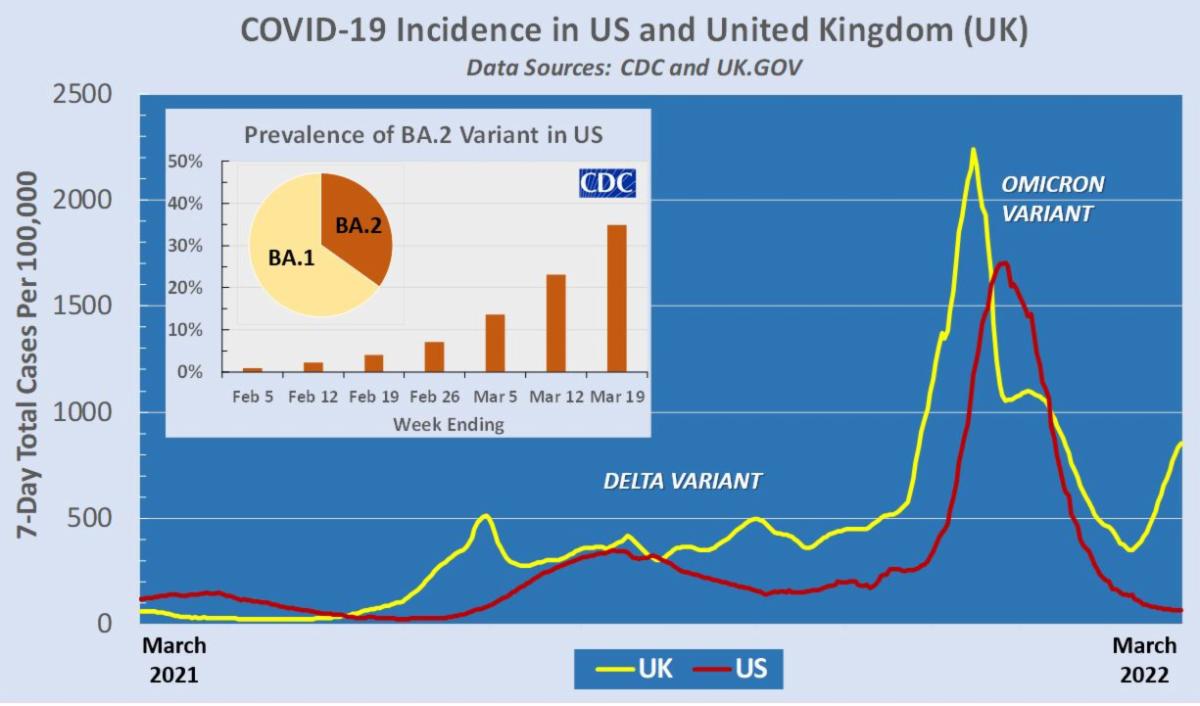
The SARS-CoV-2 Omicron variant has two main genetic subtypes, BA.1 and BA.2, both of which appear to have similar degrees of virulence and immune evasiveness; however, BA.2 is roughly 50% more transmissible. BA.1 first emerged in November 2021, and due to increased transmissibility, quickly replaced the Delta variant and caused a major global surge in Omicron cases. BA.2 subsequently began displacing BA.1 in many areas, either extending or contributing to local and regional surges. BA.2 is now the predominant variant circulating globally, with major surges ongoing in parts of Asia, and increasing case numbers being observed in Western Europe, particularly the United Kingdom (UK), Germany, and France. In the US, BA.2 has been steadily increasing in prevalence over the past two months, and according to the CDC’s genomic surveillance program, accounts for roughly 35% of confirmed US cases as of March 19, 2022 and will likely predominate soon. See the CDC data HERE.
Trends in COVID-19 incidence in the US have generally followed those in the UK by several weeks, raising concern over a possible near-term resurgence in US cases. Health officials in the UK attribute the increasing case incidence to three main factors: the very high transmissibility of BA.2 (highest yet observed); removal of COVID-19 restrictions; and waning population immunity. All three factors exist in the US and health officials are closely monitoring national and state trends for signs of increasing cases.
|
|
Effectiveness of mRNA Vaccines Against Omicron Variant
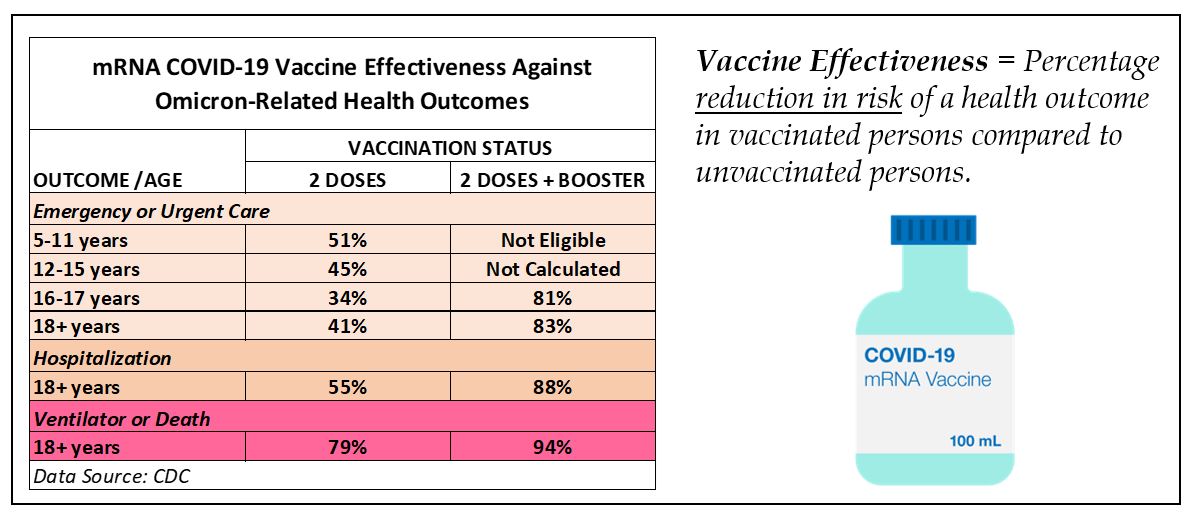
The mRNA vaccines (Pfizer/Moderna) widely used in the US protect against severe illness for all identified COVID-19 virus variants, including Omicron. The CDC defines being fully vaccinated as having received two primary vaccine doses, and up-to-date as having received the two primary doses and a booster shot. Vaccine effectiveness is monitored by CDC using different population-based studies conducted in real-world settings. Study data collected during the recent Omicron surge shows that up-to-date vaccination provides the maximal level of protection against medically-significant disease. In boosted adults, the risk of mechanical ventilation or death is reduced by 94%, while risk of hospitalization is reduced by 84%, and risk of emergency or urgent care reduced by 83%. Data are more limited in children, but vaccine effectiveness towards emergency and urgent care use is similar to that seen in adults. CDC data showing reduced hospitalization rates for fully vaccinated 5-17 year olds can be accessed HERE.
CDC recommends that all persons eligible for vaccination, including those with a prior infection, get vaccinated and stay up to date with COVID-19 vaccination. Specific vaccination guidelines can be found HERE.
|
|
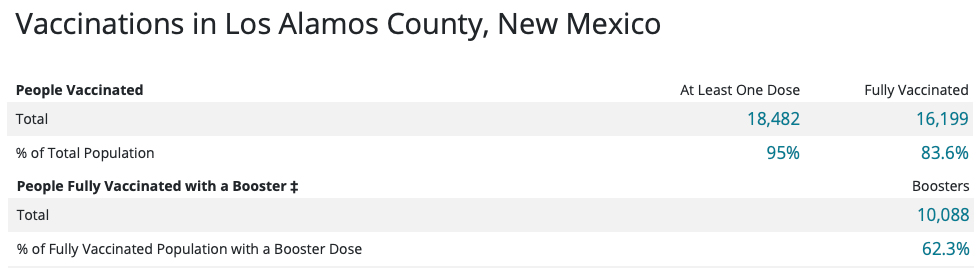
Los Alamos Vaccine & Booster Information |
|
Los Alamos County Vaccine/Booster Resources
Visit the County COVID Page for information regarding vaccinations/boosters, click below:
|
|
Moderna wants FDA to authorize its COVID-19 vaccine for kids under 6
Moderna is hoping to get the green light to administer a pediatric, low-dose COVID-19 vaccine for children ages 6 months to under 6 years of age, it said in a statement. The pharmaceutical company will submit a request to the Food and Drug Administration "in the coming weeks" for authorization for a two-dose, 25 microgram-each shot. That's 25% of the first two doses adults received, the company said.
"Given the need for a vaccine against COVID-19 in infants and young children, we are working with the U.S. FDA and regulators globally to submit these data as soon as possible," Moderna CEO Stéphane Bancel said in the statement.
In tests, the doses were given 28 days apart to 2,500 children ages 6 months to under 2 and to 4,200 children ages 2 to under 6. The pediatric doses "showed a robust neutralizing antibody response" similar to adults' doses, with "a favorable safety profile," the company said.
Though, the efficacy was 43.7% in children 6 months to 2 years old, and 37.5% in children from 2 to under 6. No severe cases of COVID-19 were reported. Dr. Jesse Goodman, a professor of medicine and infectious diseases at Georgetown University, said the study, while promising, leaves many questions unanswered, such as how long the children were observed after being vaccinated and whether efficacy rates could decline over time.
"No severe disease was seen in the study," he said, "so it is unclear whether protection against severe disease, which is most important, may be greater than the protection against milder infections, as has been generally seen in adults."
Moderna said, "The majority of adverse events were mild or moderate and were more frequently reported after dose two." 17% of children from 6 months to under 2 years old had fevers of 100.4 degrees, while 14.6% of children from 2 to under 6 had the same side effect. These results are "consistent with other commonly used and recommended pediatric vaccines," the release said.
Dr. Saad Omer, the director of the Yale Institute for Global Health, said, "Given the evidence from the other age groups, the protection against severe disease and hospitalization should be higher," while advising a booster shot be considered.
Moderna said it is planning to submit its vaccine for children ages 6 to 11 for emergency authorization use, while also currently testing a booster dose for children from 6 months to 11 years of age.
NPR's Rob Stein said the FDA usually convenes outside advisers to review data and make a recommendation about whether to authorize a vaccine, but it's not an ironclad requirement. Then the CDC would weigh in, which can happen very quickly.
|
|
Another Way to Fight Disease: Media Training
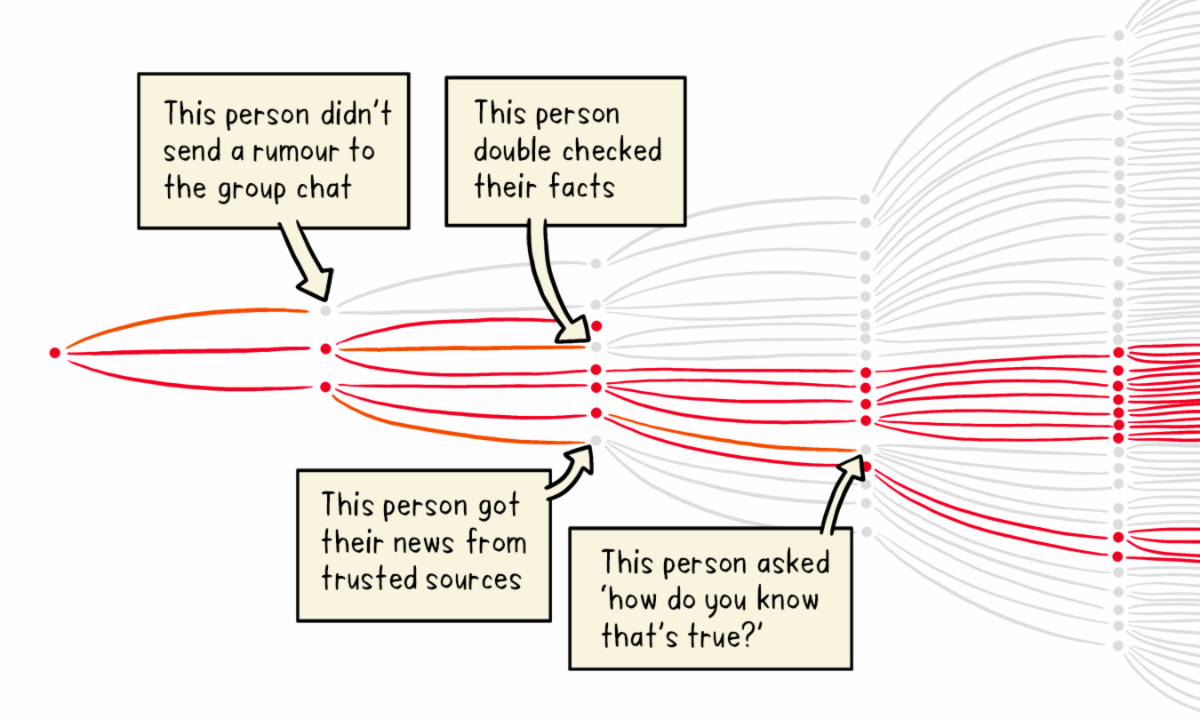
Over the years, we’ve seen the same lethal pattern repeat itself. Global health issues are largely ignored by Western media until they’ve reached full-on crisis proportions, at which point they enter the relentless 24/7 cable news and social media cycle. Then, too often, commentators with little or no scientific training sensationalize the story and provide misleading or false information. The resulting infodemic then exacerbates the medical epidemic.
And with the COVID-19 pandemic, millions of people have opted not to be vaccinated, swayed by anti-vaccine misinformation and falsehoods. Many of them lost their lives as a result: The Kaiser Family Foundation estimated that 163,000 U.S. deaths from COVID-19 between June and November 2021 could have been prevented with vaccines.
The antidote to such misinformation contagions? Accurate, transparent scientific information delivered by a trusted source. We need to fill the information void, inoculating the public with solid scientific information before crises develop. And when crises happen, we need experts who can share timely, trustworthy information.
|
|
Doctors, as some of the most trusted professionals in the US, are uniquely positioned to be such messengers. However, few leave medical school knowing how to shed the technical jargon of their training and communicate effectively with the public. [Stanford Global Health's] Academic Medicine article reviews the Stanford Global Health Media Fellowship as a model for training physician-communicators and encourages medical schools worldwide to develop similar programs.
The Stanford Center for Innovation in Global Health launched this first-of-its-kind fellowship in 2011 in collaboration with NBC News chief medical correspondent. Its goal: Train physicians to proactively share global health stories with the public and provide trustworthy, factual information in times of medical crisis.
The fellowship enables a medical school student each year to master the principles of storytelling and multimedia and medical journalism through journalism school training and an intensive internship with Sanjay Gupta at CNN, as well as a capstone global health project. To date, the program has produced 10 skilled global health communicators with medical training. These alumni, most of them doctors, now convey medical insights and expertise through compelling television interviews, engaging blogs, and powerful op-eds.
A former fellow, Michael Nedelman, now works at CNN Health as a producer and described the value of the fellowship this way: “In medical school, you develop some habits that are great for doctors, but bad for journalism.” For example, doctors are trained to deliberate in delivering a diagnosis, first presenting the facts, and eventually getting to assessment, diagnosis, and treatment. While this works for medicine, it is often inappropriate for journalism, where it’s critical to lead with the most important parts to draw the reader in.
The fellowship has enabled alumni like Nedelman and others to effectively share their medical know-how for the benefit of a public audience. For instance, Edith Bracho-Sanchez launched “Las Doctoras Recomiendan,” a podcast distributed by Univision intended to provide Latino families advice on topics including pediatrics, COVID-19, nutrition, and sleep. She uses this podcast and accompanying Q&A platform on social media to inform a demographic that the American health care system has often neglected.
Experience as a researcher for medical news stories could provide medical students valuable lessons on the inner workings of newsrooms. Doctors build trust when they break down the silos of their academic research or medical practice to speak directly with the public. And trust saves lives, as evidenced by a recent Lancet study, which found high levels of trust in government were associated with lower COVID-19 infection rates.
To read the full article, click HERE.
|
|
|
How much do you trust the media as a resource during the pandemic?
|
|
I trust main stream media to provide good information.
|
|
|
|
|
I trust information from both main stream media and government sources.
|
|
|
|
|
I don't trust information from main stream media.
|
|
|
|
|
I trust information on Social Media more than main stream media or government.
|
|
|
|
|
It's hard to trust any information.
|
|
|
|
|
|
|
State Reporting Frequency
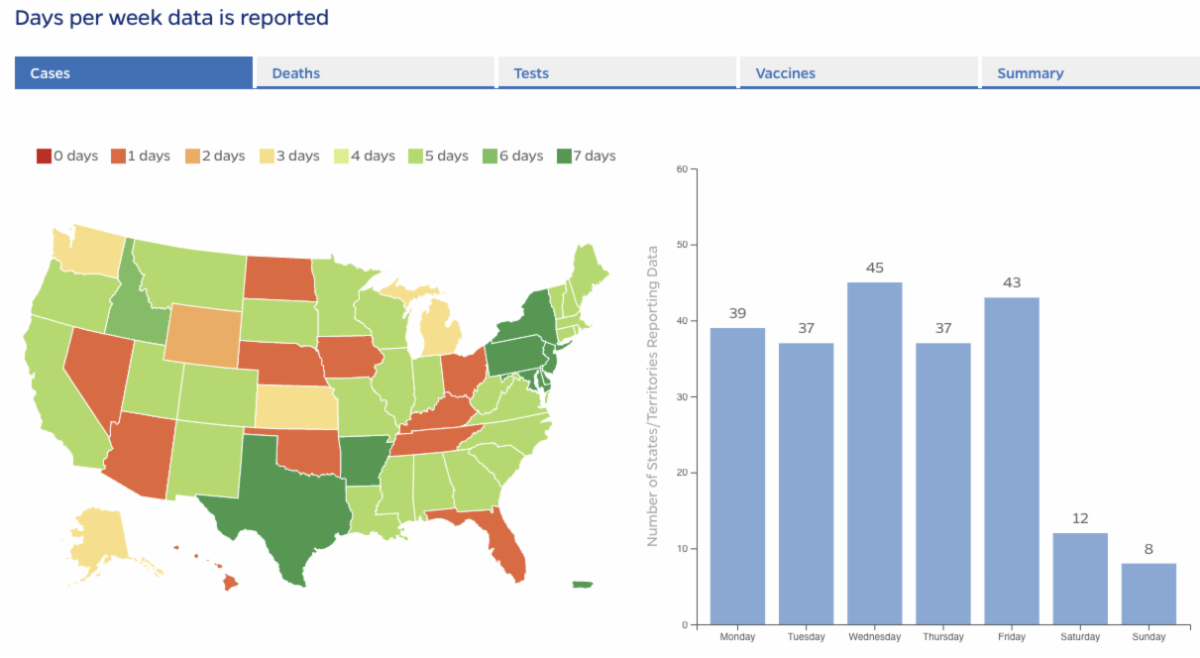
Since the start of the pandemic, U.S. states and territories have used different approaches to reporting data about COVID-19 cases, deaths, tests, and vaccines. The lack of uniformity has complicated efforts to track SARS-CoV-2 in near real time as it has spread across the United States. That tracking has been aggravated further as states have been reducing the frequency of reporting. The graphics above detail how many states report data on which days across each of those four critical categories. To view an interactive chart with expanded data, click HERE.
|
|
We are listening to you!
Your feedback is helping to shape future newsletters, inform decisions regarding services, and make Los Alamos County healthier and safer. Make sure to participate each week to be heard!
Remember, we appreciate your questions too. We always try to respond in a timely manner, and include those Q&As in future newsletters.
Take a look at these results from previous surveys.
|
|
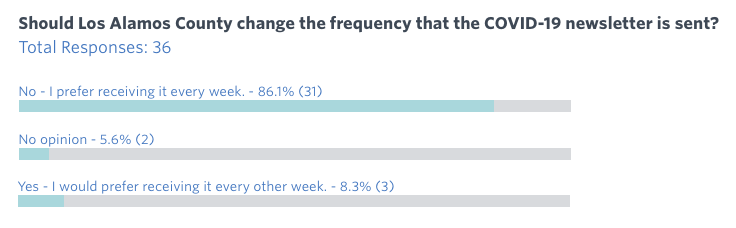
Last week we asked about the frequency of the Newsletter and learned your preference is to continue receiving it weekly. As a result, we are working on gathering more articles to continue it weekly for a while longer. |
|
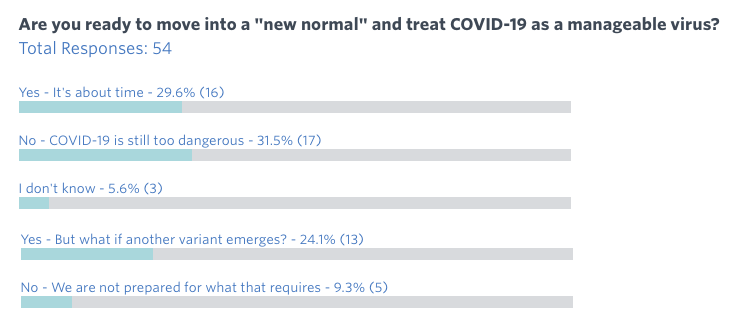
When we asked you about how ready you are to move to a "new normal" we received a wide mix of answers. This helps us understand the importance of providing information and services addressing all comfort levels. |
|
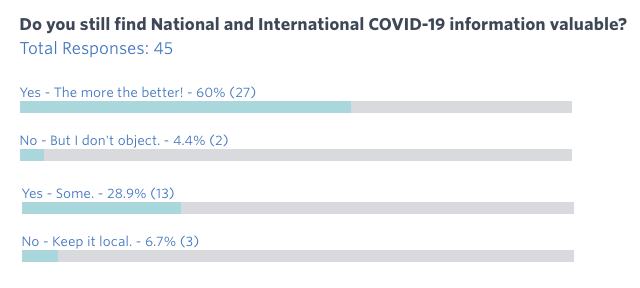
After including several national and international articles, we asked if you wanted us to continue that or focus more on local subjects only. Your answers were clear, and have helped direct the information we continue to include! |
|
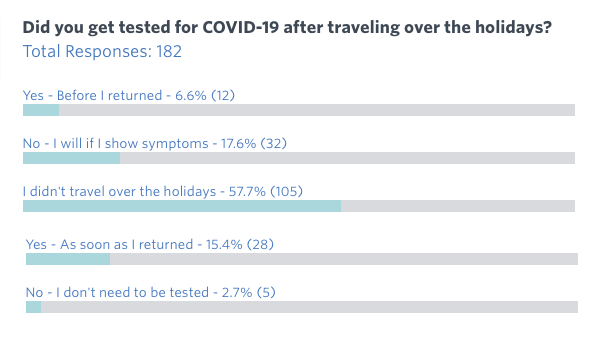
Understanding how the community responds to travel opportunities, holiday breaks, and testing needs provides us guidance for what resources we need to provide the public, what risks the community is facing, and how the community is managing the pandemic.
Overall, your feedback is valuable to inform and guide us about what your needs are as a community. This is not our only resource, but it is an important one, and we are listening. Thank you for your continued participation!
|
|
Have a question? Email us. |
|
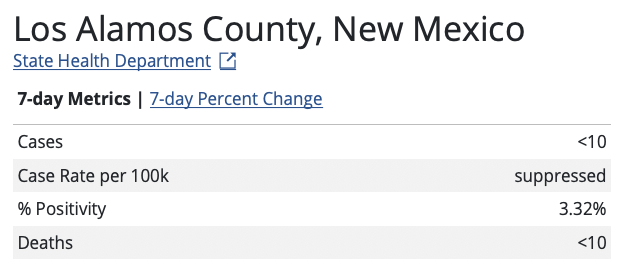
CDC COVID Data Tracker - March 24, 2022
To get today's break down of positive case data, demographics information, vaccine status and more for Los Alamos County or other counties across the United States, click HERE
|
|
LAPS COVID-19 Positive Reported Case Count
Cases Reported between March 19-23 - Total: 2
To learn more about reported cases in the individual LAPS schools, click HERE.
|
|
The charts available with this TOOL layout the key metrics for understanding the reach and severity of COVID-19 in a given area.
|
|
Johns Hopkins
COVID-19 Status Report Dashboard for
|
|
Mayo Clinic Vaccine Tracker
To see how many people are vaccinated and compare progress across states, click HERE
|
|
NMDOH Epidemiology Reports Updated Weekly
As part of the COVID-19 pandemic response, NMDOH collects and analyzes statewide data for COVID-19 positive cases, hospitalizations, and deaths. The reports reflect these critical data and are updated weekly - click HERE
|
|
Testing Resources for Los Alamos County |
|
Additional Los Alamos County Testing Resources
Visit the County COVID Page for information regarding testing, click below:
|
|
What else would you like to see in this newsletter?
Click below to email us your feedback and questions!
|
|
|
|
|
|
|