| | |
POLICY & ADVOCACY UPDATE
Issue #54, 11 September 2025
| | | |
- Consultation on Chef Shortages - we need your input
- AA back in Canberra
- Hospitality industry use of skilled migrants increases
- Government call for input on aviation consumer protections
- Capital city performance in August
- Overseas arrivals for July- signs of stronger growth
- Business turnover rises in July
| | | |
Consultation on Chef Shortages - we need your input
AA has scheduled two on-line sessions to discuss the shortage of cooks and chefs. To inform the discussions we have put together a paper which you can see here on addressing the chef shortage and have proposed a number of potential solutions.
The Zoom sessions are scheduled for:
- Tuesday 23 September at 10.30 am
- Tuesday 30 September at 2.30 pm
To participate in the discussions, send an email to policy@accommodationaustralia.org to receive the zoom link for the session that best suits your availability. We also welcome comments via email on the solutions identified. Please read the document and pass it on to those that are responsible for the recruitment and management of chefs.
| | |
| | |
3 things for you to do today to support the industry's jobs and careers platform eeger.com.au:
- Register on eeger to build your employer profile
-
Follow eeger on LinkedIn to stay in touch
- List your job vacancies on the site that has been developed for industry by industry
| | | |
AA back in Canberra
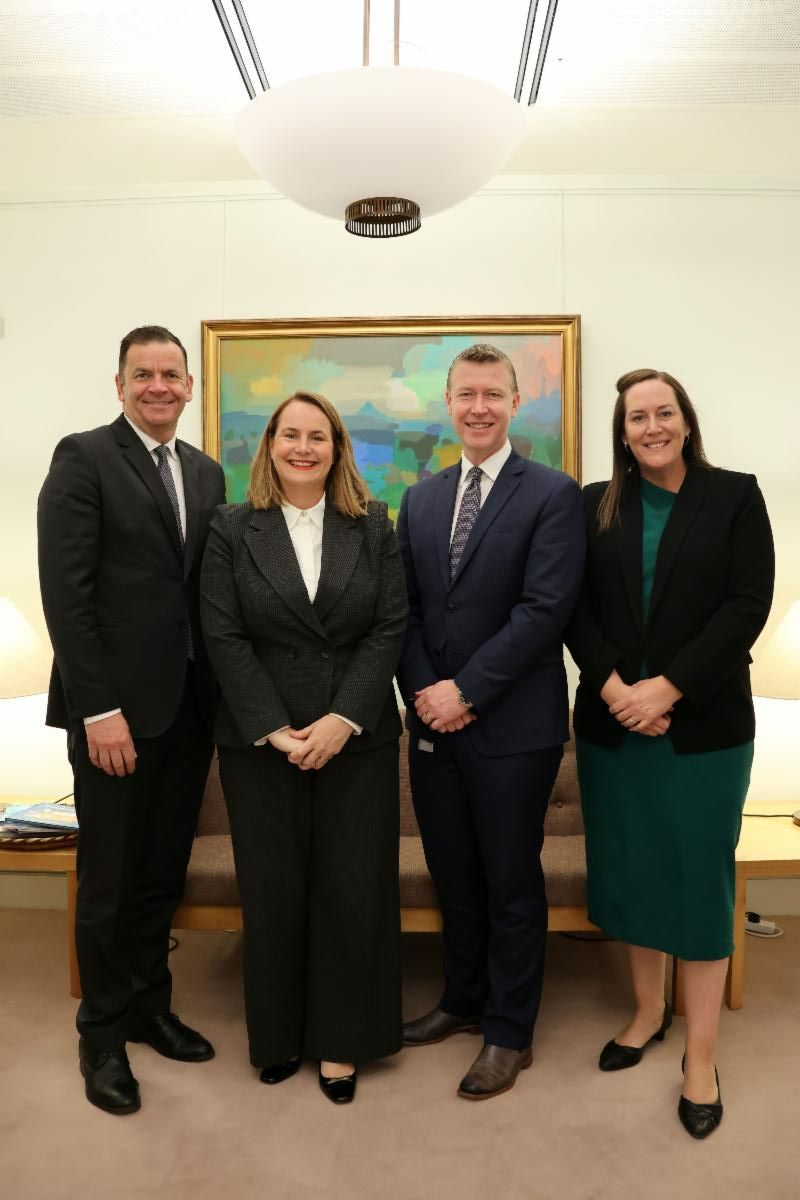
With the federal parliament back in session in the last couple of weeks, AA pressed member priorities through active engagement with the Minister for Employment and Workplace Relations, Amanda Rishworth, the office of the Minister for Trade and Tourism, and the new Assistant Minister for Tourism, Senator Nita Green. Pictured right with AA Chair David Mansfield, AA CEO James Goodwin and AA Deputy Chair Emma Hynes, Senator Green expressed keen interest in our update on the current trading conditions in the hotel sector, and also in its workforce issues. Being based in Cairns, Senator Green has a good understanding of the value of tourism. She was very keen to reinforce the need to highlight the strong career opportunities in tourism and hospitality and the importance of strongly promoting the new tourism careers and jobs platform, eeger.
Minister Rishworth also engaged on employment issues in the hotel industry, including the need for the government funded employment services to better service the industry to help address staff shortages.
| | | |
Hospitality industry use of skilled migrants increases
According to the latest data issued by the Department of Home Affairs, the number of temporary skilled visa applications lodged by the accommodation and food service (AFS) industry more than doubled in 2024-25 compared to the previous year. AFS applications totalled 16,910, up 111.5% and accounted for almost one fifth of applications lodged across all industries. During 2024-25 the AFS industry had 10,770 applications granted (up 125.2% on 2023-24), with many of those processed under the previous Temporary Skilled Shortage visa. The 6,000 difference between applications and grants is largely due to delays in processing - now around 3-4 months wait. Of the AFS granted visas, 3,820 were in NSW, 2,030 in Queensland, 2,790 in Victoria, 1,380 for WA, 350 for SA, 240 for ACT, 110 for NT and 40 for Tasmania. The occupation of chef remains the most granted temporary skilled visa, with 6,380 granted in 2024-25, up 179.2% on the previous year, and accounting for 9.3% of all occupations where visas were granted. Restaurant managers were the sixth highest with 1,680 granted, up 79.4%, all of which would have been applied for under the old TSS visa as they are not currently eligible for the Skills in Demand visa. Cooks were the 7th highest, with 1,560 visas granted, up 132.1%. NSW and Victoria both were granted close to 2,000 chef visa applications, with Queensland chef visa grants at 1,260.
| |
Government call for input on aviation consumer protections
Recent engagement with AA members in the ACT and Northern Territory has reinforcement the high priority of improving both capacity and affordability of domestic aviation as well as the need for greater flying customer confidence. Our meetings last month with the interim aviation ombuds was aimed at addressing this last issue. The Minister for Infrastructure and Transport this week also sought to address it by asking passengers to have their say in the design of the new aviation consumer protections. The aim is to inform the establishment of a new consumer protection scheme and introduce national standards that determine remedies for passengers who experience impactful cancellations or delays. The proposed Consumer Protections will be paired with an ombudsman scheme and a new regulator to ensure airlines and airports abide by the new minimum standards. Submissions will close of 5 October. More information can be found here.
| | |
Capital city preliminary data 8 months to August
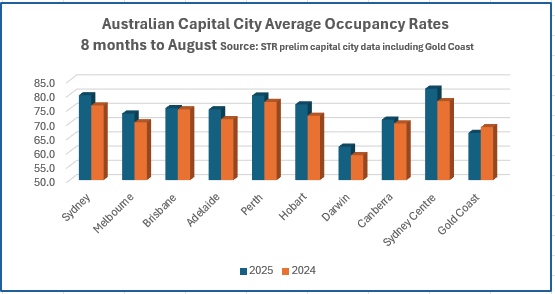
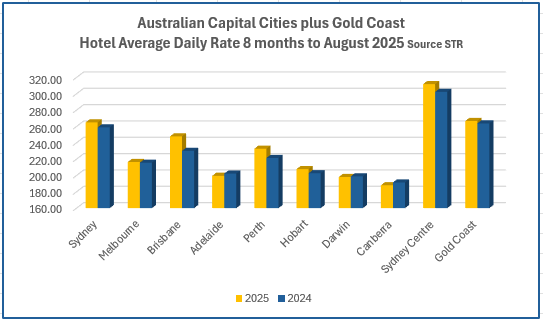
Preliminary capital city STR data for the eight months to August 2025 show that average occupancies were higher in all cities over the period compared to last year, although Gold Coast is still lagging due largely to the cyclone effect in March. The average daily rate picture has further improved due to a strong July and August and was on average down only in Adelaide, Darwin and Canberra compared to the first eight months in 2024. Brisbane remained the best performer for ADR, up 7.7%, with Perth up 5.1% and Hobart 2.5% for the eight months to August compared to 2024.
For August alone, occupancy was up in all cities compared to August 2024 except Brisbane (fell from 81.7% to 78.4%), Gold Coast (from 74.1% to 70.6%) and Perth (dropped marginally from 79.6% to 79.5%). Sydney did particularly well, up from 77.6% in August 2024 to 84.4%. Even though Brisbane saw a fall in occupancy, the city seems to be now at a new level of ADR, with another big improvement from $237.84 in August 2024 to $253.82 this August. Sydney also saw a major gain, from $249.16 to $285.67, across the whole metro area, and an even stronger lift in Sydney centre from $289.50 to $339.32. ADR changes in August 2025 compared to 2024 were not significant in other cities.
Preliminary data for the first week in September indicates a continuation of the positive performance with all capital cities except Brisbane and the Gold Coast experiencing an increase in occupancy compared to the same time last year. Sydney maintained its strong improvement, up 8.7%% on occupancy to 84.4% and 14.9% on ADR to $285.57. Occupancy was also strongly up in Melbourne (+8.6%) although the ADR rise was a more modest 1.6%. Brisbane's occupancy was 3.2% down to 78.4%, but ADR improvement was solid at 6.9% increase to $253.80. Occupancy improvements in Adelaide (up 5.9% and Hobart (up 6.2%) were both reasonable, but gains in the remaining cities were more modest.
The graphs below derived from the STR preliminary capital city data show the average performance of occupancy and ADR in the eight months to August 2025 compared to the previous year.
| | |
Overseas arrivals for July 2025 - signs of stronger growth
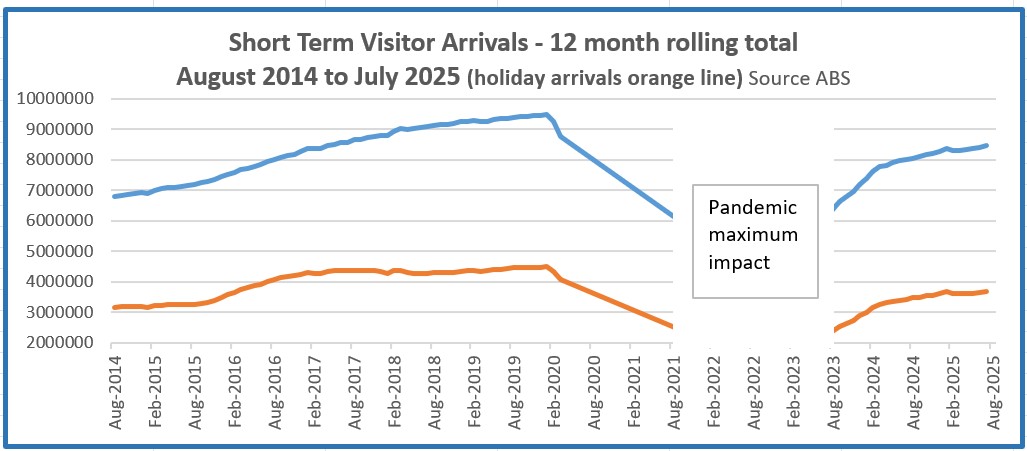
According to the ABS data released today, there was a solid increase of 12.8% in short-term visitor arrivals in July 2025 to 743,210 compared to the same month last year. Although this is an encouraging improvement, the arrival number is still 6% below pre-COVID, when 790,380 short term visitors arrived in Australia in July 2019. The stronger improvement was affirmed by comments from the Department of Home Affairs at a visitor economy meeting yesterday that tourist visa numbers were stronger this July and August compared to last year. New Zealand was the largest source country in July 2025, accounting for 19.0% of all short-term visitor arrivals. NZ was followed by China and the UK. Of the top ten origin countries, New Zealand, Singapore and Japan had more arrivals than June 2024. In June 2025 there were 46,560 international student arrivals to Australia, an increase of 7,330 students (the Lions tour would be major contributor to the UK numbers) compared with the corresponding month of the previous year.
The 12-month rolling total arrivals tell a more useful story, illustrating how far we still need to go to return to pre-COVID visitors, particularly for holidaymakers, although the July increase in holiday visitors is more encouraging. In the 12 months to July 2025, there were 8,486,650 arrivals up by 6.1% on the year to July 2024. As the graph below shows, you need to go back to 2017 to see a similar yearly total (excluding all of the COVID-impacted years). The graph below shows rolling 12-month totals for total short-term arrivals and holiday arrivals.
| | |
Business turnover rises in July
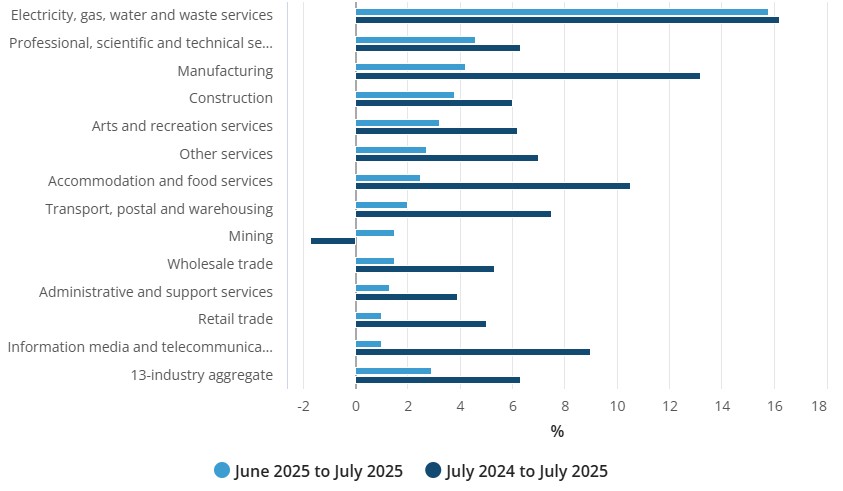
According to figures released this week by the ABS, Accommodation and Food Service industry (AFS), business turnover in July was higher than the previous month, rising by 2.5% compared with June. Compared with July 2024, the increase was a significant rise of 10.5%. As the graph below shows, industries that performed comparatively strongly when comparing July 2025 with 2024 were energy and waste services, manufacturing followed by our own industry. Industries that experienced stunted or declining turnover growth include mining, admin services and interestingly given the national focus on housing, construction.
| | |
Drop me an email at policy@accommodationaustralia.org or give me a call on 0418 277 919 if you have any national policy issue that you think AA should be following up. If you know an AA member who is not receiving this advocacy report but wants to, then encourage them to email me and we can add them to the distribution list. Back issues of the fortnightly advocacy updates can be found here.
Kind Regards
Jenny Lambert OAM
National Policy Director
Accommodation Australia
| | | | |