Quick, Timely Reads
On the Waterfront
|
|
The Orphanage: A Neighborhood Enigma |
|
Dr. David Frew, a prolific writer, author, and speaker grew up on Erie's lower west side as a proud "Bay Rat," joining neighborhood kids playing and marauding along the west bayfront. He has written for years about his beloved Presque Isle and his adventures on the Great Lakes. In this series, the JES Scholar-in-Residence takes note of life in and around the water.
|
|
‘Do that again and you will be sent to the orphanage.’
– Common 1950s parent threat
|
|
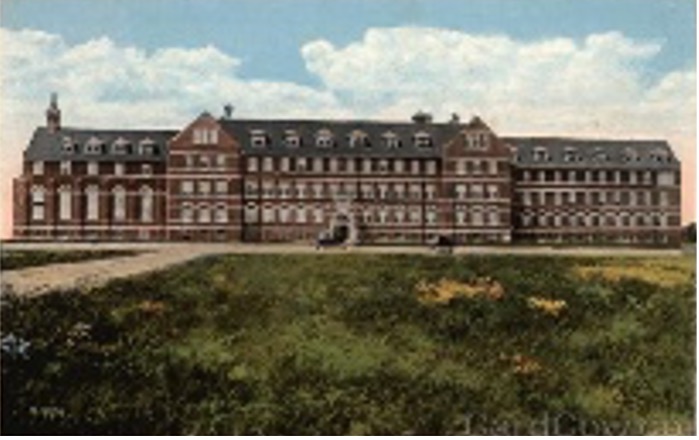
Astonishing as it now seems, many of our parents used the “classic orphanage threat” as an ultimate tool for discipline. The power of the warning stemmed from the reality that they often knew someone, personally, who had sent one or more of their children to the dreaded orphanage. To reinforce this reality there was an actual neighborhood orphanage. It was an ominous looking place that many of us passed on a regular basis. St. Joseph’s Home for Children stood on the north side of West Sixth Street, just a few blocks from the neighborhood. It was on the way to Presque Isle State Park, the popular summer destination.
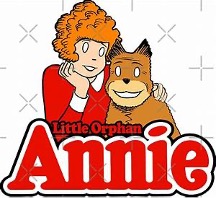
Part of the mystery of the place was that it was so incredibly self-contained. St. Joseph’s provided schooling, religion, meals, rooms, and socialization so, as a result, few of us had ever met or known an actual orphan. On a more positive note, we had been instructed in the “actual” life of orphans by reading “Little Orphan Annie” comics. And it didn’t seem all that bad.
|
|
Little Orphan Annie and her dog Sandy seemed to have quite a nice life, according to the comics. |
|
“Little Orphan Annie” was one of the most popular newspaper comic strips during the 1950s. Reading her stylized adventures probably shaped our “perceived” understanding of orphans. But possibly not in a realistic way. The comic strip ran for an astonishing 86 years, from its debut in 1924 until its cancellation in 2010. But the comic strip did not really end then. Dick Tracy rescued America’s favorite orphan a few years later, converting her into an episodic character who continues to make appearances.
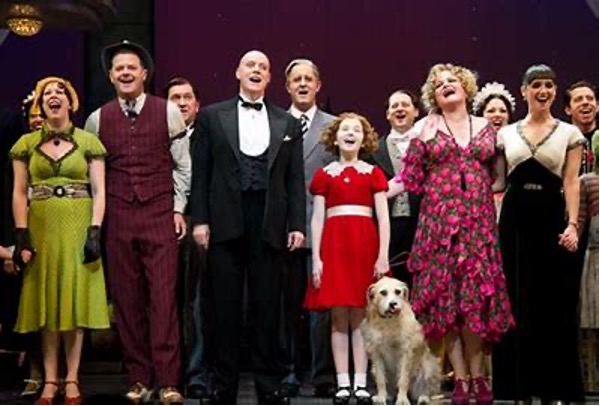
But “Little Orphan Annie” was much more than a two-dimensional comic strip. She ultimately became a franchise. To add to her legend there were movies, television programs, and a hit Broadway play, featuring Annie, her dog Sandy, a large supporting cast, dancing, memorable music, and more. Annie and her adventures became a part of Americana, convincing us that the orphan life might not be all that bad.
|
|
The cast of a stage production with Annie, Sandy, and Daddy Warbucks |
|
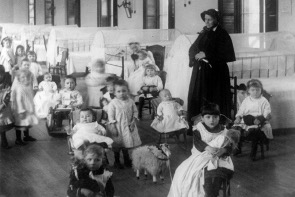
The reality of orphans and orphanages was well beyond our Bay Rat understanding. Little did we know that orphanage residents were rarely orphans, in the sense that they were without parents. In an extensive 1960s study it was estimated that fewer than 20 percent of resident children were actually parentless. The actual socioeconomic driver that produced orphans was poverty. They were from parents who were unable to provide for their children and simply gave them up. |
|
Is this what life was like in an orphanage? Happy little kids in teeny chairs with a kindly nun
looking over them?
|
|
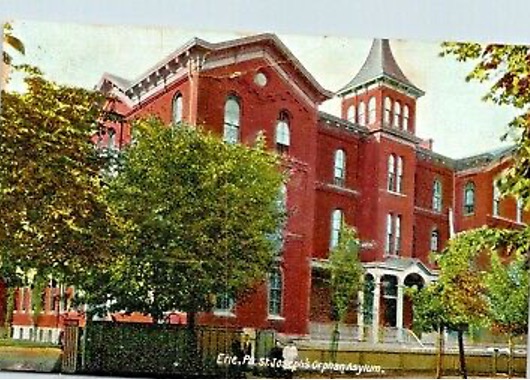
Erie’s first introduction to orphans and orphanages was a red brick building on East Third Street, in the center of the St. Patrick Irish community. Irish people and extra children, hmm? St. Joseph’s Orphan Asylum (note the grim name) opened in the 1860s and operated from the same building unit until 1924. The Orphan Asylum was a joint venture between the Sisters of St. Joseph of Norwest Pennsylvania and the Erie Catholic Diocese. Under pressure to open a local seminary to train new priests and out of space for orphans, the diocese built a new, expanded, and comprehensive facility re-branded as “a home for children.” Construction began in 1922 and the facility opened two years later on West Sixth Street. |
|
The St. Joseph’s Orphan Asylum building transitioned to St. Mark’s Seminary in the 1920s. |
|
If there was a single word that best described the “Orphanage” on West Sixth Street it was “ominous.” The combination of building size, architecture, and reputation, combined with ongoing parental threats, encouraged us to think of the place in a negative way. A search of similar orphanage buildings in other cities, reveals incredible architectural similarities, which suggests that the Erie Catholic Diocese borrowed from contemporary “best practices” in designing its new building in 1920. While local architects were hired to do the specific building design, Erie’s orphanage was remarkably similar to orphanages in several other Catholic dioceses.
The size and design of the building allowed St. Joseph’s to be a fully integrated facility. The building and grounds contained separate dorm and bathroom faculties for boys and girls as well as apartments for the staff. The building contained a full-sized gymnasium, cafeteria, kitchen, church, and classrooms for classes as well as ongoing religious instruction. The grounds included a football field, quarter-mile track, playgrounds for children, and peripheral space for gardens. As a result, residents of St. Joseph’s were almost entirely self-contained and none of us actually knew an orphan. The orphans did not attend our church or school and since much of the work at the orphanage was carried out by the residents, including kitchen, laundry, and other duties, we did not encounter orphans at our part-time jobs.
A few friends knew of distant relatives or family acquaintances whose children had been sent to St. Joseph’s but once they had moved in, they were rarely, if ever, seen again. This added to the mystery. We had all heard frightening rumors of the strict discipline that characterized orphanages. Little Orphan Annie’s back story, for example, included such terrible cruelty and nasty institutionalization that she had escaped and chosen to live on the streets. None of us had heard stories of such cruelty or abuse at St. Joseph’s but we did not want to tempt fate by being sent there.
When I played Little League Baseball, one of my teammates was an orphan. A white station wagon, bearing the name “St. Joseph’s Home,” dropped him off for games and practices. He was a nice kid and talented but, sadly, he was not treated well on the team because he did not have a parent who came to perform the “required” auxiliary work before and during games. Lining the field, manning the snack bar, etc. Even though he was as good as any of us, he did not play very often. It was a time preceding the participation rules of Boys Baseball; the minimum innings that each boy had to play. By midseason, he became discouraged and disappeared.
St. Joseph’s fielded its own basketball and football teams during the 1950s. My grade school team visited there and played against them, but the competition was not really fair. Their team was small and lacking in talent. I think that we went there primarily for the easy win. A few years later, I learned that their football team was even less talented. I still find this embarrassing, but as a freshman our Cathedral Prep JV team played St. Joseph’s on their home field behind the orphanage. Coaches had warned us that the game was going to be difficult because they would be using older kids on their team. St. Joseph’s did not have what would have been the equivalent of a high school varsity (11th- and 12th-graders) team. So, they allowed 17- and 18-year-olds to play at the JV level. To be fair, we were doing the same – playing lots of ninth-graders who had been held back. Their team was small, both in stature and number. They had barely enough players to field a team and suited up in gray sweats with old helmets, no numbers, and inferior pads. Prep, on the other hand, arrived by bus with more than 40 kids in brand new equipment. It was a slaughter. We were ahead by 20 or 30 points before the end of the first half. Just before the second half, the St. Joseph’s coach told our coach that he did not have enough players to field a team. We had to loan him a few. That may have been the last year that St. Joseph’s attempted to field a football team.
|
|
St. Joseph’s new “Home for Children” was one of the first buildings west of Lincoln Avenue. |
|
By 1971, there were no more orphans. St. Joseph’s was empty, the building was closed and the thousands of children who had made the ominous red brick building a home had become distant memories. Franklin Delano Roosevelt began the inevitable demise of orphanages with his “New Deal” reform programs of the 1930s, which provided money for parents with large families and other programs of social welfare. Slowly but surely, orphanages like St. Joseph’s began to falter as they lost residents. Eventually new waves of social programs began to support foster care and group homes and, by the mid-1960s, the only orphanages that remained in the United Sates were the enormous and well-known national institutions that had managed to develop independent funding streams. Boy’s Town in Nebraska, the Milton Hershey School in Hershey, Pennsylvania, and Moosheart near Chicago survived but changed their institutional approaches, becoming more residential schools than “asylums.”
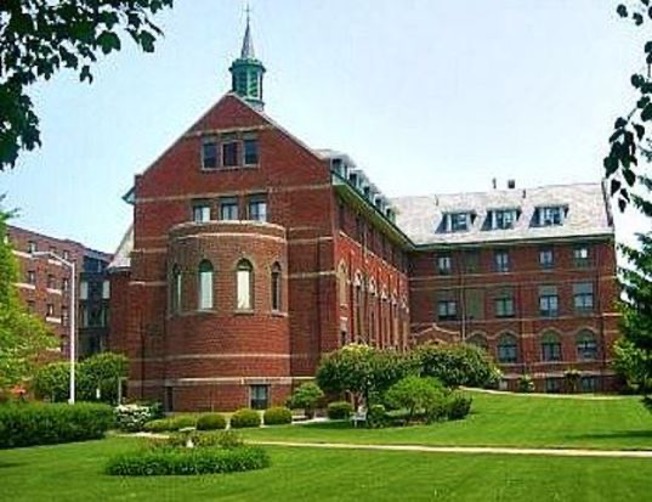
In 1978, after standing vacant for almost eight years, St. Joseph’s was rebuilt and re-opened as a senior apartment center, featuring some rent-controlled housing and a few units with assisted living. The old football field and garden complex became a practice field for Cathedral Prep and the former playground area was made into a resident parking lot. The new apartment welcomed its first residents a few months after Annie, the musical, opened on Broadway.
|
|
These days St. Joseph’s offers 223 senior apartments. |
|
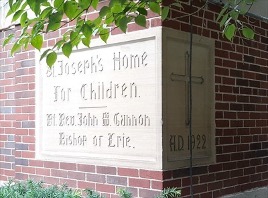
The original 1922 cornerstone reminds residents and neighbors of the original role of the building. |
|
Accidental Paradise Available at TRECF!
Accidental Paradise
by Dr. David Frew and Jerry Skrypzak
|
|
The beautiful book on Presque Isle published by authors David Frew and Jerry Skrypzak – “Accidental Paradise: 13,000-Year History of Presque Isle” – is on sale at the Tom Ridge Environmental Center’s gift shop and through a special website, AccidentalParadise.com.
The book, priced at $35 plus tax and shipping, can be ordered now through the website sponsored by the TREC Foundation, AccidentalParadise.com.
Presque Isle Gallery and Gifts on the main floor of TREC, located at 301 Peninsula Drive, Suite #2, Erie, PA 16505 will also handle sales daily from 10 a.m. to 4 p.m.
For more information, send an email to aperino@TRECF.org.
To watch "Accidental Paradise: Stories Behind The Stories" click here.
|
|
ABOUT THE AUTHOR
Historian and author David Frew, Ph.D., is a Scholar-in-Residence at the JES. An emeritus professor at Gannon University, he held a variety of administrative positions during a 33-year career. He is also emeritus director of the Erie County Historical Society/Hagen History Center and is president of his own management consulting business. Frew has written or co-written 35 books and more than 100 articles, cases, and papers.
|
|
|
|
|
|
|