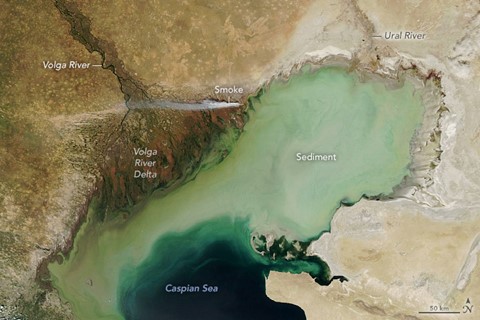
The Caspian Sea is by area the world's largest lake. Visualize its area of 143,244 square miles in comparison to the 192 square miles of Lake Tahoe. It is located within a closed (endorheic) basin between eastern Europe and central Asia and is fed by more than 130 rivers. The Volga River is the largest river and comprises about 80–90% of total river discharge. This MODIS image from NASA’s Aqua satellite captured this natural-color image of the northern Caspian on July 17, 2021. Suspended sediment delivered by the inflowing Volga and Ural rivers discolored the waters in the northern, shallow part of the lake, while winds may have also stirred up sediment.
While climate change is causing the rise of sea level around the world, for lakes the prognosis is different. Lake levels may fall over the coming decades. Radar altimetry data from satellites and compiled by NASA's Global Water Monitor indicate that the Caspian Sea’s water levels have already been dropping since the mid-1990s. Some climate simulationssuggest water levels could drop by 30 to 60 feet by the end of this century. The largest impact would be on the shallow, northern portion of the lake shown in the image, where an area equivalent to one third of Nevada could become dry land.
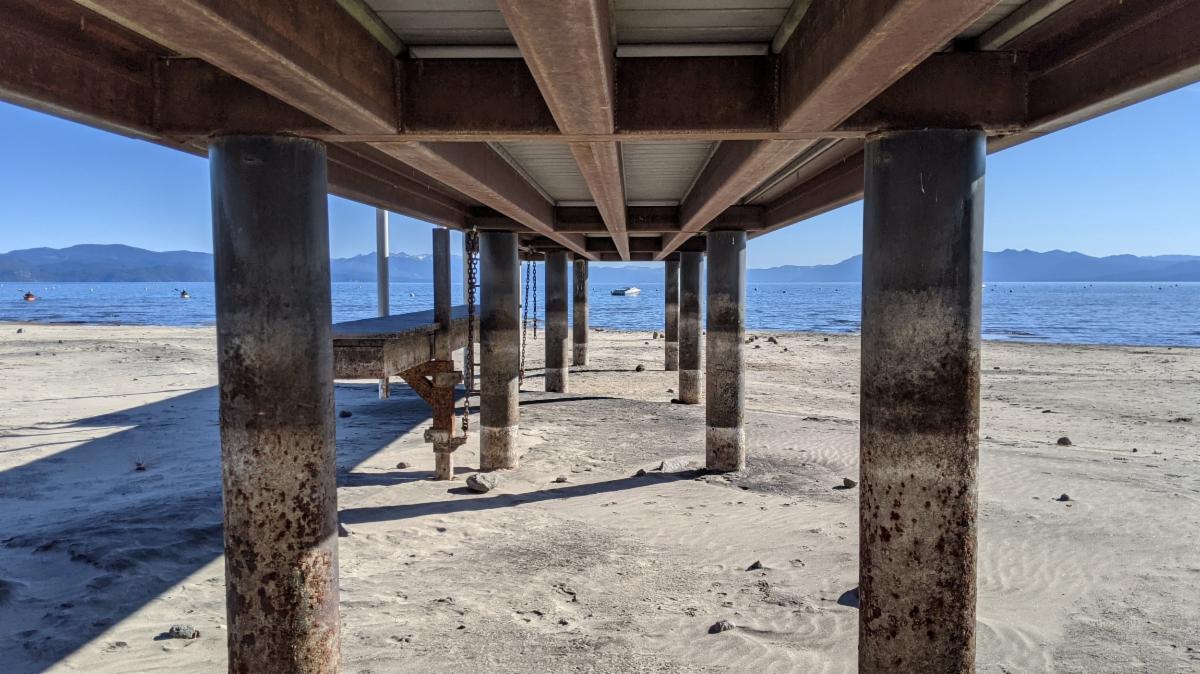
Is a long-term falling water level going to take place at Lake Tahoe too? To date that has not been the case, and the current generation of climate models suggest that precipitation is not declining at Tahoe, although the water storage provided by the snowpack is diminishing. This will likely lead to an increase in magnitude of both high and lower water level events.
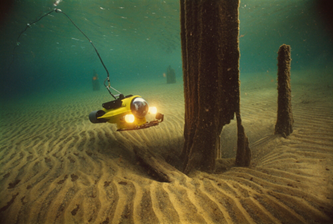
However, if there is a period of extended low lake levels awaiting us in the coming decades, it would not be without precedent. Lake Tahoe and its surrounding smaller lakes have previously experienced extended periods of extremely low water levels. Some of these periods were4000 years ago. But others were only 600-700 years ago and lasted over 200 years. The evidence for these events comes from the submerged relic trees that are still standing below water inFallen Leaf Lake, Lake Tahoe, and Donner Lake. These mega-droughts were not confined to the Tahoe region, but there is evidence of themthroughout western North America and even in Patagonia. Given that 15 of the last 20 years at Lake Tahoe have had below average precipitation, maybe the next mega-drought has already commenced.
A Remotely Operated Vehicle (ROV) exploring the submerged trees at the south end of Lake Tahoe
Photo: National Geographic, Vol. 181, No.3, March 1992