PacIOOS Tools and Services |
|
Nearshore Sensor Deployed in Awak, U, Pohnpei |
|
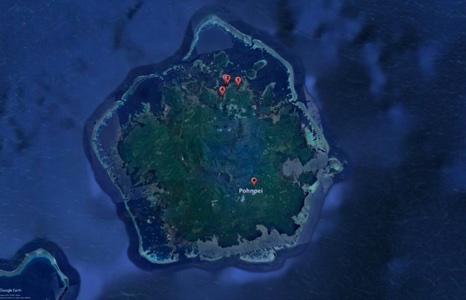
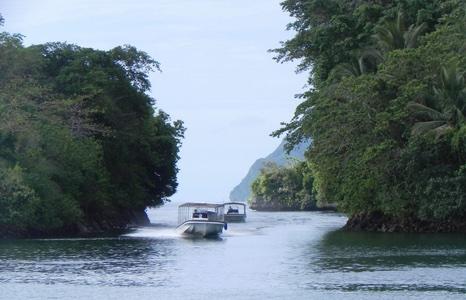
As part of the PacIOOS Water Quality Sensor Partnership Program, the Micronesia Conservation Trust (MCT) deployed a nearshore sensor in the inshore waters of Awak, U, Pohnpei. MCT is interested in developing water quality baseline data by monitoring water quality parameters to inform various plans for the Awak area. Data collected will help determine suitable sites for a proposed aquaculture site, as well as inform an integrated sustainable land use plan and a saltwater intrusion monitoring project. For a duration of 16 months, PacIOOS' nearshore sensor will be rotating to four proposed locations within the Awak area, collecting data on water temperature, salinity, turbidity, chlorophyll-a, and depth in 15-minute intervals. Data will be made available on the PacIOOS website. [Photo: Four proposed nearshore sensor sites in Awak, U, Pohnpei.] |
|
Now Hiring: Web Data/Product Developer |
|
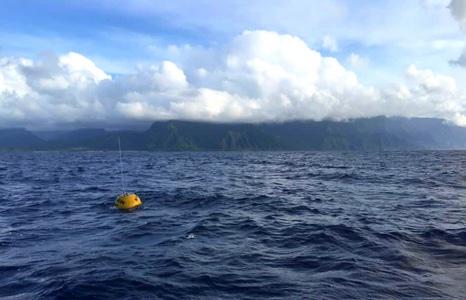
PacIOOS is seeking applications for a full-time Web Data/Product Developer. This is an exciting position that will lead all aspects of development, testing, and deployment of web-based interactive products, including design and coding of User Interface, charts, maps, interactives, and dashboards for ocean, climate, and coastal hazards data. The Web Data/Product Developer will work closely with the PacIOOS data management group to design and develop visualizations and web-based interactive products of weather, ocean, climate, and coastal information to support ocean and coastal decision-making across the Pacific Islands. To view the full job description and apply online, visit the RCUH website, click on “Job Postings” and enter job ID 222727 (closing date November 9, 2022 HST). [Photo: PacIOOS wave buoy off Hanalei, Kauaʻi.] |
|
Enhancing Oceanographic Services for Palau |
|
Under a project administered by the United Nations Environment Programme, with funding from the Green Climate Fund, PacIOOS is partnering with the Palau National Weather Service Office and researchers from the UH Mānoa School of Ocean and Earth Science and Technology to enhance oceanographic services for Palau. The goal of the project is to improve weather and wave forecasts to help ensure that island communities are safe, well-informed, and resilient. This includes developing a high-resolution atmospheric forecast; a high-resolution wave forecast; a high-resolution ocean circulation forecast; and wave run-up forecasts. The newly developed tools and technologies will equip village chiefs, government officials, planners, coastal managers, boat operators, and community members with critical information to enhance decision-making, preparedness, and public safety. [Photo: High-resolution forecasts of ocean currents enhance safe marine operations for Palau residents.] |
|
Ocean Observing Workshop on Saipan |
|
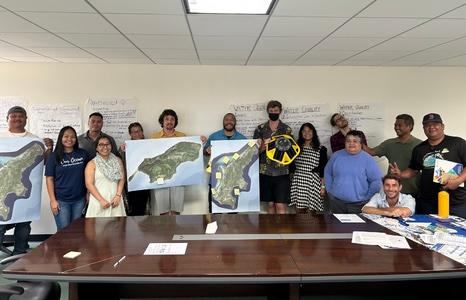
PacIOOS collaborated with nonprofit organization, Pacific Coastal Research and Planning, to host an Ocean Observing Workshop in Saipan, Commonwealth of the Northern Mariana Islands (CNMI). The purpose of the workshop was to raise awareness of the PacIOOS program; share coastal and ocean data services and tools available to the CNMI; and learn more about local agencies and organizations’ ocean data needs. More than 20 participants shared ideas for leveraging PacIOOS capacities and brainstormed ways that their agency and organization can collaborate with PacIOOS on new projects and initiatives. Si Yu’us ma’åse’ to PacIOOS MOA partner, Bureau of Environmental and Coastal Quality, for their continued support and providing the workshop space, and PacIOOS CNMI liaisons, Robbie Greene and Becky Skeele, for their dedication in engaging with stakeholders, organizations, and communities to build ocean observing capacity in the region. [Photo: Workshop participants discussed four main drivers of ocean observing efforts: marine operations, coastal hazards, water quality, and ecosystems and marine life. Credit: PacIOOS] |
|
IVLP In Hawai‘i: Sharing Experiences and Best Practices |
|
PacIOOS was invited to present to the International Visitor Leadership Program (IVLP), the Department of State’s premier professional exchange program. The IVLP brings current and emerging foreign leaders to the U.S. to cultivate relationships with their professional counterparts through facilitated short-term visits. The IVLP cohort of eight represented government officials, policy advisors, and security and defense practitioners from Australia, India, and Japan. The group was tasked with learning about best practices surrounding maritime security in the Indo-Pacific region and enhancing collaboration among member nations. While in Honolulu, they met with PacIOOS to discuss this topic and learn about the work and efforts at PacIOOS and UH Mānoa School of Ocean and Earth Science and Technology. A particularly interesting discussion occurred around emerging ocean observing technologies and the role that they will play in helping us to better understand and respond to a changing climate, as well as to monitor maritime safety and security across the Pacific Islands. |
|
Meet PacIOOS Wave Buoy Specialist |
|
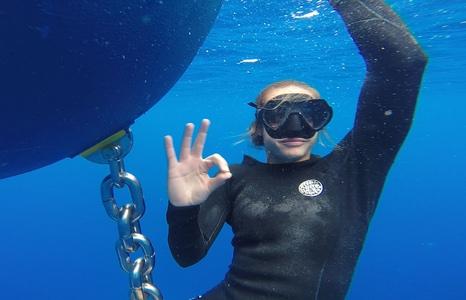
Andreia Monteiro Queima joined PacIOOS in 2019 as an Oceanographic Technician with the PacIOOS Wave Buoy Program. Her primary role is to support wave buoy operations across the Pacific Islands, including device maintenance, mooring design and fabrication, and field operations. More recently, she was selected by the Marine Technology Society to be part of the Emerging Leaders in Marine Technology Program. Designed to support future leaders in marine technology, the program flew Andreia to Virginia to attend the OCEANS Conference to expand her professional knowledge base in the latest innovations in oceanographic, weather, and marine technology services and products. Andreia also had the opportunity of gaining a mentor who guided her experience at the conference based on her professional goals and interests.
Growing up in Rio de Janeiro, Brazil, Andreia developed a passion for the ocean from an early age. Andreia became fascinated with wave buoys, as she was frequently using wave data for both leisure and work. Her keen interest in waves, ocean dynamics, and physical processes led her to pursue a Master’s degree in Ocean Engineering from the University of Hawai‘i at Mānoa. One of her favorite things about working at PacIOOS is spending quality time in the ocean, which oftentimes means boating along the coast to get to the wave buoy deployment site, and seeing the data online after a long day of work. She also enjoys engaging with local partners and communities and sharing how to access and use wave data. [Photo: Andreia checking on a wave buoy after deployment in Palau. Credit: Kimball Millikan, PacIOOS]
|
|
|
|
|
|
|