Rail Workers Weekly News Digest
Number 26 - June 30th, 2020
|
|
Below is a series of articles compiled over the previous week.
They are of interest to railroad workers and activists.
|
|
ARTICLE #1 - LEGISLATIVE NEWS
INVEST in America Act Goes to Full House for Vote This Week!
|
|
Once again, the
INVEST in America Act
is front-and-center in the
RWU Weekly News Summary.
Our apologies for the repetition. But it is not every day that a piece of legislation contains so many positive provisions for railroad workers. RWU has labored for a number of years, and has organized whole campaigns around a number of issues that this bill would fully or partially address, including but not limited to:
-- Minimum crew size
-- Maximum train length
-- LNG by rail safety
-- Adequate and proper Amtrak funding
-- Restructuring Amtrak management/financing
-- Restrictions on Amtrak contracting out jobs
-- Precisions Scheduled Railroading (PSR)
-- Workplace fatigue
-- Safe trans-border operations
Please read the following links, educate yourself about the bill's content, TAKE ACTION TODAY!
|
|
NOTE: ALL rail unions are on board! All railroad workers, family members, friends and neighbors are urged to get behind this effort. See the phone numbers below and call today. Or use the SMART-TD link below to email your Representative. Don't know who that is? The red link below will take you to them!
|
|
CALL CONGRESS TOLL-FREE
877-668-3864 or 877-668-3866
|
|
ARTICLE #2 - RAIL WORKER FATALITY NEWS
The Fatalities at CP and CN Continue to Pile Up
|
|
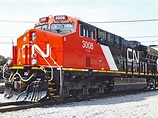
As reported in last week's Summary (#25, June 23rd, 2020), two CN switchmen were killed in two different accidents in two separate yards in British Columbia in June. Investigations into their deaths continues. Meantime, RWU issued ALERTS last week. If you missed them, please see below.
The families of both of these brothers have been set up with
Go Fund Me
Campaigns. Both were fathers and were adored by their friends and co-workers. We urge you to make a donation of support to either or both. See the Campaign links in the Alerts below.
|
|
ARTICLE #3 - ESSENTIAL WORKER NEWS
DART to Award Bonuses to Front-line, Essential Workers
|
|
(Editor's Note: Perhaps some other rail carriers will take a cue from DART and likewise show their essential workers some appreciation and respect for their dedication to the service.)
Dallas Area Rapid Transit
’s (DART) board earlier this week approved $4.3 million to fund salary bonuses for the agency’s front-line and essential employees.
More than 2,900 DART employees are potentially eligible for the bonus pay, including those whose core job functions pose a hazardous threat because of the nature of their work and their direct interaction with the public during the COVID-19 pandemic.
DART will pay eligible employees in one lump sum amount of $150 per week for the period of April 2 to May 31.
During that eight-week period, Texas officials issued stay-at-home orders and reopened businesses at 25 percent capacity, DART officials said in a press release.
DART employees not eligible for the bonus pay are those who worked remotely, did not work directly with riders, or did not work in hazardous conditions.
|
|
ARTICLE #4 - RAIL WHISTLEBLOWER NEWS
Big Award for Wrongfully Fired Amtrak Worker
|
|
A judge recently ordered Amtrak to pay back pay, compensatory damages and punitive damages to an Amtrak train attendant it wrongfully fired. The Judge also ordered the employee to be reinstated with all rights restored and to have her record expunged. The Order was issued pursuant to the FRSA “whistleblower” statute. The worker reported a problem with bedbugs on an Amtrak sleeper car and filed an injury report saying she had been bitten by the bedbugs herself while on the job. The worker’s report was not the first time someone complained about bedbugs on their sleeper cars; several employees and customers had complained about them before the worker did. Amtrak began threatening and harassing her and fired her soon after.
The worker loved her job and customers complimented her on her work and her attitude regularly. She even earned a Customer Service Star Award from Amtrak management just months before she was fired. Reporting the bedbugs was just another example of her commitment to Amtrak and to her customers. The bedbug infestation was serious, and she knew they had to take the car out of service. Amtrak left it in service, though, and the worker got bit on her very next trip. Even after the worker told her supervisor the car had to be taken out of service, Amtrak kept using it. The worker decided the only thing she could do was mark off because she felt unsafe working in the bedbug car, and also said she would take a safety stand-down. She was again bitten by bedbugs, several times, on that trip and again on another trip later. She filed injury reports again. Still, Amtrak threatened to fire her immediately if she did not work in the unsafe car. She worked in unsafe conditions to save her job. Even after she agreed to work, her supervisor made her do unusual work on the run without help.
Several weeks later, an Amtrak customer tweeted about an encounter with the worker. Amtrak used this as a pretext to hold an investigation of the worker. The worker and her union chairman fought the allegations, but Amtrak fired her.
|
|
ARTICLE #5 - FREIGHT TRAFFIC NEWS
Rail Freight Traffic Still Down
|
|
As we’ve seen recently
, total carloads for this week were 201,823 carloads, down 21.8% compared with the same week in 2019, while U.S. weekly intermodal volume was 255,455 containers and trailers, down 4.4% compared to 2019.
None of the 10 carload commodity groups posted an increase compared with the same week in 2019. Commodity groups that posted decreases compared with the same week in 2019 included commodities such as coal, down 26,340 carloads, to 52,392; metallic ores and metals, down 8,176 carloads, to 14,459; and nonmetallic minerals, down 6,839 carloads, to 29,478.
For the first 25 weeks of 2020, U.S. railroads reported cumulative volume of 5,306,511 carloads, down 15.7% from the same point last year; and 5,933,616 intermodal units, down 10.8% from last year. Total combined U.S. traffic for the first 25 weeks of 2020 was 11,240,127 carloads and intermodal units, a decrease of 13.2% compared to last year.
North American rail volume for the week ended June 20, 2020, on 12 reporting U.S., Canadian and Mexican railroads totaled 294,794 carloads, down 19.3% compared with the same week last year, and 334,884 intermodal units, down 6% compared with last year. Total combined weekly rail traffic in North America was 629,678 carloads and intermodal units, down 12.7%. North American rail volume for the first 25 weeks of 2020 was 15,545,401 carloads and intermodal units, down 11.9% compared with 2019.
|
|
ARTICLE #6 - PASSENGER RAIL NEWS
Should The Government Invest in High-Speed Rail to Boost a Post-Pandemic Economic Recovery?
|
|
As we live through the current moment, it is difficult to understate the impact that the Covid-19 pandemic has had on the world. While the current outlook on the progress of the virus in most countries is looking better than it was this time last month, there is still
a long way to go
. Large sections of the American and Canadian economies continue to be shutdown, and the Canada/United States border, the world’s longest non-militarized border, remains closed for at least a few more weeks.
The public health crisis has created another crisis as an offshoot; an economic one. The stock market has dropped, most sports leagues, theaters, bars, and restaurants have closed, and any business that is not deemed “essential” has been temporarily shutdown. Even if a vaccine is developed very quickly, or the social-distancing measures are sufficient to starve the virus of new hosts, the lasting damage to the economy will take
far longer to overcome
.
That being said, we need to begin looking toward and planning for an economic-comeback.
It has been shown historically
that government spending (in the form of a stimulus) to stimulate the economy is a proven way to recover from a slump. The most notable and oft-cited such large-scale investment is Franklin Delano Roosevelts’s New Deal which was used to pull the United States out of the Great Depression of the 1930’s. A large portion of the New Deal was the
Public Works Administration
(PWA), which spent $3.3 billion on building airports, roads, bridges, public schools, among other things. The purpose of the PWA was to address sweeping unemployment by investing in projects to maintain and upgrade existing infrastructure–thus creating good, relatively stable, high-paying jobs.
|
|
ARTICLE #7 - LABOR MOVEMENT NEWS
Postal Day of Action: "We Need the Postal Service!"
|
|
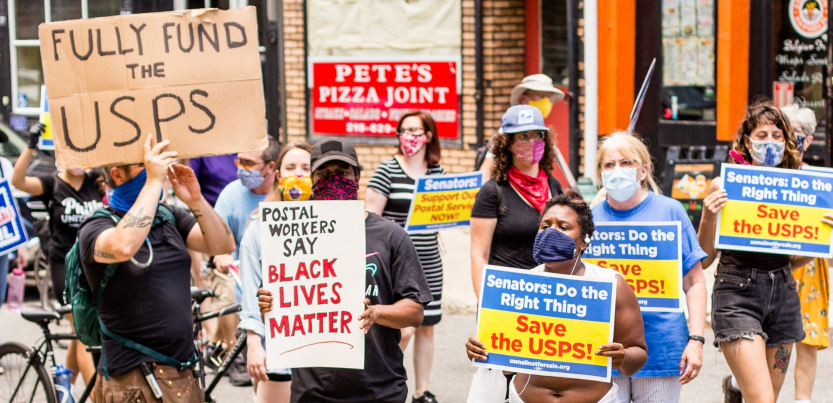
Despite the pandemic, postal workers in at least 18 cities and towns rallied on foot, by car, and even by bicycle June 23 to demand federal funding to save the U.S. Postal Service.
While the House has passed a $25 billion rescue package, the Senate is not expected to take it up until after July 4.
What’s the Problem?
According to the Postal Board of Governors and the recent Postmaster General, it will take at least $25 billion in emergency appropriations to prevent the USPS from running out of money. Trump’s newly appointed Postmaster General is an anti-union, pro-privatization guy from the private logistics sector.
A big drop in letters during the pandemic has intensified the budget crunch, but the underlying problem is a punishing 2006 law requiring USPS to prefund its retiree medical benefits 75 years in advance. This onerous requirement, now a $1 billion per year bite out of USPS funds, makes it look like the postal service is in the red—creating an artificial crisis designed to pave the way for piecemeal privatization.
Ultimately, to get the service back on firm financial footing Congress will need to repeal this law. The unions also argue for strengthening the postal service by expanding into such services as postal banking and vote-by-mail. But in the short term, the most immediate need is an infusion of cash.
|
|
ARTICLE #8 - LABOR & ENVIRONMENT NEWS
|
|
RWU is a proud member organization of the Labor Network for Sustainability. Here is their latest newsletter which includes an array of articles and features about working peoples' struggles to achieve better wages, benefits and working conditions, and a safer, greener environment both on and off the job. This issue includes a short piece about Railroad Workers United, and includes our recently adopted Resolution on Support for Essential Workers.
|
|
|
|
|
|
|