A FREEDOM WORTH FIGHTING FOR
I really need your help.
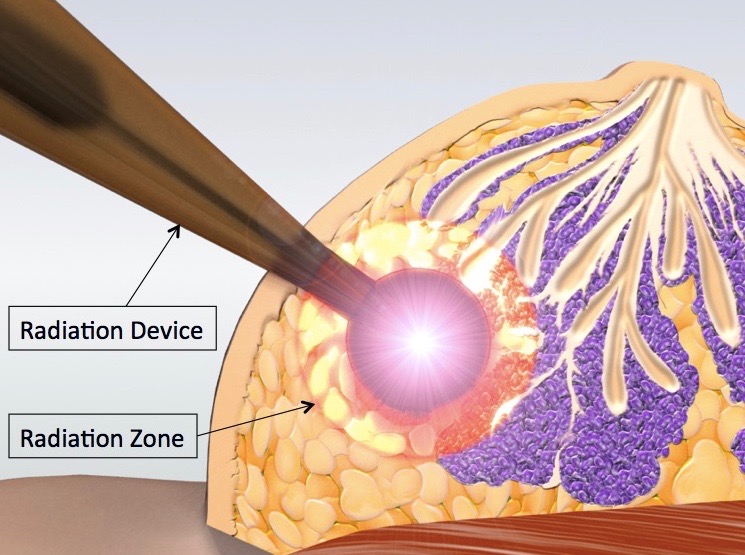
I’m looking for women who have received targeted intraoperative radiotherapy (TARGIT) (see above image) for breast cancer as well as for those who wish to preserve this treatment option for future women with early-stage breast cancer.
Here’s the problem: The American Society of Therapeutic Radiation Oncology (ASTRO) has released to the public a position statement that could lead to the loss of insurance coverage for Targeted Intraoperative Radiotherapy (TARGIT) for early-stage breast cancer. If ASTRO gets its way, insurance companies will find it easier to deny coverage of ALL types of intraoperative radiotherapy in favor of various forms of post-operative breast radiation that, not surprisingly, are more lucrative and convenient for radiation oncology doctors, but more costly and inconvenient for breast cancer patients.
Here's the underlying issue: Intraoperative radiotherapy is a type of partial breast radiation that is given as a single dose in less that 30 minutes at the time of lumpectomy while the patient is asleep in surgery. By focusing the radiation dose to the walls of lumpectomy cavity, IORT reduces radiation exposure and side effects on nearby organs like the heart, lungs, and skin. There are 2 main methods of administering IORT that have been evaluated in randomized controlled clinical trials: the TARGIT trial and the ELIOT trial. In each of the clinical trials, IORT was directly compared to the traditional 4-6 week-long course of daily whole breast radiation given after surgery.
The TARGIT trial was conducted in the U.S. and in over 30 other countries. The ELIOT trial was conducted only in Italy. Although both clinical trials used IORT as means of delivering radiation, there were major technical differences between the TARGIT and ELIOT trials in terms of 1) how the breast tissue was prepared by the surgeon to receive IORT and 2) how the IORT was administered to the breast tissues by the radiation oncologist. Another important difference is that the TARGIT trial permitted higher risk cancers to also receive the traditional 4-6-week course of whole breast radiation after surgery if the final surgical pathology results revealed unexpected findings (e.g., positive lymph nodes or significantly larger tumor size) not suitable to IORT alone. In most instances, the ELIOT trial did not permit additional radiation to be administered for higher risk cancers, which left some ELIOT trial patients at a higher risk of recurrence.
The results of the two trials were also quite different. The TARGIT trial showed EQUAL rates of cancer control within the breast amongst patients treated with either TARGIT or the traditional 4-6-week long whole breast radiation. Furthermore, among women receiving IORT using TARGIT, the clinical trial found FEWER deaths from heart attacks and lung cancers and better quality of life, which means that TARGIT IORT was at least as good if not better than traditional whole breast radiation in terms of cancer control, long-term survival, and quality of life impacts. On the other hand, the ELIOT trials showed WORSE rates of cancer control within the breast among women treated with ELIOT compared to whole breast radiation, and NO reduction in death rates from heart attacks and lung cancers among ELIOT recipients. This means that ELIOT was inferior to traditional whole breast radiation in terms of cancer control.
ASTRO’s unfair analysis of the data: The problem with ASTRO’s position statement is that it unfairly uses the results of the ELIOT trial to justify denial of TARGIT despite the major technical differences between the two methods and despite the superior results of the TARGIT Trial. In essence, ASTRO is using data from an inferior treatment that is primarily given in Italy (ELIOT) to deny access to a superior treatment (TARGIT) that has benefitted many thousands of women in the U.S. for more than 10 years.
As many of you know, I was one of the main researchers in the TARGIT trial between 2006-2010 and many of my patients were among the thousands of women who participated in the trial. Since then, my radiation oncologist and I have personally treated over 1,000 women with TARGIT with excellent long-term results as part of our ongoing mission to provide effective cancer treatments that also reduce the burden of care.
Here's why targeted IORT (TARGIT) should be protected: TARGIT in a single dose intraoperative radiation treatment administered in < 30 minutes at the time of lumpectomy. For most (>80%) women, TARGIT completely eliminates the need for the 4-6 week-long course of daily whole breast radiation that is traditionally administered after lumpectomy.
Compared to traditional whole breast radiation, other benefits of TARGIT IORT include the following:
1. TARGIT is a convenient one stop treatment. Lumpectomy and radiation are completed in one visit to the hospital.
2. TARGIT has significantly less radiation exposure to the lungs and heart.
3. TARGIT has significantly less side effects on the breast, including less injury to the skin and no radiation-induced breast shrinkage
4. TARGIT has minimal impact on lifestyle by eliminating the need for women to find time away from work, childcare, and/or homecare as required for other forms of breast radiation that must be administered over multiple days or multiple weeks.
5. TARGIT eliminates the financial burden of prolonged radiation treatments for those who do not have a car or money for gas, share ride, a taxi, or a job that gives them the freedom to take time away from work.
6. TARGIT has superior cosmetic results for women with breast implants who are at greater risk of having poor cosmetic results from whole breast radiation.
7. TARGIT reduces the physical burden of radiation for women with physical limitations or mobility challenges.
8. TARGIT does not prevent a woman from also safely receiving the traditional 4–6-week course of whole breast radiation after surgery if final surgical pathology results reveal unexpected high-risk findings most suitable for TARGIT alone.
9. TARGIT reduces the burden of radiotherapy by providing an effective, safer, and more convenient radiation treatment option for women who do not require whole breast radiation.
Here’s how YOU can help:
ASTRO’s current position statement is NOT a done deal. The current position opposing TARGIT IORT can be reversed if enough people speak up. At the very least, we can get ASTRO to judge TARGIT on its own merits rather than lumping it in with ELIOT. If you would like to help preserve the option of TARGIT for women in the U.S., please join me in telling ASTRO why you feel TARGIT should remain a radiation treatment option for appropriate women with early-stage breast cancer.
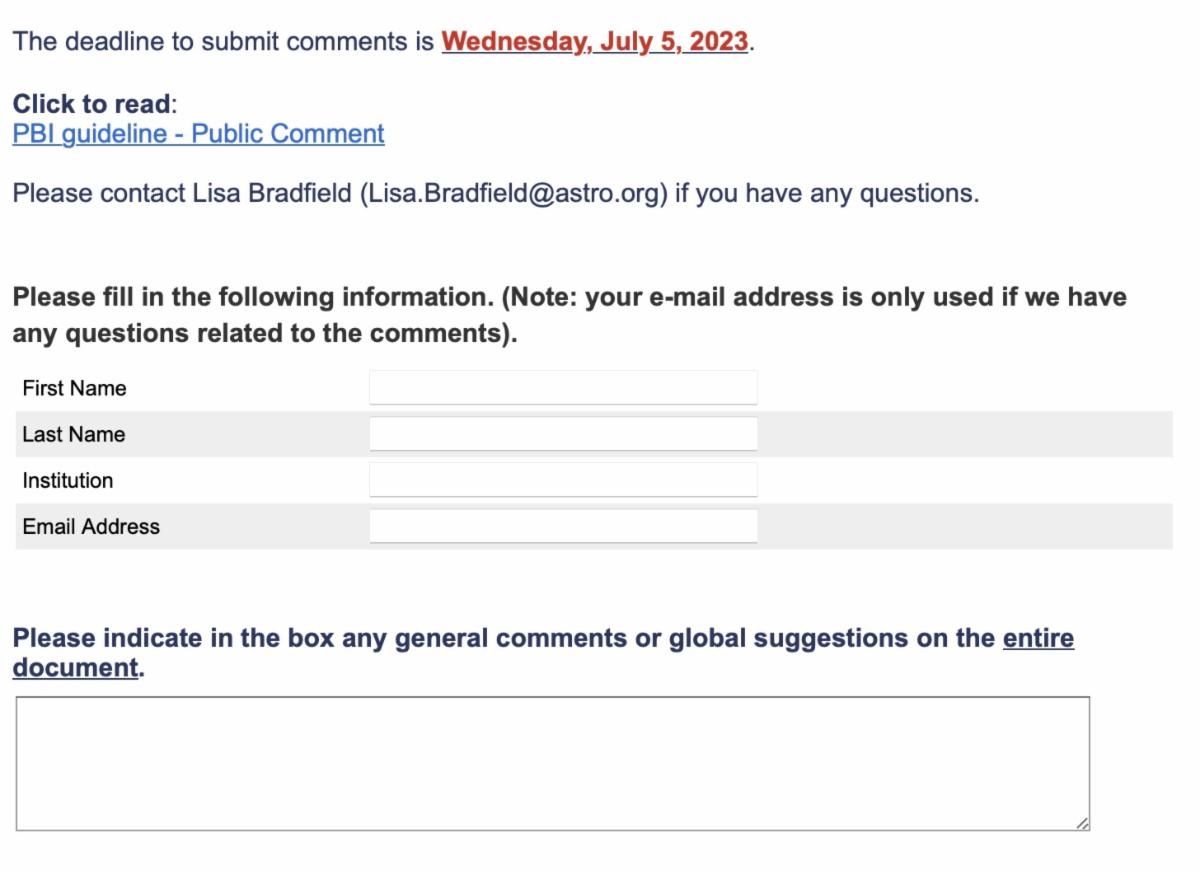
To submit your response, please go to the Public Comment Page, identify your “institution” as “breast cancer survivor,” “TARGIT recipient,” “advocate,” or however you wish, and add your comments to the “general comments” box at the top of the from. (See example below). It is not necessary to complete any other sections.
The deadline for submitting comments is Wednesday, July 5, 2023.
Sorry for the late notice on this Independence Day weekend. But the FREEDOM to access TARGIT is a freedom worth fighting for this Holiday. 15 minutes of your time can make the difference.
Thanks for your help!