October 2025 - Catch up on the latest news from CAARI! | | |
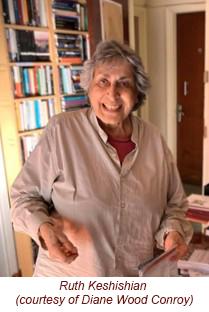
Autumn is a time of transitions and a time of change. As many of the thrills of summer subside and we busy ourselves with the customary responsibilities of a new school year beginning and a return to work routines, we are reminded also of how fleeting our time may be. We remember with heavy hearts the passing of Ruth Keshishian of the Moufflon Bookshop here in Nicosia, who was such a great friend of Cyprus and CAARI.
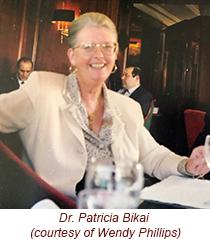
Likewise, we remember Dr. Patricia Bikai, patron of CAARI’s Anita Cecil O’Donovan graduate fellowship that was formed in memory of her sister. CAARI Vice President Matthew Spigelman introduces this Newsflash edition with a remembrance and tribute to Dr. Bikai. We are grateful to both of these wonderful women whose positive influence had impacted upon so many during their lifetime.
We also invite YOU to make your mark with our annual call for fellowship applications. CAARI is unique among learned institutions in offering fellowships specifically for research centered on Cyprus and the eastern Mediterranean. Review the list, spread the word about them, and even apply for one.
We also hear from Dr. Kevin Fisher, as he provides a tantalizing view of the incredible work by a growing team excavating Building 16 at Kalavasos-Ayios Dhimitrios. As you’ll read in the summary, our understanding of what occurred in Rooms 2 and 3 is taking shape, with queries into the Central Court being undertaken with various geoarchaeological techniques.
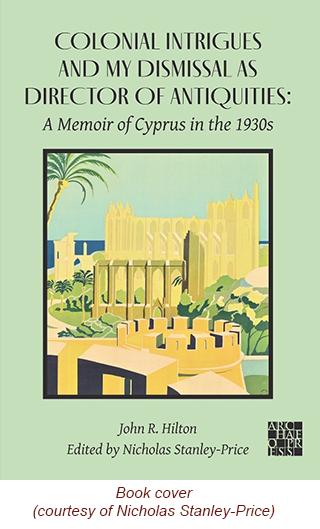
Next, we delve into Cyprus’ more recent history with a new book edited by Dr. Nicholas Stanley-Price, Colonial intrigues and my dismissal as Director of Antiquities. A memoir of Cyprus in the 1930s by John R. Hilton, which outlines how John Hilton came to be the first director of the Department of Antiquities.
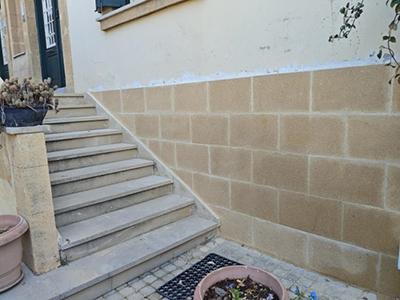
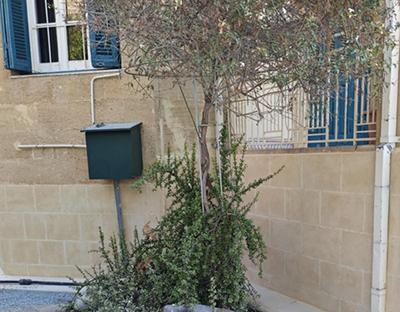
Finally, an update is given on the impressive progress on the repairs to exterior of the CAARI building in Nicosia.
| | |
Message from CAARI’s Director
Dear friends and supporters of CAARI,
We are back in the swing of the academic year here at CAARI with a busy schedule of local lectures and events, despite the ongoing heat feeling like we should be still in summertime.
As reported in the introduction to this newsflash, CAARI has lost some dear friends over the summer. In addition to the great loss of Dr Patricia Bikai, it was with immense sadness that we heard of the sudden passing of Ruth Keshishian. Moufflon Bookshop has long been one of the first ports of call for generations of archaeologists working on Cyprus and a frequent stop for those who live here and Ruth always had a warm welcome and helpful advice for us all. She was for so many years a regular attendee at CAARI lectures and the annual summer workshop. We will miss her warmth and wisdom terribly.
We have held one lecture in our autumn series already and you can find Professor Pamela Gaber’s lecture ‘La longue duree: the view from Idalion’ on our YouTube channel (https://www.youtube.com/@CAARICyprus/videos). We have also held one non-archaeological event in September. As many of you know, CAARI librarian Anthoulla Vassiliades is a cat lover and keen to help out our stray friends. She organized a ‘Cocktails and Catnapes’ evening in the CAARI courtyard to raise funds for the Trap-Neuter-Release program to ensure that that aims to minimize the numbers of kittens who live dangerous lives on the streets of Nicosia. The total raised was almost €500, ensuring the care of 10–15 cats!
Our next event will be on the 23rd October in the CAARI library (live only) as we celebrate the launch of ‘Prehistoric Anatolia and Cyprus. Studies in Honour of Ian A. Todd’, edited by Douglas Baird and Joanne Clarke. CAARI is proud to partner with the Council for British Research in the Levant and the Palestine Exploration Fund to support the publication of this volume in honor of former CAARI Director Ian Todd and published as a SIMA volume by Åström Editions. More details and how to purchase are available here: https://sima.astromeditions.com/book/?book_id=M159.
December 4th will be our final hybrid lecture of the year, an exciting topic delivered by Dr Nicoletta Demetriou on the ‘Cyprus Music Archive’, a project to collect and disseminate the poetry, folk songs and oral traditions of Cyprus. You can find all the details on our website at https://caari.org/events/ so do attend if you are able to.
We look forward to seeing those of you in Cyprus here on 23 October and all our international friends online on 4 December.
With best wishes for autumn,
Lindy Crewe, PhD
Director, CAARI
| | |
In Memoria: Patricia Maynor Bikai (1943 – 2025)
Dr. Matthew Spigelman
CAARI, Vice President
| | |
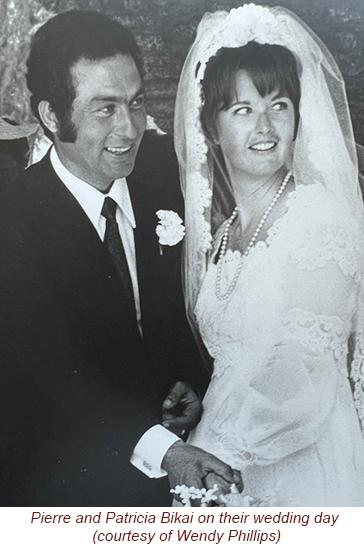
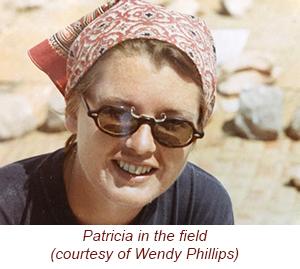
CAARI lost a stalwart supporter, friend, and scholar with the passing on August 4th of Dr. Patricia Maynor Bikai. Patricia’s engagement in the region began in the early-1970s in Lebanon, where she worked at Sarafand and Tyre. At the latter site she met and married Pierre Bikai and conducted her foundational dissertation research that resulted in The Pottery of Tyre (1978). It was that work, and the civil war in Lebanon, that brought her to Cyprus, for studies of the Phoenician imports to Kition (1981) and Palaepaphos-Skales (1983).
| |
A 1984–1985 Fulbright Fellowship to CAARI provided her and Pierre with a sustained period of time on the island, as Patricia worked on The Phoenician Pottery of Cyprus (1987) and Pierre traveled for his dissertation research on The Cedar of Lebanon (1991). CAARI at this time was a young research center, located in rented quarters at 41 King Paul Street and still acquiring its full suite of programming and facilities. Patricia was in just the second cohort of Fulbright Fellows to the Institute. Her commitment to CAARI crystallized during this time, as she and others were drawn into the excitement and challenges of growing a young organization.
While the Directorship and Associate Directorship of the American Center of Research (ACOR) in Jordan took Pierre and Patricia to Amman, Patricia remained a supporter of CAARI as a trustee and, most notably, through the funding of the Anita Cecil O’Donovan fellowship, in honor of her sister who passed away in 1981 at a young age. The fellowship stemmed from an attempt between the sisters, when Anita was in Spain with their mother-in-law and Patricia was in Cyprus, to arrange a trip to the island. However, the complications of connecting flights and international travel proved insurmountable, and the trip never occurred. The inspiration for the fellowship, as relayed by Wendy (O’Donovan) Phillips, daughter of Anita and niece of Patricia, was to provide the means to “bring Anita to Nicosia” in memory, if not in person.
| |
CAARI remembers Dr. Patricia Maynor Bikai as someone who forged connections, between the archaeological records of Cyprus and the Levant through her research, and between the world and CAARI through the funding of the many scholars who have held the O’Donovan fellowship since its founding in 1990.
| | |
Make Your Own Mark
by Supporting the O’Donovan Fellowship!
Thank you to Alison South, Stuart Swiny, and Wendy Phillips for providing memories of Patricia and her connections to CAARI. If you likewise would like to share in Patricia’s memories and make a mark as she did, we encourage you to make a donation to the O’Donovan fellowship, as hopeful scholars look to achieve their research goals in Cyprus.
| | |
Donate to CAARI online:
HTTPS://CAARI.ORG/DONATE
| |  | |
Or by mail:
CAARI
209 Commerce Street
Alexandria, VA 22314 USA
or
CAARI
11 Andrea Dimitriou Street
Nicosia 1066 Cyprus
| | |
Recent Excavations at Kalavasos-Ayios Dhimitrios, Building 16
Dr. Kevin Fisher
University of British Columbia
| | |
Many readers are probably familiar with the excavations by Alison South at the Late Bronze Age site of Kalavasos-Ayios Dhimitrios (K-AD), located in the Vasilikos River valley, about 3 km from the sea, in south-central Cyprus. From 1979 through 1998, South’s excavations were conducted as part of the Vasilikos Valley Project (directed by Ian Todd) in advance of the construction of the AI motorway, revealing evidence for a thriving urban center that reached its apogee in the 13th century BCE. In 2008, the Kalavasos and Maroni Built Environments (KAMBE) Project undertook new work at K-AD, as well as nearby Maroni, aimed at understanding the urban landscapes and social dynamics of these two important Late Bronze Age cities. Guided by archaeological geophysics, new excavations at K-AD began in 2012, with additional seasons in 2015-16, 2019 and, after a COVID-induced hiatus, 2023 and 2025. In this brief report, I focus on the recent excavations by the University of British Columbia in Building 16.
Ground-penetrating radar (GPR) survey by Thomas Urban initially documented this structure, located about 25 m southwest of the famous Building X excavated by South (see the open access article by Fisher et al. 2019 in American Journal of Archaeology for details on the geophysics and earlier excavations). The GPR results indicated a massive rectangular building, approximately 26 m long and 13 m wide with a large central room, probably an open (or partially-open) court, and smaller wings of rooms on its north and south ends.
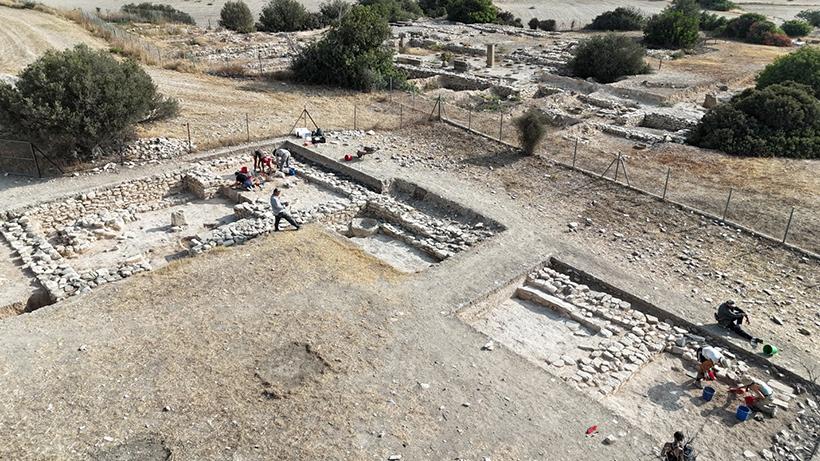
| | Photo showing Building 16, looking northeast, with the Northeast Area and Building X in the background. | | |
Our initial excavations focused on the south end of Room 2 and the northeast corner of the Central Court (Room 1), revealing a building with impressive rubble foundation walls, nearly 1 m wide. These were built in the “official style” (as South called it) of the rubble walls at Building X, with several evenly laid courses and outer faces of partially-trimmed tabular limestone. The interior of the Central Court was lined with rubble-built benches that met in the northeast corner at a unique octagonal sandstone basin with a thick ceramic lining that extended above the level of the stone rim. We await further analysis of the basin to determine its function. A microscopic study by Peter Wallace (Simon Fraser University) of the deposits below the court’s lime-plaster floor showed that the floor was renewed 11 times over the building’s use-life. In Room 2, which was accessible only from the Court, we recovered the base of a staircase with two ashlar steps as well as a fragments from a number of local fineware vessels, much of a large pithos, ceramic wall brackets and a number of clay sling bullets—a taste of things to come.
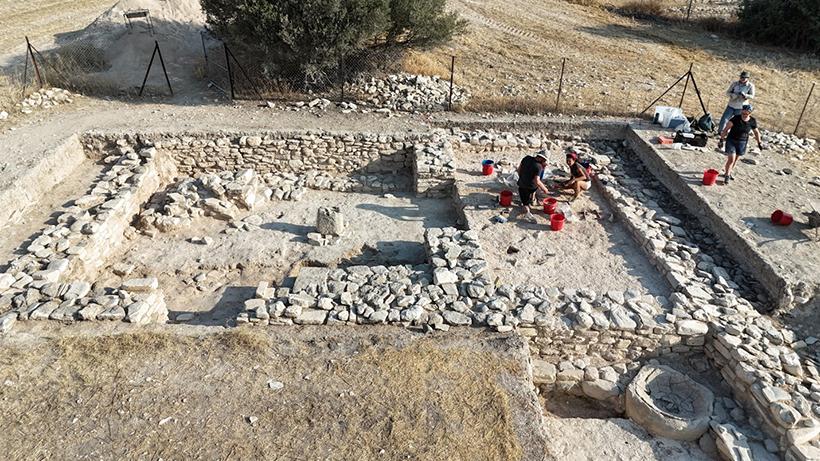
In 2019 (supervised by Anna Reynolds, UBC) and 2023 (supervised by Graham Braun, University of Cincinnati), we focused on completing the excavation of Room 2, revealing a unique space with compelling evidence for ritual activity. In the northwest corner of the room was a large, roughly square rubble platform, a few courses high, with a low projecting bench that ran along the north wall of the room. There was evidence for burning on some of the platform’s surface stones, something also suggested by our earlier electromagnetic survey. Centered in the open space between the bench and the staircase was a carved standing stone made of crystalline gypsum, erected on a platform of small flat stones. Nearby, fallen on its side, was another large, carved gypsum object, roughly cylindrical with its top surface carved into a shallow basin. In between the two gypsum objects we recovered a large triton shell, with its end cut off and two holes drilled into its side—almost certainly a musical instrument. In the deposits on, and immediately overlying, Room 2’s earthen floor, was a dense scatter of finds, including fragments of a number of fineware cups and bowls (mainly Base Ring and White Slip), a large pithos and smaller storage vessels, fragments of several wall brackets, and a number of pieces of slag (although no evidence of their production so far). Immediately to the south of the platform were numerous deer bones, mainly pieces of skulls and antlers. In the southwest corner of the room was the remainder of a massive deposit of small, oblong unfired clay objects presently identified as sling bullets—over 700 complete or nearly complete specimens in total. UBC MA student Paige Piché is currently studying this impressive collection. It is difficult not to see this room as a focal point for ritual activity that may have included ceremonial feasting centered on the consumption of deer—an animal long associated with elite hunting in the eastern Mediterranean. Room 2’s relatively small size and narrow doorway from the court suggest a degree of exclusivity to these activities.
| Photo, looking north, showing Room 2 (left), Room 3 (right) and the northeast corner of the Central Court (Room 1) with the ceramic-lined basin and benches (lower right). | |
Of course, this begs the question of what was going on in Room 3, which adjoins Room 2 through an unusually wide 2.1 m doorway. Not surprisingly, the excavation of Room 3 was a priority for the 2025 season. Supervised by Talia Neelis (UBC, and now a UCLA PhD student), this room revealed dense deposits of ceramics ranging from large storage vessels and cooking vessels to numerous fineware cups and bowls and several small juglets (including a Bucchero ware juglet). These deposits, which were well above the floor level, were in roughly linear groups, suggesting that they may have been stored in an upper story on shelves, which collapsed sometime after the building was abandoned. While we have recovered several sherds with potmarks from Building 16 since the start of excavations, this season yielded a pithos rim with a probable Cypro-Minoan inscription, consisting of three signs resembling variants of signs in the extant corpus. Other finds included shafts and bowls from several ceramic wall brackets, several pieces of slag and a few small, thin bronze fragments, one of which may be part of a vessel rim. Two triton shells, with each with its narrow end cut off, were also found (although no holes were drilled into them). Perhaps these various materials were stored in the upper floor of Room 2 for use in the social occasions that took place in Rooms 1 and 2. At the end of the season we were still some 30-40 cm above the floor.
Another goal of the 2025 season was to expand our excavation of the Central Court, while ground-truthing the location of the southern wall of the building and a circular anomaly in the southeast corner (Room 4) indicated by the GPR survey. A new trench was opened, supervised by Madeline Topor (UBC), in which the team uncovered the southeast corner of the building, including the southeastern section of the Central Court. The bench previously found in the north part of the court continued along the interior walls in the south. A long slab of tabular gypsum served as the top of part of the bench on its east side (a somewhat shorter one was found at the north end of the bench beside the basin). A number of these slabs were also found set into the lime-plaster floor immediately in front of the benches. Parts of the upper surface of the floor were eroded away, exposing sections of the earlier floors. The deposits in the south wing of the building (Room 4) proved more difficult to interpret as no clear floor was reached before the end of the season and the expected southern wall has not yet materialized. A small 30 cm-deep sondage in this area on the last day of excavation revealed no trace of a floor or wall, leaving a mystery to solve next season. We hope to further clarify the layout and use of this fascinating building in summer 2026.
| Photo showing excavations of the bench-lined southeast corner of the Central Court (Room 1) and Room 4 (top of the photo is east). | |
My sincere thanks to the many field school students, staff and specialists who made this work possible and so productive. Thanks to Sheri Pak for her work as field director and project manager and also to Alison South for her guidance and support. This work is funded by various agencies, including the Social Sciences and Humanities Research Council (Canada), the Canada Foundation for Innovation, and the National Science Foundation (US). We are grateful to the Department of Antiquities, Cyprus for their permission to conduct this work.
| | Apply for CAARI Fellowships! | |
Encourage your colleagues, students, and friends to apply for CAARI's fellowships. Information about each grant, including application forms, stipends, and expectations, is available at: https://www.caari.org/fellowships.
The fellowships offered by CAARI in the current year include:
-
Three graduate student stipends offering support for travel to Cyprus and lodging at CAARI. Application deadline: December 8, 2025.
-
The postdoctoral fellowship in honor of Professor Eddie Peltenburg, that can support a full academic year's research time on Cyprus. Application deadline: January 12, 2026.
-
Scholar in Residence: Application deadline: January 12, 2026.
Other relevant fellowship opportunities are listed on the Fellowships page, as well. Browse the possibilities and apply!
| |
Cyprus in the 1930s: A Memoir by John Hilton, First Director of Antiquities
Dr. Nicholas Stanley-Price
Independent Scholar
| |
I started researching the history of antiquities administration in Cyprus while an NEH Fellow at CAARI in 1997-98. This led in 2001 to a published article about the Ottoman Law on Antiquities and the founding of the Cyprus Museum, but many years were to elapse before I returned to the topic. When I did, I became fascinated by the period 50 years later when the Department of Antiquities came into being. Charlotte Roueché had published an important article about it but there seemed to be more to the story.
In particular, the names of two Britons appeared and disappeared in strange ways. One was John Hilton, the first Director of the Department, whose name was almost forgotten. The other was Rupert Gunnis, author of the comprehensive guide Historic Cyprus (1936), who suddenly disappeared from view on the island. What had been going on? Last year I gave lectures for CAARI and for CVAR which attempted to answer that question (both lectures are available on YouTube, https://www.youtube.com/@cvar.severis/streams).
In the early 1930s, the British government was being criticized for failing to care adequately for the ancient monuments in Cyprus. In response, Sir Charles Peers, the Chief Inspector of Monuments in England, and his friend Sir George Hill, Director of the British Museum, made a visit of inspection. They recommended revising the Antiquities Law and appointing a Director of Antiquities.
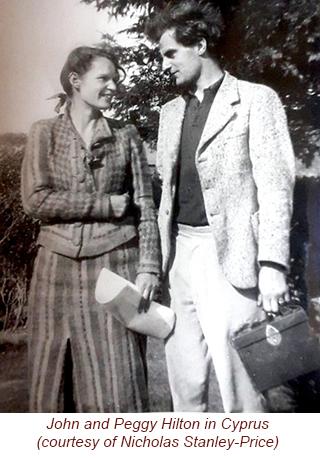
John Hilton was as surprised as anyone when in August 1934 the Colonial Office offered him the job, with Sir George Hill strongly backing his candidacy. After graduating at Oxford with first-class honors, he had studied Bauhaus architecture in Germany before enrolling at the Bartlett School of Architecture in London where he completed the first two years’ syllabus in two terms. He qualified as an Associate of the Royal Institute of British Architects (ARIBA). Both he and his wife Peggy, a graduate of the Slade School of Art, came from artistic families. Hilton’s friend since schooldays was the poet Louis MacNeice whose name, together with those of others such as Isaiah Berlin, J.D. Beazley, A.J.B. Wace and Hill and Peers, flits across the early pages of a memoir that Hilton wrote about his time in Cyprus.
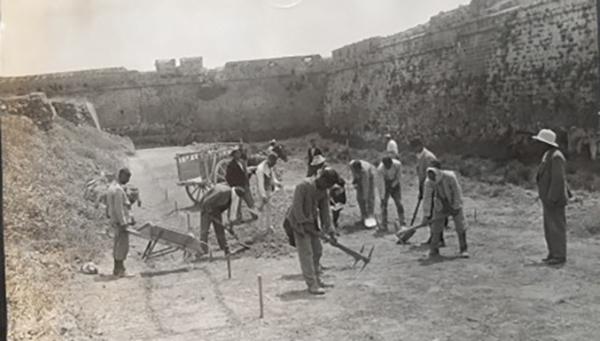
| Excavations at Famagusta, c. 1935 (courtesy of Hilton archive. KCL London) | His compiling this memoir forty years later is proof of how unforgettable he had found it. Disheartened by his family’s comments on the draft typescript, he put it aside. After his death it was deposited along with other papers and photographs in the archive at King’s College London. It then remained tantalizingly out of reach during the Covid pandemic. Hilton’s eldest daughter, Baroness Jennifer Hilton, kindly provided me with a photocopy of it, and in due course I could consult his other papers at KCL. | | |
I have now produced an edited and illustrated version (Colonial intrigues and my dismissal as Director of Antiquities. A memoir of Cyprus in the 1930s by John R. Hilton, Archaeopress, 2025). His memoir drew heavily on letters sent by the Hiltons to their families in England. Written fluently with a wry humor, it reveals how much he enjoyed the challenge of his job despite disliking the conventions of colonial society. A primary witness of those earliest days of the Department was Porphyrios Dikaios as Curator of the Cyprus Museum. He and Hilton worked well together as they collaborated on the renovation of the museum premises and a re-display of its galleries. Meanwhile Hilton started urgent restoration work on monuments at risk and on training a Cypriot team of stonemasons.
His dismissal after less than a year – in the end, he served for seventeen months – caused an outcry in Cyprus and in England from those who knew his work. Many in the Colonial Office, without being able to admit it officially, thought Hilton’s dismissal by the Governor was unjustified. He was accused of lacking administrative ability. But his subsequent long career in the Foreign Office, in a permanent government position working primarily for the Secret Intelligence Service (S.I.S.), proved the opposite. Readers of the memoir can make up their own minds while enjoying Hilton’s account of his experience as the inaugural Director of Antiquities.
| | |
To All our Friends and Supporters
To all those who helped us keep CAARI effective and hospitable, we send our sincerest thanks! We are elated to be able to share that the second phase of the repairs to CAARI’s building in Nicosia have been completed!
| | |
We send heartfelt thanks to those who have helped us over the second hurdle in this challenge. The project could not have advanced so quickly and with such impressive results without your generosity.
| | |
Zuzana Chovanec, Ph.D.
CAARI, Development Chair
| | | | | |