Rail Workers Weekly News Digest
Number 16 - April 21, 2020
|
|
Below is a series of articles compiled over the previous week.
They are of interest to railroad workers.
|
|
ARTICLE #1 -
CORONAVIRUS NEWS
|
|
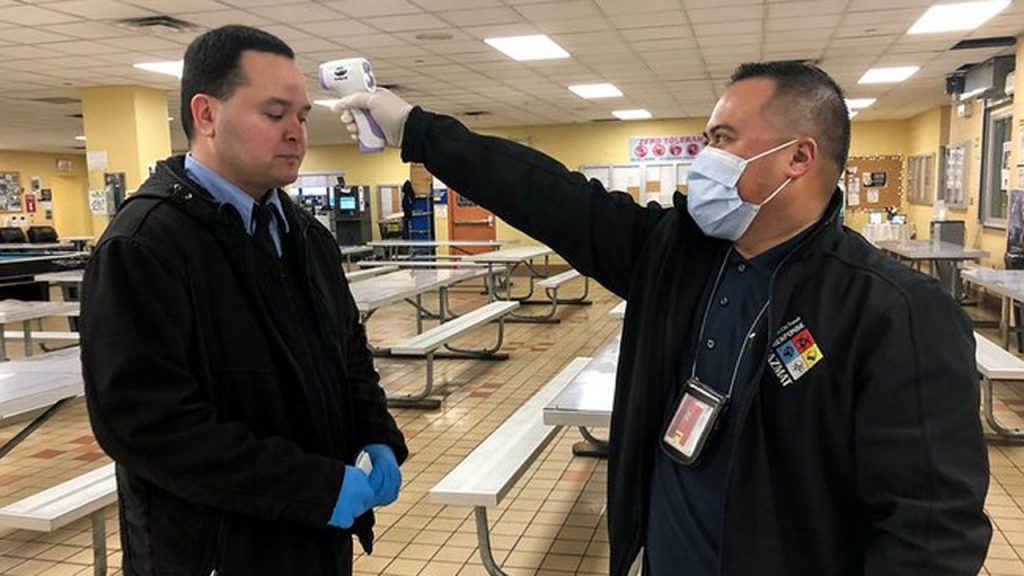
An MTA worker has his temperature checked upon reporting for work. Temperature testing of employees as they come on-duty is the most effective way to keep the workplace safe. RWU demands that the nation's rail carriers implement this at once in order to save rails' lives and promote safety.
|
|
Article 2 -
RAIL SAFETY NEWS
Unions to FRA: Railroads Must Recall Furloughed Workers Before Seeking Safety Waivers
A coalition of rail labor organizations is asking the
Federal Railroad Administration
(FRA) to ensure freight railroads are recalling furloughed workers before seeking waivers from federal safety regulations.
In an
April 9 letter
to Federal Railroad Administrator Ronald Batory, the unions said there "must be a strong burden of proof for rail carriers to demonstrate that there is a true labor shortage" before requesting waivers from certain regulations due to a COVID-19-related worker staffing shortage.
The FRA on March 13 activated an emergency relief docket that allowed the agency to waive certain regulations, including those that concern rail safety and wellbeing and fair treatment of employees, the unions' letter notes. As a result, the unions are "carefully monitoring" railroads' requests for relief and may comment on existing or future petitions.
"If a carrier finds itself short on active employees, its first option must be found in the abundant supply of out-of-work railroaders, not in administrative intervention to be exempted from safety-critical regulations," the unions' letter states.
Rail unions signing the letter include the American Train Dispatchers Association, Brotherhood of Locomotive Engineers and Trainmen, Brotherhood of Maintenance of Way Employes Division and the International Association of Sheet Metal, Air, Rail and Transportation Workers-Transportation Division.
|
|
Watch the "State of the Rail Workforce" congressional hearing from June 20, 2019, as FRA Administrator Ron Batory is grilled by House Transportation & Infrastructure Chairman Defazio over excessively long trains, employee furloughs and PSR. The segment last about 10 minutes, starts at about 20:00 minutes into the hearing.
|
|
Article 3 -
LEGISLATIVE NEWS
An "Essential Workers Bill of Rights"
(Editor's Note: This powerful idea has been floated in the halls of Congress. Both unions of the Teamster Rail Conference - BMWED and BLET - have signed on).
1. Health and safety protections. Every employee, including employees of contractors and subcontractors, should be able to do their job safely, which means having necessary amounts of personal protective equipment provided by employers at no cost to the employee. Employers should be required to take proactive actions when someone at the job site may have contracted coronavirus, including informing employees if they may have been exposed and evacuating the job site until it can be properly cleaned. And the Occupational Safety and Health Administration should be required to immediately issue a robust Emergency Temporary Standard to keep employees safe.
2. Robust premium compensation. Every worker should be paid a livable wage, and essential employees are no exception. During this pandemic, essential workers should also be paid robust premium pay to recognize the critical contribution they are making to our health and our economy. Premium pay should provide meaningful compensation for essential work, be higher for the lowest-wage workers, and not count towards workers' eligibility for any means-tested programs. It must be retroactive to the start date of the pandemic, and not used to lower the regular rate of pay for any employee.
3. Protections for collective bargaining agreements. Collective bargaining agreements must be protected from being changed or dissolved by employers during this crisis, including during bankruptcy proceedings. Workers' rights to vote for representation in a National Labor Relations Board election in a fair and safe manner must also be protected during the pandemic.
4. Truly universal paid sick leave and family and medical leave. Congress must pass Senator Patty Murray's PAID Leave Act, which provides 14 days of paid sick leave and 12 weeks of paid family and medical leave, so essential workers can care for themselves, family members, or dependents, without being required to submit unnecessary paperwork. And we must ensure that President Trump is not allowed to arbitrarily exclude workers to roll back these protections.
|
|
Article 4 -
CREW SIZE NEWS
RWU Offers New Product
for the Fight to Save the Two-Person Crew
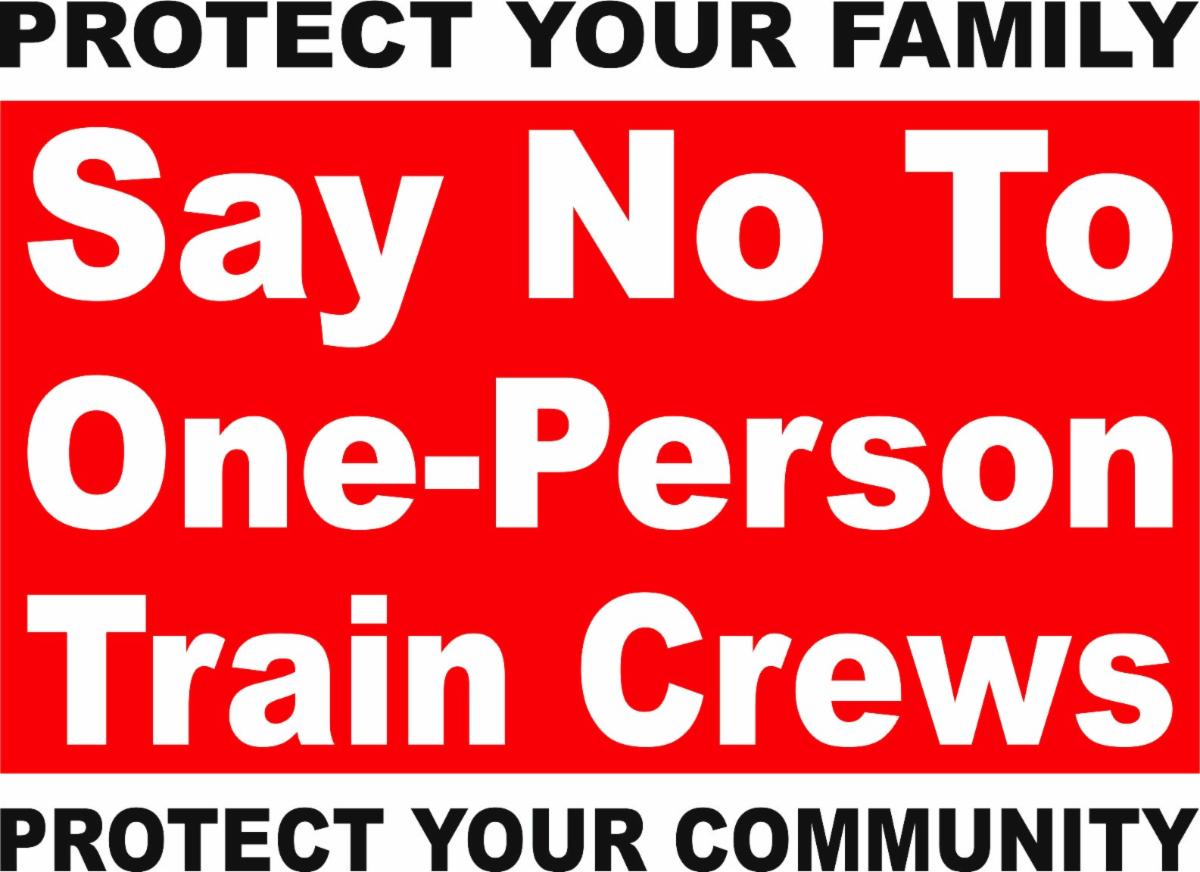
YARD SIGNS
These 24" X 18" UNION MADE signs are made of corrugated plastic and are extremely durable and can withstand rain, snow, and wind. They are great to display not only in your own yard but also in prominent places to generate public interest in the fight to save the two person train crews. They are also great to display around the rail yards and on your union bulletin board. The signs are printed on both sides and come with a pair of EZ Sign Stakes. You can order them one at a time (unfortunately, shipping is costly). Better yet, order them in quantity packs of 5, 10, 15 or 20 and share them with your fellow workers. Contact us if you want more. We can arrange drop shipping direct from the manufacturer. Ask your Local, Division or General Committee to order a bunch!
|
|
Article 5 -
FREIGHT TRAFFIC NEWS
U.S. Freight-rail Traffic Plunges 22 Percent in a Week
The COVID-19 pandemic's impact on all business sectors continues to be reflected in U.S. freight-rail traffic numbers, with railroads logging 412,503 carloads and intermodal units during the week ending April 11, a 21.9 percent decrease compared with the same week in 2019, according to the
Association of American Railroads
(AAR).
Total carloads for the week were 198,726 units, down 23.8 percent. Intermodal volume was 213,777 containers and trailers, down 20 percent.
Only one of the 10 carload commodity groups that AAR tracks on a weekly basis posted an increase: Grain was up 595 carloads to 22,237. Volumes for the other commodity groups included coal, down 29,609 carloads to 52,468; motor vehicles and parts, down 15,521 carloads to 2,185; and metallic ores and metals, down 5,982 carloads to 17,949.
"The pandemic is affecting firms in every industry, and railroads are no exception," said AAR Senior Vice President John Gray in a press release. "When rail customers suffer a drop in demand for their products, their need for transportation services declines as well, and that negatively impacts rail volumes."
Still, railroads are moving massive amounts of freight, including chemicals, food and manufactured goods, Gray said.
Once the public health crisis ends, "railroads will be ready to ramp up their service" to meet the nation's freight transportation needs, he added.
Meanwhile, Canadian railroads posted 73,556 carloads for the week ending April 11, down 13.6 percent; and 66,088 intermodal units, down 10.6 percent compared with the same week in 2019. Mexican railroads logged 16,433 carloads, down 26 percent; and 11,482 intermodal containers and trailers, down 31.7 percent.
|
|
Article 6 -
PASSENGER RAIL NEWS
Will Pandemic Have Long-term Consequences for Passenger Rail?
The coronavirus pandemic is, above all, a human tragedy. The unprecedented economic impact of COVID-19 seems to worsen by the day and is spilling over into the railroad world in a big way.
Freight railroads will respond to the downturn like they always have: Move what traffic there is to move, and otherwise hunker down by cutting costs and reducing the workforce as volume declines. When the recovery comes, they’ll bounce back.
It may not be so simple this time around for passenger, commuter, and transit systems, where ridership has cratered worldwide amid necessary social distancing restrictions and related economic upheaval.
Some people predict that travel will bounce back quickly when we emerge from the other side of the pandemic. Others aren’t so sure. Lufthansa, Europe’s largest airline, believes it will take years for air travel to recover to pre-pandemic levels, and Boeing says the commercial aviation market likely will be changed for good.
It’s unclear to me that the impact would be any different on passenger and commuter rail. Amtrak CEO Richard Anderson told employees last week that, “We are going to be a very different railroad when we come out the other on the other side of this; we will be 20% smaller … We will build up from where we are as customers buy tickets. The hope is that people will realize we’re much better than airlines in shorter-haul markets because we don’t pack ’em in like the airlines do.”
|
|
Article 7 -
RAIL SAFETY NEWS
NTSB: Amtrak Modified Safety Rules After Fatal Backhoe Accident
The
National Transportation Safety Board
(NTSB) yesterday announced three more of its top safety recommendations have been implemented, including one related to a fatal rail accident that occurred in Pennsylvania in April 2016.
After an
Amtrak
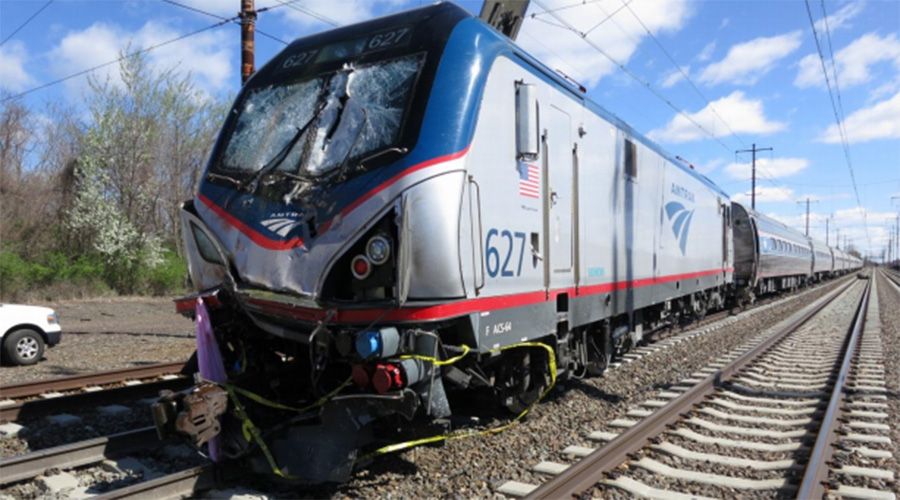
train struck a backhoe, killing two workers in April 2016 near Chester, Pennsylvania, the NTSB recommended that train dispatchers not be allowed to participate in potentially distracting activities, including making phone calls, while responsible for safe train operations.
Amtrak has since modified its rules to satisfy the
NTSB's recommendation
, agency officials said in a press release.
The other two recommendations that the NTSB marked as "closed, acceptable action" involved air and highway transportation.
"Transportation is safer than it was before these recommendations were implemented," said NTSB Chairman Robert Sumwalt. "But there is still so much more to do. There are still 230 recommendations from our 2019-2020
Most Wanted List of Transportation Safety Improvements
that have not been addressed."
|
|
Article 8 -
WORKPLACE INJURY NEWS
Top Seven Things to do After an on-duty Injury to Protect Yourself and Your Co-workers
NOTE:
Each month, the Poolson-Oden Law Firm publishes an article in their newsletter - Right on Track - published by RWU. See the most recent newsletter
Here
. The RWU article is on Page 2. In return, RWU features an article which they submit to the RWU Weekly Summary. See below ...
In these uncertain times when safety is being waived by the carriers, railroaders need to protect themselves and their fellow co-workers by knowing the steps to take after an on-duty injury. Railroad workers all over the country are anxious about safety right now, and rightfully so. The FRA has allowed the railroads to waive essential safety regulations while our nation continues to be plagued by COVID-19. Railroad workers are considered essential transportation personnel and are on the frontlines facing all these issues while trying to get home safely to their families at the end of the day. Railroad workers universally are very concerned about what do when faced with an on-duty injury at work, especially now. At educational seminars which our firm hosts for railroaders all over the country, we always get the question: What is the most important thing for me to do immediately after an injury at work? The answer is that there are seven steps to protect yourself after an on-duty injury. These are the steps:
|
|
|
|
|
|
|