|
What happened last week?
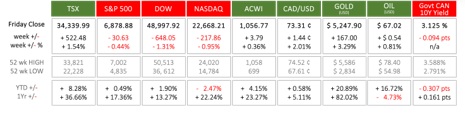
Last week and in 2026 U.S. equity indexes have been struggling as interest rates have been held higher by resilient consumer inflation, import and export uncertainty prolonged by U.S. trade policy and a recent Supreme Court ruling invalidating tariffs, and renewed tariffs of 10, then 15 percent. Despite these U.S. struggles, the TSX has delivered more than 8% over the past two months and over 33% over the past year. The political events over the weekend will distract most from the market performance and economic news released last week, like:
-
Canadian real gross domestic product (GDP) declined 0.2% in the fourth quarter of 2025, after rising 0.6% in the third quarter. Higher exports, household spending and government capital investment was not sufficient to produce an economic expansion. Real GDP increased 1.7% in 2025, which was the slowest growth since 2020, when the pandemic began. Much of last year’s decline can be attributed to decreased exports to the U.S. StatsCan GDP release
-
The U.S. Producer Price Index (PPI), which measures inflation at the wholesale level, rose faster than predicted in January. Core PPI that excludes volatile food and energy prices, increased at a seasonally adjusted rate of 0.8%, more than the gain of 0.6% in December and more than double the Dow Jones consensus estimate of 0.3%. The all-items index rose 0.5%, more than the expected rate of 0.3%. CNBC and PPI BLS and PPI
What’s ahead for this week and beyond?
Most of the market moving news will be associated with the coordinated U.S./Israel attack on Iran, which began on Saturday morning. The immediate effects include the killing of Iran’s Supreme Leader and Iran’s drone and missile response against seven neighbouring countries, including Israel and Saudi Arabia. The price of oil is expected to spike as political uncertainty, and active conflict could lead to supply disruptions. An increase in gasoline and energy prices will push inflation higher; industries and sectors would have their profit trajectory changed. Suppliers could see revenues and profits rise, and users, like trucking and transportation, could be pinched if increased costs cannot be passed along to their customers. As of Sunday afternoon in North America, it is not certain when and if the hostilities will escalate.
In Canada, the leading index, labour productivity and several Purchasing Managers Indexes will be released.
In the U.S., Import and Export Price Indexes, imports, exports and trade balance, nonfarm productivity, nonfarm payroll report, factory orders and retail sales are scheduled to be announced.
Globally, Japan’s unemployment, capital spending, household confidence and PMIs, China’s manufacturing and services PMIs and the Eurozone’s GDP, Consumer Price Index, Producer Price Index and Harmonized Index of Consumer Prices, employment and retail sales will be reported.
|