Weekly Digest Number 16 - April 18th, 2023 |
|
Welcome to the RWU Rail & Labor News! This news bulletin is produced and emailed out each Tuesday morning. We hope you find each week's news and information useful. If so, please share with co-workers, friends, and colleagues. If you like, you can sign them up to get all the news from RWU HERE. Or forward them the link. Note: If you read over this news bulletin each week, you will be sure to never miss the important news of what is going on in the railroad world from a worker's perspective!
|
|
How Corporate Greed Destroyed East Palestine |
|
This is a well-made video which provides a synopsis of the derailment and its aftermath. It has been viewed a few hundred thousand times. It is great to see all kinds of people documenting the wreck and explaining the situation from the point of view of rail workers, community members and everyday people. It is well worth a watch at 39 minutes. |
|
(Editor's Note: We would add that if/when a rail worker gets through the Whistleblower complaint screening and their complaint is not dismissed or thrown out entirely, and they actually win, the railroad as a matter of course then appeals the decision and it then goes to the courts and the process starts there all over again from scratch. The system is in dire need of a major overhaul in order to provide real justice for aggrieved rail workers.) |
|
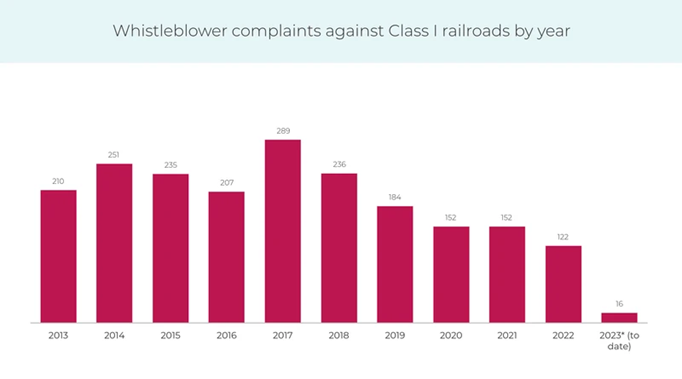
More Than 2,000 Rail Workers Have Filed Whistleblower Complaints for Safety Concerns in Last 10 Years, Documents Show
But the vast majority of the complaints are dismissed or thrown out for technical reasons.
|
|
In 2013, Jeff Kurtz, then a union officer for the Brotherhood of Locomotive Engineers and Trainmen as well as an engineer for BNSF, helped a coworker file a whistleblower complaint against the railroad.
The train’s cruise control system, known as Trip Optimizer, was reportedly malfunctioning, which can be a serious safety hazard. So the worker disabled it and took steps to generate a record of the malfunction, as Kurtz described it in a 2016 testimony to the Department of Labor in Washington D.C. and in a recent interview with Motherboard. That way, if it failed again, there would be documentation that the system is the problem, not the worker.
The following month, the worker was available for 92 percent of his scheduled hours, but the railroad assigned him to a train for only 43 hours that month. He was then punished under a company rule for low performance, which could have resulted in him being fired. In a written response to Occupational Health and Safety Administration (OSHA), which was then sent to Kurtz and viewed by Motherboard, the company accused the worker of gaming the scheduling system to work as little as possible. But they simply describe a worker using the scheduling system in the same manner I have heard dozens of other workers say they do in my two years reporting on freight rail labor issues.
According to Kurtz, the worker had an unblemished record over a multi-decade career. To him, it seemed an obvious case of retaliation for reporting a safety issue that could be expensive to fix. In a recent interview, Kurtz, who is now retired, described it as a Catch-22: Don’t call the employee in for work then punish him for not working enough. It was “awfully funny that this was done so soon after he turned the Optimizer in,” Kurtz testified in 2016.
The two of them decided to file a whistleblower complaint with the OSHA. Motherboard has viewed documentation verifying the details of the whistleblower complaint but is not publishing them to protect the identity of the whistleblower.
|
|
(Editor's Note: In this interview, locomotive engineer and RWU Steering Committee member Michael Paul Lindsey discusses the behind-the-scenes story of a massive - yet barely reported on - runaway train wreck that occurred just a few weeks ago in late March.) |
|
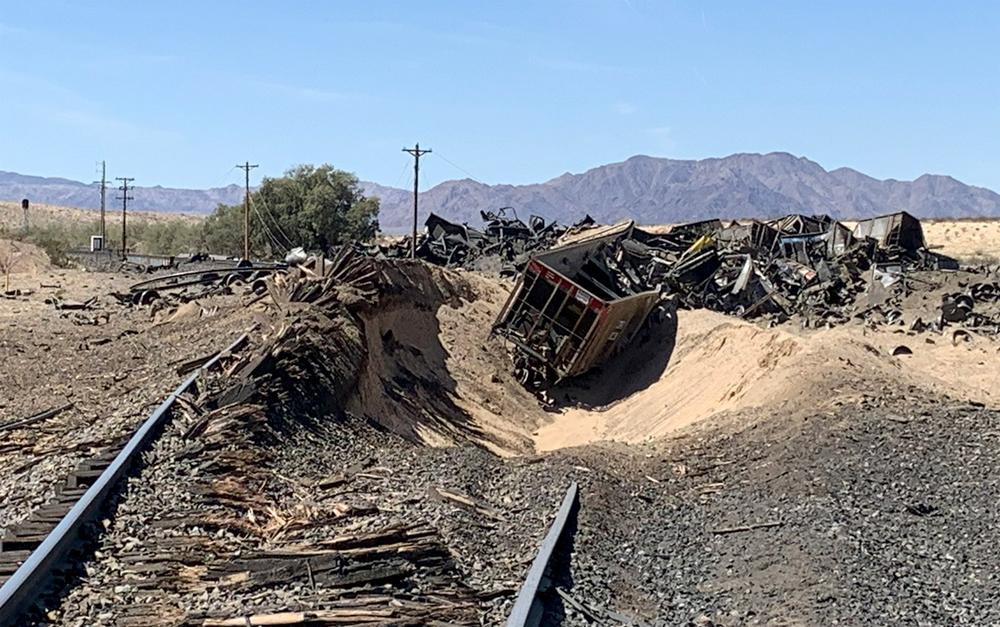
What UP and the Media Aren't Telling You About the Baker, CA Train Derailment
While rail unions have been fighting for safer and more humane working conditions, big railroad corporations and Wall Street want to keep costs down - meaning risks stay high.
|
|
As many long time supporters of The Real News knows, we’ve been covering the ongoing struggle on the railroads for over a year. Last year, The Real News editor-in-chief, Max Alvarez, and I spoke with dozens of workers from all over the country about the problems plaguing the rail industry, from Draconian attendance policies that destroy the lives and bodies of its overburdened workforce, to stagnant wages for its workers across all crafts, to the ways in which a hands off approach by regulators has led to many of these cost-cutting, profit maximizing measures to go unchecked or under-investigated, even as derailments happen almost daily, including catastrophic and damaging ones like the Norfolk Southern derailment in East Palestine, Ohio six weeks ago.
In the last month, a number of large derailments have made headlines, including a runaway train derailment in Southern California, the derailment of an ethanol carrying train in Minnesota, and most recently, one in Montana that saw dozens of cars leave the track. These derailments continue to have disastrous effects on communities across the country, leaving working people to pick up the pieces. While the prevailing narrative from the federal government and the rail carries is that derailments are commonplace with over 1000 derailments occurring each year, the question remains. Why do these derailments occur with such frequency? And what have the rail unions been doing to try and solve these problems within their industry? With me today to discuss all of this is Paul Lindsey, a locomotive engineer and a 17 year employee of Union Pacific in Pocatello, Idaho. Paul is an organizer with Railroad Workers United, who like many union railroaders has been blowing the whistle on the worsening conditions on the railroads for years now. Welcome, Paul. Please take a moment to introduce yourself to those of our listeners who may not know you and the kind of organizing work that you do.
Paul Lindsey:
Hello. Good to be on your who. My name’s Michael Paul Lindsey, and I’ve been with the railroad a long time, but over the last few years especially, since the railroads have started implementing a program that has been discussed here before on The Real News Network, precision scheduled railroading, essentially the drive to cut cost in the industry, to cut cost at all expense, even the expense of the customers, the shippers that rely on vital rail service. It’s been a blind push to cut resources, cut maintenance, cut staffing, locomotives, track maintenance, essentially with the end result of being able to buy back more shares to increase dividends and to increase bonuses for executives and shareholders and management that they entice to drive up their numbers, drive up their average train length, increase their numbers for their terminals. And basically, it’s putting the entire railroad on different teams that are all fighting against each other, which I really have to ask. So if you guys all want to be on different teams competing with each other, then why did you merge into giant monopolies to begin with?
|
|
(Editor's Note: Finally, all of this "block swapping" without regard to train make-up is coming under fire. We want trains to be be built properly and safely at their initial terminal and when making pick-ups along the way. But railroad workers need Legislation at best, and Rules at least. "Advisories" to the rail industry are not worth the paper they are written on.) |
|
FRA Links Train Configuration to 6 Derailments, Issues Safety Advisory
Configuration influences in-train forces that tug on the train, Federal Railroad Administration says
|
|
The Federal Railroad Administration has issued a safety advisory that calls on freight railroads to look closely at how they configure freight trains, saying that train configuration or makeup might have been a cause or contributing factor in at least six derailments within the past two years.
Freight railroads take into account factors such as the placement of loaded and empty rail cars, as well as the placement of distributed power units (DPUs) throughout the train, in configuring trains. The way that trains are configured can affect the in-train forces that are put upon the train, according to FRA.
FRA wants to “emphasize significant concerns related to train makeup and to ensure that all railroads exercise due diligence and recognize the importance of taking proactive measures to address potential safety risks related to operating train builds,” the agency said in its advisory, which was signed by John Karl Alexy, FRA chief safety officer and associate administrator for railroad safety. The advisory was sent for inclusion into the Federal Register on Thursday.
The advisory comes as FRA, the National Transportation Safety Board, the broader rail industry and rail stakeholders such as unions, shippers and rail equipment manufacturers have been grappling with how to bolster rail safety and prevent derailments following the Feb. 3 derailment of a Norfolk Southern train in East Palestine, Ohio.
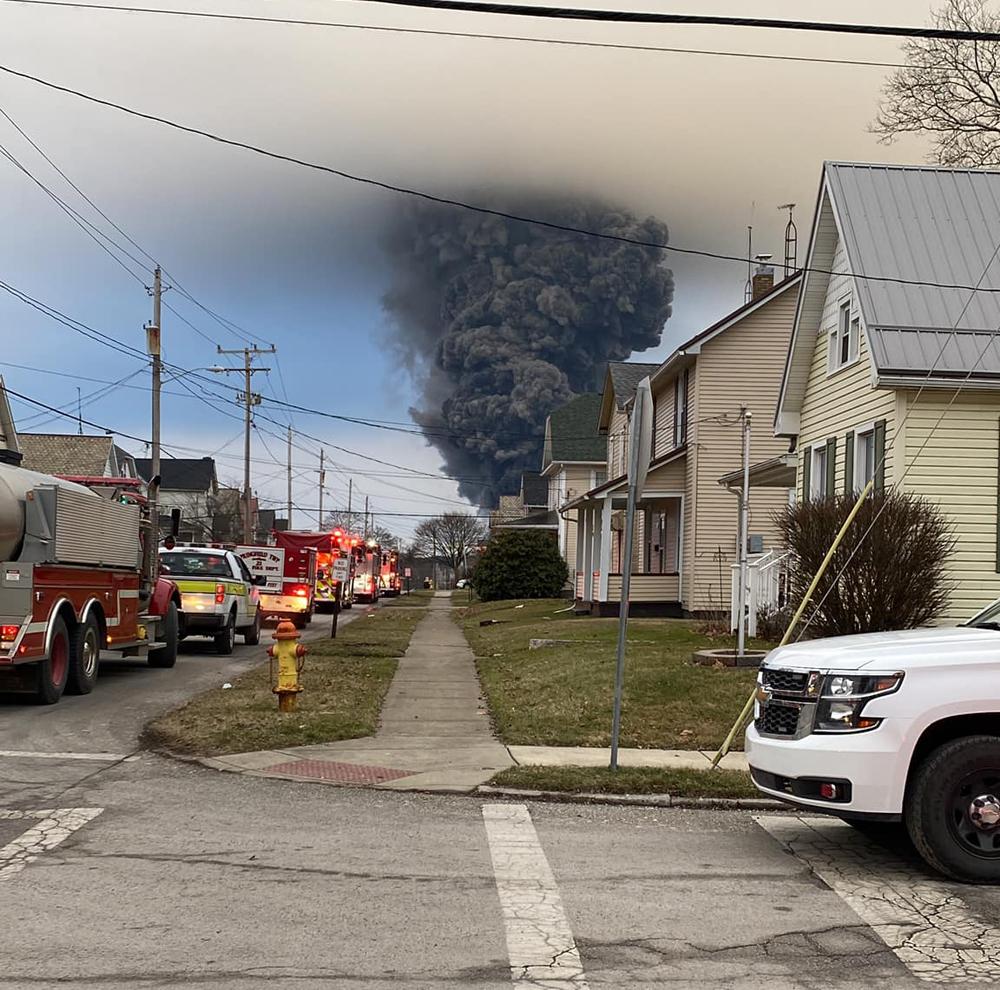
Although the NS derailment resulted in no known injuries, the derailment and the large gray cloud that formed after NS vented tank cars carrying vinyl chloride to prevent a worse catastrophe have rattled the local community and lawmakers.
The safety advisory alluded to six incidents in the past two years in which the makeup of the trains may have been a factor in causing a derailment: three involving Union Pacific trains in May 2021, February 2022 and September 2022, two involving Norfolk Southern trains in September 2022 and March 2023, and one involving a Kansas City Southern train in May 2022.
These derailments shared a number of characteristics: Each involved trains that consisted of 125 or more rail cars and utilized DPUs, which are intended to improve control of the train. Empty cars were the first to derail, and five of the six incidents involved mixed-freight trains, which typically have more complex train makeup considerations, FRA said.
|
|
(Editor's Note: It is great to see the trucking industry management start to join the ranks of those sectors calling for an end to PSR. It is unlikely that they will join the ranks of those calling for an end to private ownership of the rail infrastructure due to their ideological predilection, but at least they have found the ability to level criticism at the industry's shenanigans.) |
|
As the North American model of railroading comes under increased regulatory scrutiny, forwarders are making their own call for change to precision scheduling.
Last month, US legislators tabled their fourth bill since the February derailment of a Norfolk Southern train forced the evacuation of residents over chemical spill concerns, and forwarders want safety improvements and a change in the model.
“Precision scheduled railroading (PSR) calls for cars at origin to be loaded and shipped out with no wait time,” one forwarder told The Loadstar. “If the plan works, containers will reach the centre of the US in five to six days.
“However, as we understand it, railroads have developed a policy of waiting for a train to fill a certain number of cars before departing, which obviously causes delays.”
Acknowledging that PSR “works a little differently” for each railroad, forwarders said they had known trains to wait up to a week for more cars to be added.
In essence, this undermines the whole notion of PSR – developed by former CN, CPR and CSX head Hunter Harrison – which did away with ad hoc scheduling and waiting for a sufficient number of cars before dispatching services.
Railroads have struggled to make PSR work in practice, and have been accused of reducing safety standards and punctuality.
This, one forwarder said, was intolerable, and did not reflect the way other transport modes did business. Once containers are taken off a ship, the vessel is straight back into service, and airlines similarly do not wait for a particular number of passengers before taking off.
|
|
(Editor's Note: Union democracy is on the move in the ranks of rail labor. In December, a working locomotive engineer was elected to lead the Brotherhood of Locomotive Engineers & Trainmen, defeating a long-term incumbent. Now the "Challenger Slate" is running a full compliment attempting to unseat the established leadership of the Machinists union - IAM - District #19, railroad workers. Listen to what they have to say!) |
|
An Interview with the Rail Workers Running for Top Offices in Their Union (Machinists) |
|
The Valley Labor Report is the only union talk radio show in Alabama, elevating struggles for justice and fairness on the job, educating folks about how they can do the same, and bringing relevant news to workers in Alabama and beyond.
We're joined by two rail workers running for leadership officers in the International Association of Machinists' District Lodge 19, Reece Murtaugh, Roadway Mechanic and the Local Chairman of Lodge #696 in Richmond, VA: and Nathaniel Tinsley, locomotive technician and Legislative Chair of his local.
|
|
(Editor's Note: Obviously, legislation is needed to stop this insanity to protect injured workers' rights. Meantime, UP and other Class One's are having trouble hiring and retaining workers. What a coincidence.) |
|
Union Pacific is Sued After Firing Rail Worker on Medical Leave
A lawsuit says Union Pacific routinely hires private investigators to check out employees' medical leave claims and then fires anyone who happens to leave their house while they are off
By JOSH FUNK Associated Press Apr 3, 2023
|
|
OMAHA — Union Pacific routinely hires private investigators to check out employees' medical leave claims and then fires anyone who happens to leave their house while out on leave, according to a lawsuit filed against the railroad.
The lawyer who last month filed one of the first lawsuits in a case like this in Texas said this practice is another example of how the railroads keep the pressure on train crews to remain on call 24-7 while making them afraid to take unpaid time off they're supposed to get under the Family Medical Leave Act.
Now that the Texas case is moving forward in the courts, the lawyer, Nick Thompson, said he plans to look into the claims of several other UP employees who have contacted him with similar concerns that could turn into additional lawsuits.
“Ultimately, this has the effect Union Pacific wants: It scares people from using FMLA,” Thompson said.
Omaha, Nebraska-based Union Pacific says it didn’t do anything wrong when it fired De’Ron Rutledge because railroad managers believed he was abusing the medical leave rules by repeatedly taking time off as he was recovering from a back injury he suffered on the job. Spokeswoman Robynn Tysver said UP follows all the rules for providing Family Medical Leave Act time off.
“We encourage eligible employees to use FMLA if they or their family member has a serious medical condition that qualifies under the law,” Tysver said. “We expect our employees to properly utilize this approved leave. If we learn that an employee is misusing FMLA, Union Pacific may take disciplinary action, as permitted under the law.”
This whole situation might be less of a problem if employees had paid sick time, but the railroads have only started to address that concern in recent months through agreements giving some of their unions four days of paid sick time. But so far, most of the conductors and all of the engineers who work in locomotives — representing more than half of all rail workers — still don't have sick time. And those train crews have the most-demanding, unpredictable schedules.
|
|
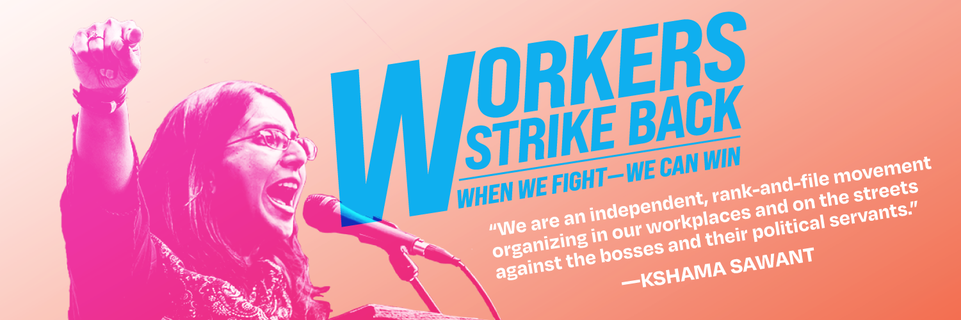
(Editor's Note: RWU has partnered with "Workers Strike Back" to promote a petition for public ownership of the railroads, healthcare for all, and an end to the Republican-Democrat monopoly of political power.) |
|
Bring the Railroads into Public Ownership! |
|
The horrific scene unfolding in East Palestine, Ohio is the consequence of a privately owned for-profit rail system. The barbaric logic of the billionaires has led to increasingly unsafe operation of the railroads through deregulation, cost-cutting, understaffing, and disinvestment in rail infrastructure. The Republican and Democratic Parties are complicit in this catastrophe by ensuring decades of deregulation and superficial oversight. When railroad workers voted overwhelmingly to go on strike last year, they did so not only for basic workers’ rights like sick pay, but also to address the dangerous state of the rail industry. When the government forced a rotten deal down the workers’ throats, their actions put us all at risk. This disaster – like so many other train wrecks - was easily preventable! |
|
(Editor's Note: Real News Editor Max Alvarez interviews Bryan Mack of Florence, SC, a railroad Conductor who was fired by CSX.) |
|
REAL NEWS PODCAST: Working People - Railroad Conductor Bryan Mack |
|
Bryan Mack is a second-generation railroad worker from Florence, South Carolina, with a Masters in Music Performance. Both Bryan and his father worked for CSX Transportation, each hiring out at times when there were statistically few Black employees or employees of color working on the railroads. For 17 years, Bryan has worked as a conductor for CSX; in that time, he has seen and experienced firsthand the worsening conditions as the industry has been taken over by greedy executives and upper-level managers hellbent on cutting costs and maximizing profits for their shareholders at the expense of workers, customers, and the public at large. As part of our continuing coverage of the crisis on the nation's railroad system, we talk with Bryan about his life and work on the railroads, and about the good, bad, and ugly parts of the industry that outsiders may not see, including the discriminatory treatment that Bryan and other workers of color have faced on the job - up to CSX's recent decision to fire him under dubious circumstances. |
|
(Editor's Note: Here is an example of what the FRA needs to do more of: Make a RULE! "Recommendations" and "advisories" generally fall on deaf ears to the rail industry if there is any cost associated at all. So make a damn RULE!) |
|
NTSB's Homendy Commends FRA for Rule Requiring Breathing Equipment on Hazmat Trains |
|
The Federal Railroad Administration last month proposed a rule to require that railroads provide an appropriate atmosphere-supplying emergency escape breathing apparatus to every train crew member and certain other employees while they are occupying a locomotive cab of a freight train transporting a hazardous material that would pose an inhalation hazard in the event of release during an accident.
The NTSB recommended such a rule be adopted after it investigated a 2005 rail accident in which the train engineer and eight other people died from chlorine gas inhalation.
After the accident, Congress mandated the FRA to require railroads to provide crews with emergency breathing equipment in 2008, and the agency issued a notice of proposed rulemaking in 2010. But no rule was ever issued.
In 2017, the NTSB closed the recommendation, categorizing FRA's lack of action as an "unacceptable response," NTSB officials said in a press release.
"I'm encouraged by FRA’s recent action under the leadership of Administrator Amit Bose to protect rail workers, all of whom deserve to be safe on the job," said Homendy. "The FRA has taken a significant step toward meeting this lifesaving NTSB recommendation and we hope the rulemaking process moves swiftly."
|
|
(Editor's Note: Despite moving less freight and fewer trains across their mainlines, Class One carriers cannot meet the expectations of many of their shippers. In 2006 when the industry moved 21% more freight than in 2022, there were not nearly the complaints there are today. The rail industry is failing our vital transportation supply chains.) |
|
Chemical Shippers Say Rail Service Remains Mired Below Pre-Pandemic Levels
Latest updates show BNSF, CSX, and UP service has improved, while Norfolk Southern lags
|
|
WASHINGTON — Most chemical shippers say railroad service has not yet returned to pre-pandemic levels, according to a survey released today by the American Chemistry Council.
Some 77% of ACC members surveyed said rail service was worse in January than it was in early 2020 before the pandemic hit. Some 22% said service had returned to pre-pandemic levels, while just 1% said service was better.
The survey found that 81% of chemical shippers reported longer transit times; roughly two-thirds reported missed switches and reduced days of local service; and half experienced increased demurrage charges.
Rail service suffered last year amid widespread and crew shortages on BNSF Railway, CSX Transportation, Norfolk Southern, and Union Pacific.
Some 62% of survey respondents said they were affected by railroad service embargoes in the second half of last year, with 89% saying their facilities or customer facilities were put under more service embargoes in 2022 compared to prior years. The embargoes were not effective in reducing congestion, according to 75% of shippers. Only 6% said embargoes were effective, while 16% they were effective in some instances but were disruptive.
The ACC report does not mention Union Pacific by name, but it issued the vast majority of congestion-related embargoes last year. The spike in UP’s use of embargoes since 2018 prompted a two-day Surface Transportation Board hearing last year.
“There are signs that conditions have improved, but the transportation problems plaguing our members are far from resolved,” ACC economist Emily Sanchez said in a statement. “Marine and truck transportation have improved while poor rail service continues to be a major concern.”
|
|
(Editor's Note: One may have to go back to the Pandemic or even the Great Recession to see a year-over-year decline in the double digits for a specific week. But here we are, read 'em and weep. Meantime, here is an article from Freightwaves "Truckload rates ‘tumbling’ in Q2, report says". It notes that truck freight rates have dropped 13% year over year. Because the Class One rail carriers are adamant about maintaining a low operating ratio, they refuse to drop shipping rates like the trucking industry. Could this have anything to do with why the rails are losing so much freight year-over-year?)
|
|
US Freight-Rail Traffic Fell 11.2% in Week 14 |
|
U.S. rail volumes fell 11.2% to 451,336 carloads and intermodal units in the week ending April 8 compared with the same week in 2022, according to Association of American Railroads data.
The railroads logged 225,669 carloads, a 4.6% decrease, and 225,667 containers and trailers, a 17% decrease, compared with year-ago levels.
Four of the 10 commodity groups that AAR tracks every week logged traffic increases. They included motor vehicles and parts, up 7.3%; petroleum and petroleum products, up 5.8%; and metallic ores and metals, up 2.6%.
Commodities that posted decreases included grain (17.1%), coal (5.6%) and chemicals (10.3%).
|
|
Weekly Derailment Department |
|
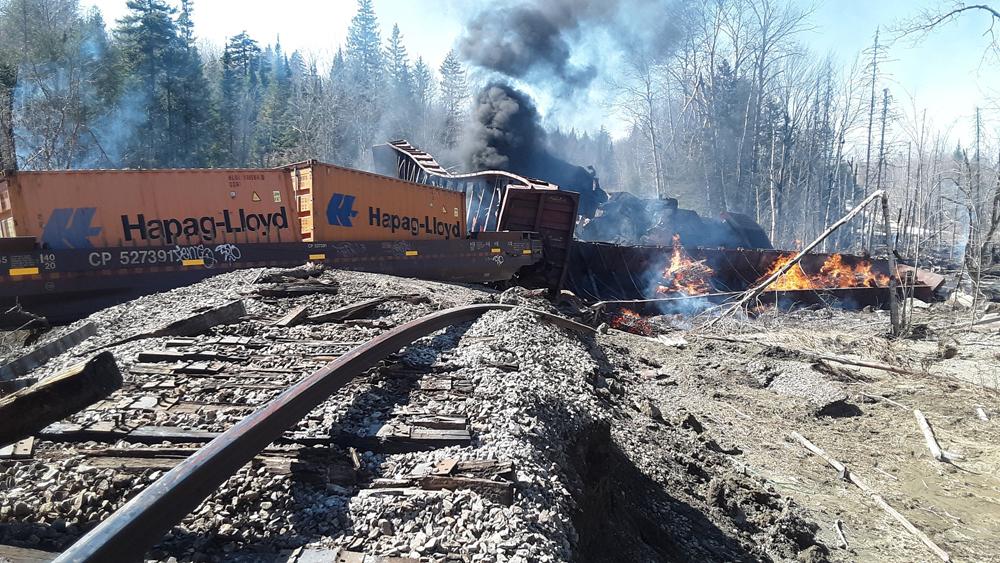
(Editor's Note: This derailment in Maine takes place on the same section of track that the infamous runaway train wreck took place 10 years ago just across the border at Lac-Megantic, Quebec, 50 miles or so to the west. This wreck comes as the 10th anniversary of that one approaches in July. Read more about the Lac-Magantic disaster HERE.)
|
|
(Editor's Note: And what is so disconcerting about both of these wrecks - the one in Maine listed above and this one in Texas below - is that in the space of a few days, no fewer than five railroad workers were injured. And the Texas wreck is the second time in 8 months that a UP train collided with another in a siding. The previous wreck killed the crew on board at the Salton Sea, CA in September.)
|
|
|
|
|
|
|