In This Issue:
Upcoming Events
Resources
- New Regional Climate Change Risk Summaries from Sustainable Forestry Initiative (SFI)
- Maine's WoodWise: Resilience Cost-Share Program
- Species Selection Tool Supporting Ecological Restoration in New York
- Carbon Reversal Risk Protocols and Tools
Latest News
- Changes in Northeastern Forest Mortality from Harvesting to Natural Stressors and Disturbances
- New Hampshire's Prohibits State or County Land's in Carbon Projects
- Rhode Island's Forest Carbon Tracking Project with University of Maryland
- World's Longest Soil Warming Experiment on Forest Carbon
Emerging Forest Carbon Programs
- First Old Forest Contract with New England Forestry Foundation
- Northeast Carry Woodlands Project Issued under New Improved Forest Management Methodology by the American Carbon Registry
- The Family Forest Carbon Program on Silvicast
| | |
ForestCORE 2026
June 23-25 | Virtual Conference
Led by Ingeobosque is an international virtual conference on sustainable forest management and nature-based solutions. The conference offers varied sessions on forest remote biometrics, quantitative silviculture, and forest economics.
Learn More and Register
| |
The Future of Forest Stewardship Workshop & National Guild Gathering
Tuesday September 15 |Freeport Maine
The Forest Stewards Guild will mark its 30th anniversary this September with a three-day gathering in Freeport, Maine focused on the future of forest stewardship. The event will bring together practitioners, scientists, landowners, and community leaders for field tours, workshops, and discussions on a variety of topics. Early bird registration is available through June 15 for those interested in attending.
Learn More and Register (Web)
| | |
10 years of Adaptive Silviculture for Climate Change Research at the Second College Grant
Learn about 10 years of Adaptive Silviculture for Climate Change research at the Second College Grant in New Hampshire. This series will include seven lunch-hour webinars throughout the summer and will conclude with a field tour of the research sites at the Second College Grant in September.
| | | |
Webinar Presentations June-August | Wednesdays at 12-1 PM
- Forest Management History of the Second College Grant (June 10)
- Ten Years of Adaptive Silviculture for Climate Change at the Second College Grant (June 17)
- How Mammals Respond to Climate Adaptation Actions: An Example from the Northern Forest (July 8, 2026)
- Tree Planting for Adaptation in Northern Forests During an Era of Global Change (July 22)
- Linking Fungi, Fauna, and Forest Recovery: The Role of Small Mammals in Mycorrhizal Fungal Spore Dispersal & Regeneration Processes (August 5)
- Colder Logs in a Warmer World: Tracking the Post-Harvest Microclimate and Respiration of Coarse Woody Material (August 12)
- Adaptive Silviculture for Climate Change Enriches Bird Communities (August 19)
Field Tour Sept. 1 Second College Grant | 9-4 PM
- Adaptive Silviculture for Climate Change at the Second College Grant.
- Tour of Adaptive Silviculture for Climate Change Research Sites
- Lunch at Sam's Look Out
- Tour of Forest Management at the Second College Grant.
| | |
New Sustainable Forestry Initiative Regional Climate Change Risk Summaries of the Northeast and Lake States
The Sustainable Forestry Initiative® (SFI) has released new Regional Climate Change Risk Summaries for the Northeast and Lake States, Northwest, and Southeast U.S., providing forest managers with practical, science-based guidance to identify and prioritize climate risks. Developed with Michigan State University as part of the Climate Smart Forestry Initiative, these resources help organizations meet SFI standards while supporting informed, climate-smart management decisions.
Read the Announcement
Read the Northeast US and Lake States Report (PDF)
| |
Maine's WoodWise Resilience Cost-Share Program
The WoodsWISE Resilience Program is a new cost-share initiative from the Maine Forest Service that helps woodland owners implement practices to improve climate resilience through early stand tending, regeneration, and forest health treatments.
Eligible applicants are open now on a rolling basis primarily for non-industrial private landowners with 10 to 1,000 acres, with some larger properties also may be elligable.The program offers reimbursement rates of 60% for most participants and up to 90% for underserved landowners to conduct early-stand tending, regeneration, and forest health practices.
Learn More About the Program
| |
Species Selection Tool Supporting Ecological Restoration in
New York
The New York Natural Heritage Program, in partnership with the Department of Environmental Conservation and SUNY ESF, has created a new online tool to help with species selection for plantings. By entering the coordinates of a project site, users can generate a list of recommended species for forests, forested wetlands, shrublands, grasslands, wetlands, dunes, and barrens. The tool uses Natural Heritage data to suggest species based on the natural communities most likely to occur at that location and provide additional information.
View the Tool
| | |
Carbon Reversal Risk Protocols and Tools
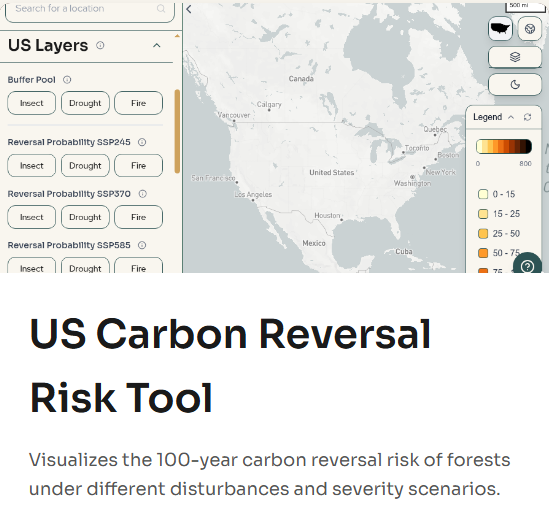
The Wilkes Center for Climate Science Policy led by Dr. Chao Wu highlights the urgent need to better account for potential carbon losses in forest-based carbon credit projects. Their study simulated 100-year risks of carbon loss from disturbances such as wildfire, drought, and insect outbreaks to estimate long-term threats to stored forest carbon. Results show that these “carbon reversal” risks are significantly higher than current carbon credit systems assume.
To support better planning, the team also developed a publicly accessible tool that maps these risks and helps guide more durable forest carbon investments.
| | |
Changes in Northeastern Forest Mortality from Harvesting to Natural Stressors and Disturbances
Researchers from the University of Vermont, led by Lucas Harris, recently published a study examining changes in tree mortality across northeastern forests using long-term Forest Inventory and Analysis data across 18 northeastern states.
The study found that over the past 15 years, the leading cause of tree death has shifted to natural disturbances such as insects, disease, and extreme weather. For example"5% greater biomass loss than natural mortality in 2009 but natural mortality accounting for 39% greater biomass loss than harvesting in 2024".
Read the Article
Read the Paper
| |
New Hampshire's Prohibits State or County Land's
in Carbon Projects
New Hampshire has enacted a new law prohibiting state and county-owned lands from being enrolled in carbon sequestration projects. House Bill 1205 reflects concerns that such programs could limit the state's forestry industry and concerns public lands purchased for timber purposes.
Read the Article
| |
Rhode Island's Forest Carbon Tracking Project
with University of Maryland
A new collaboration led by the University of Maryland is helping Rhode Island better measure how trees capture and store carbon using high‑resolution satellite data and advanced modeling. The project will provide more accurate, frequently updated estimates of forest and urban tree canopy impacts, helping the state track progress toward climate goals and refine its forest carbon inventory.
Read the Article
| | |
World's Longest Soil Warming
Experiment on Forest Carbon
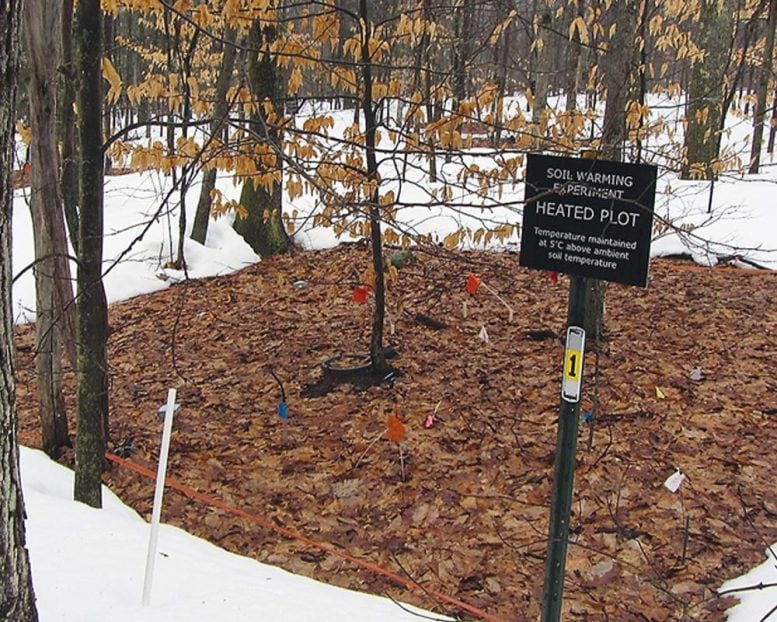
Scientists at Harvard Forest, led by Dr. Jerry Melillo, recently reported findings from a 37-year soil warming experiment examining how rising temperatures affect carbon stored in forest soils. By heating soils 5°C above ambient conditions over several decades, researchers were able to observe long-term changes in soil carbon dynamics.
The study found that prolonged warming altered microbial communities and activity, disrupting carbon storage processes and accelerating the breakdown of both readily available and more resistant carbon pools.
Soil warming plot at Harvard Forest. Credit: Jerry Melillo
| | | Emerging Forest Carbon Programs | | |
First Old Forest Contract with New England Forestry Foundation
The New England Forestry Foundation recently signed its first contract under a new initiative to protect some of Maine’s oldest forests, conserving 23 acres of approximately 150-year-old trees in Naples, ME and support forestry practices elsewhere on their parcel to support carbon storage and timber production.
Read the Article
Learn About Conserving Maine’s Oldest Forests Project
| |
Northeast Carry Woodlands Project Issued under New Improved Forest Management Methodology by the American Carbon Registry
Finite Carbon, a U.S. forest carbon project developer, recently announced the issuance of carbon credits for its Northeast Carry Woodlands project in Maine under the American Carbon Registry’s updated Improved Forest Management (IFM) v2.1 methodology. The 212,806-acre project is one of the first and largest to meet this new standard, with all credits receiving the Core Carbon Principles.
Read the Article
Read About The Northeast Carry Woodlands Project
| | |
The Family Forest Carbon Program on SilviCast
The Wisconsin's Forestry Center's Brad Hutnik and Greg Edge invited foresters from the Family Forest Carbon Program to share the basics of the program and the role of family forests in carbon markets and climate-smart forestry.
| | |
Who to Contact in Your State
-
Connecticut – Andrea Urbano, Service Forester, CT Dept. of Energy and Environmental Protection – Andrea.Urbano@ct.gov
-
New York – Molly Hassett, Forest Climate Section Leader, NY DEC, Division of Lands and Forests – Molly.Hassett@dec.ny.gov
-
Rhode Island – Nancy Stairs, Cooperative Forestry Program Supervisor, RI Dept of Environmental Management, Div. of Forest Environment – Nancy.Stairs@dem.ri.gov
| | | | Sign Up for this Newsletter! Link | | | | |