|
|
|
Press Release
November 2023
| |
WHY THE RISE OF COMPACT MACHINES IS UNSTOPPABLE | |
Vast new markets, customer types, attachments and alternative powertrains offer the potential for explosive growth in the compact equipment market, says José Cuadrado, Managing Director of Yanmar CE’s EMEA region. | |
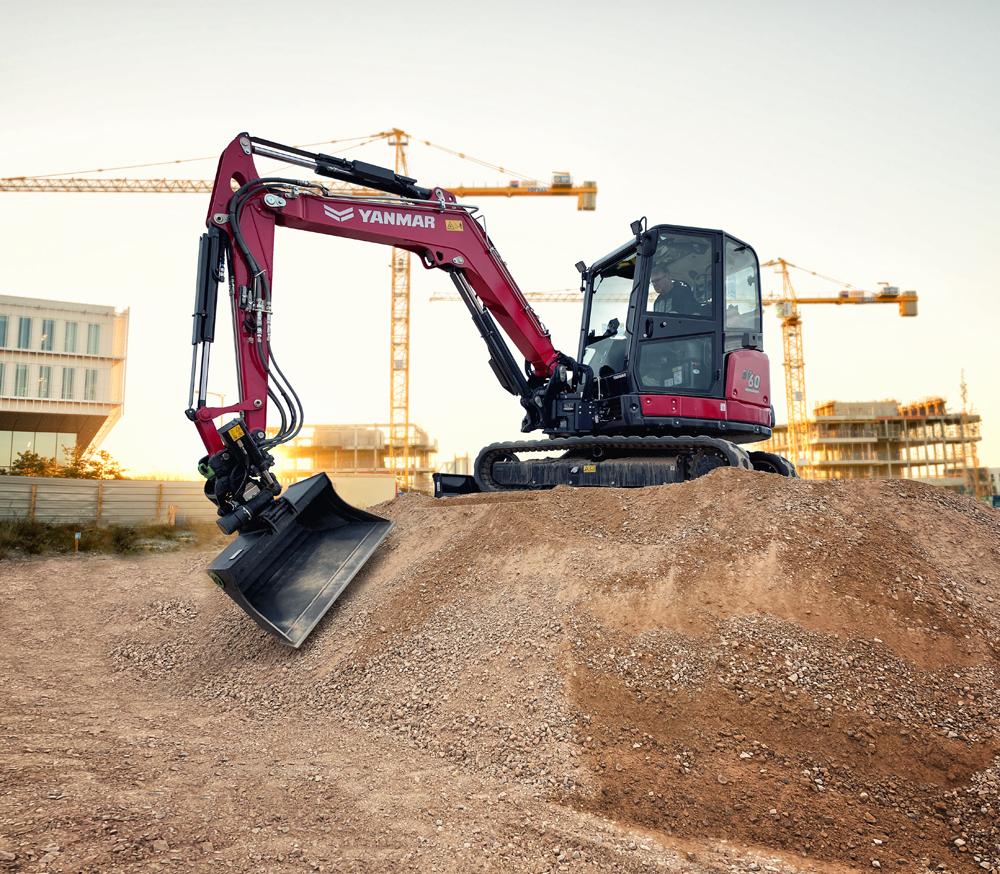
Why hasn’t the market for small equipment grown in the same way as for larger, more general-purpose equipment? Well, the short answer is that they are not just smaller versions of big machines doing the same tasks – but fundamentally different. Compact machines might have a much shorter history (mini excavators have only been around for just over 50 years), but their time has now come, and there has never been a more exciting period for smaller machines than now. | |
|
Why is it exciting?
As countries start developing economically, it makes sense for small-scale excavation/earthmoving tasks to be carried out by humans; keeping large numbers of people in work and protecting the social fabric.
But as the labour market tightens and wage costs rise, opting for mechanical alternatives starts to make economic sense. These machines are also much more productive, doing the work of many manual labourers in a fraction of the time, and to a higher quality. Initially the move to mechanization begins by the use of versatile machinery, such as backhoe loaders or 3-5 tonnes excavators. This is what has happened in developed countries around the world. And now, with much of Africa, the Middle East, South America and Southeast Asia reaching this economic tipping point, the potential for growth in compact earthmoving equipment is enormous. As economies continue developing, the application mix expands and the cost of labour increases, the range of compact machines and attachments needed multiplies exponentially.
| |
José Cuadrado, Managing Director of Yanmar CE’s EMEA region. | |
|
Technology transfer
But it’s not all about developing markets. There is still plenty of potential for compact equipment to grow in the more mature markets. New technologies that were first seen on larger machines are now migrating to smaller equipment. (E.g. the application of sensor technology for digging purposes, connectivity, automation etc.) This helps to automate some processes and ensure that work is conducted precisely and efficiently. This in turn increases productivity and reduces total cost of ownership over the lifetime of the machine. While earthmoving remains the predominant use of compact equipment across multiple segments, the never-ending explosion of attachment options for compact loaders and compact excavators means that they have become multi-functional tool carriers. Forks, grapples, augers, mulching heads, tampers, breakers – the list of new attachments continues to grow.
Another peculiarity that separates smaller machines from larger ones is the regional nature of how smaller machines have developed. While some differences can be explained by the different applications existing in each country, others are just the result of countries doing thing ‘their own way’. The result of this is products such as dumpers or compact track loaders being very country specific. While in Italy or in the USA they prefer the skid steer loader and the mini excavator working as a ‘combo’, much of continental Europe favours the compact wheel loader and the mini excavator. The UK, on the other hand, loves the mini excavator and the dumper working together. The common denominator of these trends is the mini excavator – hence it is becoming increasingly popular in all markets.
Another development of the compact equipment market is the rise of alternative ownership models. The rental concept in various forms continues to grow fast and expand globally, meaning that it is easy to get compact machines into the hands of new users inexpensively. Younger customers are not necessarily interested in getting involved in the ownership of expensive assets. They want a solution for their work – and they want the solution ready to use, with zero downtime and productive. This creates a great opportunity for our rental partners and dealer network.
| |
|
A dedicated compact equipment industry
There used to be a belief that the customer base for compact equipment and heavier equipment was almost the same. While there is some overlap, it is now clear that this is not the case. The typical compact equipment customer – the landscaper, the residential construction contractor, or the municipal utility contractor, for example – might never need machines larger than 10 tons over their entire business lifecycle. Even the supply chain of compact equipment – the rental firms, dealers, workshops, contractors – differ from that of larger general-purpose machines.
The way the machines are used is also different – larger machines often work longer shifts and are evaluated on a cost-per-ton basis, whereas compact machines are seldom used for more than half a typical workday – and priced out accordingly. All this make us convinced that there is a dedicated compact equipment industry with specific needs. This creates a great opportunity for compact equipment specialists like Yanmar to meet the needs of compact equipment customers worldwide.
| |
|
New technologies, a new future beckons
The adoption of new technologies by the compact equipment industry is a reality. The advent of electric machines presents a mixture of opportunity and challenge to established manufacturers in the sector. Design-wise, the opportunity for battery powered machines up to three tonnes is a reality. We can replicate the performance and duty cycles of ICE machines – but without incentives or legislation it’s hard to see that this new technology becoming the norm. The reduction on the cost-per-kW in batteries will help, but the cost delta is still significant, and customers won’t pay for it unless regulation and/or incentives support a transition to electric. Connectivity, automation and A.I. technologies will also develop within compact equipment, although the heavy equipment industries are taking the lead here, where the ROI for investing in these technologies is shorter. It is only a question of time that repetitive tasks such as digging or ground preparation can be done fully automated, or performed with much less human intervention than today.
| |
|
Long live the king
The king of the sector is – and will remain – the compact excavator, both crawler and wheeled. This will continue to outgrow even the rest of the compact segment, as it is increasingly seen as both a key earthmoving machine and a versatile tool carrier, rather than simply a digging machine.
So, regardless of what the global economy has in store, it is clear compact equipment will outperform the wider general-purpose sector for the foreseeable future. Vast untapped markets, new customer groups, new applications and a raft of new technologies mean that there has never been a more exciting time.
| | |
|
About Yanmar Compact Equipment
Today Yanmar is a leading global player in the industrial machinery industry. In the construction equipment sector, Yanmar was first to market with the launch of the first mini excavator in 1968 and its invention of the revolutionary zero-tail excavator in 1993.
Yanmar’s Compact Equipment Business has four plants, in Japan, France, Germany and the U.S., to deliver a range of products and services to the global market.
For more details, please visit the official website.
https://www.yanmar.com/global/construction/
About Yanmar
With beginnings in Osaka, Japan in 1912, Yanmar was the first ever to succeed in making a compact diesel engine of a practical size in 1933. Moving on, with industrial diesel engines as the cornerstone of the enterprise, Yanmar has continued to expand its product range, services, and expertise to deliver total solutions as an industrial equipment manufacturer. As a provider of small and large engines, agricultural machinery and facilities, construction equipment, energy systems, marine, machine tools, and components — Yanmar’s global business operations span seven domains.
On land, at sea, and in the city, Yanmar’s Mission of “providing sustainable solutions focused on the challenges customers face, in food production and harnessing power, thereby enriching people’s lives for all our tomorrows,” stands testament to Yanmar’s determination to provide us with “A Sustainable Future”.
For more details, please check out the official website of Yanmar Holdings Co., Ltd. https://www.yanmar.com/global/
| | | | |