|
NNA Community Newsletter
July 2026 Issue
| |
- Call for Oral and Poster Presentation Abstracts for the 2026 NNA Annual Community Meeting
- Join the NNA Early Career Community of Practice for Ethical Engagement with Arctic Communities
- Fostering Indigenous-led Research Convergence Working Group Mini-series Podcast Episode 5 Available Now
- Call for AK STEAM Newsletter Items
- AGU Fall Meeting 2026 Sessions Accepting Abstracts
- Permafrost Grown Art and Science Walk
-
NNA Project Highlight - Foundations for Improving Resilience in the Energy Sector against Wildfire on Alaskan Lands (FIREWALL)
- Upcoming Events
| | Call for Oral and Poster Presentation Abstracts for the 2026 NNA Annual Community Meeting | | |
The NNA Community Office invites you to submit an abstract for an oral or poster presentation at the 2026 NNA Annual Community Meeting. This meeting will be fully in-person from September 15-17, 2026 in Fairbanks, Alaska. We encourage submissions across career stages and disciplines to share your work. Please fill out the following form to let us know you would like to give an oral presentation or present a poster at the meeting. Find out more about the sessions accepting abstracts here. The deadline to submit your interest is Friday, July 31, 2026 at 11:59pm MT.
| | Join the NNA Early Career Community of Practice for Ethical Engagement with Arctic Communities | | |
The Navigating the New Arctic Community Office (NNA-CO), with support from the Polar Science Early Career Community Office (PSECCO), is launching a new Community of Practice for early career researchers interested in conducting community-engaged Arctic research thoughtfully, effectively, and ethically. Launching in late summer/fall 2026, this cohort-based program will create space for participants to learn from one another, explore community engagement and convergence research, and build connections across Arctic regions, disciplines, and sectors.
The program is open to individuals working in or connected to the Arctic, including those within and outside traditional academic environments. No previous involvement with the Navigating the New Arctic initiative is required.
Apply for the Community of Practice here by July 31, 2026 at 11:59pm MT.
| | Fostering Indigenous-led Research Convergence Working Group Mini-series Podcast Episode 5 Available Now | | |
The Fostering Indigenous-led Research (FILR) Convergence Working Group (CWG) is one of three Convergence Working Groups that the NNA-CO supported from June 2023 to May 2025. The FILR group focused on what Indigenous-led research is now, what it can look like, and next steps to creating research that is Indigenous-led. One of the final products of the FILR CWG is a podcast mini-series, of which this is the fifth and final episode. This episode is hosted by host Dr. Anamaq Margaret Rudolf with guests Mary Beth Jäger and Dr. Cana Uluak Itchuaqiyaq. Find more information here.
| | Call for AK STEAM Newsletter Items | | |
The NNA-CO is seeking opportunities to share in our AK STEAM newsletter! Help us share Alaska and Arctic-focused opportunities and resources for educators in science, technology, engineering, arts and math. Submit opportunities here by August 3 to be included in the August 2026 edition.
| | AGU Fall Meeting 2026 Sessions Accepting Abstracts | | |
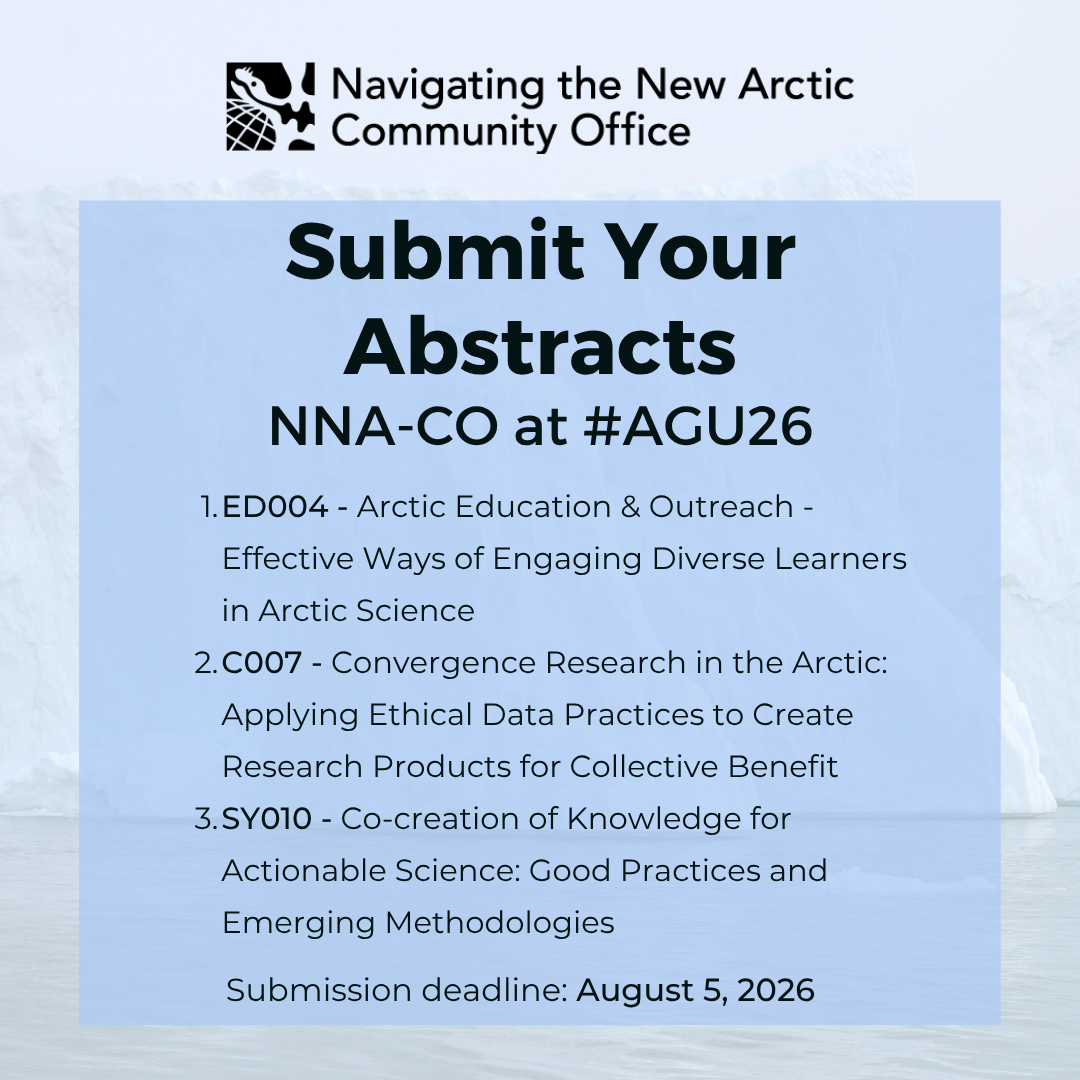
The American Geophysical Union (AGU) Annual Meeting will take place in San Francisco, CA from December 7-11, 2026. The following sessions with relevance to NNA are accepting abstracts. Abstract submissions are due August 5, 2026.
-
ED004 - Arctic Education & Outreach - Effective ways of engaging diverse learners in Arctic science
-
SY010 - Co-creation of Knowledge for Actionable Science: Good Practices and Emerging Methodologies
-
C007 - Convergence Research in the Arctic: Applying Ethical Data Practices to Create Research Products for Collective Benefit
-
H081 - Hydrological and Biogeochemical Processes in Permafrost Landscapes
-
C029 - Permafrost Observation and Monitoring across Diverse Knowledge Systems
| | Permafrost Grown Art and Science Walk | | |
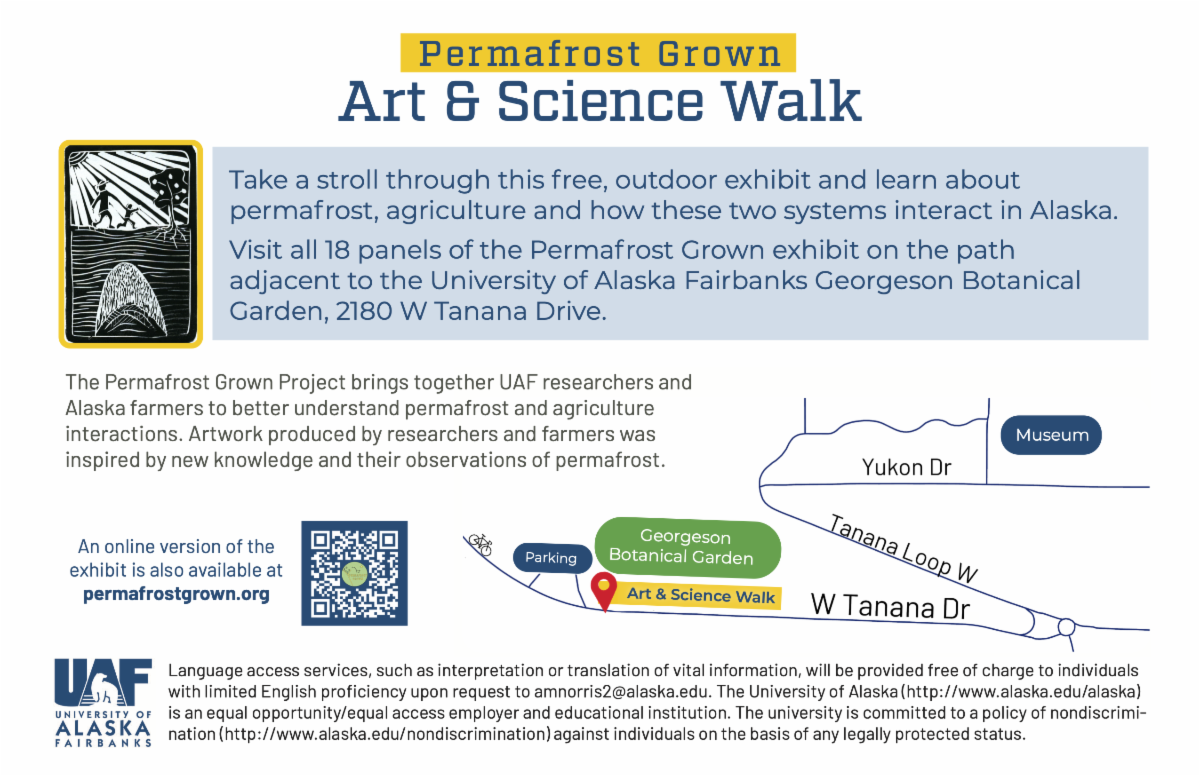
Take a stroll to view a free outdoor, or view freely online, art-and-science exhibit that explores the complexities of permafrost and its effects on farmers' lives. The installation is located along the path on West Tanana Drive, which parallels the Georgeson Botanical Garden (2180 W Tanana Drive) on the University of Alaska Fairbanks campus in Fairbanks, Alaska.
This co-produced exhibit showcases art made by farmers and University of Alaska Fairbanks researchers who participated in Permafrost Grown, an NNA NSF funded project, studying the interactions between permafrost and agriculture. Visit the online version of the exhibit. The installation is available for viewing until the end of September. A guided tour is being organized as part of the 2026 NNA Annual Community Meeting during September 15-17, 2026.
| | Foundations for Improving Resilience in the Energy Sector against Wildfire on Alaskan Lands (FIREWALL) | | |
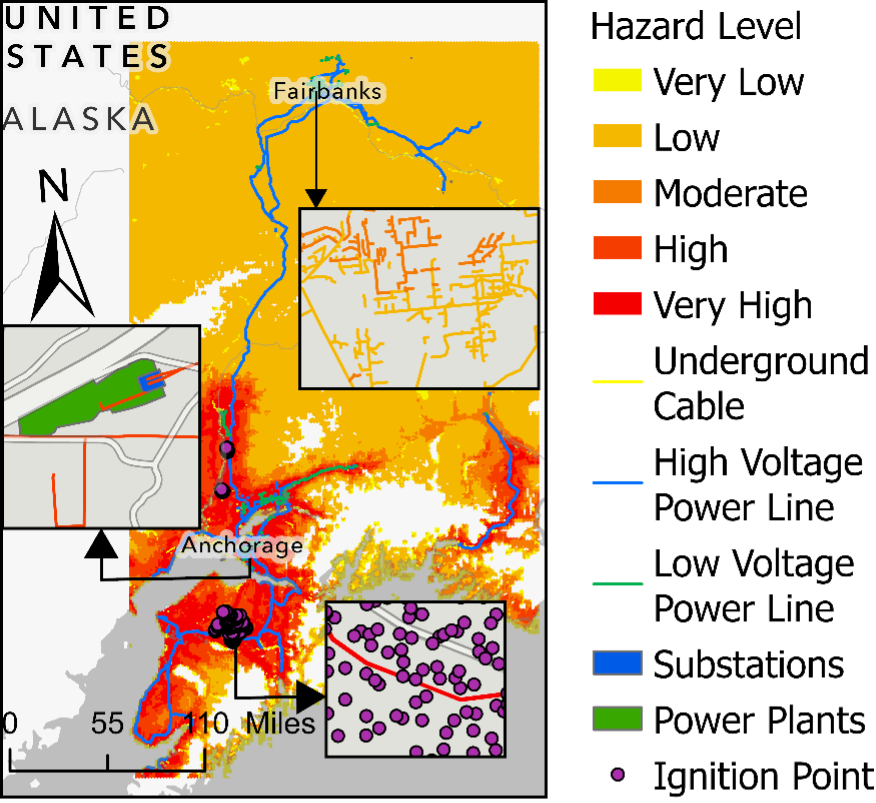
The Foundations for Improving Resilience in the Energy Sector against Wildfires on Alaskan Lands (FIREWALL) is an interdisciplinary research project focused on understanding the interactions between electric power grid infrastructure and wildfires. The project is a collaborative effort among the University of Alaska Anchorage, George Washington University, Washington State University, and the University of Alaska Fairbanks.
Through stakeholder interviews, interdisciplinary modeling, data visualization, and application development, the project is advancing an integrated understanding of wildfire risk and bridging critical gaps in preparedness, response, and recovery before, during, and after wildfires. By integrating wildfire hazard, exposure, vulnerability, and risk into a comprehensive decision-making framework, the project is developing decision-support tools that strengthen the resilience of communities and critical energy infrastructure. The FIREWALL project follows an iterative, stakeholder-informed development process in which preliminary models and decision-support tools are presented during listening sessions, refined based on community feedback, and continuously improved throughout the project.
| | |
One recent outcome of the FIREWALL project is the publication of “It Takes Two to Tango: A Qualitative Study of Cross-Sectoral Collaboration at the Community–Wildfire–Energy Interface in Alaska.” Drawing on interviews with stakeholders from electric utilities, emergency management, public health, healthcare, transportation, and wildfire management, the study examines how organizations collaborate before, during, and after wildfire events. The findings highlight the importance of proactive cross-sector partnerships, information sharing, and stakeholder engagement to strengthen community resilience and improve decision-making in the face of increasingly complex wildfire risks in Alaska.
| | |
Article submitted by Mohammad Heidari Kapourchali, PI of the Foundations for Improving Resilience in the Energy Sector against Wildfire on Alaskan Lands (FIREWALL) project.
Photo 1 caption: Justice Evans, a graduate student at the University of Alaska Anchorage, presenting his research on vegetation proximity detection around power lines in Alaska using aerial imagery at the 2026 IEEE IAS Electrical Safety Workshop (ESW), held March 9–13, 2026, at the Kalahari Resort and Convention Center in Round Rock, Texas.
Photo 2 caption: Spatial distribution of modeled wildfire hazard during the 2019 McKinley Fire across the Alaska Railbelt.
| |
Copyright © 2021 CIRES, All rights reserved.
The Navigating the New Arctic Community Office (NNA-CO) is jointly implemented by the University of Colorado Boulder, Alaska Pacific University, and the University of Alaska Fairbanks. The NNA-CO is supported through a cooperative agreement with the U.S. National Science Foundation (Award #2040729).
| | | | |