|
If your car breaks down because of a lack of routine maintenance you might get stuck on the side of US 19. If your helicopter breaks down mid-flight, it’s another story entirely. Flight maintenance supervisor Brian Egnatuk, and flight mechanics Charles Galloza and Joshua Wells are responsible for the perpetual cycle of frequent inspections and repairs that keep our helicopters ready to provide air support to our deputies and law enforcement partners.
“Helicopter maintenance is extremely complex and unforgiving of any error or oversight,” said Flight Sergeant Bryan Smith. “They need to be looked at every day, even when nothing is broken, to make sure problems are addressed before they become bigger issues. To be honest, there is no such thing as a ‘minor’ problem when it comes to helicopter maintenance. Experienced helicopter technicians are few and far between in the aviation industry.”
That’s why having someone like Egnatuk is so vital. “With more than 30 years of experience, the value Brian brings to our program is absolutely incalculable. He once brought me a tiny piece of carbon, no bigger than a grain of sand, that was partially blocking oil flow to a critical engine bearing. Only someone with his level of knowledge, professionalism, and patient thoroughness would have found that tiny speck, which would have eventually led to a major problem. Nobody in the Flight Unit is more trusted and respected than him.”
There’s a reason the Pinellas County Sheriff’s Office (PCSO) has three helicopters – that’s the only way to make sure one is always available. Their strict maintenance schedule can keep them out of commission for days or weeks at a time. “Typically we like to keep one aircraft as the duty aircraft,” Galloza said. “When you start flying two at the same time, or even on rare occasions three, you start running into inspection times colliding, and then you can end up having no aircraft available.” It takes a lot of planning to time the flight hours and repairs just the right way to ensure there’s always an aircraft ready.
Although it can vary, on a typical day a helicopter might be in the air for a total of four to six hours between day and night shifts. Mechanics check the helicopter every day in the morning, looking over the general condition, making sure nothing is leaking. “Then when the flight crew comes they look it over too,” Galloza said. “They have a checklist.” The helicopters undergo an inspection every week after 30 hours of flight time. That inspection is fairly quick, but the 100-hour inspection takes a day or two.
The next level, which takes place after 150 hours of flight time, takes about a week. “Our typical inspection is the 150,” Galloza said. “We clean the filters, change the oil in the tail rotor gear box. It’s just a little more in-depth maintenance – we’re taking things apart, greasing bearings, blade pins.”
The 600 hour inspection is even more intense. The landing gear is removed and inspected, and the whole rotor head and tail rotor are taken apart. The engine or gear box may be sent out for overhaul. As FAA-certified mechanics they have the know-how to do those overhauls themselves but, “When it comes to component overhauls we send that out because they have all the tooling, they have the way to test it once they put it back in.”
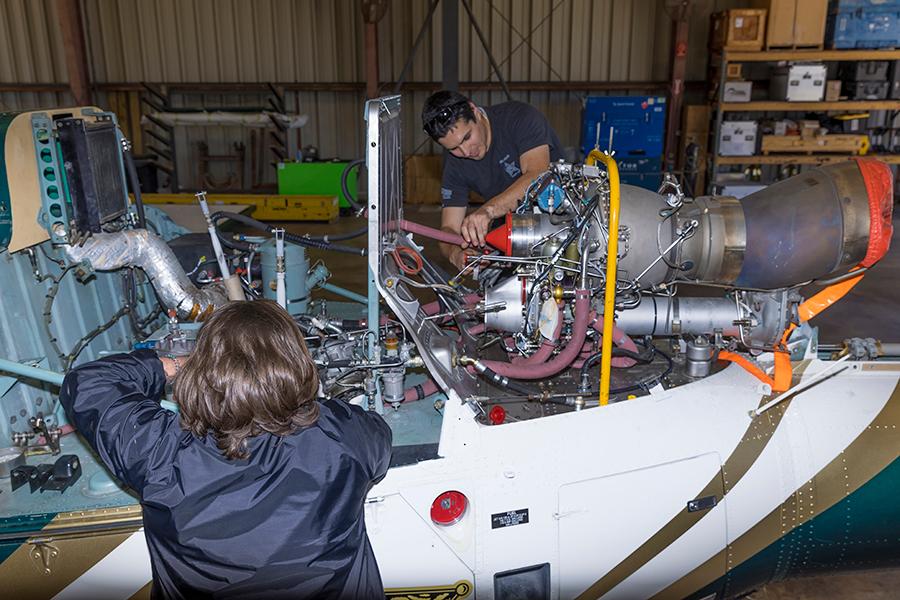
When the 600 hour inspection is in progress, “It looks like a different aircraft,” Wells said. “All the panels are gone.” This level of inspection and maintenance takes a couple of months. That’s a long time for a helicopter to be out of commission – which is why it is so vital that the PCSO has three helicopters. We provide law enforcement aviation support for the entire county so there always has to be a helicopter ready to take off at a moment’s notice.
Minor leaks are a common issue. “You can fly with some things leaking,” Galloza said. While that might not sound very reassuring, he says they never even get close to the level of leaks the manufacturer allows.
If a pilot reports a leak and the mechanics say they’ll take care of it, the pilots never tend to follow up. However, one repair job leads to constant queries. “In their pre-flight the pilots might miss something that would be obvious to a mechanic, but one thing they always catch is when the air conditioner doesn’t work. If the blower isn’t 100 percent, they report it. It’s not the most common problem, but it is definitely the thing they complain loudest about.” And no, the helicopter doesn’t get grounded for a broken air conditioner, even in the middle of August.
Wells went through aviation school and then worked at a flight school before joining the PCSO. He always wanted to work on helicopters. “This is where I wanted to end up, working on an Airbus helicopter. I just think they’re fun to work on.” He considers himself lucky to be working with such knowledgeable professionals as Egnatuk and Galloza. “These guys know a lot, especially our supervisor, he’s been doing it for 30 years. It’s just crazy how much these guys know and how much I get to learn.”
“I always wanted to do avionics,” Galloza said, referring to the electrical components of the helicopter. He worked on planes at various places, including commercial airlines, but reached a point where he thought he wanted to get out of aviation so he applied with the PCSO as an automotive mechanic in 2014. Luckily they needed someone with an electrical background, and he started out in Fleet, doing installs for the Tahoes. “It wasn’t avionics, but at least it was electrical work.” Later he checked out the Flight Unit and made the move there in 2018. “I always wanted to work with helicopters but it’s hard to get those jobs.”
Galloza now gets to work on the avionics, just as he always hoped. “It took me a little while to get the blessing from supervision,” he said. “Our supervisor has to answer for what we do, so he has to make sure we’re spooled up and okay before he can set us free.” Also, Egnatuk enjoys working with avionics himself, and there’s always a little competition for the most enjoyable work.
Some of the tasks are fun, others not so much. “I’m not a big fan of doing corrosion” Wells said. With a hot humid climate and a hangar right next to the salty air of the bay, they fight a constant battle against the elements. The helicopters get frequent engine rinses with distilled water, and they get a wash every 150 flight hours with a special soap.
“We’re a repair station, so the FAA could come out at any time and look at our work orders,” Galloza said. “They come once a year for a surprise visit. Being a repair station makes us more transparent. We’ve always had the culture of taking pride in our work.”
|