|
Dear Muskoka ECE Community,
February arrives with its hearts and Valentine’s cards, and it's got me thinking about what we mean when we talk about love with young children.
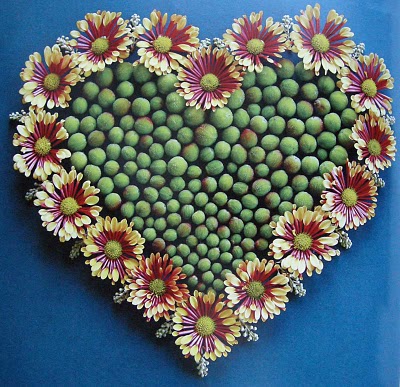
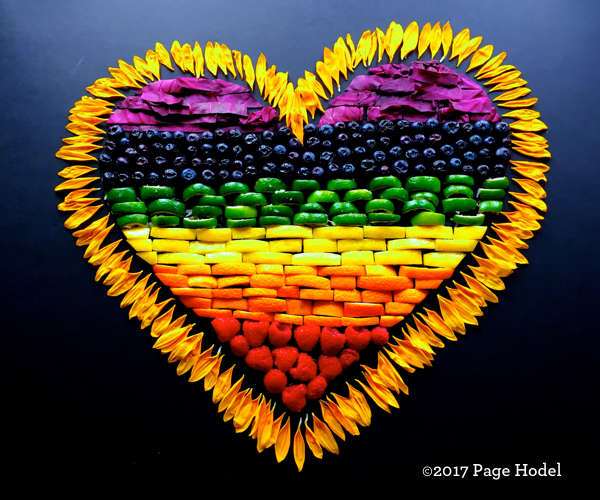
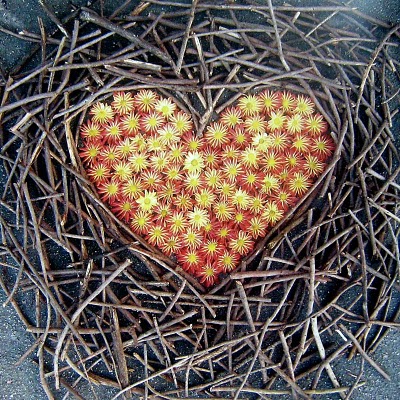
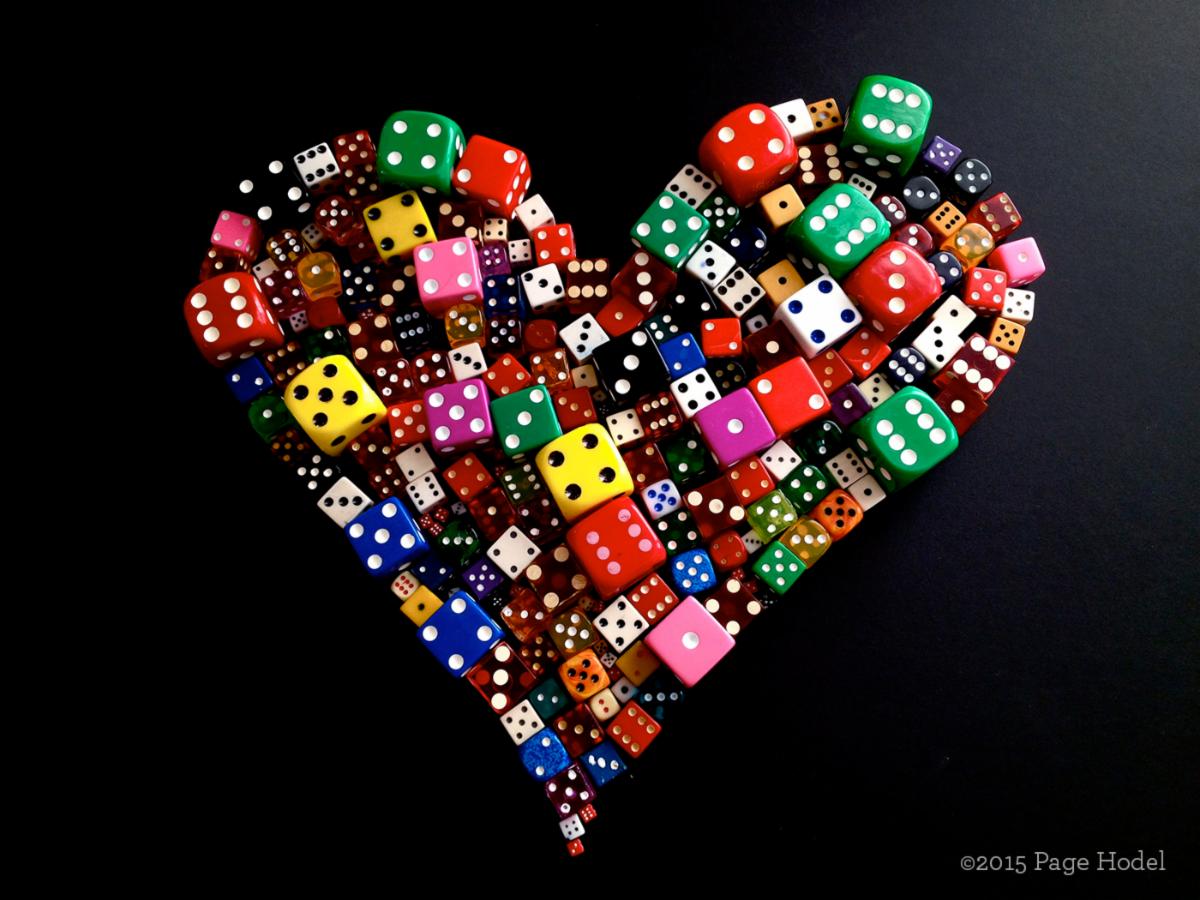
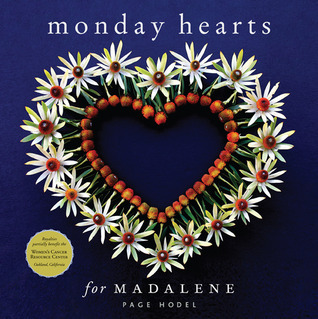
I recently discovered a beautiful book of photography called Monday Hearts for Madalene by Page Hodel. After falling in love, Page began creating hearts every Monday morning and leaving them outside Madalene's door—fashioned from acorns, buttons, clothespins, corks, candy corn, and countless other materials. Even after Madalene's death, Page's love continues, expressed through these hearts made from the everyday abundance of the world around her.
| | |
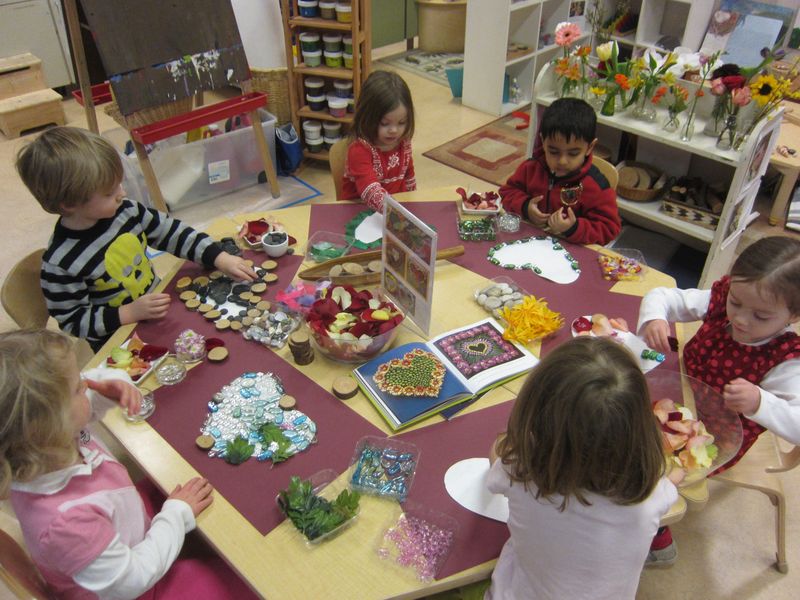
Page's artwork is a visual representation of the diversity of ways we express and experience love. Some hearts are delicate, some sturdy. Some symmetrical, some wildly improvised. But each one is unmistakably love. The children at Opal School in Portland used Page's photographs as an invitation to explore love through loose parts, and it got them talking: What is love?.
Their answers were lovely:
Love is saying sorry. You love people in your heart when you are hugging someone and you feel your heart beating. Love is sharing your toys with your baby brothers or sisters.
They're naming love not just as a feeling, but as practice. Love is what we do—how we repair, how we make space for each other, how we take care of our shared world.
| | |
The children are watching us in community with one another. They notice when we apologize to a colleague, observe how we navigate disagreement, watch us make space for each other's ideas, and support one another when things get hard. Our relationships with co-workers, families, and other children are part of our 'program', whether we intend them to be or not. We explicitly teach these skills—modelling and direct teaching work together.
Just like Page's hearts, friendship doesn't look one way. Some children connect through intense verbal negotiation; others through quiet parallel play. And children absolutely need our support in developing these skills. An infant learning that crying brings comfort, a toddler negotiating "mine" and "ours," a preschooler navigating "you can't play"—all of this is learned. Through responsive guidance, we honour different ways of being social, center belonging rather than compliance, and make space for neurodivergence and communication differences.
So as Valentine's Day approaches, I'm wondering: what are we teaching about love? It isn't just something we exchange once a year with cards and candy, of course. Love is what we do—how we respond when a toddler grabs a toy, the language we offer when a preschooler says 'you can't play,' how we hold space for a child who struggles to read social cues, and how we treat our colleagues when we're tired, stressed, or disagree. And yes, there's actual brain science to back up why kindness and love are so important – read on as we dig into the neuroscience of kindness and offer some practical ways to build brains and hearts in our programs.
With LOVE,
Vanessa
| |
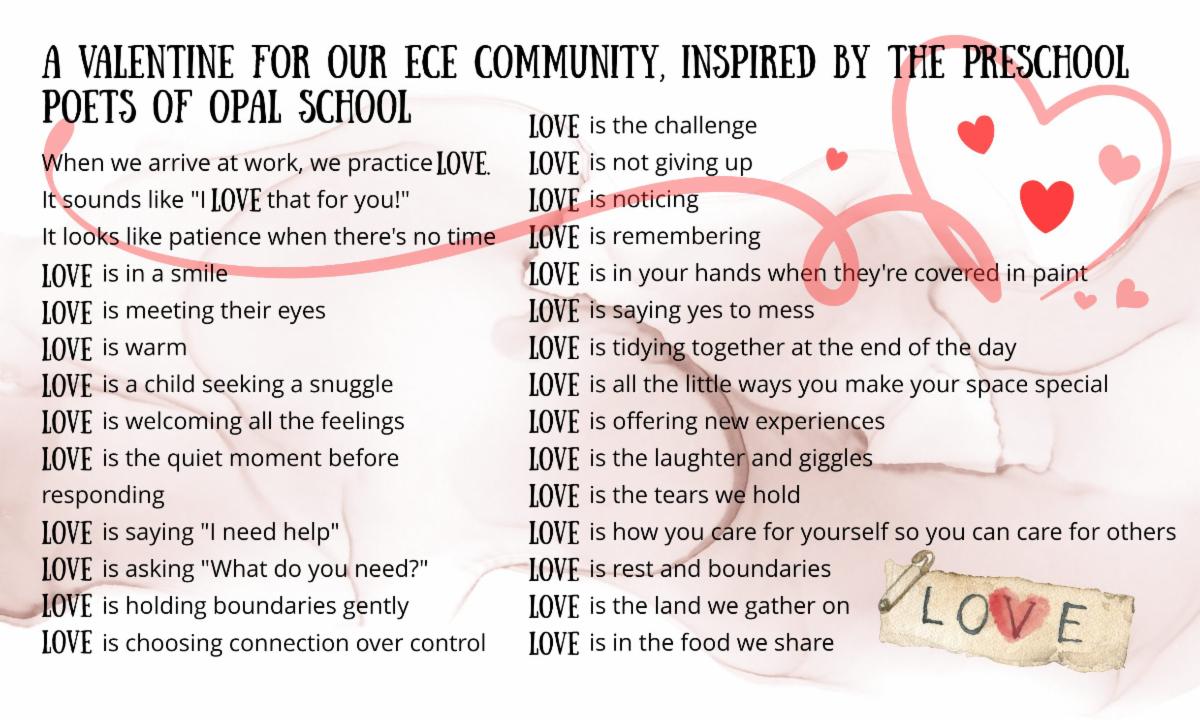
I'm no poet, but when I started listing all the ways love shows up in our work, it just kept growing. So here's my attempt at a Valentine for us—messy, incomplete, and hopefully recognizable: | | | | |
🔎 Want to shape what shows up in your inbox?
I'd love to hear from you - and I'll enter you in a draw for a $50 resource of your choice for your program (books, loose parts, art supplies, whatever your space needs).
Just reply to this email with ONE of these:
- One thing from this newsletter that resonated with you
- One topic you'd love to see covered in future newsletters
- One practice or moment from your program you'd be willing to share (even just a sentence!)
Draw date: March 1st.
Submit your thoughts here: vanessa.fraser@muskoka.on.ca
🎉Congrats to Katsi'tsí:io Sandra Huxtable from Wahta Mohawk's Child Care Program for winning last month's prize!
| | |
The Science of Kindness
I've been reading some fascinating research lately about what happens in children's brains when they practice kindness, and I keep thinking: we get to do this work! We get to create conditions where children's brains literally build stronger pathways for empathy, connection, and care.
When children engage in prosocial behaviours—helping a friend, sharing materials, comforting someone who's upset—regions associated with both empathy and reward processing are activated. With repetition, these pathways strengthen. Kindness releases dopamine and oxytocin, which means kindness feels good, which motivates children to do it again. What a beautiful feedback loop!
This starts so early in life! Children as young as 18 months spontaneously help, share, and comfort others—even without adult prompting. In one remarkable study, researchers watched hungry 19-month-old infants look longingly at a piece of fruit... and then give it away to an adult who seemed to need it. Even when faced with one of our most fundamental biological needs—food—these babies chose to help a stranger.
In another study, pairs of toddlers (18-24 months) who'd never met before were given four marbles to share. Most of the time, they divided them fairly. But get this: when the set-up gave one child three marbles and the other just one, about a third of the time the "lucky" child voluntarily gave up one of their marbles to equalize things. "This is the youngest age ever observed at which young children make sacrifices in order to equalize resources," the researchers noted. These toddlers weren't selfish—they were generous.
"This innate capacity for kindness grows stronger with practice and support. Research from the University of British Columbia found that children who performed three acts of kindness weekly for four weeks experienced significantly greater peer acceptance compared to peers who didn't participate in the study. This matters because peer acceptance is directly linked to academic achievement and a substantially reduced likelihood of being bullied."
In preschool settings, a 12-week 'Kindness Curriculum' study found that children receiving ‘kindness training’ showed improved social competence, better self-regulation, enhanced executive function skills, and higher teacher ratings on end-of-year developmental assessments. Notably, children who began with lower social competence showed the largest gains—suggesting this work particularly benefits children who struggle socially.
There's also something researchers call the "contagion effect"—witnessing kindness activates similar neural responses to performing it. When children see acts of care, their brains respond positively, and they become more likely to extend kindness to others. Every kind interaction in your space isn't just affecting the individuals directly involved—it's shaping the social-emotional climate for everyone present.
When we teach children to be kind, we're not just helping them be "nice." We're supporting their neural development, strengthening their capacity for empathy and self-regulation, improving their peer relationships, and enhancing their academic outcomes. We're building kinder brains.
| | | |
- When do you see kindness happening naturally in your space? What conditions support it? How do you hold onto those moments and share them with others?
- Reflect on your own team dynamics. What do children witness when they watch educators interact with each other?
- Which children in your program seem to struggle most with prosocial behaviour? What additional support or scaffolding might strengthen their capacity for connection?
| | | |
Everyday moments matter more than we might think. When a toddler helps pick up spilled blocks, when a preschooler notices someone is sad, when school-age children collaborate to solve a problem - we're not just teaching manners, we're supporting neural development, strengthening capacity for empathy, and building the architecture for healthy relationships.
I've been noticing how you weave kindness into the fabric of your days:
-
Embedding it in routines: "Maya, can you help Samir find the blue blocks he needs?" "I notice you're checking on Liam—that's caring." "Who needs a hand putting their boots on?"
-
Making it visible: Naming what you observe: "Jamal, you noticed Aisha was struggling with that puzzle and you sat down to help her. That's kindness." Documenting moments of cooperation so children see themselves as kind, helpful people.
-
Modelling repair and vulnerability: "I interrupted you when you were talking. I'm sorry—what were you saying?" "That looks tricky—can I hold this while you tie that?" "I'm feeling overwhelmed right now, so I'm going to take three deep breaths."
-
Building structures that invite kindness: Table helpers, buddy systems, mixed-age partnerships, cooperative jobs where children work together.
Underlying all of this is relationship. When children feel safe and valued, they have emotional resources to extend care to others. Your commitment to seeing behaviour as communication creates conditions where kindness can flourish.
Valentine's Day gives us a lovely prompt to think about caring and connection. The real work is already happening in your daily, ordinary moments, year-round.
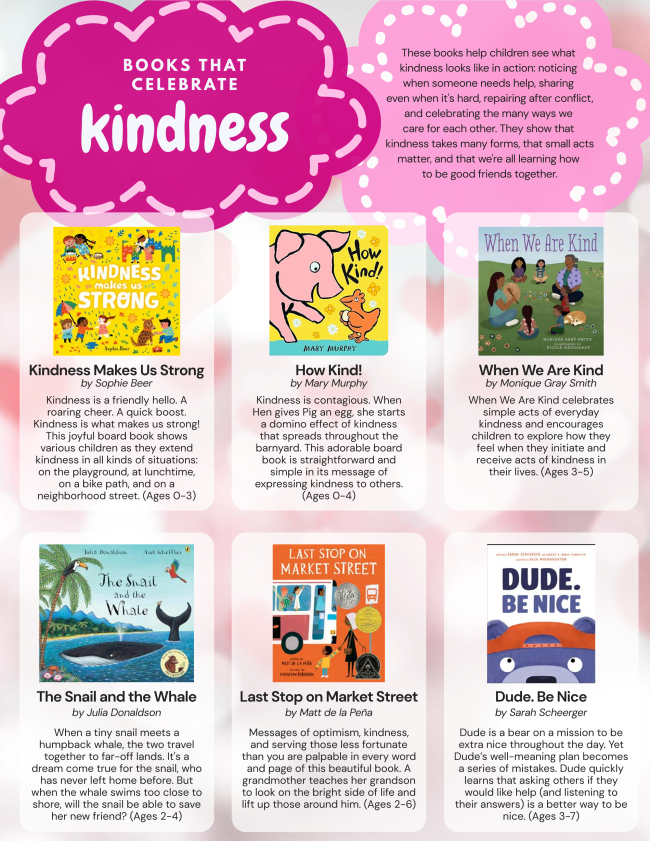
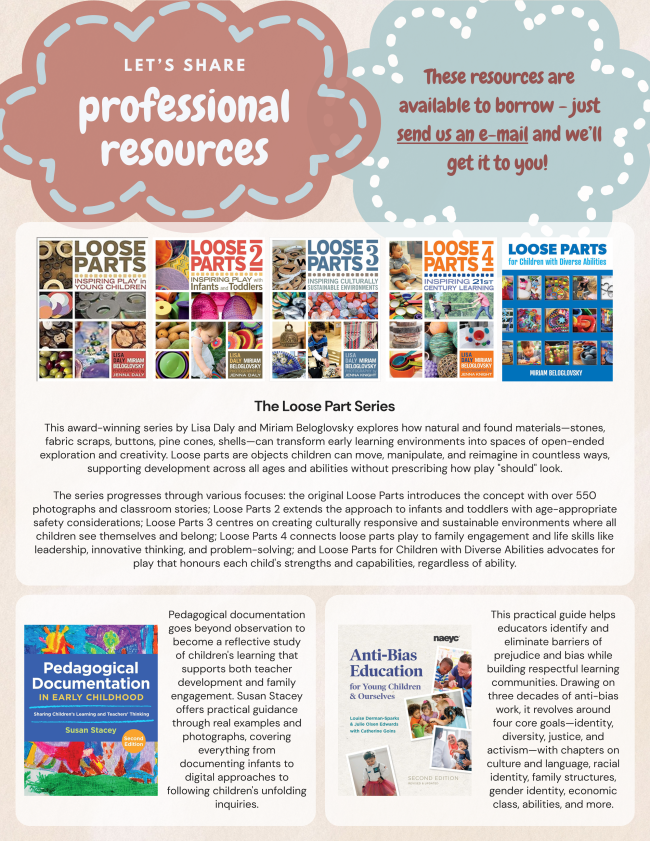
| | Books That Celebrate Kindness and Connection | | Kindness isn't something children either have or don't have, it's something they learn and affirm through stories, observation, and practice. These books help children see what kindness looks like in action: noticing when someone needs help, sharing even when it's hard, repairing after conflict, and celebrating the many ways we care for each other. They show that kindness takes many forms, that small acts matter, and that we're all learning how to be good friends together. (Click the image for a printable PDF) | | 🎧Tune in and Learn on the GO! | | |
Prefer listening over reading? Here are a few podcast episodes that explore the importance of building kindness skills in childhood:
Why Kindness Matters (Voices of Your Village) (45 mins)
This was one of my favourite episodes this month. Claudia Hammond, author of The Keys to Kindness, explores the crucial difference between being nice and being kind. She shares research on how kindness affects mental health across the lifespan, what kindness looks like with toddlers, and how we can cultivate it in ourselves and our communities. The data are clear: kindness matters, and this conversation offers practical ways to build these skills in early childhood and beyond.
Apple Podcasts | Spotify | Pocket Casts
A Conversation with Natalie Royer on Belonging (Can We Talk? Conversations in the Early Years) (26 mins)
Belonging consultant Natalie Royer explores what belonging truly means in early childhood settings—and crucially, what it looks like in practice in our classrooms. She discusses how we can use belonging as a tool rather than an outcome, supporting organizations to cultivate spaces where children and educators genuinely belong, leading with love and compassion.
Spotify | Pocket Casts
The Hidden Life Skills in Simon Says (No One is Coming to Save Us) (57 mins) Researcher Ellen Galinsky shares how everyday games like Simon Says build executive functioning skills in young children. Slumberkins co-founders Kelly Oriard and Callie Christensen discuss using affirmations and storytelling to teach conflict resolution and emotional courage. This podcast offers a relatable entry point for discussing the life skills we develop through quality early childhood programs – including kindness.
Apple Podcasts | Spotify |Pocket Casts
| | |
February is Black History Month
As we enter Black History Month, join this reflective workshop that moves beyond performative awareness to meaningful action. Through discussion, relevant history, and viewing your setting through the eyes of Black families, participants will deepen their understanding of the experiences Black children, families, and educators navigate in early learning spaces. This is a space to examine our biases and leave with practical tools for supporting and affirming Black children, families, and colleagues—not just in February, but all year long. This event requires a $10 investment.
| | |
New! Reduce the risk of choking – For children ages 1 to 5
(TeachNutrition.ca)
Choking on food can happen at any age, but young children are at higher risk because their airways are small and can easily block. They are also still learning how to chew and swallow and can get easily distracted while eating. The good news? A few simple changes to food prep can make a big difference. See the resource which features expert-backed guidance to make meals and snacks safer for kids ages 1 to 5.
Resource includes the following:
- Real-life photos showing safe preparation, cutting sizes, and textures
- A list of foods to avoid (some foods cannot be modified to be safe and should not be served to children under age 5)
- Food prep instructions by age to lower choking risk for common foods
- Tips for creating a safer eating environment — even during busy snack breaks
| | 📍More (mostly) FREE Upcoming Webinars & Courses: | | Opportunities from our wider community to connect, learn, and be inspired. This month, we’re including a few low-cost PL opportunities as well as the usual freebies. | | |
What resonated with you this month?
What are you wondering about?
We'd love to hear from you.
| | |
➕Did someone forward this newsletter to you, but you want to be added to our distribution list? Want to make sure you hear about workshops? Sign up here - Newsletter and Workshops.
| |
|
🔎Looking for past newsletters? Dig into our archive.
The Archive
| |
| |
| How did you like this months Newsletter? | | | | Please note that the information contained in this newsletter is intended to encourage conversation and self-reflection and is not to be considered as advice. | | | | |