How easy or difficult is it to become a 401k millionaire? With Einstein’s eighth wonder of the world, The Power of Compounding, it may be easier than you think. Assuming an annual investment of the current maximum for 401k participants of $19,500, with a relatively conservative 6% annual rate of return, a 25-year-old would accumulate nearly $1.1 million by the age of 50. (The current annual maximum contribution for 401k participants under the age of 50 is $19,500; the catch-up amount for those age 50 or older is an additional $6,500.)
Invest early and invest often. Contributing $19,500 per year for 25 years without any gain would accumulate $487,500. With a 5% annual rate of return the total would be $930,678, while a 7% return would result in more than $1.2 million. The key is that the part of the equation you can control, the level and consistency of contributions, will play a large role in the future outcome of your nest egg.
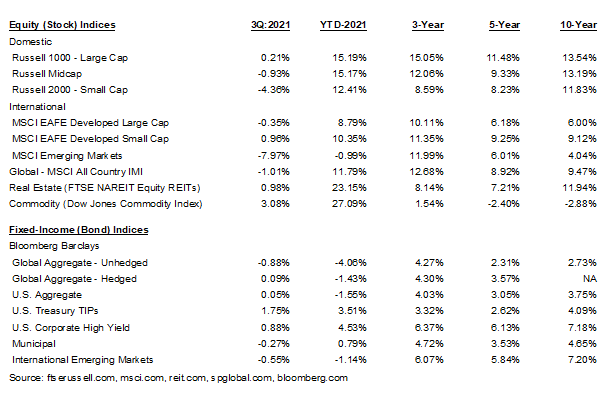
The world may not be flat, but sometimes investment markets are. Stocks continued to rise in July and August, but hit the skids in September, leaving broad indexes little changed for the third quarter of 2021. The Standard & Poor's 500-stock index (total return) ended a seven-month upturn in September, but managed to eke out a third-quarter gain of 0.58%, while the NASDAQ Composite index shed 0.38%. Broad bond measures were nearly unchanged, with the Bloomberg U.S. and Global (Hedged) Aggregate indexes adding just 0.05% and 0.09%, respectively.
Stand-out third-quarter performers included Emerging Markets, shrinking nearly 8.0% as Chinese government economic controls took hold, along with the potential default of Evergrande, a large real estate company. With oil and other commodity prices rising, the Dow Jones Commodity Index picked up 3.1%. In the bond market, U.S. Treasury TIPs (inflation protected securities) improved by 1.8% as annual inflation leapt 5.3% for the year ending in August.
Despite muted market moves, it was the worst quarter (and September the worst month) for stocks since the onset of the pandemic. Investor concerns rose about the spread of Covid-19, inflation, and federal spending and debt ceiling deliberations. For the first nine months of 2021, broad stock measures provided mostly low-to-mid-teen double-digit returns, while bonds declined by 1.4% to 4.1%.
Although the Federal Reserve left its near-zero interest rate policy unchanged during the quarter, after its most recent meeting, the Fed signaled that it would begin tapering its purchases of securities in November and predicted that rate hikes could arrive by the end of 2022, sooner than previously anticipated. Assuming the economy progresses as expected, the Fed plans to wind down its $120 billion monthly purchases of treasury and mortgage securities in 2022. The central bank began the purchases in 2021 when Covid created widespread economic uncertainty and roiled stock and bond markets.
The Fed lowered its 2021 economic growth estimate to 5.9% from 7.0% and predicted that inflation would return to the 2.0% level in 2022.