|
CMS Rule on Gender Affirming Care
A rule finalized by the Centers for Medicaid & Medicare Services (CMS) is ending coverage of medically necessary gender affirming care for low-income children and youth in Medicaid and CHIP. The final rule is scheduled to take effect October 13, 2026.
The rule bans use of federal funds for many services provided as gender-affirming health care for people under age 18 in Medicaid and people enrolled in CHIP under age 19. The final rule does not ban gender-affirming care related services and applies only to federal Medicaid and CHIP funding. Funding will be available for a tapering off period of up to six months for children currently on hormone therapy. The rule does not affect coverage of mental health services. Medicaid’s Early and Periodic Screening, Diagnostic, and Treatment (EPSDT) provisions continue to ensure comprehensive coverage of mental health services for eligible children, and CHIP continues to require coverage of necessary mental health services in accordance with federal law.
| | |
State-Level Data Dashboard on
Impacts of OBBBA Provisions
The One Big Beautiful Bill Act (OBBBA), or HR1, signed into law last summer, made significant changes to the Medicaid program, such as adding work and community engagement requirements and more frequent redeterminations for Medicaid expansion-enrolled adults. It also created the Rural Health Transformation Program (RHTP), a grant program designed for states to strengthen rural communities across America by improving healthcare access, quality, and outcomes by transforming the healthcare delivery ecosystem.
Milbank and RAND partnered to create a Data Dashboard, which shows at a high level how state Medicaid funds will be affected by both OBBBA changes and funding entering states from the Rural Health Transformation Program.
Indiana will enter a budget session in January 2027.
| | |
State of Coverage
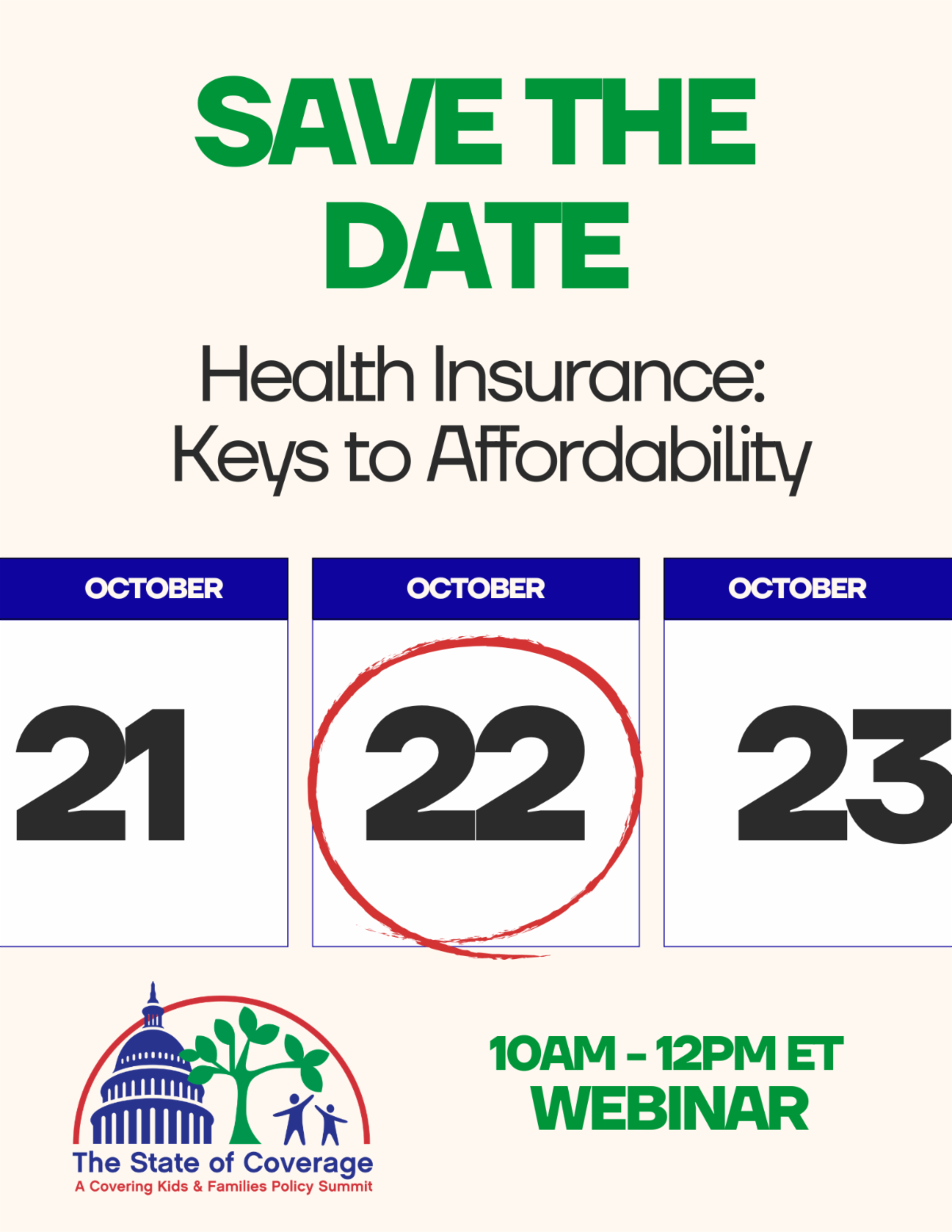
The annual CKF State of Coverage virtual learning opportunity is less than two months away! Please save the date and plan to join CKF and guests. This year, participants will learn about risk pools and other fundamental concepts included in healthcare coverage affordability conversations. Additionally, hear from two companies offering solutions to small businesses and other groups looking for affordable options.
| | SCHOOLS & EARLY CHILDHOOD | | | | |
|
Indiana Schools Recognized as
America’s Healthiest Schools
The 2026 America’s Healthiest Schools list, part of Healthier Generation’s annual award program, was released this week. The program celebrates schools that implement best practices in areas of nutrition, physical activity, school health services, staff well‑being, and family engagement.
Of the 1,376 schools recognized nationwide, 29 Indiana schools were awarded this honor! We are proud to celebrate these Indiana schools for their commitment to creating healthier, more supportive learning environments for students, staff, and families.
| | |
Town Halls on HIP Work Requirements
The Indiana Family and Social Services Administration (FSSA) in partnership with Covering Kids & Families of Indiana is hosting a series of public town halls across the state to help Healthy Indiana Plan (HIP) members, providers, and community partners learn more about upcoming HIP work requirements.
Current town halls are listed below, and additional ones will be announced throughout the year.
September 1 – Ivy Tech Fort Wayne
- Auditorium - 3800 N Anthony Blvd. Ft. Wayne, IN 46805
- Time: 6 to 7:30 p.m. ET
September 4 - Ivy Tech Muncie
- Fisher Building - F110 - 345 S High Street, Muncie, IN 47305
- Time: 6 to 7:30 p.m. ET
September 14 - Ivy Tech Terre Haute
- Sue Ellspermann Community Room - E102 - 8000 S. Education Drive, Terre Haute, IN 47802
- Time: 6 to 7:30 p.m. ET
September. 18 - Ivy Tech Evansville
- Vectren Auditorium 0 3501 N First Avenue, Evansville, IN 47710. Note: Please use the entrance at Door C, the North side of the building on Colonial Drive.
- Time: 6 to 7:30 p.m. CT
September 21 - Indianapolis - Indiana Government Center South
- Conference Room A - Indiana Government Center South - 402 W. Washington St. Indianapolis, IN 46207
- Time: 1 to 2:30 p.m. ET
| | |
Uninsured Rate for Children
Georgetown University’s Center for Children and Families released a report, Health Coverage Trends for Infants and Toddlers Under Age 3, which shows that between 2022 and 2024 the uninsured rate for infants and toddlers under age 3 rose significantly.
- In 2024 in Indiana, this group’s uninsured rate was 6.5% - well above the national rate of 5.1%.
- The Indiana uninsured rate for this group increased from 4.8% to 6.5% - one of nine states with a significant increase.
- 41.8% of Hoosier children under age 3 have Medicaid/CHIP coverage.
| | |
Connecting Kids to Coverage
The Connecting Kids to Coverage campaign by www.insurekidsnow.gov offers back to school outreach materials including posters, palm cards, videos, social media content, infographics, PSAs, and more in multiple languages.
Some key messages to keep in mind:
- Enrollment is year-around.
- Many families qualify without realizing it.
- Coverage must be renewed every year.
- Even if a parent loses coverage, the child may still be eligible.
| | |
Wildfires and Birth Outcomes
A new University of Maryland study found that wildfire smoke is eroding decades of clean air progress, based on an analysis of 17 years of birth records linked to air pollution data. While exposure to harmful fine-particle (PM2.5) air pollution during pregnancy fell by two-thirds since 2003, the share attributable to wildfire smoke more than doubled. Because the study predates the record wildfire seasons of 2020, 2024, and 2025, this trend – and the associated risks of adverse birth outcomes, including preterm birth – may now be even more pronounced.
| | |
Wednesday, September 9 from noon – 2:30pm ET
Young Invincibles is inviting Marketplace Certified Application Counselors (CAC) and advocates to their annual Outreach and Enrollment Summit. The Summit will include best practices for outreach as well as a session focused on Marketplace updates and eligibility changes.
Register here.
| | |
Monday, September 17 at 1pm ET
Georgetown University’s Center on Health Insurance Reforms and Families USA are presenting Preparing for Marketplace Open Enrollment: What Diabetes Providers and Assisters Need to Know. Millions of people with diabetes rely on Marketplace coverage but federal policy changes mean this year’s open enrollment period comes with new challenges. Join this webinar for a breakdown of what to expect and how to help people with diabetes get ready.
Register here.
| | |
Thursday, September 24 from 9am - 4:15pm ET
Registration is now open for Indiana Family to Family’s virtual Heart to Heart Conference. This free annual conference is an opportunity for families and professionals to learn and connect in support of children and youth who have various health and mental health needs and disabilities.
Learn more here.
| | |
On demand
The Alliance for Health Policy posted their August 12 webinar, Health Insurance Fundamentals: How the U.S. System Really Works, on their website. The webinar covers the history of health insurance in the United States, core concepts and terminology, and the different major health insurance markets.
| | TOBACCO PREVENTION & CESSATION | | |
Tobacco Promotion on Social Media Nearly Triples Odds of Intending to Vape
The Truth Initiative examines how exposure to tobacco promotion and imagery on popular social media platforms may influence young people’s intentions to use tobacco products. The study surveyed 1,032 young people ages 15–24 and found that more than one-third had encountered tobacco-related content on these platforms, with promotional content reported particularly often on TikTok, YouTube, and Twitch. Young people with high exposure to promotional tobacco content had 196% higher odds of intending to vape and 119% higher odds of intending to smoke cigarettes compared with those who were not exposed.
The findings highlight how social media can normalize tobacco and nicotine use and reinforce the importance of prevention efforts that address tobacco promotion and imagery in digital spaces frequented by youth.
| | | |
|
IHCP Membership
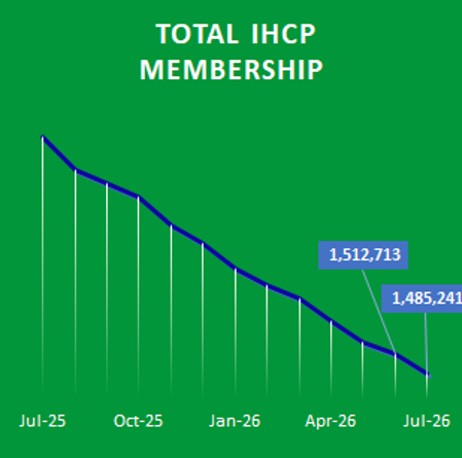
Total Membership decreased in July. With 1,485,241 members, there were 27,472, or 1.82%, less members in July 2026 than in June 2026.
Membership has dropped for fifteen months straight.
| | | | | |